
New climate graphic shows Sacramento underwater. It doesn’t account for a key protector
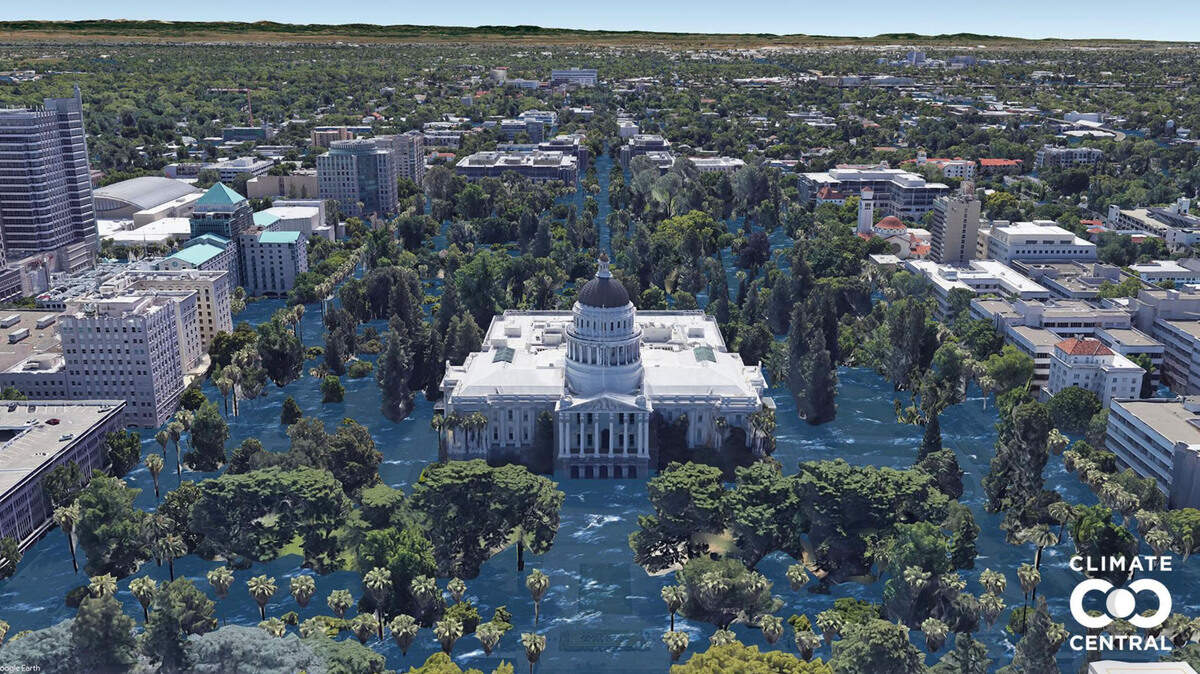
Climate Central, an independent organization of scientists and journalists who research and report on climate science, released new visualizations and data that show how rising sea levels from climate change could impact Sacramento.
One of the graphics projects dramatic flooding at the state Capitol Building in the next hundreds of years if carbon pollution continues to go unchecked and, in turn, causes a 4-degree Celsius increase in global temperature. Climate Central also released an interactive map of Sacramento, depicting areas in the region that would flood in the future due to rising sea levels.
But these visuals do not consider one important element — levees.
Levees are natural or human made walls that protect communities and properties from inundation. Sacramento has levees that border the Sacramento River and the Deep Water Ship Channel that runs to the San Francisco Bay. The Sacramento Flood Control Agency also has ongoing projects to improve and add flood banks between Folsom Dam and downtown and between downtown and Freeport.
Benjamin Strauss, the CEO and chief scientist at Climate Central, said levees were not accounted for in the visualizations to showcase actual projected sea levels.
“We recognize that levees are in place in some locations,” said Strauss, who is also the lead author of the study. “But we realized that this is hundreds of years. Additional levees are going to get built over this period. So it’s a very important point that these images do not take into account present or future defenses that may be built.”
Strauss also added that the sea level projections can be very high in some scenarios, which would require unprecedented flood control measures. “Today’s levees don’t stand a chance against the sea levels in these projections,” he said. “But there’s lots of time to repair them and make them higher.”
Gary Griggs, a professor of earth sciences at the University of California, Santa Cruz, said that while most of Sacramento is protected, the “levees were built over many, many years, so many of those are old.”
He added that upstream floods, waves, tidal fluctuations, structural issues, erosion, inadequate foundations and burrowing animals can also cause levees to fail.
Currently, the U.S. Army Corps of Engineers and other state and local agencies are working on modernizing Sacramento’s flood defense.
The Climate Central visualizations are also based on the bathtub approach, which means areas protected by higher ground will still be identified as flood areas.
“The bathtub approach basically just raises the water level like you would in a bathtub,” Griggs said. “But it doesn’t account for waves or storm surge or hurricanes or anything above that basic level.”
He said that data found from this method should be viewed as a “minimum” because other factors such as wind, river flow and changing tides can add to the projected sea level.
“The images aren’t literal images of how it will look in the future because there’s hundreds of years of development that can happen between now and then,” Strauss said. “But our idea is to give a real look at the scale of how much sea level could rise and how shockingly high it is, compared to our familiar landmarks if we don’t clean up our economies.”
According to Strauss, this means changing the way energy and food are produced and how we transport ourselves.
Griggs said transitioning to sustainable and renewable energy sources, such as wind and solar, can also slow down how quickly sea levels rise.
“When you look at this problem and these images, climate change can seem overwhelming,” Strauss said. “And I think it’s easy for people to feel like they can’t do much at all. But the way I think about it is — how can you be a force multiplier?”
He added, “So for me, the most powerful thing individuals can do is talk to their family, talk to their schools, talk to the companies where they work, talk to their communities and elected officials. If you can influence the organizations and communities that you’re a part of, then you are a force multiplier and the change can really start to get big.”
To gauge the different outcomes of how global warming can impact sea levels in and around your neighborhood, see Climate Central’s risk map.