
‘Everybody’s pumping.’ How California’s plan to conserve groundwater ran into a drought
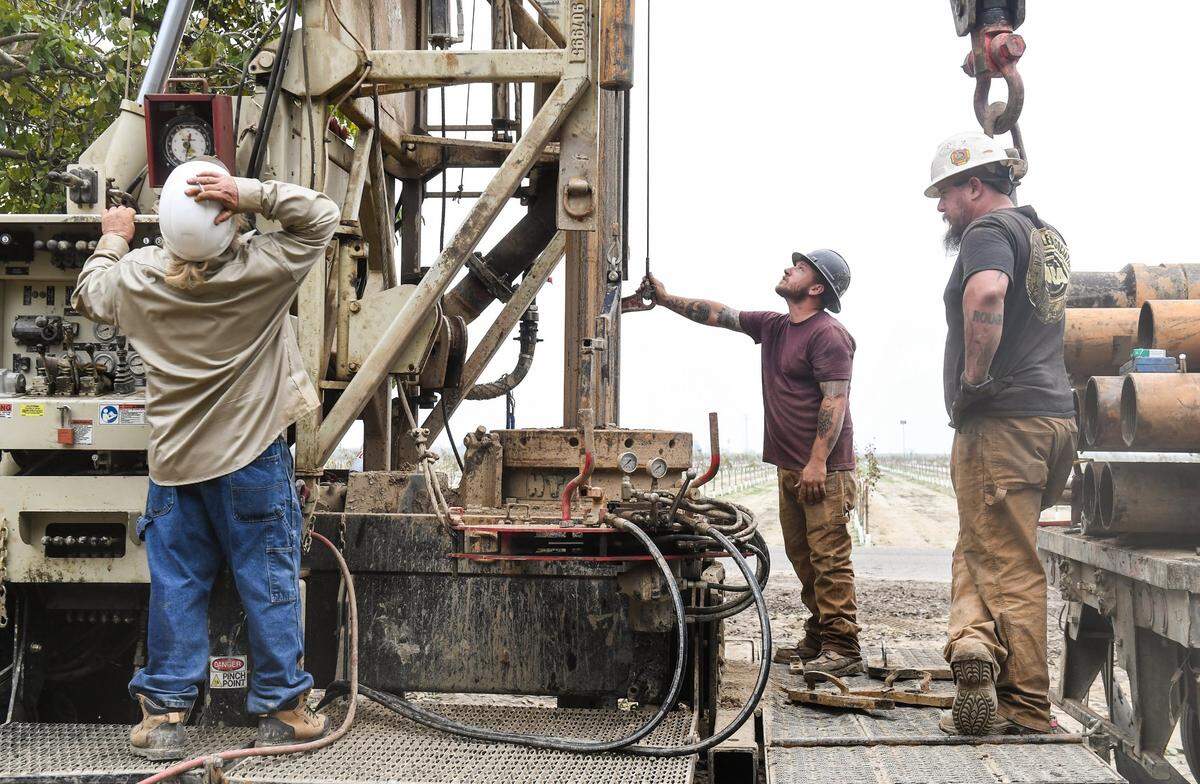
On the parched west side of the San Joaquin Valley, the drought has created a windfall for companies like Big River Drilling.
A water-well contractor based in the Fresno County community of Riverdale, Big River can hardly keep up with demand for new wells as farmers and rural residents seek to extract more water from underground.
“I could work seven days a week if I wanted to,” said owner Wesley Harmon. “In my area, everybody’s pumping. You can’t blame the farmers. They’re trying to make a living, they’re trying to grow food for everybody.”
But talk about poor timing: California farmers are supposed to start throttling back their groundwater pumping to comply with a state law called the Sustainable Groundwater Management Act, or SGMA.
The law is designed to gradually curb groundwater usage and help replenish the state’s badly over-taxed aquifers.
Instead, as an epic drought has put major rivers and aqueducts largely off limits to agriculture, many growers have had to ramp up their pumps this year to keep their crops from dying.
”Pumping was all we had,” said Sarah Woolf, whose family grows garlic, onions and tomatoes on 1,000 acres in western Fresno County. “It was a necessity.”
The groundwater crisis is especially problematic in the San Joaquin Valley, where farming is the main economic engine. Decades of pumping have left its groundwater basins in such rough shape, they’ve been declared “critically overdrafted” by the Department of Water Resources.
Farmers and community leaders are grappling with the realization that vast stretches of Valley farmland will become permanently retired by 2040, when the groundwater law is fully implemented.
Some areas of the Valley are taking an aggressive stance on implementing SGMA, which is known to many as “sigma.” They’re already cutting back on pumping, idling land and getting an uncomfortable glimpse into the future.
But in many parts of the Valley, farmers are still pumping — and some are pumping heavily.
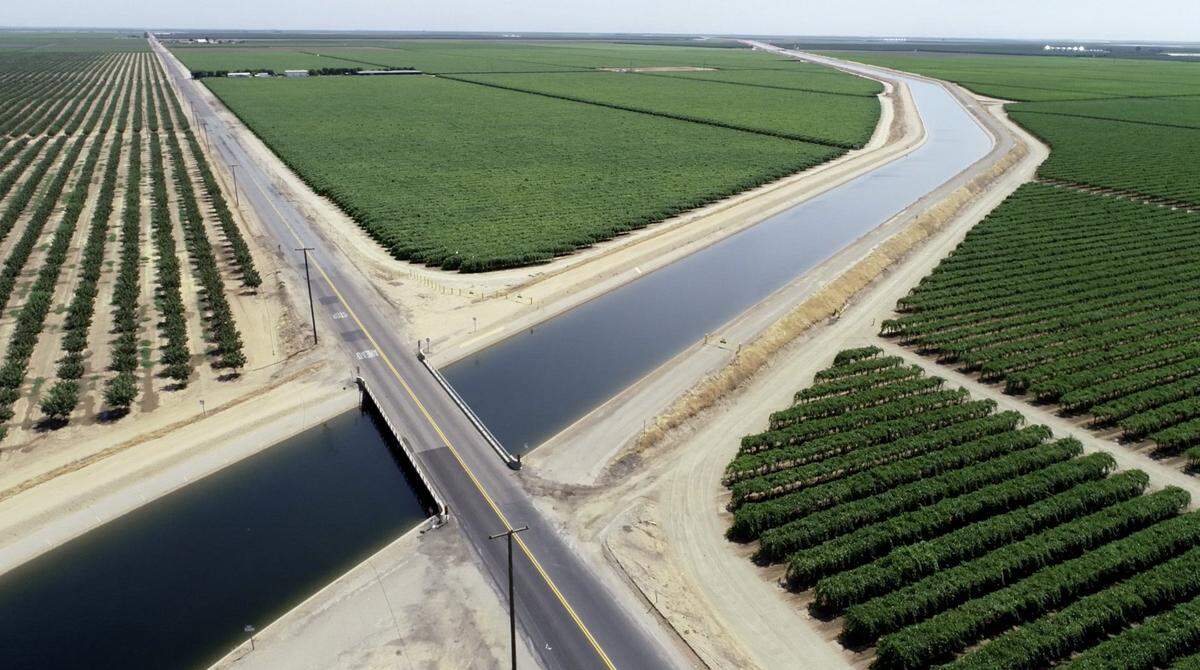
Woolf gets her water from Westlands Water District, which contracts for water deliveries with the Central Valley Project, the federal government’s elaborate network of reservoirs and canals begun during Franklin Roosevelt’s presidency.
This year, Westlands, like many other irrigation districts in the Valley, got a zero allocation from the project. The result: Growers in Westlands pumped nearly 507,000 acre-feet of water from the ground between March 1 and the end of September. That’s an increase of about one-third from a year earlier, said Tom Birmingham, the district’s general manager.
The groundwater pumping “relates directly to the allocations of water we receive,” Birmingham said.
He said his farmers aren’t oblivious to the need to eventually reduce pumping. Westlands will begin curtailing groundwater usage in 2023, and plans to achieve sustainability “well before 2040,” he said. “The Westlands board is serious about managing the groundwater basin.”
In the meantime, though, the pumping goes on — and so does the drilling of new wells.
If current trends hold, about 640 new wells will be drilled in the San Joaquin Valley this year, a 14% increase from last year, according to a Sacramento Bee analysis of Department of Water Resources data.
That’s still short of the record well-drilling activity that took place in the last drought. But the numbers are certainly growing; the 2021 figure will represent a 58% increase over 2018. Nearly all of the new activity is occurring in Fresno and Tulare counties, The Bee’s analysis shows.
“Water is No. 1 in the Valley,” said Josh Van Haaster, manager of Strickland Well Drilling in Sanger, east of Fresno. “They can’t tell us you can’t drill.”
This year’s drought has Van Haaster and other drillers scrambling to deploy their rigging equipment as quickly as possible.
“We have the rigs out,” he said. “We don’t even take them back to the yard. They go straight to the next job.”
California’s long history of groundwater use
Farmers have been pulling water out of the ground for years. Groundwater accounts for about 40% of the state’s water supply in a normal year, and as much as 60% during droughts.
While no precise figures show how much groundwater is used, on average, Californians overdraft their aquifers — that is, they pull more water out of the ground than they put back in — to the tune of an estimated 2 million acre-feet a year, according to the Department of Water Resources. About 79% of all the groundwater is used for farming, the state says.
Dependence on groundwater is particularly vital in the Valley, where climate change and environmental restrictions have made rivers and canals increasingly unreliable.
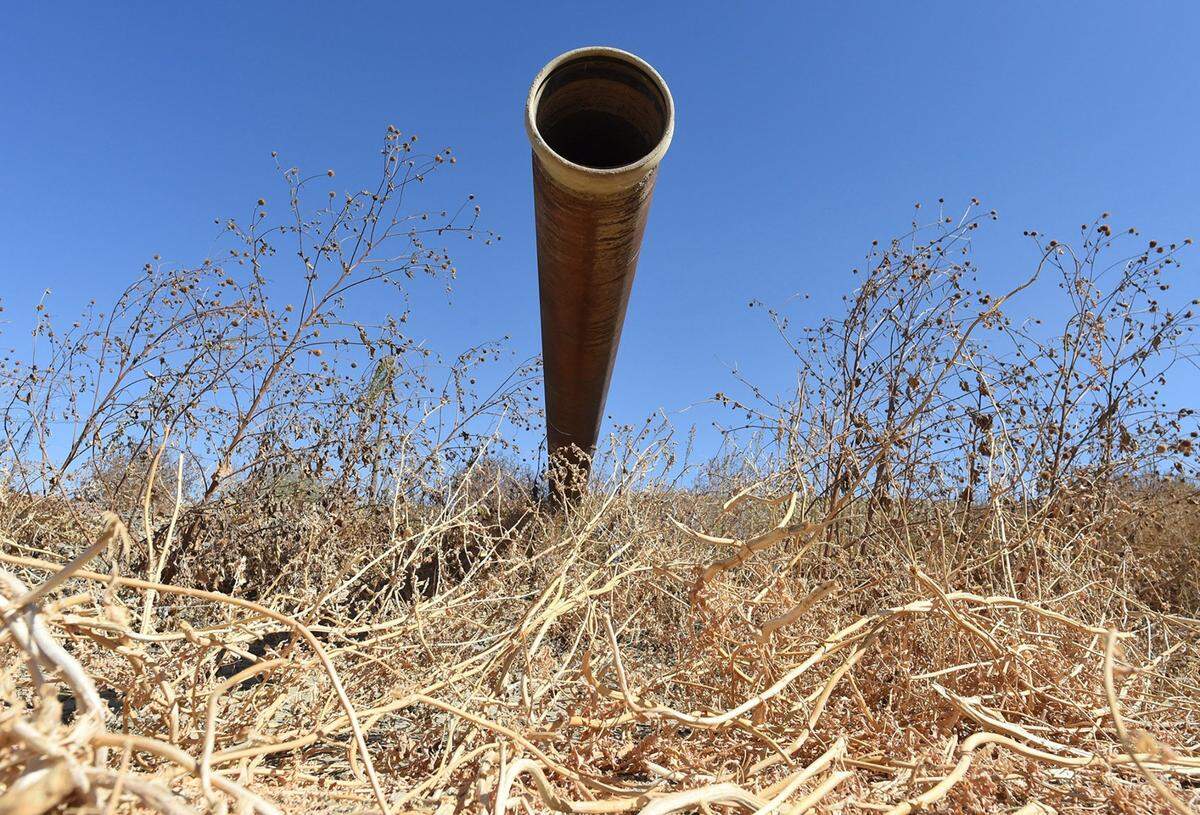
In the Tulare Basin region of the Valley, the water table in 2018 was an average of 195 feet below ground — compared to a mere 25 feet in the Sacramento River region. The problem keeps getting worse: Over the past 20 years, about 37% of the Valley wells that are monitored by the state have seen their water tables fall by at least 2.5 feet a year.
Portions of the Valley floor have sunk because of over-pumping, a phenomenon known as subsidence. That’s caused sections of the state’s most important irrigation canals to buckle and is creating bottlenecks in California’s water-delivery system. It’s a problem that feeds on itself; if canals can’t deliver water efficiently, farmers will pump more from the ground.
In 2014, as the last drought was intensifying, the Legislature declared that enough was enough. Signed by then-Gov. Jerry Brown, the sustainable groundwater law says the over-drafted basins must be brought into “sustainability” by 2040 for the hardest-hit basins and 2042 for the rest. Sustainability is defined as reducing consumption to the point that farmers are no longer causing “chronic lowering of groundwater levels” or other “undesirable results.”
But the law didn’t really kick in until last year, when newly-formed regional Groundwater Sustainability Agencies were required to submit their plans for reining in pumping over the next two decades.
In the meantime, many Valley farmers were essentially thumbing their nose at the Legislature. In the year after Brown signed the bill — the drought year of 2015 — a Sacramento Bee analysis showed that more than 2,000 wells were dug in the Valley, far and away the most on record. In 2016 another 1,500 wells sprouted in the Valley.
Farmers said it was a matter of preserving their livelihoods. It’s no secret that curbing groundwater pumping, even gradually, could bring devastating economic results for the chronically impoverished Valley.
The region relies on agriculture for about 20% of its economic output, according to the Public Policy Institute of California. Now a good chunk of its farmland is going to go out of production over the next 20 years as groundwater pumping is reined in.
Climate change is likely to make the economic problem worse. As the state dries out, less water will be running through the rivers and aqueducts in most years. And because of the groundwater law, farmers will have less and less freedom, with each passing year, simply to turn on their pumps to compensate.
“We’re going to have to account for more severe droughts because of climate change,” said Paul Gosselin, the state Department of Water Resources’ deputy director for groundwater management.
A 2019 study by the Public Policy Institute said as many as 700,000 acres of farmland could be permanently idled by 2040 as groundwater pumping dwindles.
That estimate is already looking outdated. The study’s lead author Ellen Hank said the number of retired acres will likely grow.
“We could be looking at something more like 1 million,” she said.
Detailed statistics from this year aren’t yet available, but clearly farmers are pumping to make up for the shortage of water from rivers and aqueducts. Well-drillers and farmers around the Valley say water tables have fallen by 100 feet or more this year.
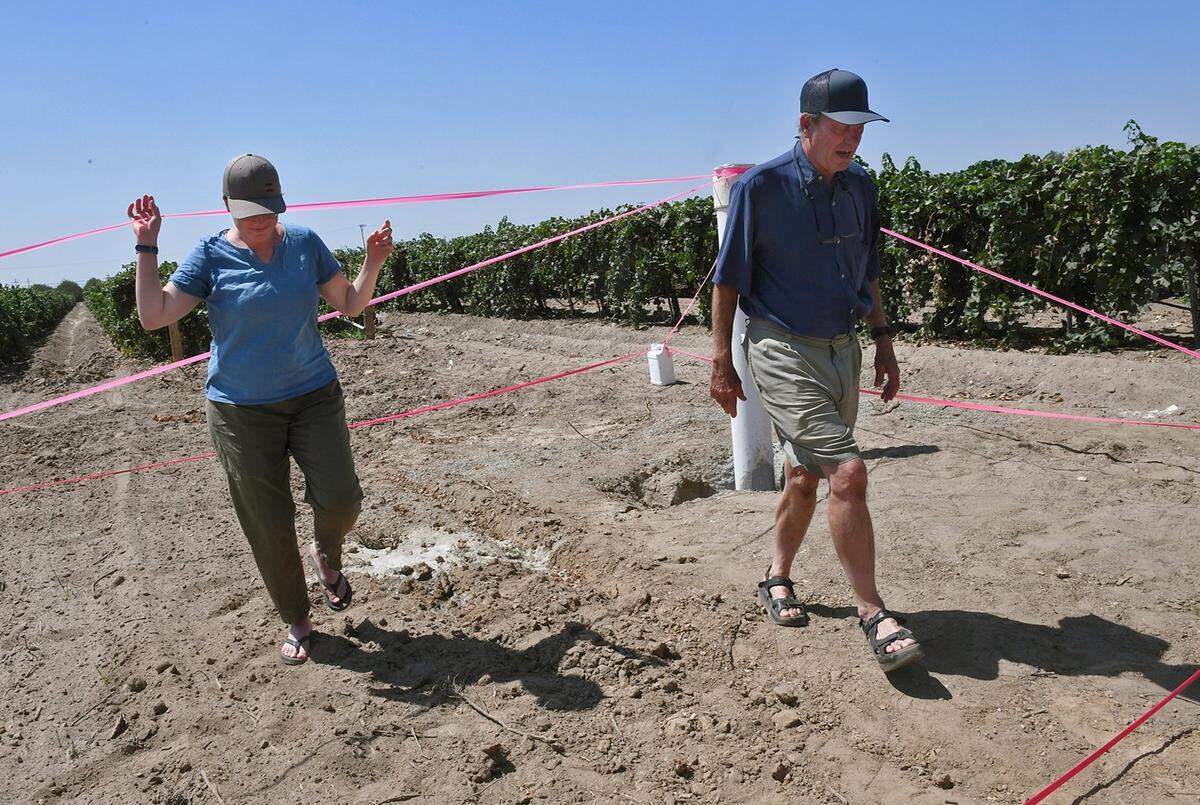
“There’s a huge amount of overdraft,” said Aaron Fukuda. Fukuda manages the Tulare Irrigation District and runs his area’s groundwater sustainability agency — one of several dozen regional entities in charge of setting and enforcing pumping limits in the coming years.
Likewise, Woolf said farmers in the Westlands area aren’t “thumbing their nose” at the groundwater law by pumping more. They realize they have to curtail their pumping before long to comply with the law and keep their wells from going dry.
“We are very nervous about the integrity of our wells,” she said. “If we have back-to-back years of this kind of pumping, that is not good.”
Gosselin said that farmers pumping more groundwater this year is hardly surprising. That doesn’t mean they’re ignoring the sustainability law. What matters is that the regional sustainability agencies appear to be on the right path toward setting realistic restrictions that will bring groundwater basins back into balance.
“I believe we’re making good progress ... to achieve the end goal within 20 years,” he said.
‘Head-on collision’ between state law and drought
Although the Legislature acted in 2014, implementation of the groundwater law is still in its early stages. The state is still approving the 20-year plans submitted by most of the regional sustainability agencies.
Last week the Department of Water Resources kicked four agencies’ proposals back to them for more work, saying they lacked specificity. Among them is Westlands, the big irrigation district on the west side of the Valley. Westlands spokeswoman Shelley Cartwright defended the district’s plan, saying it’s based on “robust groundwater modeling.” But she added Westlands will work with the state “to clarify these issues in full compliance.”
In the meantime, some agencies are already moving to curb their groundwater usage.
The two agencies serving the Pixley area in Tulare County became one of the first to start setting limits on how much water could be pumped, starting with this year. The agencies established a market-based system that charges farmers extra — as much as $500 an acre-foot — if they use too much water. The cap declines every five years.
“Our guys wanted to give our growers the full 20 years (to adapt),” said Eric Limas, who runs the groundwater agency. “They felt that the longer they put it off, the less flexibility we’d have in becoming sustainable.”
Then the drought intensified with a ferocity that caught practically everyone off guard. After a warm spell dried up much of the Sierra Nevada snowpack, the resulting runoff into the reservoirs was reduced to a trickle.
And farmers in the Pixley area got an uncomfortable glimpse of their future. Instead of a long, gentle glide path toward groundwater sustainability, Pixley area farmers are already wrestling with abrupt limits on how much they can pump. The region is getting just 10% of its contracted allocation of water from the Central Valley Project.
“It’s like a head-on collision,” said Joey Airoso, a Pixley dairy farmer who cut his groundwater usage by around 15% this year. That forced him to idle about 220 acres of normally used for growing feed for his cows. He’s had to supplement his feed by purchasing supplies from other farmers, raising his costs.
But he said getting an early start on complying with the law is probably for the best, over the long haul.
“At least this way we’re going to get prepared for the worst,” he said. “We want to be responsible so 50 years from now, my grandson, who’s 11, can make a living doing what I’m doing.”
The new protocols don’t mean agriculture pumping has stopped altogether — not by a long shot. And the consequences are spilling over into neighboring areas.
Just northeast of Pixley, the tiny Woodville Public Utility District has been struggling to maintain reliable water supplies for its 1,700 residents for months, forcing general manager Ralph Gutierrez to slap his customers with $50 and $100 fines for over-consumption.
Gutierrez said the problems have been caused in part by chemical contamination in one of Woodville’s wells — and but also by pumping by neighboring farmers, which has lowered the water table.
“The farmers warned me they’d be pumping,” said Ralph Gutierrez, who manages the Woodville district. “I can’t blame them. Their livelihood depends on it.”
The ag-irrigation districts that are doing the pumping acknowledge the problem.
“We’re aware of those consequences of relying on pumping,” said Limas. “We’re trying to put together some projects where we can do some strategic re-charging of those wells where those communities are.”
Limas and others in agriculture say farmers, after several years of complaining about the groundwater law, have come to understand they’ll have no choice but to curtail their pumping as a means of securing the long-term health of the Valley’s agricultural economy.
“The realization has finally hit everybody,” said Mike Chrisman, who grows almonds and walnuts and raises beef cattle on about 150 acres near Visalia.
Chrisman, who was secretary of California’s Natural Resources Agency in then-Gov. Arnold Schwarzenegger’s administration, said the irrigation ditch that pulls water from the St. Johns River delivered nothing this year. So he increased his groundwater pumping. But pumping limits are set to begin next fall in his area of Tulare County.
“The rubber is hitting the road down here,” Chrisman said.
The drought has spurred some of the Valley’s groundwater agencies to accelerate, rather than delay, their efforts to curb groundwater pumping.
The groundwater agency serving the Kaweah River area of Tulare County was originally going to wait until 2025 to implement its “groundwater pumping cap,” said Fukuda, the agency manager.
Now that’s being moved up to next year.
“Growers know we need to get started sooner rather than later,” Fukuda said. “We need to get to sustainability.”
This story was originally published November 24, 2021 at 5:00 AM.