
‘Drought still far from over.’ Sierra snow survey shows results of dry January
The Sierra Nevada snowpack is dwindling, and California’s drought is worsening.
A once-promising start to winter has given way to grim predictions about a third year of tight water supplies. The California Department of Water Resources’ monthly survey of snow conditions Tuesday revealed a substantial loss of snow from a month earlier, following a bone-dry January.
“Our snowpack has hit this flatline and we’re not getting any snow,” said Sean de Guzman, manager of the state’s snow surveys, after his crew completed its measurements at Phillips. “We’re starting to get more concerned.”
The results of the manual survey at Phillips, conducted amid biting winds near Echo Summit at 6,800 feet elevation, showed that the snowpack had shrunk by 2.5 feet in the past month — results that mirror recordings taken elsewhere in the Sierra.
The one bright spot was that the snow at Philllips lost only one inch of its water content in January, and remains 9% above average for this time of year. But that was of little consolation, given that dry conditions are expected to continue for the next two weeks if not longer.
“This drought is still far from over,” de Guzman said. “The real story is that we’re not accumulating (new snow).”
Snowfall in January was nearly nonexistent. The last snow recorded by UC Berkeley’s Central Sierra Snow Lab was a modest 3 inches Jan. 8.
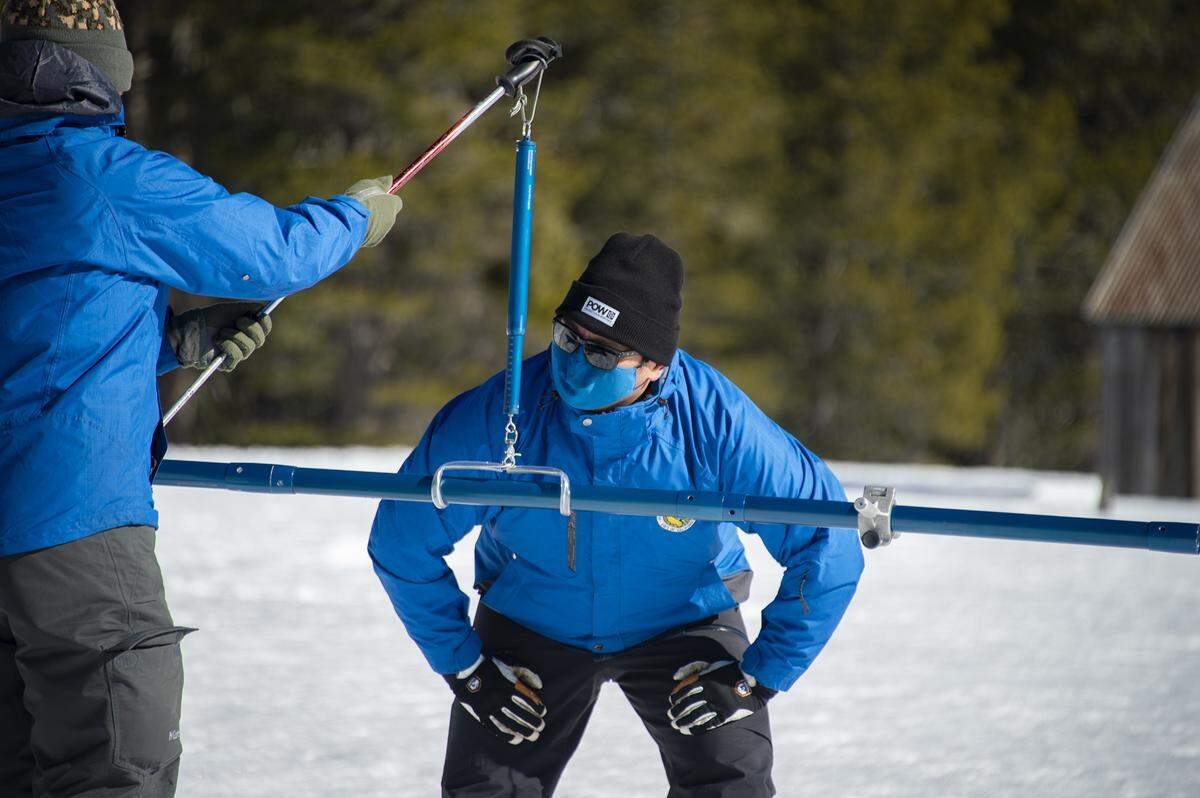
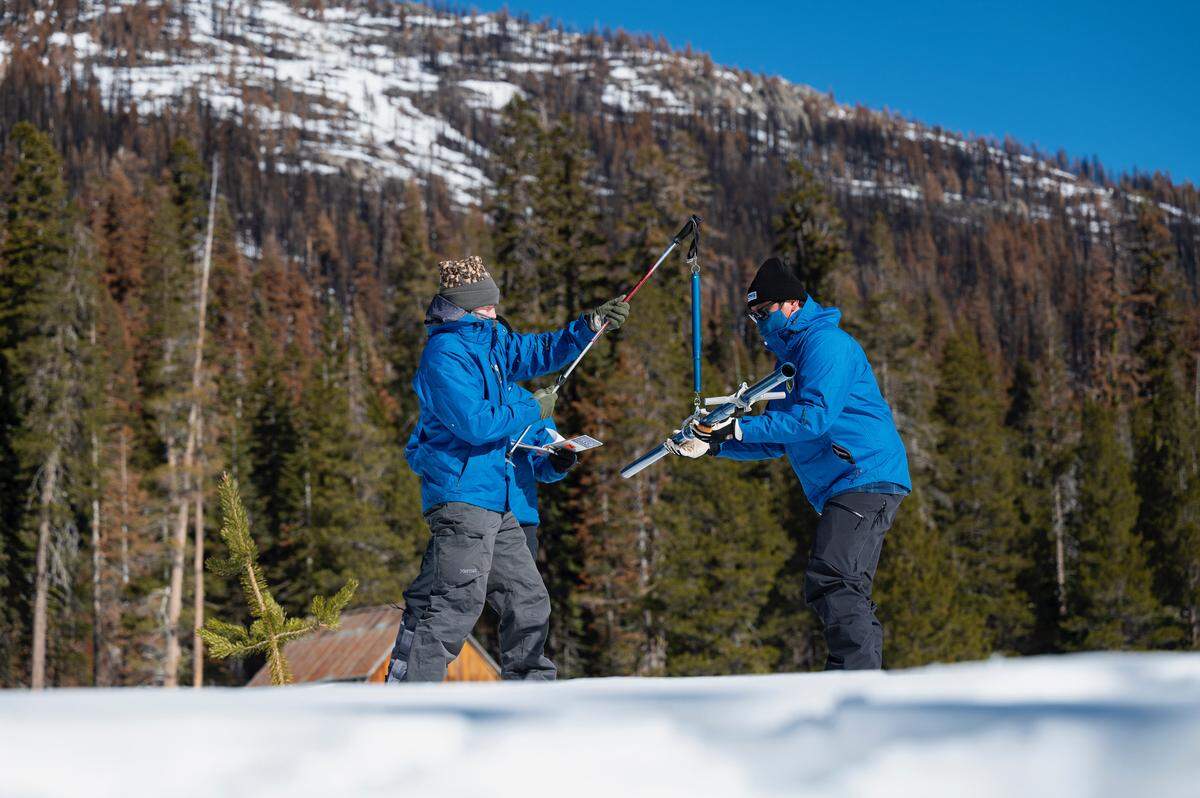
The state measures snow levels continuously through electronic sensors embedded in the soil throughout the Sierra. The monthly surveys at Phillips, a former cattle ranch and stagecoach stop, are a low-tech affair: Crews from the Department of Water Resources plunge a specialized hollow aluminum tube into the snow at multiple points along a 200-yard course and then calculate the depth of the snowpack by measuring what’s inside the tube.
As it happens, the Phillips site sits amid countless reminders of how drought and climate change are plaguing California. Burnt trees litter, left over from last summer’s Caldor Fire, dominate the landscape on both sides of Highway 50 around Phillips. The snow survey site is a mile or so from Sierra-at-Tahoe ski resort, where some facilities burned last summer. The resort hasn’t yet reopened.
A month ago, after the snowiest December ever recorded in the Sierra, the survey revealed 78.5 inches of snow at Phillips. On Tuesday that was down to 48.5 inches.
In the Sierra as a whole, snow depths had been about 40% above normal. Officials believed the drought was easing and agreed to release more water to farms and cities that rely on the State Water Project, the elaborate state-run network of reservoirs and canals that supplies millions of Californians.
Now much of that progress has been wiped out.
All over the Sierra, weeks of dry weather have left snow depths 8% below average.
“January is supposed to be our wettest month of the year; we would have expected the snowpack to grow,” said Michael Anderson, the state hydrologist. “We’ve gotten almost all the opposite.. All of the benefit we got in December, we’ve been backing off.”
Granted, some of the snow has turned into snowmelt, creating runoff to partially replenish California’s parched reservoirs. Lake Oroville, the largest reservoir in the State Water Project, has added 200,000 acre-feet of water in the past month.
But Oroville is still less than half full, and about 20% below average for early February. And it’s likely that some of the snow has vanished into the air.
Ben Hatchett, a climatologist with the Western Regional Climate Center in Reno, said much of the Sierra’s snowpack has probably evaporated, a result of the dry weather and strong winds that have buffeted the area.
“I think we’ve lost a fair bit of it,” Hatchett said. “We don’t get that water.”
A similar phenomenon occurred last year, when a spring heatwave robbed the state of an estimated 800,000 acre-feet of Sierra snowmelt and dramatically intensified the drought. An acre-foot is 326,000 gallons and 800,000 acre-feet would be nearly enough to fill Folsom Lake.
Meanwhile, scientists and state officials don’t expect much relief in the near future. A persistently strong high pressure system over the northern Pacific — essentially, a dense mass of air — is pushing storms northward and preventing them from reaching California.
Anderson, the state hydrologist, said the system doesn’t appear to be breaking up.
“When it comes entrenched like this,” he said, “and we miss a whole month of precipitation, and it doesn’t look to be going anywhere anytime soon, that’s when it becomes disruptive.”
There’s no snow or rain in the immediate forecast, and Anderson said the long-term outlook calls for below-average precipitation through the end of March.
De Guzman summed it up simply: “We have to be prepared for a third dry year.”
This story was originally published February 1, 2022 at 12:33 PM.