
How California is frantically trying to protect endangered salmon from extinction in drought
Critically endangered adult salmon are again swimming above a century-old dam in this remote corner of far Northern California in the shadow of the Mount Lassen volcano.
But this isn’t a habitat-restoration success story — at least not yet.
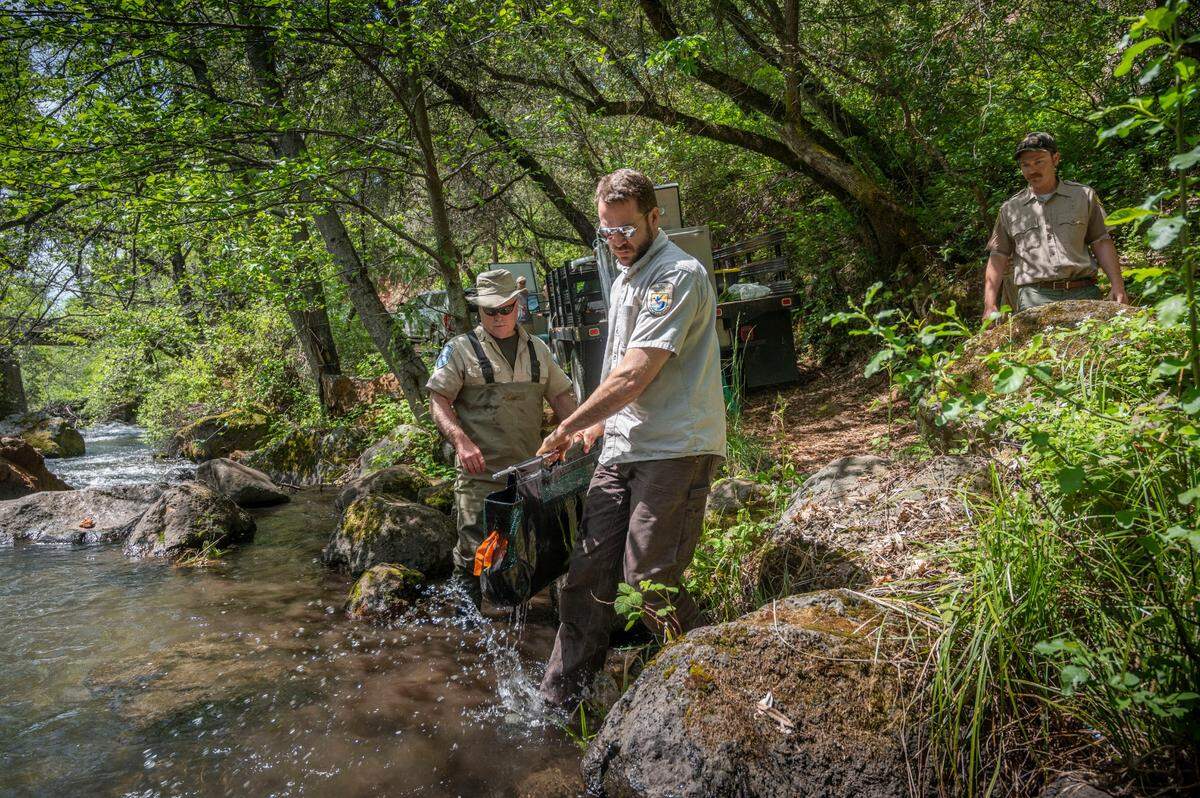
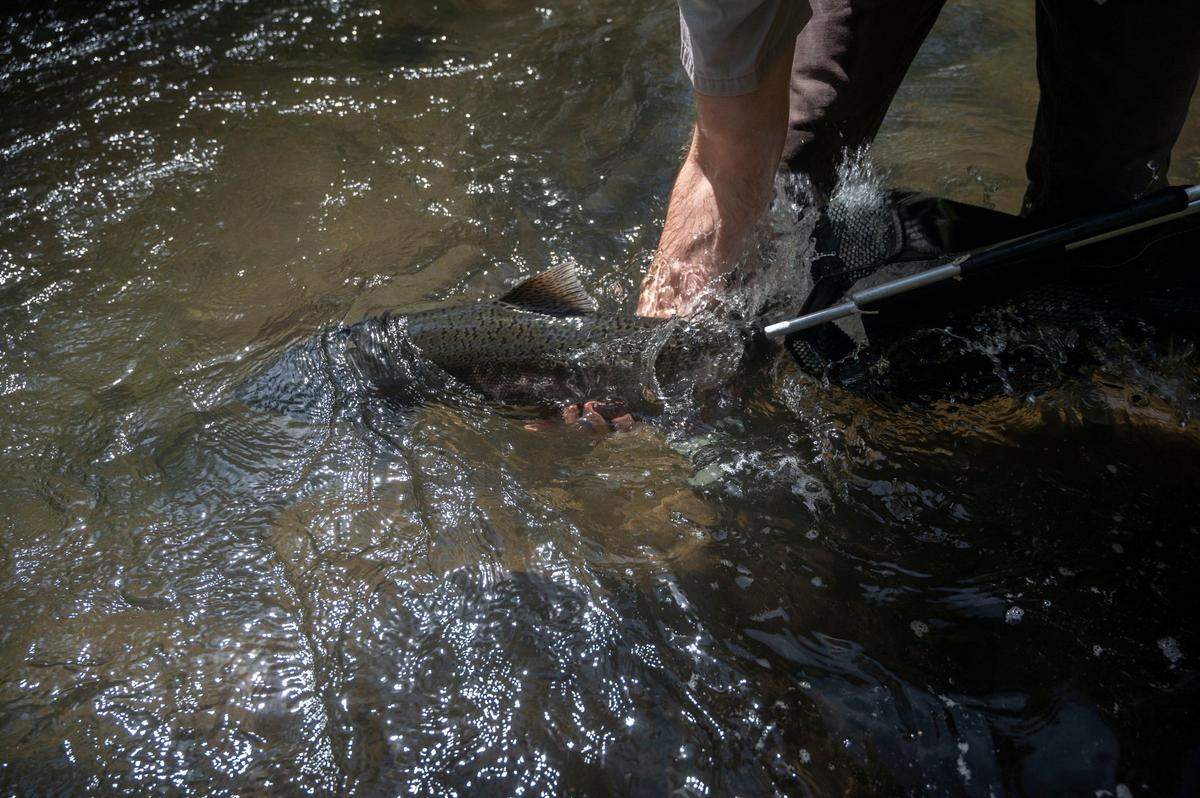
For the past two weeks, state and federal fisheries managers have begun hauling the winter-run Chinook nearly 50 miles by truck from the dangerously warming Sacramento River to a stretch of the north fork of Battle Creek and releasing them, a handful at a time, into the creek’s icy waters.
It’s part of a frantic effort to save the few naturally spawning Chinook from a massive die off this summer in the third year of California’s latest crippling drought. But the fact that trucking fish is needed at all above Eagle Canyon Dam on Battle Creek, a 2 ½-hour drive northeast of Sacramento, points to a larger systematic failing in California, as state and federal leaders try to stave off a long-brewing ecological collapse hastened by a rapidly warming climate.
Twenty-three years ago, state and federal officials, biologists and conservation associations came to a consensus. Battle Creek and its northern and southern forks, they agreed, could serve as a key refuge to keep the winter-run Chinook and other cold-water native fish from going extinct. The solution they proposed was a relatively simple one: build fish passageways around a handful of small dams and remove other barriers. Clearing a path up the stream would give the cold-water dependent fish access to dozens of miles of the chilly, spring-fed steam they thrived in for eons before the dams were erected and blocked their migration route.
Hundreds of pages of planning documents, hours of public hearings, $165 million and nearly a quarter century later, the fish are still unable to swim upstream to their ideal habitat, making the trucking of these fish necessary during one of California’s worst droughts on record.
The failure to move faster to complete the work on Battle Creek doesn’t bode well for various other habitat-restoration efforts in California that have been on the books for years, said Jeff Mount, a watershed expert at the Public Policy Institute of California.
“It just kills me,” Mount said, “that things are changing faster than our ability to adapt to them.”
The stakes go beyond the fate of the fish.
Increasingly, the state’s economy and the day-to-day lives of Californians are tied to the survival of endangered fish species.
In drought years, such as this one, farms and cities across the state have their water supplies slashed in order to try to keep the Chinook and other fish from going extinct. This has lead to criticisms from the agricultural industry and its allies that the scales have tipped too far toward the needs of fish over people.
“The truth is,” said Charlton “Chuck” Bonham, the director of the California Department of Fish and Wildlife, “the moment we can get these fish healthy and stable again, life will be better for everybody.”
The history of the winter-run
There are four runs of Chinook salmon that inhabit California’s Central Valley rivers. Each genetically-distinct run — the fall, late fall, spring and winter — are named for the general time of year when the fish swim under the Golden Gate Bridge on their way up in the Sacramento and San Joaquin rivers and their tributaries in which they spawn.
Adult salmon lay their eggs in river gravel before dying at the end of their three-year life cycle. The swarms of small fish that hatch then make a perilous journey back to the ocean. The comparative few that survive to adulthood begin the cycle anew, navigating from the vastness of the open ocean back to the same stretch of river where they hatched.
Last century, more than 1,000 dams — massive ones like Shasta, Folsom and Oroville and tiny facilities such as the ones on Battle Creek — were built in California for water storage, hydroelectric power and flood control. Without the dams, California wouldn’t have grown to become the most populated state and its farmbelt the most productive in the nation, but they blocked much of the spawning habitat for salmon and other migratory fish.
Around the time the dams were going in, the state and federal governments built hatcheries at the base of the largest dams to try to sustain salmon populations, on which a major commercial fishing fleet relied. In the decades since, all the salmon runs have declined substantially, even with the hatcheries supplementing wild-born populations. California’s salmon fishing industry is a shadow of what it once was.
The winter-run is in particularly bad shape due to the time of year the fish spawn. The winter-run evolved to lay their eggs at the beginning of the Central Valley’s unpleasantly hot summers. That wasn’t a problem before the dams were erected. The cold-water dependent fish would just swim far upstream into frigid spring-fed tributaries such as Battle Creek to lay their eggs. Before the dams went in, the fish thrived. An estimated 200,000 adult winter-run salmon returned to Northern California each year to spawn.
Now, as few as a couple of hundred winter-run Chinook return each year to the only habitat left that’s cold enough for them to hatch naturally in the summer: A short stretch of the Sacramento River below Shasta Dam in Redding. There, temperatures in the summer regularly peak at over 105 degrees, often warming the river to more than 56 degrees, the point the fragile eggs and hatchlings start to die.
The federal government declared the winter-run threatened in 1989 and then fully endangered five years later.
Today, the winter-run is now almost entirely propped up by workers with the U.S. Fish and Wildlife Service, who collect eggs and sperm from a few adults that make their way to Redding to spawn.
After they’re hatched, the young fish are reared in refrigerated holding pens at the Livingston Stone National Fish Hatchery at the base of Shasta Dam before the juvenile fish grow large enough to be released back into the river to head downstream.
Droughts play hell on salmon
California’s recent droughts have been especially hard on the few winter-run fish that try to spawn naturally in the Sacramento River.
California’s wildlife agency made a dire prediction last July: “Nearly all” of the winter-run’s juvenile population was likely to be cooked to death.
It turned out to be true. Only an estimated 2.6% of the winter-run Chinook salmon juvenile population survived the hot, dry summer, the state Department of Fish and Wildlife said.
Even in good times, the winter-run struggle to survive. Since 2005, the highest recorded survival rates were 49% in 2011 and 44% in 2017 — two extremely wet years.
The 2.6% survival rate was even worse than the 4% survival rate from the depths of the last drought in 2015, according to federal figures. Just 153 and 461 naturally-hatched adult fish returned in 2017 and 2018 respectively, reflecting the severity of juvenile fish kills three years earlier at the start of their life cycles.
Regulators warn another catastrophic fish kill is just as likely this summer. Shasta Lake, which holds the cold water the fish need, is at just 47 percent of its average capacity for this time of year. Not much cold water will be flowing downstream from the lake.
To try to prevent another catastrophe, the state and federal governments are taking unprecedented steps this year, including raising even more juvenile fish at the hatchery and hauling fully grown Chinook into Battle Creek even before a fish passage project is completed.
Trucking fish to save them
On Monday at the Livingston Stone hatchery, a big-rig truck with a large tank on the back chugged up a narrow road toward the base of the towering Shasta Dam. A handful of state and federal biologists were waiting for it to arrive. They stood alongside a group of large circular holding tanks, each holding about four feet of water, circulated via pumps.
The tanker truck was hauling a precious cargo: adult winter-run fish that had been captured as they swam up the Sacramento River to the base of another small dam called Keswick that’s a couple of miles downstream of Shasta Lake.
Biologists pulled them out of the truck’s tank and put them into the larger circular tanks. In most years, the adult fish would live out the few months left of their lives in those tanks before it’s time for the biologists to spawn them. The biologists bonk them on the head with a club to kill them since they’d die anyway in the wild after spawning. They then squeeze the sperm and eggs out of them and wait for their eggs to hatch in another set of chilled fish pens.
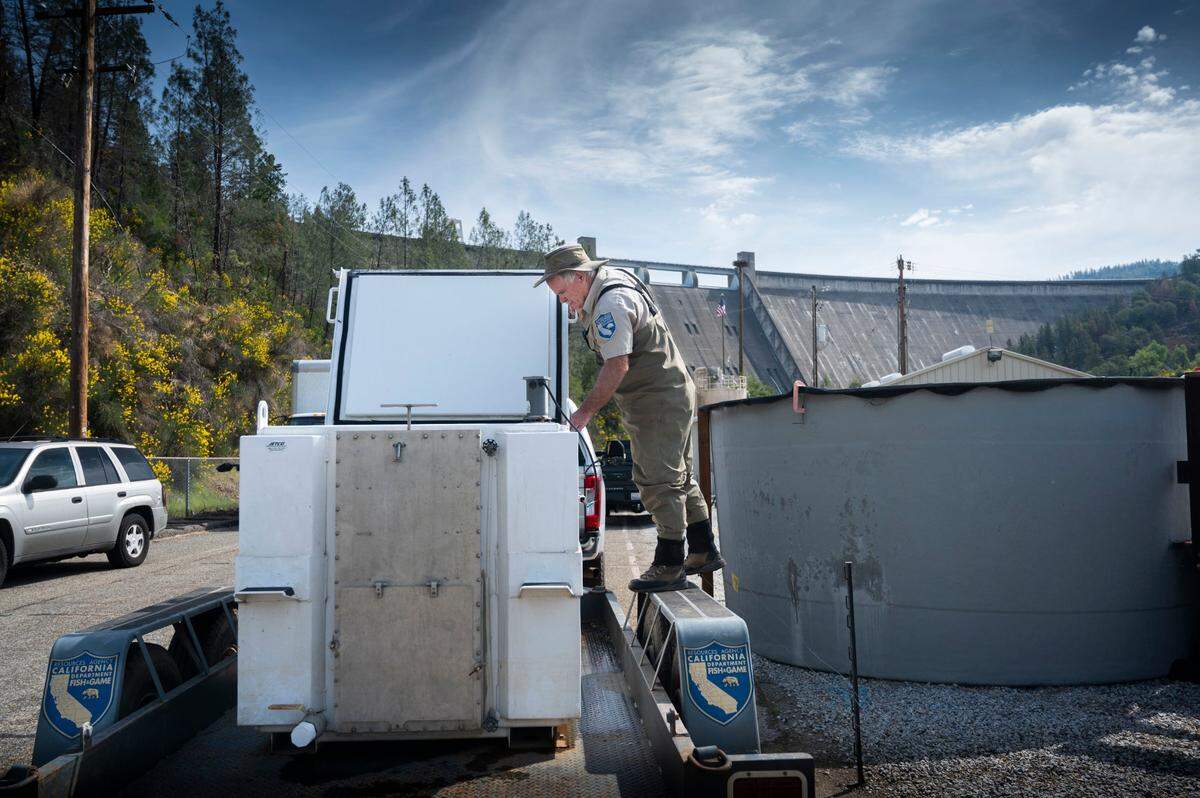
Normally, the hatchery captures around 180 adult fish with the goal of rearing 250,000 young winter-run salmon, to the point they’re grown to around three inches long and are called smolts. That’s an age when they have a better chance of surviving a trip down river. This year, due to the likelihood of a fish kill in the river, the hatchery is ramping up production with a goal over the next few months of rearing up to 1.5 million smolts to supplement what few wild-hatched fish survive this summer.
State and federal biologists also are for the first time trucking adult fish from Livingston Stone to above Eagle Canyon Dam on the north fork of Battle Creek. Biologists hope as many as 300 adult fish will make the nearly hour-long drive to remote Tehama County.
As of Wednesday, nine adult fish had already made the journey and were released into a shady stretch of stream just outside of the town of Manton. The water temperature was under 50 degrees, perfect for a species whose eggs and fry die if the water gets warmer than 56.
The hope is that in the coming weeks, the trucked-in fish spawn naturally in the cold water that flows down from Mount Lassen, and that their offspring, which are small enough to swim past barriers blocking adult fish from coming up, will provide a key boost to the hatchery-raised fish and for the few that are expected to survive in the Sacramento River.
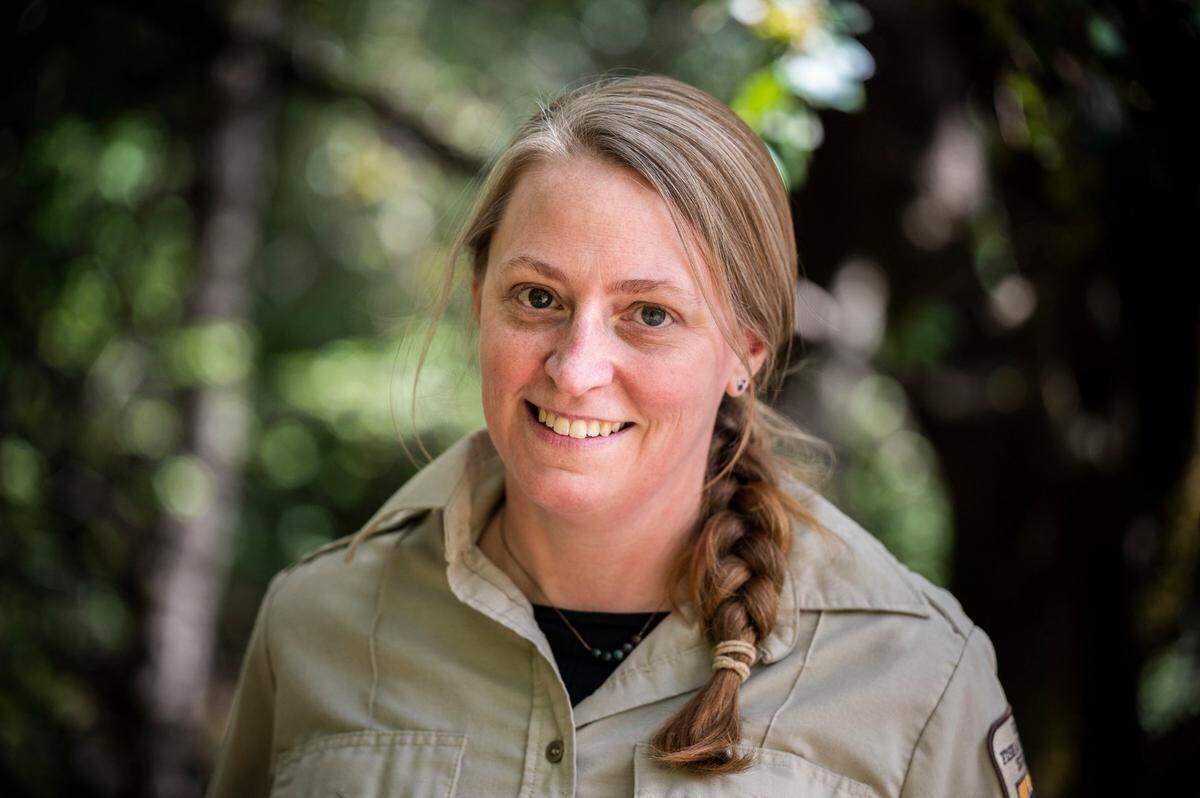
“Hopefully we have some good survival here on Battle Creek,” said Laurie Earley, a biologist with the US Fish and Wildlife Service who is overseeing the reintroduction work.
Battle Creek a haven for fish
Battle Creek is named for a bloody Gold Rush-era battle between trappers and local Native Americans. The nearly 42 miles of the creek have long been considered an ideal place to reintroduce winter-run Chinook and other migratory fish.
The various dams blocking fish passage on Battle Creek are just a few yards across, unlike massive behemoths such as Shasta Dam that are too huge to build passageways around them.
In 1999, Pacific Gas & Electric Co., the power company that owns Battle Creek’s hydroelectric facilities, and the federal and state governments signed a “memorandum of understanding” that created an outline for a plan to remove or modify the dams to allow fish to pass and to restore their habitat.
PG&E still operates the dams, but the U.S. Bureau of Reclamation, is the lead agency responsible for the modification work. At the time, Reclamation promised to get the work done quickly, said Bill Kier, an independent fisheries consultant who’s been advocating for getting the winter-run into Battle Creek since the 1990s.
“I would like to see winter-run (swim) into the north fork of Battle Creek — where we intended them to go more than 20 years ago — in my lifetime,” said Kier who’s 86. “This job, Reclamation said they could knock out in one year. And that was 22 years ago.”
It took six years to complete the required environmental reviews. A lawsuit from a private landowner, bickering between the government and the power company and other regulatory hurdles further delayed the project. Originally, the governments pitched in $28 million for the cost of restoring the creek. With work still underway, the price has ballooned to nearly six times that amount.
There has been some positive work accomplished. Since small fish are able to make their way downstream, in 2018, the state and federal fisheries agencies began releasing smolts reared at Livingston Stone into Battle Creek’s upper reaches. Of the 567,412 smolts that were placed in the creek since then, at least 1,000 grew into adults that returned to Battle Creek’s lower reaches. Some of them actually spawned naturally in 2020 in Battle Creek below Eagle Canyon Dam.
But one key barrier — rock piles in the river near PG&E’s Eagle Canyon Dam — still remains, blocking adult fish from swimming back up to where Monday’s fish release took place. Biologists agree this seven-mile stretch of the creek is the best winter-run spawning habitat.
Earley said a fish ladder and screen on the dam itself has been built, but it’s not clear when the work to remove the rock barrier in the canyon near it will get completed.
“We’ve been working through these issues,” Earley said on Monday over the babble of Battle Creek’s rushing current. “And we would love to see them resolved before the next couple of years, so fish can actually have access up here.”
Various groups are working with a private landowner to get access to the rock pile so it can be cleared out, said Curtis Knight, the executive director of the nonprofit California Trout, which played a key role in removing another rock barrier last year on Battle Creek.
“But the money’s there to do it,” he said. “And we’re ready to do it.”
That it’s taken so long to get the fish back into Battle Creek even via truck shows why it’s critical for state and federal agencies to ramp up the speed at which they do restoration projects, said Bonham, the director of the state Department of Fish and Wildlife.
Gov. Gavin Newsom’s administration has embarked on a “cutting green tape” initiative that seeks to speed along similar habitat restoration work across the state. He’s also signed laws that would bypass a lengthy state permitting process on critical habitat projects Bonham’s office oversees.
Still, various state projects that would restore tens of thousands of acres of fish habitat have been on the books for years. The majority remain in the “planning” phase.
“I don’t think it can take this long anymore,” Bonham said. “Enough is enough.”
In the meantime, instead of swimming up Battle Creek this summer, the winter-run will be making their way upstream along narrow, winding roads as their brethren downstream face a likely death in the warming Sacramento River.
.JPG "SAC_HA042522Salmon1029 (1).JPG")
This story was originally published April 29, 2022 at 5:00 AM.