
California has a drought and 4 million acres of lawns. Should state ban grass to save water?
Californians have thousands of square miles of lawns, enough grass to cover almost every inch of Connecticut and Delaware combined — and they use a lot of water to keep them green. A lawn in the Sacramento area can soak up an average of 45,000 gallons a year, according to state calculations.
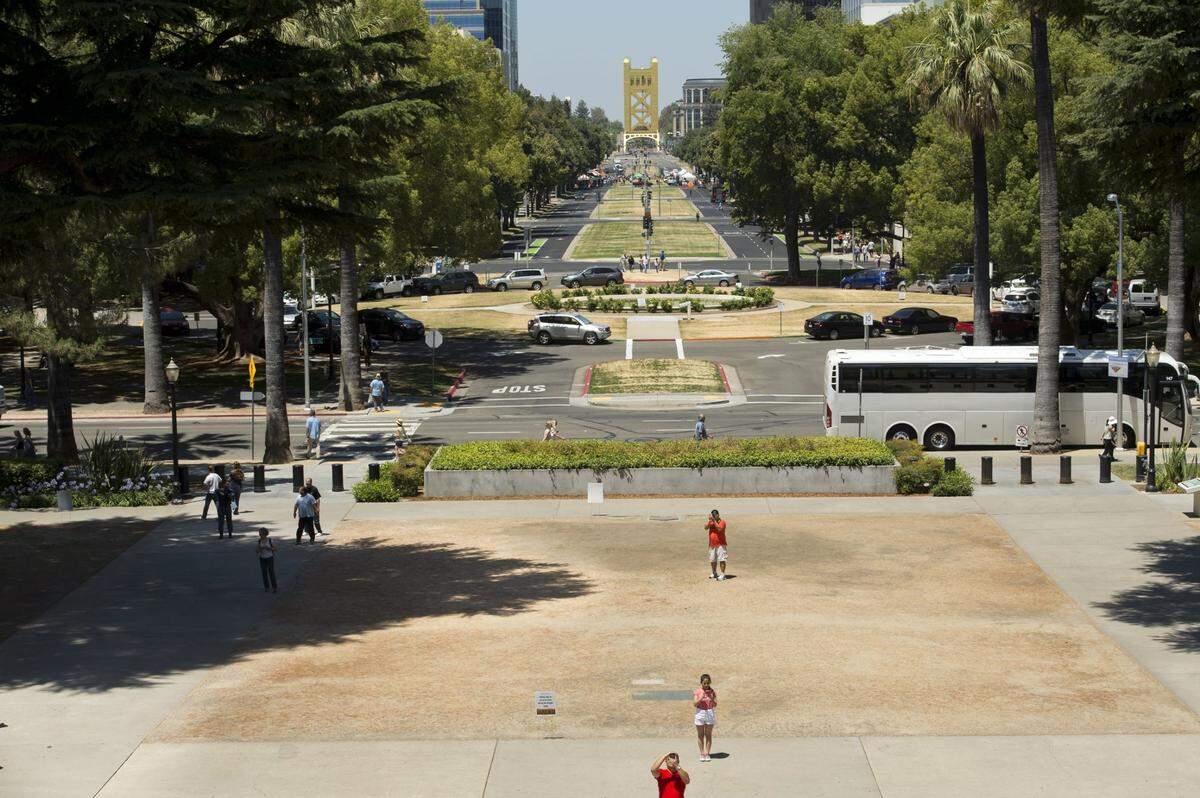
But when the State Water Resources Control Board imposed a new round of drought restrictions last month, it targeted a much narrower slice of water usage. The agency ordered businesses and local governments to stop watering the “non-functional” turf that grows around hotels, shopping malls, roadway medians and the like.
Experts agree: California could withstand this new era of megadroughts without ever worrying about rationing toilet flushes and putting timers in showers if its 14 million homeowners weren’t watering their lawns.
As much as half of the water used in the state’s urban areas is poured on outdoor landscaping, predominantly to keep residential lawns green. If Californians reduced the footprint of their lawns — replace turf with drought-tolerant plants or just let the grass die — it would leave the state with a meaningful cushion against water shortages.
“If everybody took out half their lawn, you would create enough water for the indefinite future,” said Jeff Mount, a water expert at the Public Policy Institute of California.
But California won’t tell its residents to tear out their lawns. The lush, green carpeting remains as much a part of the California experience as redwoods, coastal sunsets and Disneyland.
The former head of California’s largest regional water agency says eventually that could change. Jeff Kightlinger, the former general manager of the Metropolitan Water District of Southern California, said he thinks some day the state will ban lawns — if not statewide, then at least in parts of the state.
“My guess is we’ll get there,” Kightlinger said.
As it is, new homes built in California since late 2015 have limits on lawn sizes. The Legislature is considering a bill that would set increasingly-strict targets for overall household water consumption, even when there isn’t a drought. And surely millions of Californians will get a taste of life with a brown or yellow lawn this summer, given the curbs on water usage that have been imposed on a temporary basis in many areas of the state.
“We’re surely going to have a lot less lawn,” Mount said. “That’s a given. And all the trends are pointing that direction.”
Former Gov. Jerry Brown tried to prepare Californians for that future. In April 2015, on the day he imposed significant cutbacks in urban water use, he declared: “People should realize we’re in a new era. The idea of your nice little green grass getting lots of water every day — that’s going to be a thing of the past.”
But transitioning California to a less-grassy urban landscape won’t come easily.
Barriers to lawn removal
For one thing, millions of property owners who bought homes with lawns would need to tear them out and replace them with drought-tolerant landscaping — an expensive and labor-intensive chore for homeowners with limited time and incomes.
And if those residents were to just let their lawns die outright, there’s a real concern the ugly, weed-filled spaces would form what are known as “heat islands” that raise neighborhood temperatures during California’s blast-furnace summers. That’s a particular problem in sweltering Southern California and the Central Valley.
Another key barrier: Many of California’s 400-plus urban water districts face significant budget shortfalls when their customers use less water. Critics say this makes water districts less likely to aggressively crack down on customers over-watering their grass, and it stops them from wanting to invest as much in the sorts of programs that give rebates or other financial incentives to help customers tear out their turf.
And not everyone is convinced that lawns are the enemy.
Jim Baird, a University of California Cooperative Extension specialist in turfgrass management, listed a litany of reasons to keep lawns. He cited their benefits to “property values, mental health, erosion control, groundwater recharge and surface water quality, organic chemical decomposition, carbon sequestration, and environmental cooling.”
“Irrigating lawns is not rocket science,” Baird said in an email. “We need to educate Californians on the proper (grass) species to use, as well as irrigation technology and practices. Turfgrasses don’t waste water. People and faulty irrigation systems waste water.”
That’s largely the tack state regulators are taking — at least for now.
So far, Gov. Gavin Newsom has resisted mandating urban water conservation targets of the type imposed by his predecessor, Jerry Brown. During the last drought, Brown ordered the state’s cities to reduce water use by a cumulative 25% — a move that pressured Californians to kill their lawns.
Instead, Newsom has asked Californians voluntarily to cut back their water use by 15%. And so far they haven’t. The most recent state data from April show that urban residents have only reduced their water use by 2% since he issued his call to conserve last July.
The state board’s decision last month to ban lawn watering around businesses was part of a broader move to ratchet up the pressure on urban water providers to have their customers cut back. The ban on watering turf in the commercial sector is expected to free up enough water to supply nearly 800,000 homes a year.
Nevada has taken it a major step further. Last year Gov. Steve Sisolak signed a bill permanently banning ornamental turf around businesses, starting in 2027. That will take out a lot of turf, about one-third of the grass surrounding casinos, traffic circles and other locations in the Las Vegas area.
Regulators don’t want to see all lawns disappear from California, but they do think Californians need to be scaling back how much water goes on their grass, said James Nachbaur, a residential water-use expert at the State Water Resources Control Board.
“Lawns can definitely be part of the California landscape,” Nachbaur said. “It depends on a lot of different factors. How much lawn? What kind of lawn? What’s it being used for? What part of the state are you in? Those all come into play.”
Then there’s the key truth about California’s water supply: Agriculture uses substantially more water than its cities do, no matter how much water is going on lawns. As a general matter, around 80% of the state’s water used by humans goes for farming, according to the Public Policy Institute of California.
That figure is a reason why some argue that getting rid of lawns alone wouldn’t do much to help the state’s troubled aquatic ecosystems. Native fish species are struggling to survive due in large part to having so much of the water they need siphoned off to grow crops.
“A wholesale removal of every blade of grass in California is not going to do it,” said Sandra Giarde, executive director of the California Landscape Contractors Association. “It’s not going to save enough water.”
Pulling out all of California’s outdoor landscaping would reduce overall water use by just 10%.
“Would it be helpful to agriculture and ecosystems?” said Jay Lund, the director of the UC Davis Center for Watershed Sciences. “Sure. Yeah. A little bit.”
California lawn policy
But that’s not to say policymakers haven’t been acting to reduce California’s lawns.
During the last drought, Brown set a goal of removing 50 million square feet of California’s turf. State and local governments spent more than $350 million on turf replacement rebate programs. There’s no one clearinghouse of data that would show how many lawns got removed since the last drought. But state and local officials said various “cash for grass” programs were successful.
In Southern California, the Metropolitan Water District, which delivers water to 19 million people, has had customers remove 200 million square feet of grass through its turf-removal program. That saved enough water to serve about 62,000 households each year. A statewide program eliminated 15 million square feet of turf, the Department of Water Resources said. The Newsom administration has asked the Legislature to revive the program this year, but the tentative budget approved by lawmakers didn’t allocate funds for that purpose.
Sacramento officials recently announced their turf replacement rebate program has replaced 1 million square feet of lawns with drought-tolerant landscaping. These programs, along with Californians generally becoming more conscientious about their outdoor water use, have prompted many homeowners to pull out their grass.
“You walk around any suburban neighborhood,” said Mount of the Public Policy Institute of California, “and you’re going to see a whole lot less lawns.”Regulators also have taken steps.
In 2015, in the worst of the last drought, lawmakers passed a law that prohibits cities from banning the installation of drought-tolerant landscaping, synthetic grass and artificial turf on residential property. That same year, the California Water Commission enacted rules limiting lawn sizes surrounding newly-built homes, saying that grass can’t take up more than 25% of the landscaping.
After officially declaring the end of the last drought in 2017, Brown signed two bills that sought to cut down urban water use by setting water-use targets for water utilities.
The targets are designed to ratchet down the districts’ water use over time, making conservation “a California way of life,” as state officials put it. Local water agencies could get fined if they miss the targets.
A bill making its way through the Legislature this year would tighten up those “water budget” targets even further — a move that the bill’s supporters hope will lead to less water going toward lawns in the years ahead.
Meanwhile, legislation that would reinstate a tax exemption for those who spend money on turf replacement passed the Assembly last month. The tax exemption had expired after the last drought. The bill is pending in the Senate.
At the same time, millions of Southern California and Bay Area homeowners are likely to see their lawns die this year — and not by choice.
Faced with a significant reduction in the water it receives from the wetter northern half of the state, the Metropolitan Water District of Southern California took the unprecedented step this spring to order about one-third of its 19 million customers to water lawns only once a week.
Santa Clara County’s water provider, facing a similar shortage, is telling its customers to cut back on watering or face fines of up to $10,000 for wasting water.
But will Californians switch their sprinklers back on if the state ends up getting a few wet winters and springs in the years ahead?
Heather Cooley, director of research at the Pacific Institute, a water-policy think tank based in Oakland, worries that they might.
“We can’t go back to what we were doing before,” Cooley said. “We’re facing a hotter, drier West. And we need to change how we use water as a result.”
In urban areas, that will require Californians to end or at least scale back their love affair with lawns, which are as ubiquitous to California’s sprawling suburban landscapes as crowded freeways and strip malls.
History of the lawn
Lawns in the United States date to Colonial times, when settlers from England brought with them the romanticized ideals of vast, grassy landscapes that at the time were popular with the European aristocracy.
The rainy, humid climates on the East Coast may have made it easy to keep Americans’ grass green, but settlers who began heading West after the Gold Rush would have had little hope of keeping grass alive year round outside of foggy coastal areas.
What became popular instead was the concept of “swept lawns,” said Chris Brown, former executive director of an organization now called the California Water Efficiency Partnership. The lawns were essentially bare dirt.
“Before there were irrigation systems,” he said, “people thought a swept, clean lawn with no weeds — ‘Just get rid of the weeds and sweep it’ — looked nice.”
That began to change during the Great Depression, when the federal government launched a dam-building boom — erecting Shasta, Hoover and others — to “reclaim” the West’s naturally flowing rivers. The feds’ dam management agency is still named the Bureau of Reclamation.
“It’s that value system,” Brown said, “that says, ‘Well, what’s the best thing to do with water running down the river? Let’s put it behind a dam. And then let’s use it, and let’s sell it and make money off of it.’ ”
The water stored behind those dams turned desert regions into massive farm belts in places where rain rarely falls. The dams also supported the massive building boom that saw desert cities like Las Vegas and Los Angeles turn into major metropolitan areas — filled with people who wanted lawns.
After World War II, millions of Americans began moving to new subdivisions. The lawn became popular in the arid West, thanks to all that “reclaimed” water pouring into those growing cities. Around that time, home sprinkler systems also came on the market.
“Growing up in the post-war 1950s,” said Giarde of the landscape contractors’ association, “everybody was getting that starter house that came with a lawn.”
For the next quarter century — a particularly wet period in the state’s modern history — no one really cared in California how much water anyone used to keep sprawling checkerboards of grass green in suburbia.
“This was at a time when the ethos in the industry was: If you ask people to conserve water, you lose your job,” said UC Davis’ Lund.
Tim Quinn, a visiting fellow at Stanford University and former senior executive with the Metropolitan Water District of Southern California, said he can’t envision the state ever prohibiting lawns. “To ban it entirely in my opinion would be over-reach,” he said. “It’d be very controversial.”
Attitudes started changing in California during the devastating drought of 1976 and 1977, which for the first time all but completely drained California’s largest reservoirs. It forced several cities and water providers to do the unthinkable: Tell people to start cutting back on their household water use and let their lawns turn yellow.
In the decades since, due in large part to more efficient household appliances and sprinkler systems, California has made a dramatic reduction in how much water goes to cities and their lawns.
Despite its population doubling since the 1960s, California’s urban centers now use the same amount of water per capita as they did back then.
That’s despite Californians still having nearly 4 million acres of lawns, according to the University of California’s Division of Agriculture and Natural Resources.
If Californians think about their ornamental and residential lawns as a crop, their turf is by far the state’s most expansive, outpacing hay (1.4 million acres), almonds (1.3 million acres) grapes (844,000 acres) and rice (514,000 acres).
Conservation budget shortfalls
Part of the reason why many water districts are reluctant to tell their customers to use less water for lawns is because their financial systems were designed in the “reclamation” era when the state had ample water and no one much cared if water from hoses and sprinklers ran into the gutter.
Now, when they use less water, the districts’ cash flows start to dry up.
It stems from the way nearly all of the water providers’ billing systems are structured. Less water use typically means lower monthly utility bills, and for many utilities, there is no correlating decline in basic operating costs, such as payroll, debt obligations and maintenance of pipes and treatment plants.
In the last drought, Sacramento-area water districts lost $25 million in revenue in the first nine months of 2015, when the drought was at its worst and strict conservation measures were imposed by former Gov. Brown. That represented a 12% drop in revenue, according to the Sacramento Regional Water Authority, which comprises area water agencies.
In the years since, many districts have socked away cash as a drought buffer, and they’ve changed their billing systems to help offset drought losses.
Many increased the flat fees every customer pays, regardless of the amount of water used. Some instituted tiered systems that charge customers for using more water.
But even with the changes, most agencies will still lose some money if their customers turn their sprinklers off for long periods of time.
That’s not a bad thing over the long run, said Mary Ann Dickinson, a consultant who was the president and CEO of the Alliance for Water Efficiency.
She’s convinced that the short-term pain that comes with changing habits leads to permanent reduction in water demands. That ends up lowering costs for districts — and their customers — in the years to follow.
She points to studies that show that reducing water use means utilities won’t have to spend as much money investing in new sources of water to accommodate future growth.
“If you’re reducing the amount of long-term demand that your system is going to experience, that saves money in the long run,” Dickinson said, “because you don’t have to invest in as much infrastructure.”
Still, the pain of raising rates — particularly on lower-income residents — makes it tough on water district boards of directors, said Sanjay Gaur of Water Resources Economics LLC, a Southern California consulting firm.
Raising bills when people are using less water during a drought can infuriate a utility’s customers.
“That’s my experience,” Gaur said. “People get really worked up.”
Variation in California
Another factor that complicates discussions about lawns in California is just how big and complex the state is, both in terms of its varying climates and the differences in local water supplies.
On the foggy Northern California coast, lawns aren’t nearly the water hogs they are in hot inland areas.
For instance, a 1,500-square-foot lawn in Crescent City on the North Coast would need around 22,000 gallons of water a year to keep it green, according to the state Department of Water Resources. But that same lawn in Palm Springs would require at least 63,000 gallons a year.
Different areas of the state also have dramatically different sources of water, making some areas more likely to face shortages during droughts.
The Sacramento area, bounded by two major rivers, has relatively good supplies — so much that several of its water agencies are selling some of their water this year to Silicon Valley, Southern California and other hard-hit areas. The deal is for enough water to supply about 70,000 households.
Sacramento’s relative bounty explains why most of the area’s water districts complained bitterly when Brown ordered them to cut water usage by as much as 36% in the last drought.
Those were the strictest mandates in the state — a result of the Sacramento area’s heavier-than-average water consumption.
But Sacramento water officials said the mandates were unfair. The region has plenty of water, and it uses a lot because its lawns are relatively large and its summers are among the hottest in the state, they argued.
As the new drought enters its third summer, they’re still pushing back against tough restrictions. Take the San Juan Water District, which serves wealthy Granite Bay. It was one of several water utilities that urged state regulators last month not to issue mandatory cutbacks for districts that had ample supplies and had invested in conservation.
San Juan’s customers are never “going to get into a situation where people turn their taps on and nothing comes out,” said Paul Helliker, the district’s general manager.
As it stands, Helliker’s district is only telling its customers to reduce lawn watering this summer to three days a week, even as residents in the city of Sacramento are ordered to cut back to twice a week. Helliker said the reduction would cut water use in the district by 20%.
Unlike other water agencies, San Juan also doesn’t offer rebates to customers for replacing their turf.
Instead, Helliker’s district provides rebates of up to $500 for residents who buy “smart controllers” for household irrigation systems. These are devices that can be programmed to reduce water use by automatically switching lawn sprinklers on and off depending on weather conditions.
Since 2013, just 608 of San Juan’s 10,700 customers have taken the district up on the offer.
But even though Helliker isn’t forcing draconian measures on his customers in Granite Bay, he’s willing to tear out his own lawn.
A resident of east Sacramento, he’s spending $30,000 this year to replace his grass with drought-tolerant landscaping.
He noted that there are other motivations besides water reduction that might inspire people to consider killing their lawns. For him, he’d like his outdoor space to be full of flowers that draw in bees, butterflies and hummingbirds.
“I don’t really care how much it costs,” he said. “I don’t really care how much water I’m going to save. I want to make my lawn habitat for pollinators.”
This story was originally published June 19, 2022 at 5:00 AM.