Coronavirus updates: 6 California counties ask Newsom to reopen, 6 in Bay Area extend closure
The worldwide coronavirus infection total surpassed 3 million early Monday, of which nearly 1 million confirmed cases have come in the United States, as state governments continue to consider when and how to reopen their economies.
The U.S. also makes up more than a quarter of the global death total from COVID-19, the disease caused by the highly contagious virus, according to data maintained by Johns Hopkins University. Nearly 56,000 had died nationwide as of Monday afternoon out of more than 210,000 total fatalities around the world.
California accounts for at least than 1,755 of those deaths, with more than 900 coming in Los Angeles County, according to the state and county public health departments. The state reported Monday that there were more than 3,300 COVID-19 patients hospitalized as of Sunday, with close to 1,200 of them in intensive care units.
Despite infection totals and death figures continuing to rise across the country, a few states have already begun to ease social distancing measures or plan to do so soon, faced with economic devastation as the pandemic has prompted widespread shutdowns since late March.
Entire industries — tourism, fitness centers, professional sports, nonessential retail and much more — came to a sudden halt as governments issued mandatory orders to create social distancing, an unprecedented society-wide effort to slow the spread of the coronavirus. Restaurants were forced to transition to delivery or pickup service online. On-campus learning has ceased for schools. Mass layoffs and furloughs followed, propelling unemployment numbers to unprecedented highs nationwide.
In a controversial move, Georgia Gov. Brian Kemp allowed some businesses including gyms, bowling alleys, barbershops and nail salons to reopen as of last Friday. Colorado Gov. Jared Polis replaced the state’s stay-at-home order with a “safer at home” plan that began Monday.
But later Monday morning, shortly before California Gov. Gavin Newsom’s daily news conference, Nevada and Colorado joined the “Western States Pact,” which California, Oregon and Washington formed earlier this month in a collaborative effort to safely and gradually reopen the states’ economies.
California became the first state to institute a mandatory stay-at-home order, which Newsom issued March 19.
During a daily news conference Monday, Newsom suggested that social distancing rules could be loosened within “weeks” rather than months, if statewide hospitalization rates stabilize and if Californians adhere to physical distancing requirements.
“The only thing that can stop that is more images like we saw over the weekend,” he said, referring to photographs that showed crowded beaches in Southern California.
Several Bay Area counties extend stay-at-home orders through May
Six counties in the Bay Area – Alameda, Contra Costa, Marin, San Francisco, San Mateo and Santa Clara – plus the city of Berkeley announced on Monday that their shelter-in-place protocols, originally set to expire May 3, will be extended through at least the end of May.
The Bay Area jurisdictions’ seven public health officers announced that later this week, officials “will issue revised shelter-in-place orders that largely keep the the current restrictions in place and extend them through May,” according to a joint news release.
“The new order will include limited easing of specific restrictions for a small number of lower-risk activities,” the statement said, but did not provide further details.
6 rural counties in California write to Newsom, ask to reopen
Elected officials from six rural north state counties urged Newsom on Monday to let them reopen for business.
Mayors, supervisors and legislators from Wheatland to Red Bluff, citing a low infection rate from the coronavirus, asked Newsom for permission “to implement a careful and phased reopening of our local economies.”
The officials, led by Republican Sen. Jim Nielsen of Tehama and Assemblyman James Gallagher of Yuba City, told Newsom “that the local public health data, in addition to our area’s ability to continue monitoring cases, should allow our counties to soon begin a science-based, thoughtful reopening of our economy, consistent with national guidelines, which would allow our residents to get back to work.”
The letter represents the latest push by political and business leaders, mainly in rural and more conservative parts of the state, to persuade Newsom to relax or rescind the stay-at-home order he issued in mid-March.
The officials writing to Newsom on Monday hail from Butte, Colusa, Glenn, Sutter, Tehama and Yuba counties, which have a combined population of about 500,000.
In their letter, they said the six counties have recorded just 69 cases of COVID-19 in all, and 50 of those patients have fully recovered. “As of today, there is only one confirmed COVID-19 patient in the ICU,” they added.
So far the Democratic governor has refused to budge. Newsom maintains that more widespread testing is needed before normal economic activity can resume, and has expressed previously that rural parts of California face unique challenges in dealing with the coronavirus, including lower hospital capacities.
Sutter Roseville opens new emergency room early
Sutter Roseville Medical Center will open its expanded emergency room Tuesday, almost a month ahead of its scheduled May 27 opening.
The $178 million project doubles the hospital’s emergency care capacity. The old emergency department space, for now, will be used as an area for patients with symptoms consistent with COVID-19.
When will we know more about California’s strategy to reopen?
Newsom’s stay-at-home order has no definite end date. Two weeks ago, the governor released a set of six key indicators — areas in which the state must see measurable improvement before the restrictions can be eased in a significant way.
Those six criteria are:
▪ expansion of testing, contact tracing, isolation and quarantine protocols;
▪ ability to protect high risk groups, including seniors, the medically vulnerable and people in facilities like nursing homes;
▪ ensuring hospitals have enough beds and supplies to care for patients;
▪ progress in developing treatments;
▪ ability of schools and businesses to support physical distancing; and
▪ ability to decide when to re-institute stay-at-home orders if needed.
The governor and state health leaders have suggested diagnostic testing is the most urgent priority on the list, and that California’s goal is to reach 25,000 tests per day by this Thursday, the end of April. Labs were conducting about 16,000 tests per day as of last Wednesday. Newsom added that the state’s ultimate goal for “Phase One,” which he has said is expected to extend through roughly mid-to-late May, will be between 60,000 to 80,000 tests per day.
In the first formal loosening of the order, Newsom announced last week that hospitals may resume scheduling some elective surgeries, such as tumor removals, an indication that California’s health systems remain at adequate capacity to handle those matters as well as COVID-19 patients.
At the end of Friday’s daily news briefing, Newsom seemed to hint that there could be some more details released this week regarding gradual reopening.
“I hope next week, I don’t want to get ahead of myself, but I hope next week we can start taking some of these other indicators, start pointing in the direction of green and we can make those announcements,” he said.
Newsom during news conferences has referred to “toggling” or “augmenting” elements of the stay-at-home order and repeatedly used the metaphor of a dimmer switch, telling the state’s 40 million residents that change can happen in either direction — loosening or tightening of social distancing measures as is deemed necessary by science and heath experts.
Latest in Sacramento area: 65 dead among nearly 1,400 cases
As of Monday evening, the four-county Sacramento region had reported a total of 65 COVID-19 fatalities and 1,392 confirmed cases of the coronavirus, of which more than 1,000 cases and over 40 deaths have come in Sacramento County.
The regional death toll rose sharply last week. Between Monday and Thursday, 11 new deaths were reported: six in Sacramento County and five in Yolo County. More than 17 percent of the four-county area’s coronavirus deaths were reported in those four days.
Two more deaths, both in Yolo, were reported since then — one Friday and one Sunday.
Sacramento County now reports 41 deaths among 1,045 confirmed coronavirus cases, last updated 8:40 a.m. Monday. The increase of just eight newly reported cases is among the lowest reported in a single day this month. The county on Thursday announced five additional fatalities, representing the second-deadliest day of the pandemic so far. No more new deaths were reported Friday, Saturday or Sunday.
Yolo County reported two more deaths Monday afternoon, raising the total number of people killed by the virus to 16. In addition, 161 people have been infected. No new cases were reported Monday. At least six fatalities and 64 confirmed cases have come at Stollwood Convalescent Hospital, a skilled nursing facility that is part of St. John’s Retirement Village, a senior living campus in Woodland. A total of 31 residents and 33 staff had tested positive for COVID-19 as of early last week. All six deaths were residents. The convalescent hospital has 48 beds.
Placer County stands at eight deaths among 143 total cases, last updated 10:20 a.m. Monday. The county has not reported a death since April 16, and has reported just 11 new infections since then.
El Dorado County reported one additional case Monday afternoon, bringing the total number of people infected there to 43. There have been no deaths reported.
Yolo County makes masks or face coverings mandatory
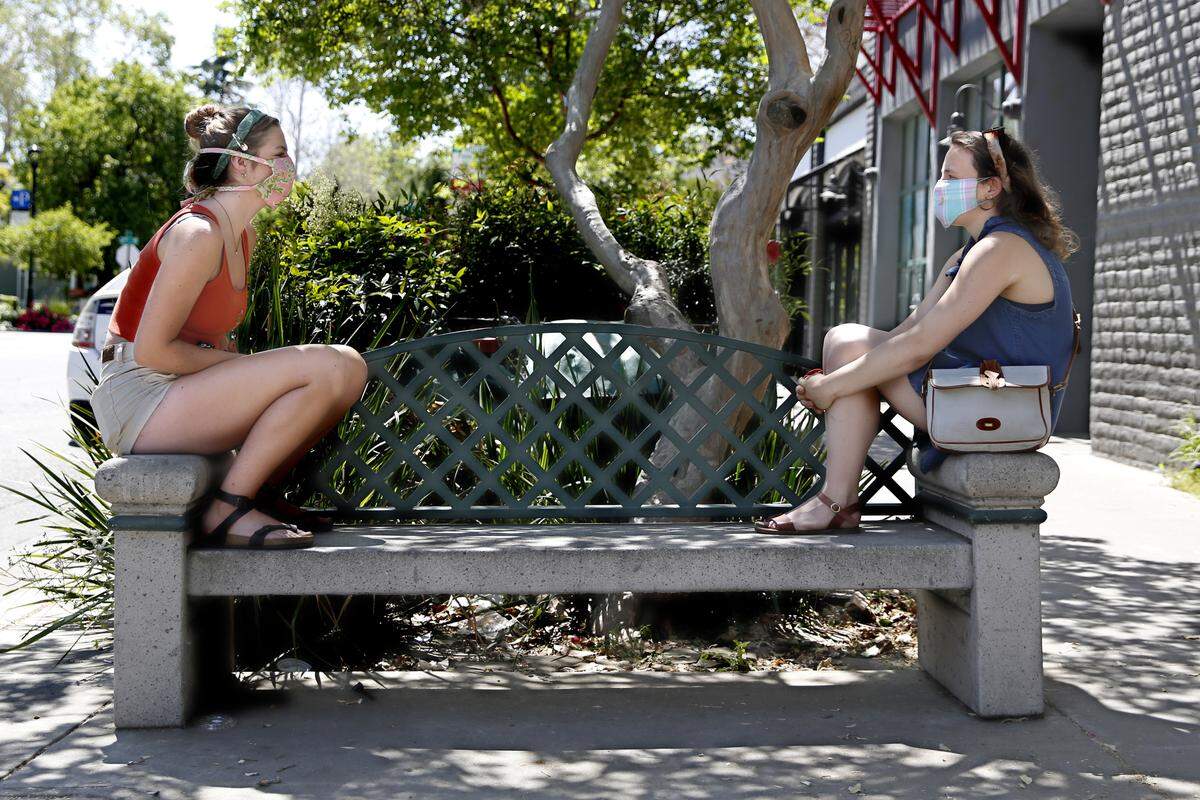
Yolo County last Friday announced that effective immediately, non-medical grade face coverings would be required while in public and while working at an essential businesses. There are a few exceptions; those walking or jogging outdoors for exercise are not required to wear a mask so long as they keep six feet of distance from others. Small children and those with certain medical conditions that may make facial coverings hazardous are also exempt.
The county said the new rule would become enforceable Monday. Over the weekend, officials specified that there are “no plans for the public to be cited for not wearing a mask,” and that enforcement “is only planned for businesses who aren’t complying,” according to tweets by the county.
Businesses are required to turn away customers who are not wearing a mask, according to the new order.
Foster Farms donates more than 100,000 servings of poultry to food bank
The Sacramento Food Bank & Family Services announced in a news release Monday that Foster Farms is delivering more than 106,000 servings of donated poultry to the food bank, part of the company’s donations of 2.4 million total servings across the West Coast, Louisiana and Alabama.
Foster Farms will deliver the food by truck Tuesday morning.
World numbers: Global total passes 3 million, deaths top 200,000
A total of 3 million confirmed COVID-19 infections had been reported as of Monday afternoon, according to the Johns Hopkins data map. Over 985,000 of those came in the United States.
The U.S. has more than 55,000 deaths, of which over 22,200 have been in New York state. Another 6,000 have died in New Jersey, 3,400 in Michigan and just over 3,000 in Massachusetts. Between 1,500 and 2,000 have died in California, Pennsylvania, Illinois, Louisiana and Connecticut. More than 1,000 have died of the coronavirus in Florida.
Worldwide, the U.S. still has by far the highest reported death toll. Italy follows at nearly 27,000 fatalities, then Spain and France at more than 23,000 and the United Kingdom at over 21,000.
After that, Belgium has reported 7,200 deaths from the virus, and 6,000 have been reported in Germany. Iran stands at about 5,800 dead. China’s Hubei province has recorded more than 4,600 deaths, while Brazil and The Netherlands have surpassed 4,500, according to Johns Hopkins.
What is COVID-19? How is the coronavirus spread?
Coronavirus is spread through contact between people within 6 feet of each other, especially through coughing and sneezing that expels respiratory droplets that land in the mouths or noses of people nearby. The CDC says it’s possible to catch the disease COVID-19 by touching something that has the virus on it, and then touching your own face, “but this is not thought to be the main way the virus spreads.”
Symptoms of the virus that causes COVID-19 include fever, cough and shortness of breath, which may occur two days to two weeks after exposure. Most develop only mild symptoms, but some people develop more severe symptoms, including pneumonia, which can be fatal. The disease is especially dangerous to the elderly and others with weaker immune systems.
This story was originally published April 27, 2020 at 8:21 AM.