Coronavirus updates: California faces big budget cuts as cases in state top 75,000
A total of 22 California counties are now being permitted to begin reopening restaurant dining rooms and retail stores, with modifications, as the coronavirus death toll has surpassed 3,000 statewide.
Del Norte and Modoc counties on Friday morning joined the list of mostly rural counties that have had their “local variance attestation” documents approved since Tuesday, meaning Gov. Gavin Newsom’s office has cleared the jurisdictions to move further along in Phase 2 of reopening. Siskiyou County was added Thursday evening.
These counties may allow restaurants to reopen their dining rooms, with a number of significant modifications to everyday operating procedures required, and can open up retail stores as well as shopping malls. They’re not yet allowed to advance to Phase 3 of reopening, which would see the return of personal services like gyms, barbershops and nail salons — businesses the state has said have a higher risk for virus transmission.
All of California has been under Newsom’s stay-at-home order since March 19, with the governor at the end of last week saying curbside retail operations and office spaces that could not implement telecommuting were allowed to reopen.
California surpassed 75,000 cases of coronavirus on Friday, according to Johns Hopkins University, a figure which continues to grow despite efforts from state lawmakers to slow the spread of the virus.
Nearly half of the state’s total number of infected reside in Los Angeles County, one of the greatest population centers in the state that has seen a pervasive outbreak. More than 1,700 people have died of COVID-19 in the county.
California Department of Public Health, meanwhile, reported just under 75,000 cases on Friday. More than 3,000 positive-testing coronavirus patients are being treated in hospitals, while over 1,000 are being treated in intensive care units. At least 3,108 state residents have died as of Friday afternoon, according to the CDPH.
Newsom releases state budget amid recession
The coronavirus pandemic and ensuing shutdown have devastated the U.S. and state economies, turning California’s once-sunny financial outlook gloomy in a matter of weeks.
Newsom on Thursday unveiled an updated, $203.3 billion 2020-21 budget proposal that includes significant cuts to education, pensions and pay cuts for state workers to address a projected $54.3 billion budget deficit brought on by the health crisis.
K-14 education funding dropped from $81.1 billion in last year’s budget to a projected $76 billion. Newsom’s budget proposes eliminating $2.4 billion in supplemental payments to California’s largest public pension plans, CalPERS and CalSTRS. And the plan would also reduce wages by 10 percent for California state workers and cut Medi-Cal services, including some dental and vision benefits.
The California State University and University of California systems would each lose 10 percent of state funding under the revised proposal. Each would also lose several million in summer financial aid.
The governor appealed to President Donald Trump and congressional leaders to allocate more economic assistance for states.
“The president of the United States, with the stroke of a pen, could provide support for Nancy Pelosi’s HEROES Act,” he said, which would provide nearly $1 trillion for state and local governments.
In the meantime, Newsom is proposing to spend more than $16 billion from the state’s so-called rainy day fund over the next three years to offset cuts.
The impact on the U.S. and California economies in the roughly eight weeks since the crisis started to peak has been shocking.
Approximately 4.5 million Californians have filed for unemployment insurance since March 12, and about 36 million nationwide have filed jobless claims in the same span, according to the U.S. Department of Labor. Newsom’s office projects unemployment could peak at nearly 25 percent, roughly double the spike seen during the Great Recession.
Retail sales across the U.S. plummeted 16.4 percent in April, according to a U.S. Census Bureau report released Friday — the worst decline since the beginning of record in 1992.
The pandemic-driven job losses have disproportionately hit low-wage jobs in California, according to Newsom’s Department of Finance, widening the gap between the rich and the poor. The department estimates personal income will drop by nearly 9 percent.
Government building projects may be put on hold in Sacramento
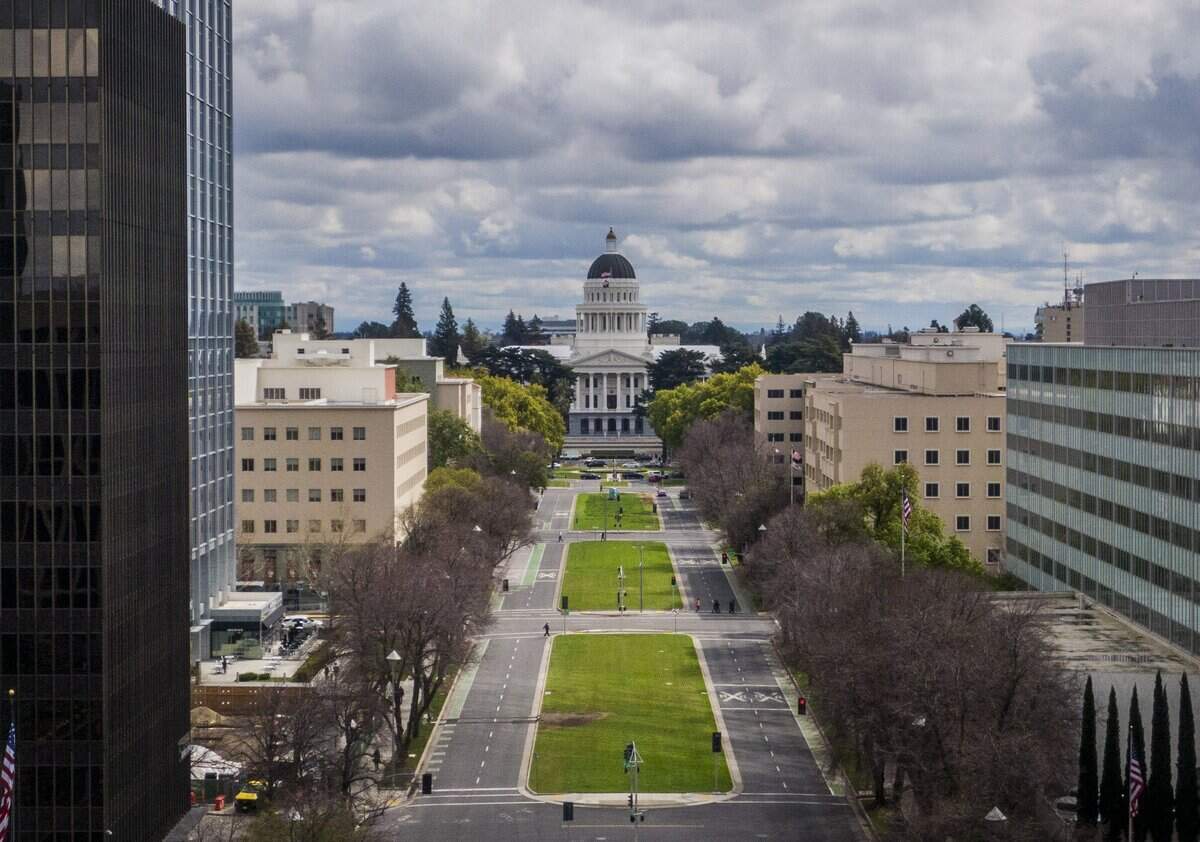
Also on Thursday, Newsom proposed “pausing” about $750 million worth of renovation work planned for three aging state buildings in downtown Sacramento: the Resources Building at Ninth and O streets; the Gregory Bateson building at Ninth and P streets; and the Jesse Unruh building on Capitol Mall.
That proposal would be necessary to address pandemic spending, “absent additional federal (stimulus) funds,” according to the state budget proposal.
“With an increased remote workforce, the administration ... will evaluate the state’s real estate portfolio to determine which agencies and departments may be able to reduce lease space,” Newsom’s budget summary read. “Agencies and departments may be able to reconfigure their workspace to include additional meeting rooms and hoteling space, thereby reducing their lease footprint.”
What’s the status of Sacramento, Yolo counties’ reopening plans?
While neighboring Placer and El Dorado counties have been cleared to enter the dine-in-restaurant and retail portion of Phase 2, Yolo and Sacramento counties have not yet had attestation plans approved by the governor’s office.
The biggest hurdle, according to guidelines Newsom and state health leaders shared late last week, has been the two counties’ death tolls, which continue to rise. While Placer County has, as of Friday, gone one month since reporting a confirmed COVID-19 death, and El Dorado County has yet to report any deaths from the coronavirus, Yolo County reported two new deaths earlier this week. Sacramento County reported one fatality, in the city of Sacramento, on Tuesday; and three more fatalities, all in Citrus Heights, on Thursday.
The state has said that counties should meet a number of criteria in terms of low coronavirus activity and sufficient resources to handle a spike in cases. Those criteria include going 14 days without a reported COVID-19 fatality.
Sacramento County leaders are pushing for an exemption to the death requirement, with health chief Dr. Peter Beilenson saying earlier this week that Sacramento representatives are in talks with state health officials, and will likely submit its attestation documents early next week.
Beilenson said he is arguing that a county of 1.6 million residents with numerous assisted care living facilities and hospitals should not be held to the same zero-death standard as counties with one-tenth the population.
Yolo County, meanwhile, has amended its shelter-in-place order to allow a number of businesses to reopen, such as car washes, pet grooming and landscaping, with guidelines to prevent spread of the virus. Childcare for non-essential workers and outdoor museums can also reopen in Yolo.
Eldorado National Forest reopens recreation sites
Eldorado National Forest will reopen a number of recreational areas and trails that had been shuttered by the coronavirus, the U.S. National Forest Service said in a news release Friday.
Recreation sites, trailheads, parking areas, boat ramps and vista points throughout the forest will reopen Saturday. Restroom facilities will be back open “as soon as personnel can mobilize and safety and cleaning supplies are obtained,” the news release said.
Latest Sacramento-area numbers: 84 dead, over 1,600 infected
At least 84 people have died of COVID-19 in the four-county Sacramento region among more than 1,600 confirmed cases, according to the counties’ public health departments. Another 62 infections and three deaths have come in nearby Yuba and Sutter counties.
Sacramento County public health officials have recorded 1,211 cases of the coronavirus and 54 deaths, last updated Friday morning. Three additional fatalities were reported on Thursday, all in Citrus Heights. The infection total grew by 17 Friday and 11 on Thursday, after increasing by just two cases in the Wednesday’s update.
Yolo County reported three new confirmed cases Thursday afternoon, one in West Sacramento and two in Woodland. On Wednesday, the county reported two new COVID-19 cases. The county has a total of 182 cases and 22 deaths from the respiratory disease. Fifteen of those deaths — including at least one staff member — have come at Stollwood Convalescent Hospital, located within the St. John’s Retirement Village campus in Woodland, according to the county website. The facility has reported 33 residents and 34 employees infected with the virus.
Placer County has reported 174 lab-confirmed cases and eight fatalities from the coronavirus, last updated Friday morning. Two additional cases were disclosed in the day’s update. The last death in Placer was reported one month ago, on April 15.
El Dorado County reported two new confirmed cases Thursday afternoon, a man and a woman from the Diamond Springs/El Dorado area. The county has a total of 62 people infected with the virus, with four new cases reported Wednesday afternoon. No deaths from the virus have been reported in the county. Most of the infections are in the Lake Tahoe and El Dorado Hills areas, at about 20 apiece.
Sutter County reported one new confirmed COVID-19 case Thursday afternoon, reaching a total of 37 cases. The county had one new case reported Tuesday and another reported Wednesday. The county has two deaths due to COVID-19. The most recent death in Sutter was reported April 4.
Yuba County reported no new cases Thursday, but the county had two new cases Wednesday and two new cases Tuesday. The county has a total of 25 cases. One person in Yuba has died due to COVID-19, which the county reported April 9.
World numbers: Infection total reaches 4.5 million, 300,000 dead
The total, global death toll for COVID-19 has exceeded 306,000 as of Friday afternoon, according to a data map maintained by Johns Hopkins University.
The U.S. accounts for nearly 87,000 deaths and over 1.4 million of the world’s 4.5 million confirmed coronavirus cases, according to Johns Hopkins.
Within the U.S., over 27,000 people have died of COVID-19 in New York state, and just over 10,000 have died in New Jersey. Illinois, Pennsylvania, Michigan and Massachusetts range from about 4,000 to 5,500 dead. About 3,200 have died in Connecticut, over 3,100 in California and 2,400 in Louisiana.
Maryland, Florida, Indiana, Georgia, Ohio, Texas, Colorado, Washington state and Virginia have all recorded between approximately 1,000 and 2,000 coronavirus deaths, according to Johns Hopkins.
As of Friday morning, more than 34,000 have died of the disease in the United Kingdom and over 31,000 in Italy. Spain and France report death tolls near 27,500. Over 14,000 have died in Brazil. Belgium, Germany, Iran, the Netherlands and Canada each have confirmed fatality totals between 5,500 and 9,000.
What is COVID-19? How is the coronavirus spread?
Coronavirus is spread through contact between people within 6 feet of each other, especially through coughing and sneezing that expels respiratory droplets that land in the mouths or noses of people nearby. The CDC says it’s possible to catch the disease COVID-19 by touching something that has the virus on it, and then touching your own face, “but this is not thought to be the main way the virus spreads.”
Symptoms of the virus that causes COVID-19 include fever, cough and shortness of breath, which may occur two days to two weeks after exposure. Most develop only mild symptoms, but some people develop more severe symptoms, including pneumonia, which can be fatal. The disease is especially dangerous to the elderly and others with weaker immune systems.
This story was originally published May 15, 2020 at 8:18 AM.