Could high altitudes protect you from COVID-19? Here’s what some researchers say
People who live at high altitudes with low-oxygen levels might be more protected from coronavirus infection and the adverse effects it causes than people living at sea level, a recent study says.
The team of international researchers says the findings can aid the development of coronavirus treatments for people living in coastal and other lowlands at or below sea level, potentially saving them from harsh symptoms from COVID-19 — the disease the coronavirus causes — early on.
The study has its critics, however, who say there are a multitude of other factors such as genetics, pollution levels and varying lifestyles that can influence a person’s chance of contracting, and seriously suffering from, the novel coronavirus.
The study was published in April in the peer-reviewed journal Respiratory Physiology and Neurobiology.
“Although the data of the present study suggest a strongly decreased pathogenicity of SARS-CoV-2 in high-altitudes, there is yet no evidence of an underlying physiological mechanism that could affect the severity of infection,” the study said.
When high up, oxygen molecules are more separated than at sea level because there is less pressure to squeeze them together, meaning there is less of the gas in the air to inhale, an article in The Conversation said.
Turns out, the amount of oxygen dissolved in a person’s blood at 10,000 feet above sea level — about a third of Mount Everest’s height — is 69% of what it is down at the ground, the Centers for Disease Control and Prevention said.
This oxygen deficiency is called hypoxia, and studies show that people who grow up in high altitudes such as in Colorado have large lung volumes and more efficient oxygen flow to tissues, The Conversation article said.
This, researchers noted, could explain why people living in high altitudes are better equipped to recover from the coronavirus, which is known to cause hypoxia due to inflammation in the lungs.
The study examined COVID-19 cases in the Tibetan region of China, Bolivia and Ecuador, regions that have large populations living at high altitudes.
In 67 coronavirus patients in Sichuan, China, 54% showed no symptoms and less than 10% had a fever at any point, the study said.
The researchers noted that 10% developed severe medical conditions, but all recovered after treatment.
“Thus, it appears that both the pathogenesis of the SARS-CoV-2 virus and the general prevalence of infection in Tibet does not correspond to global trends,” the paper said.
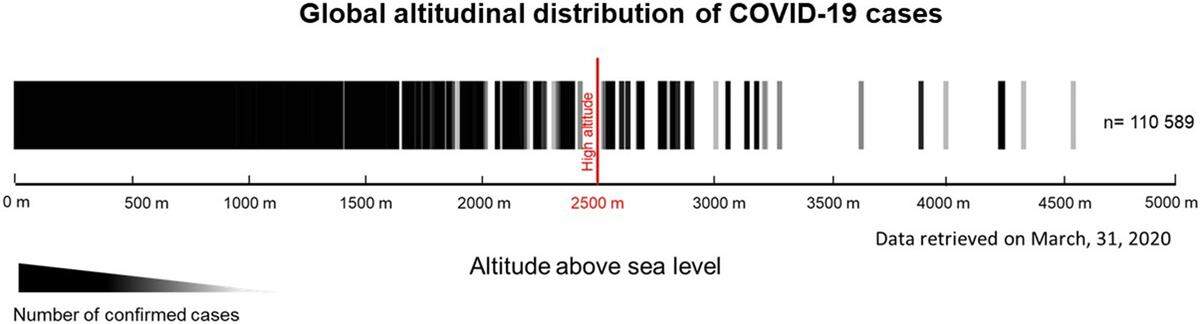
As of early April, coronavirus infection rates in high altitudes in Bolivia were found to be three times lower than those in lowlands, and cases high up in Ecuador were four times lower than those in coastal regions, according to the paper.
However, high altitude environments are also significantly colder and less humid than regions at sea level, the CDC said, which could affect whether someone contracts a virus.
They are also exposed to more ultraviolet radiation, which the researchers say “shorten the half-life of any given virus,” lowering the pathogen’s chance of survival.
Experts say the wide range of high altitude-specific conditions makes it difficult to determine what makes people who live above sea level effective against hypoxia, and in this case, infection from the coronavirus.
As a result, medical professionals warn that the study isn’t a reason to stop following social distancing and other methods to prevent infection and spread of COVID-19.
“Because of all the other factors involved in this infection, we really can’t change anything that we’re doing,” Colorado physician Dr. Christine Ebert-Santos, who was not involved in the study, told Sky-Hi News. “We still have to be just as cautious about the contagious virus (and) the presence of a person who could spread the virus.”
“Even though we could say these are potential mitigating factors of COVID-19 infection, we cannot promise any individual that they have more protection or they would have a less severe course,” she said.
Study co-author Dr. Gustavo Zubieta-Calleja told the outlet that injecting a hormone called erythropoietin into a person’s blood can trigger the production of red blood cells that carry oxygen throughout the body.
It’s a practice often used to treat patients “with anemia related to chronic or end-stage kidney disease,” according to WebMD.
Zubieta-Calleja said this can help coronavirus patients breathe more easily once the disease becomes more severe by providing “a reserve of red blood cells.”
However, further research is needed to make a direct link between living in high altitudes and lowered chances of coronavirus infection.
This story was originally published May 19, 2020 at 11:15 AM with the headline "Could high altitudes protect you from COVID-19? Here’s what some researchers say."