Having trouble hearing people through their masks? This type might help, study finds
For some, face masks make it hard to communicate with others by muffling speech and covering visual cues, especially for those with hearing loss.
But studies have shown they offer an important barrier against COVID-19 when near others who may be infected. So, researchers from the University of Illinois at Urbana-Champaign set out to learn which kinds of masks are best to wear when talking with others.
Using a human-shaped speaker, the team discovered that disposable surgical masks “offer the best acoustic performance,” whereas masks with clear windows over the mouth — popular among people with hearing impairments — block the most sound of all masks tested, according to a Dec. 23 news release.
“Previous research performed on this subject has focused on medical masks worn in health care settings,” study co-author Ryan Corey, an electrical and computer engineering postdoctoral researcher at the University of Illinois at Urbana-Champaign, said in the release. “But no one has looked at the acoustic effects caused by different kinds of fabric masks, so that’s where I focused our study.”
The good news: most masks don’t completely absorb and block sound, the team said, they deflect noise to the sides of the mouth instead.
This means sound amplification devices such as lapel microphones clipped onto your shirt can make masked talking more accessible for everyone, especially in classroom and meeting settings, the researchers said in their study published in October in The Journal of the Acoustical Society of America.
Corey and others used a custom-made speaker shaped like a human head that emits sound like a real mouth would and dressed it with medical masks such as N95s, disposable surgical masks, masks with clear plastic windows around the mouth, and homemade and store-bought cloth masks made of different fabrics and numbers of layers.
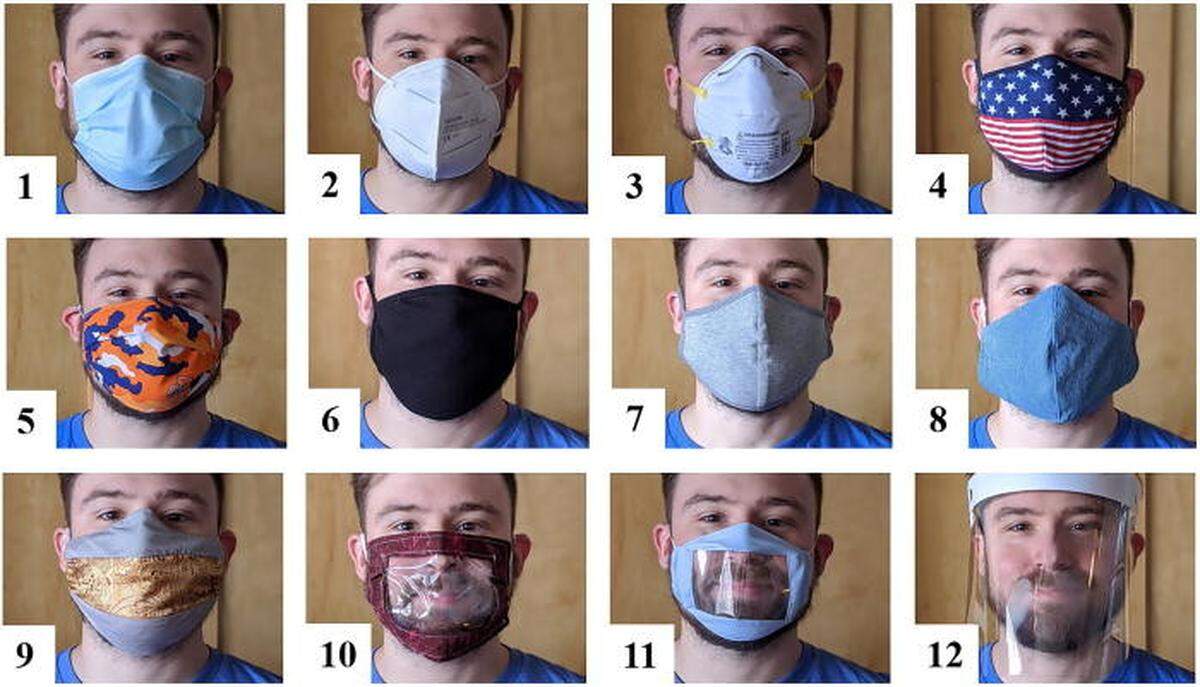
The team played the same sound for every test and placed the human-like speaker on a turntable to replicate sound coming from different directions. They also had a real masked person speak to compare the results.
“Using a real person makes the sounds less repeatable because we can’t say the same thing the same way every time. However, it does let us account for the real shape of the head and real movements of lips,” Corey said. “Even though these two data sets are a bit different, they both show which sound frequencies are most affected by mask-wearing and which masks have the strongest effects.”
Turns out all the tested masks muffle high-frequency sounds when people pronounce consonants — all sounds made by non-vowel letters — which are already a challenge for people with hearing loss, according to the study.
Surgical masks are the most talker friendly, as well as loosely woven 100% cotton masks, but the latter aren’t as effective as the former at blocking respiratory droplets that could potentially carry coronavirus from coughs and sneezes.
Tightly woven cotton and other blended fabrics masks block a significant amount of sound, too, so the researchers suggest homemade or store-bought masks with multiple layers as a “compromise between droplet-blocking efficiency and acoustic performance.”
This story was originally published December 28, 2020 at 2:42 PM with the headline "Having trouble hearing people through their masks? This type might help, study finds."