
National Guard helps rural California hospitals as locals resist ‘death dart’ vaccine
Widespread evacuations from the Fawn Fire and a surge COVID-19 infections have put a significant strain on medical staff and hospitals in far Northern California, as rural areas continue to show significantly lower vaccination rates than urban counties.
The two main hospitals in Shasta County, Mercy Medical Center and Shasta Regional Medical Center, last week received a deployment of 16 National Guard medics and other staff to help treat patients at the overwhelmed facilities that serve as a major medical hub for a wide swath of rural Northern California.
The medics will stay and help for at least another week.
The Fawn Fire, which ignited last week north of Redding and forced thousands to evacuate, added more stress to the healthcare system, since several doctors, nurses and other medical workers had to flee their homes, said Chris McMurry, a spokeswoman for Dignity Health, Mercy’s parent organization.
Though the evacuation orders have since been lifted, the medical system remains very much under strain, she said.
“We’re seeing significant fatigue in our staff,” McMurry said. “Our staff is working multiple 18-hour shifts just to simply cover our volumes right now. And you know, we’ve been at this for 18 months now. … People are tired.”
Shasta County has one of the highest per-capita COVD-19 case rates in the state. At the same time, just under half of the 151,844 people eligible for vaccination in Shasta County are fully vaccinated, according to county health officials.
The vaccination and case rates are similar in the six surrounding counties, all of which send at least some of their patients to the Redding hospitals for medical care.
In those counties, about 48% of residents 12 and older had received at least one dose of COVID-19 vaccine by Sept. 29, compared to almost 80% of the population in that age group statewide, according to state and federal data.
That’s translated into a much higher infection rate than elsewhere in California.
There were about 5,400 new COVID-19 infections in Shasta and surrounding counties from Aug. 30 to Sept. 29, according to preliminary data from the California Department of Public Health. That’s about 15 new cases per 1,000 residents, triple the statewide rate.
There were 63 new COVID-19 deaths in Shasta and surrounding counties from Aug. 30 through Sept. 29. That’s about 18 deaths per 100,000 residents, nearly quadruple the statewide rate.
As of Sept. 29, there were 142 COVID-19 patients in hospitals located in Shasta and surrounding counties. That’s about 40 hospitalized patients for every 100,000 residents, triple the statewide rate.
At the other end of California’s Central Valley, where regional caseloads are similarly surging, two teams of 16 National Guard medics and support staff have been deployed to help hospitals in Bakersfield, said Lt. Col. Jonathan M. Shiroma, a spokesman for the National Guard.
Rural California’s caseload mirrors a trend elsewhere in rural America, where communities are seeing death rates at more than twice the rate of those in cities, according to data from the Rural Policy Research Institute that was first reported this week by Kaiser Health News and NBC News.
Last week, in response to the surge in rural COVID-19 surge, the National Rural Health Association announced it was creating a “Rural Vaccine Confidence Initiative,” to urge rural leaders to promote vaccinations.
“Community leaders, especially health professionals, know better than anyone that vaccine hesitancy among rural Americans means COVID-19 will linger in smaller communities for the foreseeable future – unless more is done to increase vaccination rates,” the association said.
McMurry, the Dignity Health spokeswoman, pleaded with those in rural California to get vaccinated to ease the strain on local healthcare workers.
“They are your friends, your neighbors, your community,” she said. “And the only way out of this pandemic is through vaccination.”
But overcoming the resistance to vaccines in a place like Shasta County is no small task.
Politics and refusal to get COVID-19 vaccine
In this conservative region, vaccine hesitancy is linked with political ideals that have intertwined the push to get vaccinated with firmly held resistance to government control.
Last week, a group of about 50 activists, many of them healthcare workers, gathered in front of the Shasta County Board of Supervisors chambers to protest California’s vaccine mandates for state government employees and healthcare workers.
Someone set out a sign reading, “Just tested positive for sovereignty” beside a picture of Bill Gates with the slogan, “I identify as a doctor.”
One man held a Gadsden “Don’t Tread on Me” flag. Someone set out six pairs of shoes to symbolize each of the healthcare workers who have already quit their jobs in protest of the vaccination mandates at their healthcare institutions.
“I will not violate my body by putting an experimental death dart with undisclosed ingredients in it,” Deborah Burns, an interventional radiology nurse from Redding, told the crowd.
Asked what she wanted her Board of Supervisors to do, she replied “We want them to say to Sacramento, ’Guess what? That doesn’t work here in Shasta County, in the north state.’ ”
Another nurse, Authur Gorman, who had contracted COVID-19 earlier during the pandemic, told the crowd that he’s seen how effective the vaccines are, but he believes that mandating the shots is wrong.
“We’re all here standing for your medical freedom of choice,” he said. “You should have the choice to choose your medical treatment.”
More than 90 percent of Dignity Health’s employees across California are vaccinated or have received an approved medical or religious exemption, McMurry said.
That compares to more than 75% of the employees at Mercy in Redding, she said.
‘We shouldn’t be bowing down to everything’
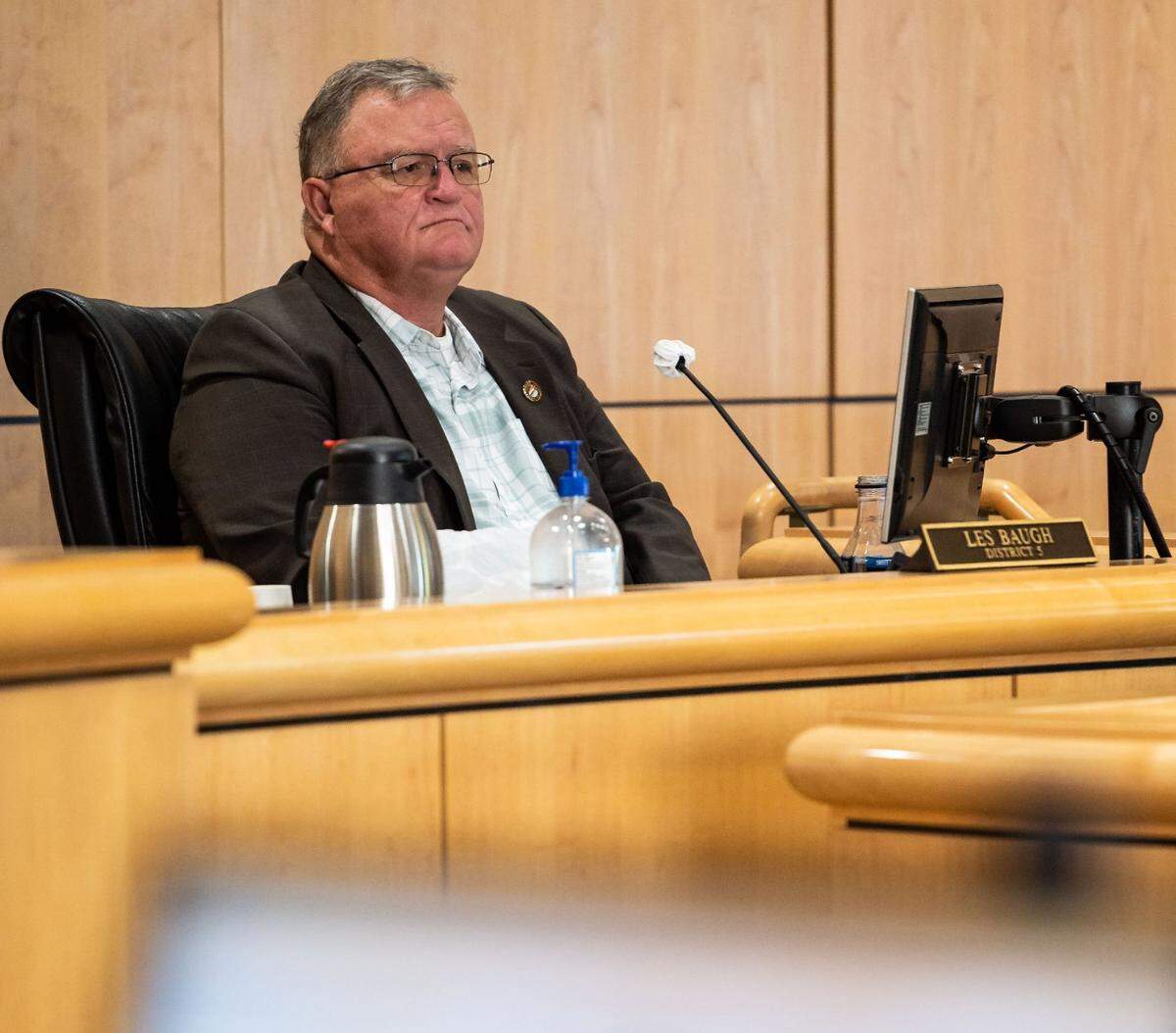
The Board of Supervisors had scheduled a special meeting at that time to hear testimony from local healthcare workers and other activists who are urging the board to rebel against Newsom’s pandemic edicts, but the meeting was canceled in part because supervisors Les Baugh and Mary Rickert tested positive for COVID-19.
Baugh was one of the two board members who had called for the special meeting. The other was local gun store owner Patrick Jones, who won election last year on the platform he’d rebel against Gov. Gavin Newsom’s pandemic orders.
“We shouldn’t be bowing down to everything when we believe that he’s overstepped his authority,” Jones told The Bee last week in an interview in his Redding gun store. “They just simply needed to send letters to the governor saying, ‘We’re not going to do the emergency order. And we are not going to enforce your vaccination mandate.’ ”
Neighboring Tehama, and Siskiyou counties, which also have low vaccination rates, have already passed resolutions opposing Newsom’s vaccine mandates.
Jones said he doesn’t need the vaccine, despite his colleagues catching the virus and the spike in local cases.
“I haven’t got it,” he said. “I’ve been out there for the last two years with large groups of people shaking hands, hugging, doing all the things and haven’t changed my life one bit. ... I haven’t so much as got a cold. So obviously I have enough immunity that I don’t need to be vaccinated, but I may be possibly forced to under the governor’s mandates.”
Supervisor Rickert, who has recovered from her infection, said she was fully vaccinated when she had what’s known as a breakthrough case. She said the numbers don’t lie: If you’re vaccinated like she was, you’re far more likely to recover in a few days like she did.
Rickert said the activists who have swarmed her board chambers for months are so obsessed with their individual rights they’re forgetting that the choices they’re making to not get vaccinated or wear a mask can kill their neighbors and loved ones.
“We have to work together as a community in order to survive this pandemic,” she said. “And right now we’re struggling. Our hospitals are very full. We’ve lost a lot of people in the last few weeks, and a lot of them are not vaccinated. And it’s a real tragedy.”
This story was originally published October 2, 2021 at 5:00 AM.