COVID updates: New health order in Sacramento; California breaks delta hospital record
California’s wave of omicron infections is intensifying by the day as the state continues to routinely break COVID-19 transmission records, disrupting everything from schools to the Grammy Awards.
The California Department of Public Health on Thursday reported statewide test positivity at 21.4%, setting an all-time record for a third straight day.
One week earlier, positivity was 15.8%. Two weeks earlier, it was 5.3%.
The state reported the daily case rate at 107 per 100,000, up from 89 per 100,000 in Wednesday’s report, and almost meeting the all-time high of 112 per 100,000 set in January 2021.
However, CDPH in a footnote said the day’s numbers include underestimated case counts due to a data processing error, and that the day’s report “does not include COVID-19 molecular testing data from Los Angeles County due to delayed submission.”
Hospitalizations with the virus have soared to 8,671, CDPH reported Thursday, shooting past the peak of about 8,350 seen at the height of summer’s delta variant surge and bringing the state to its highest patient total since Feb. 14.
California Health and Human Services Secretary Dr. Mark Ghaly on a Wednesday call with reporters acknowledged that state health officials aren’t currently tracking the distinction between patients who are being treated in hospitals specifically for COVID-19 vs. those treated for other reasons who “incidentally” test positive while hospitalized.
“We are trying to work through exactly how many are there because of COVID,” Ghaly said. “We are working with hospital partners across the state to be able to better understand that information, and it will certainly help us be able to protect and plan better for the future.”
Ghaly said about 51,000 inpatient beds are currently occupied, which would mean about 17% of patients in hospitals for any reason have confirmed COVID-19.
Ghaly during the same call announced that California will extend its mask requirement for indoor public settings by an additional month, now lasting through at least Feb. 15.
Sacramento County bans in-person board meetings amid surge
In a new health order Thursday morning, Sacramento County health officer Dr. Olivia Kasirye required all public board meetings, council meetings and commission meetings to be conducted virtually rather than in-person.
The order applies to city councils and school boards located within Sacramento County, along with the county Board of Supervisors, as well as all commissions within those bodies.
Kasirye in a statement called the order “necessary to protect essential government functions.”
The order doesn’t apply to businesses or other private entities, but it recommends that they “consider conducting meetings remotely.”
The state Legislature operates independently and has not said whether it will pivot to remote sessions.
Rendon, other California lawmakers stay home
Assembly Speaker Anthony Rendon did not attend Thursday’s legislative session at the Capitol after an potential exposure to COVID-19 at a going-away party in Sacramento for Assemblywoman Lorena Gonzalez, D-San Diego.
State Sen. Josh Becker, who attended Tuesday’s party, on Wednesday morning announced he tested positive for COVID-19. Becker, D-Menlo Park, and Rendon, D-Paramount, are both fully vaccinated and boosted.
Rendon tested negative Thursday morning but is staying home. A spokesperson for Rendon noted that while vaccinated and boosted people are not required to isolate under CDPH guidelines, he is doing so “out of an abundance of caution” and is asking other lawmakers who attended the party to do the same.
Those potentially exposed will test again Monday before being admitted to the floor session.
Latest on Sacramento’s omicron surge
Kasirye spoke on Sacramento’s sharp omicron surge during a call with reporters Thursday morning.
“The recent surge is mainly due to an increase in the omicron variant,” she said. “The omicron variant is now the predominant strain, and accounts for 50% to 70% of the specimens we are sending for whole genome sequencing.
“Definitely the holiday gatherings and travel also contributed.”
Sacramento County reached a record-high daily case rate of 83.7 per 100,000 residents as of Wednesday’s update, more than 30% higher than the 63.6 per 100,000 seen at the high point of the winter 2020 surge, according to the health office’s online data tracker.
Kasirye stressed vaccination and booster doses for those who are eligible. She said recent state data show unvaccinated people have a four times higher risk of infection, 10 times higher risk of hospitalization, 17 times higher risk of ending up in an ICU and 18 times higher risk of death from COVID-19 than those who are vaccinated.
Kasirye urged residents not to use hospital emergency rooms for the sole purpose of getting a COVID-19 test, saying those resources should be saved for true emergencies.
“What we’ve seen from other countries, it does seem like people don’t get as sick with the omicron variant,” Kasirye said. “I say that, but also point out that because there’s so, so many more people that are getting infected … there is still a significant risk for people to get severe disease.
“So it is still very important for us all to take this very seriously.”
Will Sacramento County address long wait times for COVID tests?
As transmission rates skyrocket, demand for testing has also exploded.
The county earlier this week distributed 91,000 at-home rapid antigen tests to the Sacramento Public Library and Folsom Public Library systems, which were then given out for free on a first-come, first-serve basis. Residents snatched up all 91,000 in a little more than 24 hours.
Liz Gomez, a county health program manager, said the county depends on shipments from the state for at-home test kits.
“At this time, we haven’t received any additional shipments from the state, and therefore there’s no additional information we have on take-home tests,” Gomez said on Thursday’s call.
Gomez said the community testing sites partner with the state because they use the state’s technology and data reporting systems.
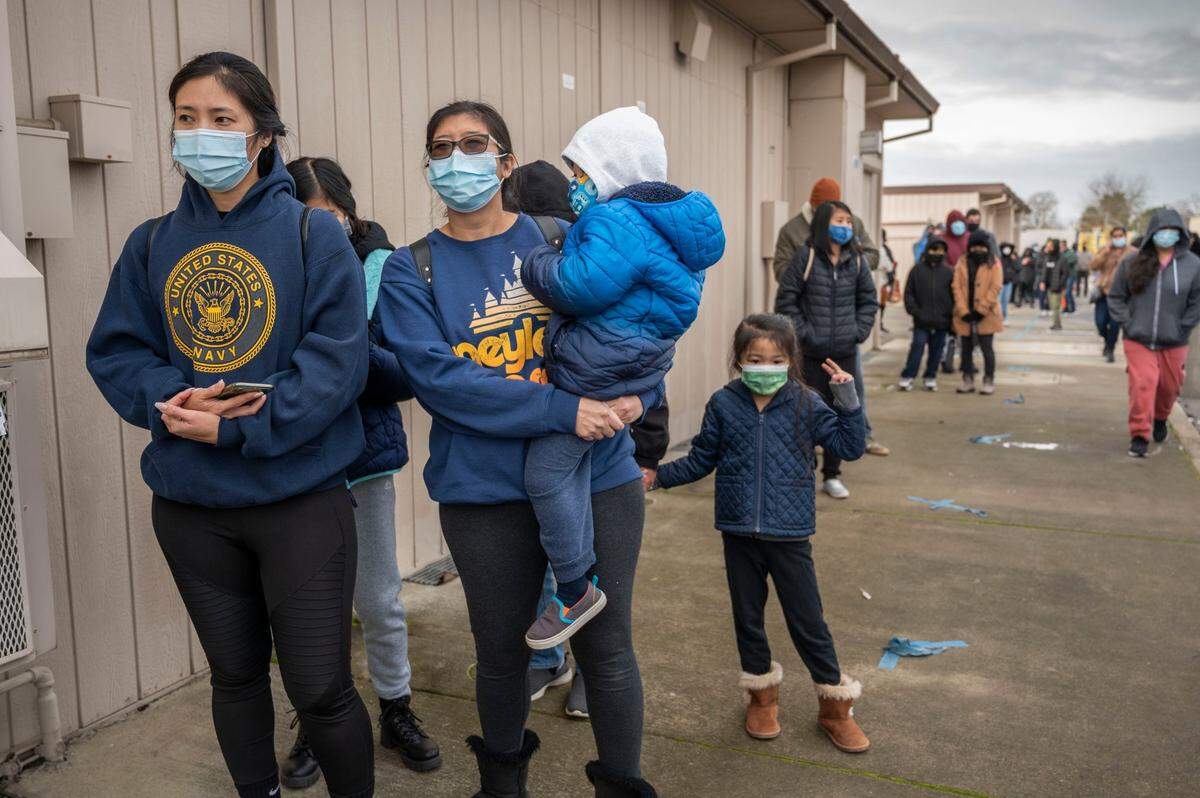
PCR (polymerase chain reaction) and rapid antigen tests conducted at the 13 county-partnered community sites have seen long wait times and, at least once earlier this week, came to a crawl due to an outage involving a state-partnered registration system.
Average wait times at those sites have swelled to anywhere from one to three hours, Gomez said, with three factors are contributing to the bottlenecks: extreme demand for tests amid the surge, short supply relative to that demand and “significant” impacts to test sites’ staffs.
“Our staff and their families are being impacted by COVID-19 as well,” Gomez said. “So when we add staffing, unfortunately, we also have folks that are calling out.”
Gomez acknowledged the frustration of long wait times, and couldn’t predict when they may begin to ease, but said anyone in line at a test site should be able to get a test.
As for wait times after taking a PCR test, Gomez said results should return within 72 hours of the specimen arriving at a state-run laboratory.
In non-surge periods, those results often return faster than that, sometimes the same day. The surge has led to longer waits, “but we’re still seeing it beat the 72-hour turnaround requirement,” Gomez said.
Some Sacramento restaurants close down
Some notable restaurants around Sacramento have closed temporarily in recent days in response to the omicron surge.
Mulvaney’s B&L had too many staff test positive to continue operations and on Tuesday morning closed for the rest of this week. Bacon & Butter and Beast + Bounty also shuttered temporarily, as precautions.
Numerous others have closed their indoor dining rooms, limited seating capacity or switched to takeout-only.
More California universities opt for virtual start
Several more California State University campuses have announced plans to begin classes remotely for the approaching semester, after Sacramento State and Cal State Los Angeles were among the first in the system to do so earlier this week.
Fresno State, San Diego State and CSU Channel Islands have all also announced that they will begin instruction on a virtual basis in 2022.
UC Davis in December announced it would begin the winter quarter with one week of remote instruction, planning to return next Monday. Six other UC campuses on the quarter system — UC Riverside, UC San Diego, UC Irvine, UC Santa Cruz, UCLA and UC Santa Barbara — announced a two-week delay, slating returns for Jan. 18.
UC Merced, which is on a semester system, will hold its first week of classes remotely from Jan. 18 to Jan. 22. UC Berkeley, also on the semester system, currently plans to return with in-person learning Jan. 18.
The CSU and UC systems have also required that students, staff and faculty members receive booster vaccine doses when eligible in order to remain on campus.
K-12 schools report many cases
Hundreds of Sacramento County public school students have tested positive for the coronavirus in recent days, as most districts returned this week from winter break, but local districts do not plan to return to distance learning.
“If advised by local health officials, we would consider temporary closure or move to distance learning for an individual school community,” said Raj Rai, a spokeswoman for San Juan Unified School District. “We do not anticipate a return to distance learning for all schools unless required to do so by local or state health officials.”
San Juan Unified’s infection total continued climbing, from 561 students and 223 staff on Wednesday to 764 students and 259 staff as of Thursday morning. More than 1,400 students have been exposed to the virus, according to district’s COVID-19 dashboard.
Other local districts, such as Elk Grove Unified, are also seeing their highest rates since the school year began in August.
“The priority is to keep schools open,” Kasirye said Thursday. “We do of course monitor very closely school-by-school in terms of if there’s a large outbreak ... but we do not anticipate having to close all the schools.”
Gov. Gavin Newsom on Dec. 22 announced the state would give out enough at-home test kits for all of California’s 6 million public K-12 students. Roughly a million didn’t arrive by the beginning of this week, a CDPH spokesperson said, citing delivery delays due to stormy weather.
.JPG "SAC_HA_01032022_COVIDTest1496 (1).JPG")
When might the omicron surge peak?
In a recent op-ed she penned for The Sacramento Bee, Kasirye noted that her office has now been responding to the coronavirus pandemic for more than 100 weeks.
“We, like you, are exhausted,” she wrote.
The omicron variant has brought plenty of uncertainty and added to that exhaustion.
“The numbers have gone up a lot faster than they have in past surges,” she said on Thursday’s call. “I don’t know when we’ll hit that peak. We’re hoping it will be soon. From what we’ve seen in other places, our hope is that we’ll be able to peak soon and starting and then start declining very quickly, but there are no guarantees.”
Latest Sacramento-area COVID numbers
Sacramento County has recorded 185,013 total lab-confirmed cases and 2,564 deaths from COVID-19 over the course of the pandemic, according to local health officials.
The county on Thursday reported its daily case rate at 87.1 per 100,000 for the week ending New Year’s Day, again extending on an all-time record. Prior to the omicron surge, Sacramento’s highest case rate had been 63.6, set in December 2020.
According to CDPH, Sacramento County’s latest test positivity rate is 19.4%.
County hospitals were treating 307 patients with confirmed COVID-19 as of Wednesday, up from 195 one week earlier. The ICU total increased to 65 from 42.
Placer County has tallied 42,611 cases and 492 virus deaths to date, last updated Wednesday.
Local health officials last reported the daily case rate at 34.1 per 100,000 for the week ending Dec. 27.
Placer’s positivity rate is 18.6%, according to CDPH.
Placer County hospitals had 151 COVID-positive patients Wednesday, up from 96 one week earlier. The ICU total dropped to 22 from 27.
Yolo County has confirmed 22,682 infections and 266 deaths from COVID-19, last updated Wednesday.
The county’s latest reported case rate is 19.3 per 100,000, for the week ending Jan. 2.
CDPH reports Yolo County’s positivity rate at 7.2%, among the state’s lowest.
Yolo County hospitals were treating 12 patients with COVID-19 on Wednesday, up from 11 a week earlier. The ICU total rose from one to three.
El Dorado County has reported 18,573 cumulative cases and 175 deaths from COVID-19, last updated Wednesday.
El Dorado’s latest reported case rate, for the week ending Dec. 29, was 48.7 per 100,000, up from 38.8 just one day earlier.
The county had a positivity rate of 22.9%, CDPH reported Wednesday.
Hospitals in El Dorado County had 15 COVID-positive patients Wednesday, up from 12 one week earlier. ICU patients held at five.
Sutter County has recorded 15,674 cases and 202 deaths, and Yuba County has recorded 12,148 cases with 90 deaths, according to a Wednesday update from the bi-county health office.
The per-capita case rate shown on the bi-county dashboard has not been updated since early December. CDPH reported Sutter County at 33 per 100,000 and Yuba County at 35 per 100,000 as of Thursday.
Positivity was 23.1% in Sutter County and 23.8% in Yuba County, according to CDPH.
The lone hospital serving Yuba and Sutter counties, Adventist Health and Rideout in Marysville, as of Wednesday had 21 patients with confirmed COVID-19, up from 13 one week earlier. Six were in intensive care units each day.
This story was originally published January 6, 2022 at 11:41 AM.