California’s monarch butterflies are in crisis. Inside a state parks plan to revive them
Big changes could be coming to the Pismo Beach monarch butterfly grove as part of California State Parks’ wide-ranging plan for Oceano Dunes State Vehicular Recreation Area and Pismo State Beach.
The roughly 900-page Public Works Plan and subsequent environmental impact report outline State Parks’ ideas for the Pismo State Beach Monarch Butterfly Grove.
Located off Highway 1, the grove is considered the most important overwintering site in California for western monarch butterflies — a species that has seen a dramatic and disheartening population decline in recent years.
Volunteers counted just under 200 butterflies at the Pismo Beach monarch grove for the 2020 Thanksgiving population count, organized by the Xerces Society for Invertebrate Conservation.
According to its Public Works Plan, State Parks wants to “enhance the ecological function of the grove and improve visitor-serving amenities through improved visitor access and enhanced resource protection.”
The agency’s plan must be approved by the California Coastal Commission before it can go forward because the commission authorizes State Parks’ permit to operate the Oceano Dunes.
Stu Weiss, chief scientist at the Creekside Center for Earth Observation, has extensively researched the Pismo Beach grove. He said he “feels pretty good” about State Parks’ plan.
“Those of us working for the monarchs, we feel like we did not compromise the monarch part of it,” Weiss said.
State Parks wants to plant more trees at Pismo Beach butterfly grove
Under its plan, State Parks proposes to plant new, sterile eucalyptus trees at the Pismo Beach butterfly grove to replace any existing trees that have been impacted by fungal disease.
Public comments submitted to State Parks argue that the agency should avoid planting the non-native eucalyptus trees — urging State Parks to plant native species such as Monterey cypress instead.
However, in a site management plan for the Pismo Beach grove released in October 2020, the Xerces Society found that planting both eucalyptus and cypress trees would likely be the best way to help monarch butterflies, since both are established in the park and provide adequate habitat.
“The western monarch population is currently in crisis, and protecting and restoring their overwinter sites is crucial to their recovery,” the 120-page Xerces Society plan states. “Using the existing tree species known to establish well, quickly, and provide the correct microclimate for monarchs is of the greatest value to the species.”
Over the past year, State Parks completed nearly all of the tree plantings proposed by the Xerces Society. Out of a recommended 70 trees, the agency had planted a total of 64 Monterey cypress, eucalyptus and oak trees as of fall 2020.
State Parks proposes to plant more sterile eucalyptus trees to replace deteriorating trees impacted by fungal disease to maintain the ideal microclimate in the grove, according to the plan.
The additional trees are likely crucial to guaranteeing the monarch butterflies return to the Pismo Beach grove to spend their winter there, Weiss said.
In October 2020, a private landowner cut down eucalyptus trees on the east side of Highway 1, across the road from the butterfly grove. Conservationists worry that act had a detrimental impact on the microclimate of the grove — to which the butterflies are sensitive.
“The new trees will provide more wind shelter and can perhaps create a more self-contained grove,” Weiss said. “As was hopefully made really clear in the (Xerces Society) report, the trees across Highway 1 on Union Pacific tracks are absolutely crucial in sheltering the grove. So the degree to which the grove can provide its own wind shelter is important. And we made a good start.”
New entrance, parking lot proposed for monarch watchers
Additionally, State Parks wants to replace the current entrance with a native vegetation buffer to “further protect the grove,” according to the plan.
The Xerces Society’s site management plan suggests that State Parks continue to plant nectar plants that attract the monarch butterflies and other pollinators.
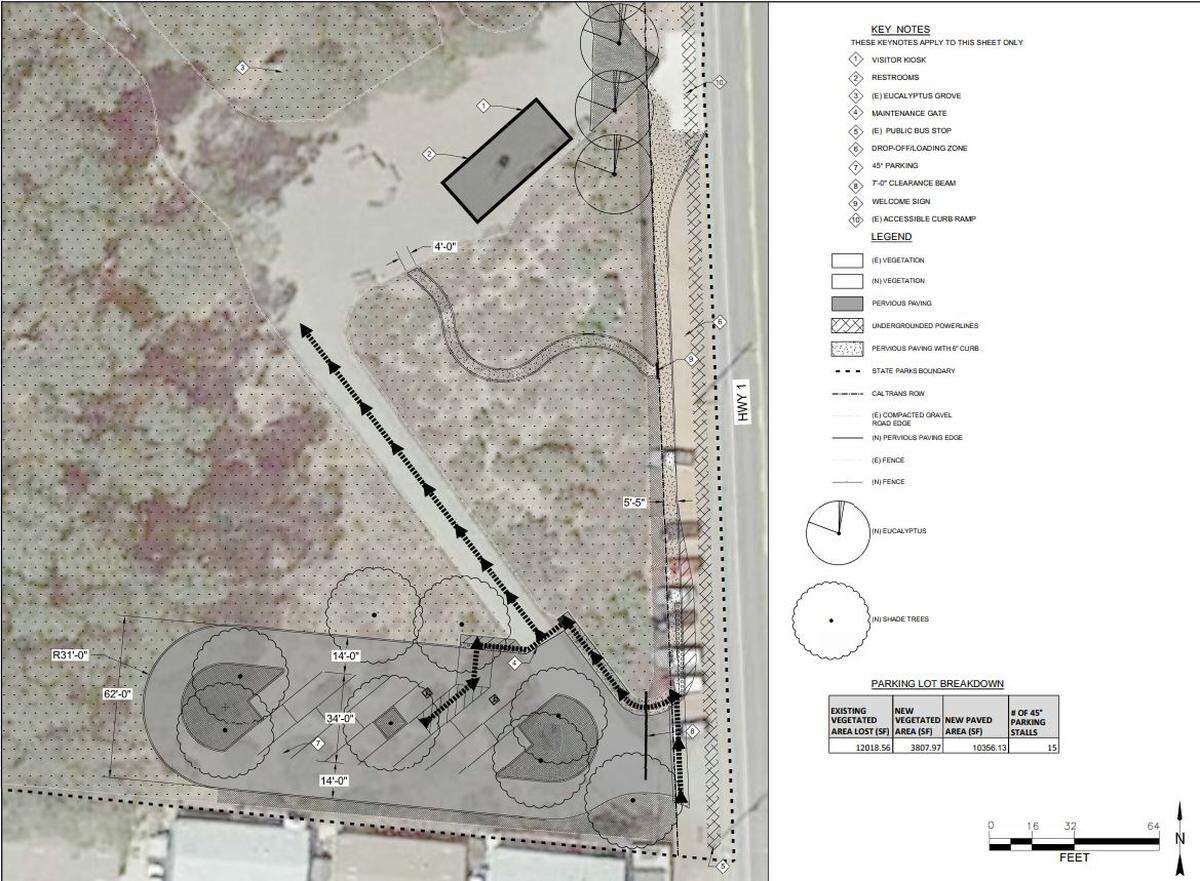
State Parks also wants to build a new entrance for the Pismo Beach butterfly grove, along with new parking, benches and picnic tables, according to the plan. Power lines may be moved underground.
The agency also proposes building a new concession kiosk and restrooms at the grove.
In its plan, the Xerces Society asked State Parks to refrain from to paving over any existing vegetation, as the state agency has proposed.
According to State Parks’ plan, a little more than 12,000 square feet of existing vegetation would be lost, while about 3,800 square feet of new vegetated area would be added. Roughly 10,350 square feet of the grove could be paved for parking, which is nearly 12% of the park.
Weiss said he’s just glad that State Parks plans to put the parking lot as far away as possible from the trees where the monarchs roost.
“State Parks is trying to balance a lot of different things. Right now, the public access to the site is kind of dangerous,” he said. “So, that’s the kind of decision that resource agencies like State Parks have to make — they have to make trade-offs.”
If approved, construction could begin in 2023.
Monarch butterflies see sharp decline in population
The changes proposed for the Pismo Beach monarch butterfly grove come during a trying time for the rapidly declining species.
Volunteers across California counted only 1,914 monarch butterflies during the Xerces Society’s annual Thanksgiving count in 2020, down from 29,436 the previous year, according to the nonprofit organization.
Comments submitted to State Parks before the draft plan was released suggested that the agency consider leaving the park alone to avoid any further disturbance of the butterflies.
In December 2020, monarch butterflies were denied federal protection under the Endangered Species Act.
The butterflies were denied further statewide protection after a judge in the Superior Court of Sacramento County ruled in November 2020 that the state of California does not have the legal authority to protect insects under the California Endangered Species Act. This means that the monarchs cannot be protected by state law.
“If this ruling stands, the California Endangered Species Act will effectively exclude a huge proportion of animal diversity from a law that was enacted to broadly protect the state’s wildlife,” Sarina Jepsen, the Xerces Society’s director of endangered species, wrote in the nonprofit’s blog after the ruling. “Pollinators, among other insects, are essential to life on this planet, and should be conserved in their own right — but also for the services that they provide.”
Central Coast Congressman Salud Carbajal, D-Santa Barbara, along with Rep. Jimmy Panetta, D-Carmel Valley, and Sen. Jeff Merkley, D-Oregon, wrote a letter on Feb. 4 to the principal deputy director of the U.S. Fish and Wildlife Service that asked the Service “expeditiously dedicate” resources to the monarch butterfly conservation and habitat restoration.
“The agency’s decision to forego listing the monarch under the Endangered Species Act is inconsistent with recent administration of the Act under which the agency has avoided almost all candidate listings in recent years,” the letter read. “The decision to delay protections for at least another year could be the final shove that pushes the western monarch butterfly to extinction.”
Weiss said State Parks’ proposed improvements at the Pismo Beach monarch grove are important, but added that there’s much more work to be done on a much larger scale in order to save the species.
“It’s definitely necessary conditions for the recovery of the monarchs — to keep these overwintering sites in good shape — but it’s not sufficient,” he said. “There are so many other problems in the monarch migration cycle, and climate is turning out to be a really big, big factor. So, it’s something we need to do, but it’s not going to solve the problem by itself.”
BEHIND THE STORY
MOREBehind our reporting
Tribune reporter Mackenzie Shuman spent hours reading and analyzing more than 900 pages of California State Parks’ Public Works Plan and related Environmental Impact Report for Oceano Dunes State Vehicular Recreation Area and Pismo State Beach, released in December 2020.
Click the arrow to see what went into her reporting.
Who was interviewed for this story
After reading the plan, Mackenzie then went to experts who could help fill in the blanks about the plan, including State Parks officials, California Coastal Commission leaders, environmentalists and advocates for off-highway vehicle users.
She also spoke with local business owners who fear their livelihoods may be destroyed by State Parks’ plan.
Those folks answered questions such as: What are the long-term effects of this plan? How will this impact the local environment? What about the local economy?
Other background research
Additionally, Mackenzie examined decades-old documents that walked her through the history of the entire Nipomo-Guadalupe dunes complex.
She read about how conservationists and an oil company agreed more than 20 years ago to set aside several hundred acres of land for preservation, and how toxins leaked into the ground on Phillips 66’s Santa Maria Refinery property.
What stood out to Mackenzie the most was the precarious balance State Parks must strike between its duty to protect the unique ecosystem that exists at the Oceano Dunes, while allowing for accessible recreation.
In her article, she breaks it down to the essential facts you need to know.
This story was originally published February 15, 2021 at 5:00 AM with the headline "California’s monarch butterflies are in crisis. Inside a state parks plan to revive them."