
UC academic workers won big raises in their new contracts. How will the university pay?
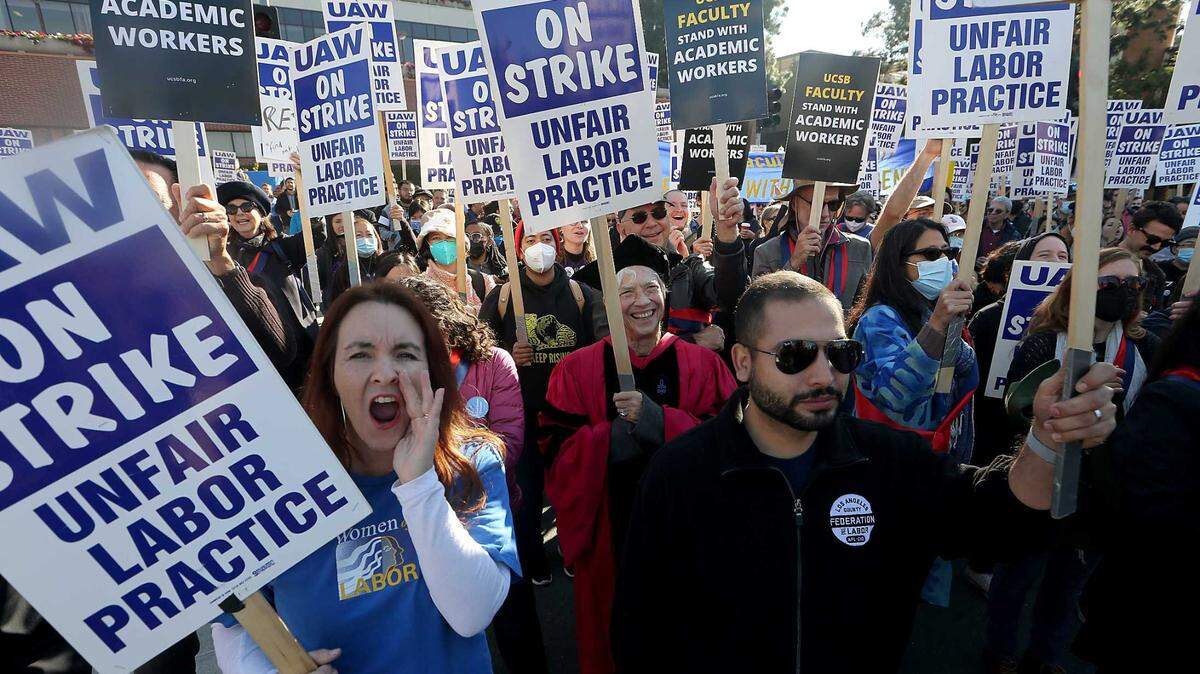
More than a month after academic workers secured a historic labor deal with the University of California, administrators have yet to announce how the system will pay for it. Students and faculty fear enrollment cuts and other cost-saving measures that could harm the quality of education.
The total cost of increased salaries and benefits across the 10-campus system, the UC Office of the President estimates, ranges from $500 million to $570 million. Individual campuses have tallied their own estimates. For instance, the UC Davis office of finance anticipates the increased salaries and benefits will range from $77 million to $95 million over the life of the contracts.
The extra costs reflect pay raises that are among the highest ever in American academia — won by the 48,000 workers after a six-week strike. Teaching assistants, graders, researchers and postdoctoral scholars represented by the United Auto Workers will see salaries jump by 20% to 80% depending on the job. Childcare subsidies and fee remissions are also part of the package.
Funding options are limited, especially given California’s anticipated $22.5 billion budget shortfall. In the absence of additional state dollars, students and faculty worry the UC might resort to cost-saving measures that would harm the quality of education, such as cutting graduate student admissions and limiting the number of TA sections per class.
“There’s this sort of folk knowledge,” said Stacy Fahrenthold, an associate professor in the UC Davis history department, “that faculty will be asked to make do with the same number of graduate students who will now be paid a lot more.”
Campuses signal cuts to graduate enrollment
According to a survey by UAW Local 2865, academic workers from 89 departments across the UC system said they had learned of plans to cut graduate student enrollment next year. The union reported that many respondents said they’d heard undergraduate class sizes could increase, and research groups might shrink.
A slide deck from the UC San Diego physics department describes the “likely reduction” in TA and graduate student researcher positions. Assuming funding stays the same, the department anticipated it could lose about 19 graduate student researcher positions. The reduction could be “even more severe” if faculty prioritized funding postdoctoral and academic researcher positions over graduate researchers. TA numbers would suffer even more, they predicted.
“Without additional campus funding, 72 TA positions would be reduced to 46 TA positions (due to 55% salary increase),” the department’s assessment read.
An email to UCLA students from the school’s chancellor Darnell Hunt announced the formation of a committee tasked with “reassessing” graduate education “in light of the new contract agreements.”
“The committee will address issues such as: balancing the allocation of resources for our outstanding graduate programs and other campus needs...determining the right size of graduate programs and evaluating how these changes might impact our work as a top public research institution,” the message read.
Rumors about cuts in graduate admissions fly in the face of a 2022 compact between UC and the state. The university agreed to enroll an additional 2,500 graduate students and 8,000 undergraduates by 2027 in exchange for an extra 5% increase in General Fund support – over $200 million in the 2022-23 budget.
Fourth-year doctoral student Samantha Abbott, a rank-and-file Local 2865 member who studies physics at UC Davis, says the chatter about admission cuts are just “scare tactics” on UC’s part to try and admonish workers for seeking livable wages and better benefits.
“I’ve tried to reorient the conversation toward, ‘Where else could this money come from?’” Abbott said. “But it’s like moving mountains.”
Instead of cutting graduate positions, Abbott wants faculty to push the university administration to take smaller chunks from federal and private grant funding that departments receive. Guidelines from the president’s office suggest that UC takes between 25% to 33% of a grant to cover “facilities and administrative” costs.
“There are so many places that money could come from,” Abbott said, referring to funding for unions’ newly won raises, “and we don’t have to take from the bottom.”
UC plans to dock strikers’ pay
Adding to the money troubles, the university also erroneously paid many of the striking academic workers for labor they didn’t provide. Earlier this month, workers received “attestation forms” that asked them to document how many hours they struck so the university could retroactively recover the money by docking their March, April and May paychecks.
But some workers say they never received the forms.
“Unless I missed an email, I didn’t receive one,” said Max Greene, a third-year doctoral student in UC Berkeley’s department of vision sciences. Greene says he would’ve attested to his hours if he’d received guidance on how to do so.
Faculty members also received attestation forms, Fahrenthold said, although the Council of UC Faculty Associations advised faculty not to fill them out. The council said that the university was treating strike-related absences differently than other occasions where professors might have to cancel classes, such as when caring for ill relatives.
“UCOP’s willingness to penalize us specifically and uniquely for strike-related absences has a chilling effect on campus labor organizing,” the statement said.
The university said that it must be responsible with taxpayer money. The UC “may not legally pay our employees or gift them funds if they did not provide a service to the institution,” spokesperson Ryan King wrote in an email to The Bee.
UC says it collaborated with UAW leaders to develop fair attestation forms and even incorporated union feedback into the final versions that were sent out. Still, lawyers representing workers filed an unfair labor practices charge against the university, saying that the UC “wrongfully deceived” workers into thinking the union had supported the attestation process.
“The UAW did not consent to the University’s issuance of this form to bargaining unit members,” the charge alleges.
While the unions and administrators wage the legal battle over unearned pay, faculty members must make tough decisions about who to admit for the fall term. Winter and spring quarters are the time of year when departments must finalize graduate student admissions decisions and send out offers, Fahrenthold said. Rumors about cuts have forced faculty and applicants into limbo, she said, and the UC risks losing talented young scholars if it can’t figure out its budgetary issues.
“We have prospective students who are waiting on us,” Fahrenthold said. “Those students won’t wait forever.”
This story was originally published February 1, 2023 at 4:00 AM.