Nonprofit scrambles to help Sacramento farmworkers after abrupt loss of food aid
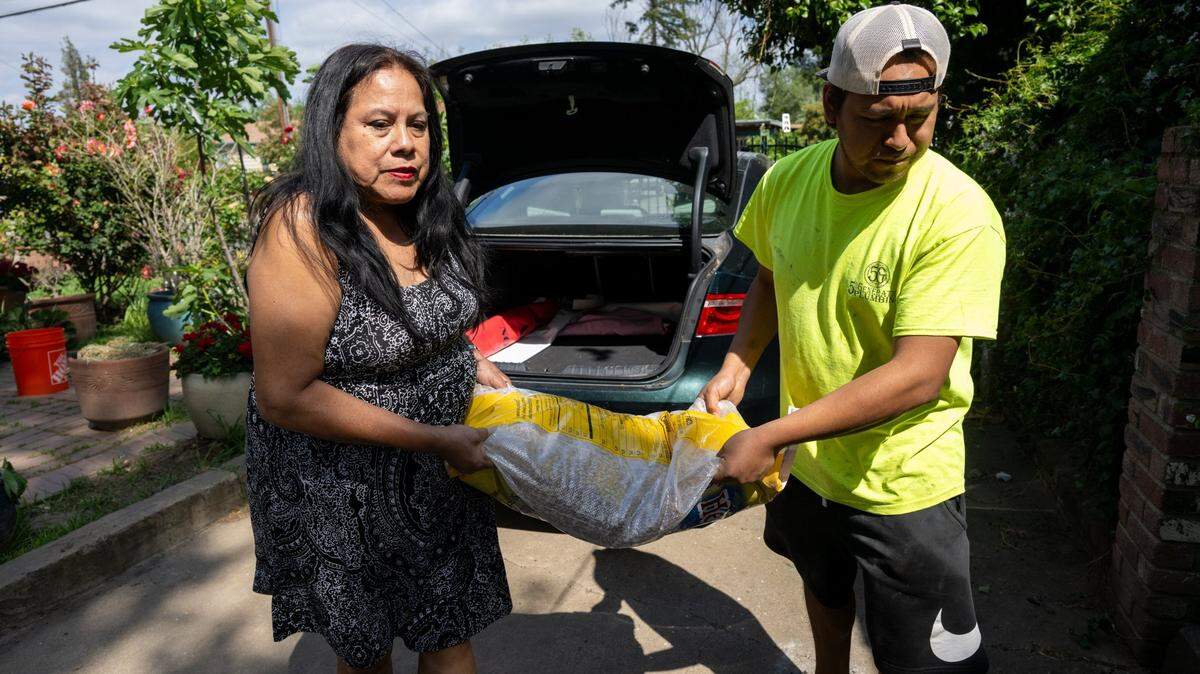
On a Thursday afternoon in late March, Ramona Landeros was preparing for the usual stream of tired farmworkers who would arrive at her Del Paso Heights driveway to collect groceries — rice, beans, fruit, vegetables.
Then, the phone rang.
The food closet she relied on told her that day’s distribution would be her last.
“What I find so unjust and ironic,” Landeros said, “is that these are the people who work to put food on our tables, but they have none for theirs.”
The abrupt end of the informal food pickup effort has left dozens of low-income farmworker families in North Sacramento without a weekly lifeline, highlighting what Landeros sees as a failure by the Sacramento Food Bank & Family Services to accommodate the working poor — especially those without cars, fluent English or flexible schedules.
The food bank’s president and CEO, Blake Young, said his organization is continuously searching for new partners to ensure equitable food access throughout Sacramento County. To be clear, he said, the Sacramento Food Bank never directly supplied food to Landeros or her Benito Juárez Foundation, but one of its partner agencies had.
In the process, he said, some rules governing how the food bank and its partners can distribute food were violated. Health and food safety requirements state that “our network partners are unable to redistribute food to other organizations or distribute food from a residential location.”
Landeros said she was not “redistributing food.” Rather, she had submitted applications to pick up boxes for families who couldn’t do so themselves. Those applications, she said, had been approved.
She’s determined, she said, to blast through the systemic access barriers often overlooked when aid programs are designed.
Once a farmworker herself, Landeros said, she has experienced those obstacles.
“My family would work sometimes to sundown because we had to take advantage of the light of day, and in the morning, we would use headlights to be able to see what we were doing because we had to beat the heat of the day. It’s not traditional 9-5 work,” she said.
Elderly residents, the disabled and other people who face barriers to pick up have long designated proxies to pick up food boxes on their behalf from food closets, Landeros said.
While that’s true, Young said, there are limits. “Individuals can serve as proxies and pick up food for up to five others.”
Rules changed midstream, nonprofit leader says
Landeros said the grassroots organization she founded, the Benito Juárez Foundation, received approval to collect food for 50 to 75 families — far more than the five-person limit the food bank now says is allowed. That rule, Landeros said, was never communicated to her.
“The food bank cut us off in a very cruel way and without giving us any notice to give us any time to try to come up with a plan,” she said “We’re having to take action and do this ourselves and try to see what we can come up with.”
Young said the food bank and its partner agency attempted to work with the foundation to find a compliant solution, but that Landeros’ group withdrew from talks. Landeros, however, said she was blindsided.
Young encouraged the Benito Juárez Foundation to apply to become a partner. It’s something that Landeros tried before applying to be a proxy, but the food bank told her that the organization didn’t meet eligibility requirements.
Landeros said she does plan to try again, and she’s formally asked a neighborhood church to allow her to use its building facilities to do food distribution, something she will need to become a partner agency with the food bank.
To build trust with farmworkers in her neighborhood, Landeros said, she visited them in the apartment buildings and complexes where they lived, asking them to tell her what services they needed and how they wanted them delivered.
The farmworkers emphasized that they required late evening access for food pick-up, and they expressed concerns about sharing their ID’s, facing language barriers and poor access to transportation.
The food bank has dozens of partner agencies, and many of them have evening or weekend hours, including three within two miles of the Del Paso Heights neighborhood.
Here are those three sites, along with their evening or weekend hours:: Manna Food Bank, 4840 Marysville Blvd., 4-7 p.m. Thursdays. Youth Xplosion, 3271 Marysville Blvd., 5-7 p.m. the fourth Fridays of the month; and Redeemed Christian Church of God-Redemption Parish, 548 Display Way, 1-2 pm the third Sundays of each month.
Landeros said a distance of five to 10 miles would be hard to cover for many farmworkers because they don’t own vehicles, carpooling with neighbors or riding in labor contractors’ vans to get to the fields.
Despite the setback with the food bank, the Benito Juárez Foundation is offering food distributions twice a month on Thursdays. She made an appeal for donations at the Benito Juárez Foundation’s website, and she’s planning to do some added fundraising at the organization’s June 28 gala. To learn more, email Landeros at ramonalanderos@yahoo.com or call her at 916-529-5299.
It’s important to continue, Landeros said, to ensure she doesn’t lose the trust that she’s built with the families she has been assisting.
“I tell people that we (farmworkers) were the first commuters in this country,” she said. “I went to 15 different schools before I finished high school. I know what it’s like to be hungry.”
This story was originally published April 20, 2025 at 5:00 AM.
CORRECTION: This story was updated to correct how far farmworkers living in Del Paso Heights must travel to find a food closet that is open after their work hours.