
‘Young, Gifted and Black’: UC Davis exhibit celebrating new vanguard of Black artists in final week
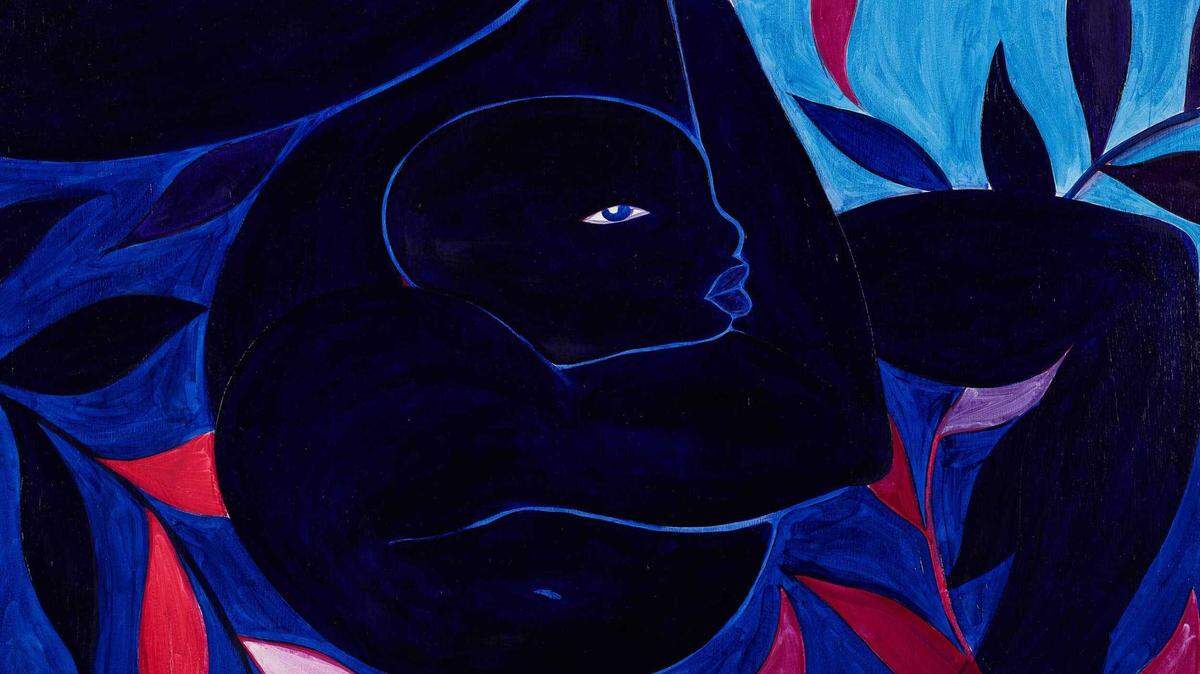
“Young, Gifted and Black,” the dynamic exhibit showcasing the works of new and emerging Black artists, is in the final days of its run at UC Davis’ Jan Shrem and Maria Manetti Shrem Museum of Art. The show, which made its pandemic-delayed West Coast debut at the Davis campus, ends its residency Monday.
Originally scheduled for July 2020, the collection loses none of its immediacy two years later, its urgency amplified as museums and universities across the country continue to confront the dearth of Black representation in its artistic spaces.
“At a time when America is wrestling anew with race and racism, and debates about equality and inclusion in the art world have taken on a greater urgency, this exhibition assesses how artists today are shaping the way we think about identity, art and history,” said New York collector and advocate Bernard Lumpkin, who with husband, Carmine Boccuzzi, brought the show to the UC Davis campus.
Lumpkin and Boccuzzi have long championed Black artists in bringing their works to the broader public. The more than 50 works on view make up the first public exhibition culled from Lumpkin and Boccuzzi’s family collection.

“There’s a real educational focus. It will travel 2-3 more years to university galleries. That is very intentional. We want it to be this educational tool,” Susie Kantor, associate curator at the Manetti Shrem, said. “Bringing these important works to UC Davis, you give access to art that audiences wouldn’t otherwise have.”
The exhibition — its title comes from the the playwright and activist Lorraine Hansberry’s famous phrase — urgently and uniquely speak to issues of race and gender identity, history, and, ultimately, of access. Tavares Strachan’s neon sculpture that greets visitors to the collection makes the exhibition’s motivation plain.
Its glowing script reads simply, “I belong here.”
“It is an extraordinary introduction to these artists that you may or may not know,” Kantor said later. “There’s so many different media, so many reasons (to see the show). I tell people, come see the show, then see it again, because there’s so much to absorb.”
‘A conversation between works’
The sprawling survey is divided into four sections: Color, Black, Material and Portraiture, all programmed, curator assistant Ginny Duncan said, as “a conversation between works;” the artists, she said, “looking at color as context and thinking about it in different ways.”
The vibrant yellows of Vaughn Spann’s large-format “Radiant Sunshine, the Morning After (For Lula)“ (2017) with its sunburst of flora serve as a centerpiece of the exhibit. The deep indigos of Tunji Adeniyi-Jones’ “Blue Dancer,” (2017), chosen to adorn the exhibit’s program cover, stand in mysterious counterpoint.
The stark monochrome of Bethany Collins’ “Too White To Be Black,” (2014), is vast in its blackness — a “reclamation of the color black,” say the exhibit’s programmers.
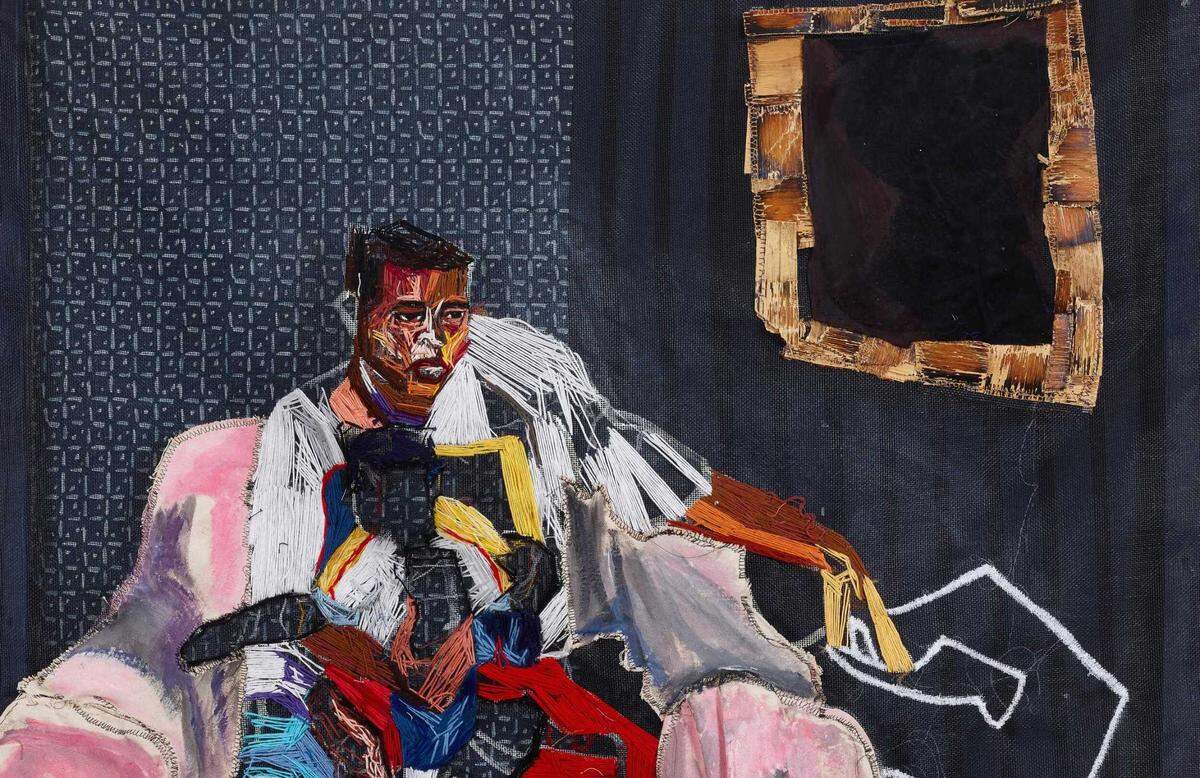
The collective works stun in their multiplicity of voice and approach — bold colors to portraiture to works utilizing found materials. Staples, coffee and orange peel, a hooded sweatshirt, even improbably, the covers of football tackling pads — all find purchase, and purpose, in service to the artists’ vision.
Staples by the thousands illuminate the shimmering silhouette of the men in Wilmer Wilson IV’s “Pres,” (2017). The work was inspired by the wooden telephone poles in Wilson’s neighborhood and the staples left behind that once held posters, fliers and community announcements.
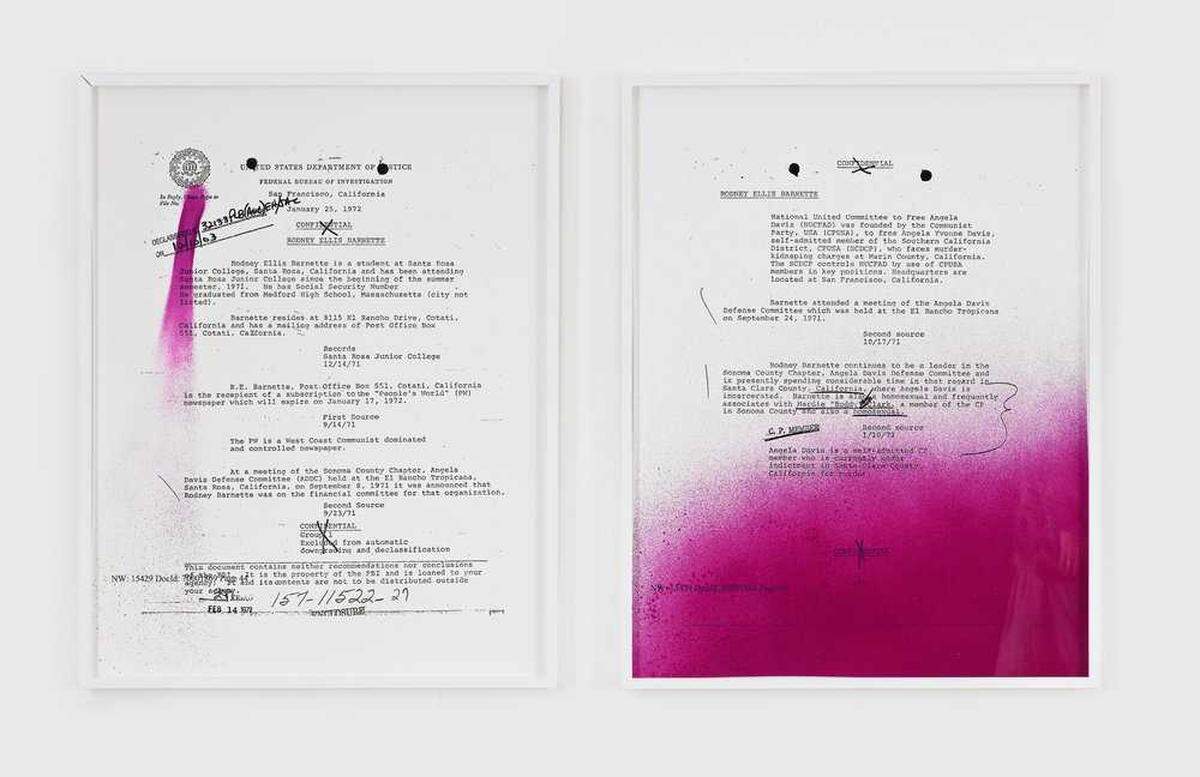
Oakland artist Sadie Barnette filed federal Freedom of Information Act requests to retrieve FBI files on her activist father. Her resultant portrait of the secret dossier’s pages, “Untitled (People’s World)“ (2018), speaks powerfully to state surveillance and the very real costs paid by Black activists and their families in the fight for equality, while plumbing her own family history.
Chiffon Thomas evokes Polaroid memories of a young father, his newborn child slumbering on his chest, in “A New Dad,” (2017), the image carrying the poignancy of a family album’s snapshot.
Chase Hall’s portrait “Eric Dolphy” (2020), pays tribute to the visionary jazz musician who died far too young at 36 in 1964, while the coffee and acrylic painted on its cotton canvas bitterly evoke the produce of the transatlantic slave trade.
Christina Quarles, whose Daliesque, defiantly titled “Now Top That,” (2017) is a featured work, is among the exhibit’s artists who has seen her star rise. Quarles visited UC Davis in November as part of the exhibit’s run.
“She got to say, ‘Here’s my practice and over there, you can see my work,’” curator assistant Duncan said, smiling at the memory. “It’s those moments that allow a show like this to bring exciting people to Davis. That’s what makes it such a thrilling show.”
Manetti Shrem museum looking forward
Manetti Shrem pays deep respect to its legacy artists — foundational figures like late contemporary art icon Wayne Thiebaud — but Kantor said “we also want to look forward. ‘Young, Gifted and Black’ is focused on these younger generational artists. We want to tell a broader history — the story we think we know — but let’s tell a different side of it.”
The exhibit’s mix of established and next-generation artists also shows how an earlier generation of artists including Henry Taylor and Mickalene Thomas “forge a path for those who are up-and-coming now” and serves as an overdue ovation for their own vital work.
For visitors, the emotional heft of seeing so many Black artists, in the vanguard and on display, is hard to overestimate. Visitors are asked to leave behind comments reacting to the collected works.
“This exhibit found a place deep in my soul and rested,” one visitor wrote. “It’s refreshing to know that our experiences are captured, embodied and propelled into the creative exhibit here right now. I only hope that it will open the eyes of those who are not living our physical existence to understand our purpose, our strength, our tenacity and our creative genius.”
This story was originally published December 13, 2022 at 8:25 AM.
.JPG)