
Exclusive: Sacramento jail deputies abused inmates and kept jobs, internal documents reveal
Patrick Hoyt ended up in the Sacramento County Main Jail on Dec. 1, 2015, after being picked up on a misdemeanor domestic violence warrant.
Within hours, he said, he was escorted by two deputies into an area of the jail without camera coverage, where one of them twisted his arm and shoved his face into a brick wall so hard he ended up with a swollen black eye.
Hoyt said he later complained of excessive force and, after his release, was interviewed by internal affairs investigators who asked, “What would make this right again?”
“And I said, ‘I don’t know, $1,000?’ ”
A week later, Hoyt said, a man in a suit showed up at his door.
“He said, ‘You still want that? I can give you that today.’ ” Hoyt took the $1,000 check, and said in a telephone interview that he agreed not to talk about what happened inside the jail, then left town for Portland.
The payoff came from the county’s third-party claims adjuster, along with Hoyt’s signature releasing the county from all future claims, the sheriff’s office said.
Hoyt’s case went away without the public knowing anything about it — until now.
Hoyt’s file is one of 79 internal affairs and jail-abuse case file that Sheriff Scott Jones’ office released this year to Sacramento civil rights attorney Mark Merin in an unrelated case. The county turned over the files under a court order requiring Merin to keep them confidential and return or destroy them once his case concluded.
Instead, Merin later objected to giving up the documents, and The Bee subsequently intervened in the case in federal court, arguing that the confidential order violated the First Amendment. In October, U.S. Magistrate Judge Edmund F. Brennan lifted the order and released hundreds of pages to The Bee.
The result is the largest-ever release of internal affairs and jail abuse complaints involving deputies working inside Sacramento’s Main Jail downtown and the Rio Cosumnes Correctional Center in Elk Grove. They include allegations of beatings, misuse of pepper spray, an illegal body cavity search, efforts to avoid being caught on video surveillance and recommendations of deputy discipline and firings.
“The files are a treasure trove of complaints, incident reports ... and citizens complaints,” Merin said. “It’s a record of jail abuse at the Sacramento County jail from the moment people reach the door until the time they’re let out.”
Merin said the documents show “abuse is rampant and people who commit it are undisciplined, so there’s no discouragement to excessive force and the result is that people are injured and many people sue.”
The sheriff’s office says no deputies accused in the documents of abusing inmates were fired. Two deputies in the Hoyt case were recommended for termination, but that was later rejected by the sheriff in favor of suspensions. Other penalties range from a letter of discipline — the lowest form of punishment but one that can affect a deputy’s ability to seek promotion or other assignments — to suspensions without pay.
Sheriff Jones disputes the notion that abuse is rampant in the jails, saying that with 40,000 inmate bookings annually, some suspects are going to act out and that the use of force is sometimes necessary.
“You have to understand the jail is not like the community, or it’s not like a normal community that you and I might think of or most normal, going-to-work, tax-paying folks might think of,” Jones said in an interview with The Bee. “You look at the population, for example, they all have one thing in common: that is, they don’t want to be there.”
‘Appropriate amount of force’
Under department policy, all uses of force by deputies, injuries or complaints of pain from inmates have to be documented, and sheriff’s officials with the professional standards bureau — also known as internal affairs — review each instance through jail video recordings and interviews with deputies and inmates.
“Obviously, we have to meet force with force many times,” Jones said. “We don’t have the luxury of underestimating the amount of force it’s going to take to immediately quell a situation.”
Jones said his deputies make sure to use “an appropriate amount of force to make sure that not only the situation gets resolved but they’re not creating a greater danger for other inmates and maybe out for other staff, including civilian staff that are down there that don’t get paid enough to fight with inmates like we do.”
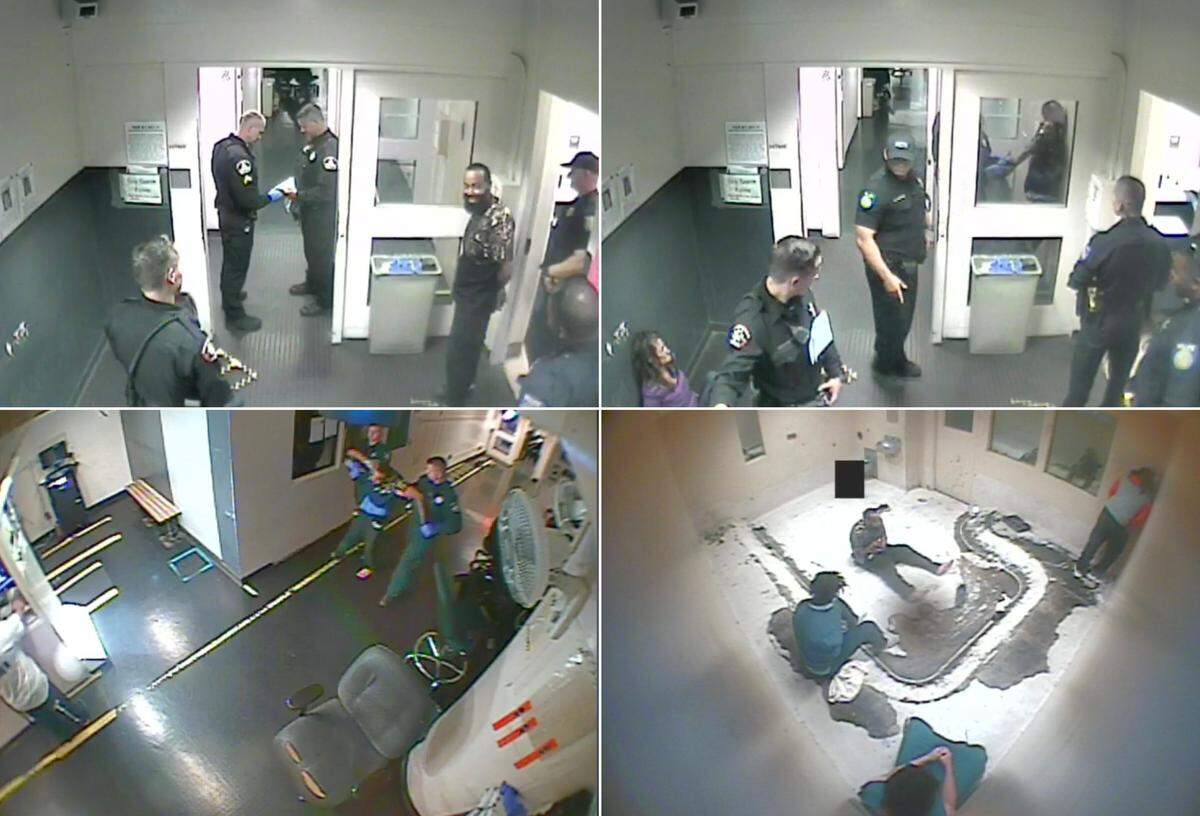
The files involve abuse allegations from 2012 through 2018 and are separate from the 33 files and 10 video incidents the sheriff’s office has released so far as the result of a separate lawsuit brought by The Bee earlier this year. That lawsuit sought to force compliance with Senate Bill 1421, a new state law requiring greater transparency by law enforcement agencies, and is pending in Sacramento Superior Court.
Until now, however, such jail abuse allegations have remained largely secret unless they were released through individual lawsuits, and the files released to The Bee show allegations that range from what appear to be frivolous complaints to serious errors in judgment by deputies.
The Hoyt case is one of the most serious, with the internal affairs investigation saying other inmates “could hear his screams” after deputies took him to an area not covered by video cameras, then later lied to investigators.
“He wasn’t yellin’, he was screaming, you know what I’m saying, like he was in pain ...,” inmate Perry Locke told investigators. “They were puttin’ hurt on him.”
Both deputies, whose names were redacted in the documents, were recommended for termination, the files show, but the case eventually ended up on Jones’ desk and the sheriff says he decided against firing them.
“I’m asking myself, ‘Can these employees be salvaged?’ ” he said. “There’s an accountability to the public, of course, but can these employees be salvaged? If they were given a chance do I believe that they would conduct themselves in a manner that we expect?
“... I hope I’m right, but I guess time will tell, so these folks were not terminated, but they did both receive a lengthy, lengthy suspension.”
In fact, a separate abuse allegation file refers to the Hoyt case and says the deputies received suspensions of 240 hours and five-year assignments to work in the jails rather than be moved out to patrol.
That file also reveals that one of the deputies was accused six months after the Hoyt incident of again using excessive force, this time against an inmate named Roshawn Jackson.
In that case, the deputy was accused of using a “leg sweep” to suddenly knock Jackson, who was handcuffed, to the floor.
BEHIND THE STORY
MOREWhy we did this story
The Bee is committed to covering law enforcement and its elected officials in a thorough and fair-minded manner. The public has a right to know how its police and sheriff departments operate in public and behind the scenes. The public’s trust in its major institutions is at stake, along with tens of millions of taxpayer dollars.
This year, our reporters have been looking deeply into the operations of the police and sheriffs departments around the state, with reporting projects on deaths in county jails, law enforcement officers with criminal records, and police shootings. We have been aided by new state law, Senate Bill 1421, which was designed to increase transparency by law enforcement agencies whose officers are involved in shootings or other incidents.
Read more by clicking the arrow in the upper right
Transparency lawsuit
In January 2018, The Bee and the Los Angeles Times jointly sued Sacramento County Sheriff Scott Jones in Superior Court seeking the release of internal investigation records under SB 1421.
The requests asked for five years worth of records involving investigations or sustained findings of deputies involved in sexual assault or dishonesty; records involving the use of firearms; and incidents involving use of force resulting in death or great bodily injury.
Sheriff Jones quickly rejected both requests, saying it had such records but would not release them until it had “clear legal authority to release such records.”
The newspapers won the case, and in October, a Sacramento County judge ordered Jones’ office to pay more than $100,000 in legal fees to The Sacramento Bee and the Los Angeles Times. Sacramento Superior Court Judge Steven M. Gevercer said the legal costs mounted as sheriff’s officials slow-walked the records’ release.
Support local journalism
Your support of journalism is critical to investigations such as this. To support local journalists and The Sacramento Bee, please consider a digital subscription. Subscribe here.
“Based on the video, it was clear that Deputy (name redacted) deliberately conducted a front leg sweep takedown of Jackson, who was handcuffed with his arms behind his back essentially rendering him defenseless,” the sheriff’s report says. “This was an unnecessary use of force as there was no evidence presented or observed that indicated Jackson was an immediate threat or actively resisting other than the failure to follow the immediate directive to go to his knees.”
The review, which redacts the name of the chief deputy who conducted it, said the case caused “great concern that Deputy (name redacted) was unable, or unwilling, to immediately take responsibility for his actions after being shown the videotaped segment of the incident by internal affairs investigators.
“He had ample time to review documents relative to his investigation, view the video and he still failed to admit he conducted a leg sweep and defaulted to ‘I don’t recall’ response when asked specific questions related to this investigation.”
The report sustained findings that the deputy violated use-of-force policies and recommended an 80-hour suspension without pay.
“One of the deputies involved in the Hoyt case received a substantial discipline in another case about 6 months later,” sheriff’s Sgt. Tess Deterding confirmed in an email. “That case was related to a Use of Force.”
No deputies lost their jobs
Jones said he has been aggressive in weeding out problem deputies, and that he has fired more than 40 deputies since winning his first election in 2010.
But the discipline recommended in the Hoyt case - firing the deputies, which Jones rejected - is an outlier, the files show.
The Hoyt case is the only one in the files showing a recommendation that the deputies be fired, with Capt. James Ortega, the jail commander, writing in a July 26, 2016, review that the deputies’ claims about what happened with Hoyt were not credible.
“In all my years as a law enforcement officer, supervisor and manager, I have never read or heard of a description of trying to control a hostile subject like the one put forward by Deputy (name redacted),” Ortega wrote. “Even in the course of a dynamic, fluid confrontation with a hostile subject, most deputies are able to articulate the actions of their partner deputy during the conflict where two deputies are involved.”
“He used force when it was not necessary,” Ortega added. “He failed to document his use of force. When asked about his actions regarding Patrick Hoyt, Deputy (name redacted) lied.”
The review found the deputy’s actions “intentional and negligent,” and concluded that “he intentionally moved Patrick Hoyt into a room where there is no camera coverage.” “Moving Hoyt into an area not covered by the camera system brings into question (the deputies’) intent,” Ortega wrote.
From 2014 through 2018, the sheriff’s office said there have been 414 abuse complaints or investigations involving inmates, and that 35 complaints were “sustained.” Of those, 15 were generated by deputies or supervisors reporting their concerns about an incident.
The files show that deputies found to have used unnecessary force or to have violated policies were almost always recommended for letters of reprimand, demotion or suspension.
A June 2015 incident at RCCC led to the demotion of two officers, sheriff’s officials say.
That stemmed from inmate Deshun Williams claiming a sergeant smashed his head into a wall after Williams’ allegedly made comments about the sergeant’s wife while he was on a phone call.
The files say the sergeant was described by other deputies as “red faced,” “blood boiling,” and “visibly angry” when he announced to a lieutenant that he planned to conduct a disciplinary hearing and put on latex gloves to go see Williams.
No video footage analysis is included, despite the report mentioning that video evidence was reviewed.
The internal affairs investigation found that the sergeant “violated the RCCC inmate discipline policy, conducted a biased and unfair inmate hearing, used excessive/unreasonable force, was discourteous, failed to appropriately document the incident, failed to provide a positive leadership example.”
“Prior to the completion of a formal investigation in this case, a probationary lieutenant and probationary sergeant were both released from probationary status and demoted back to their prior classifications as sergeant and deputy,” sheriff’s spokeswoman Deterding said in an email to The Bee. “After the conclusion of the investigation, they each also received formal discipline.”
Search of inmate’s rectum
Another inmate filed a $150,000 claim saying a sergeant in the Main Jail violated the limits of a search warrant by allowing a search of his rectum for weapons on March 12, 2014. The search left the judge who had issued the warrant saying “the county should pay the civil claim because if the case goes to court she (the judge) would be willing to testify as a witness.”
“A search of both cells was negative for metal or weapons,” the sheriff’s internal affairs report says. “A strip search and a search with a metal detector were conducted on (the inmate) with negative results. ... (He) was placed in a new cell where he verbally threatened the deputies saying he would put a knife in a deputy’s neck if given the chance.”
Ultimately, a jail sergeant concluded the inmate might be concealing a weapon and the sergeant obtained a search warrant “to confirm the presence of possible illegal contraband in (his) anal cavity and if illegal contraband was detected to have it removed,” the report says.
The search warrant called for an X-ray examination and said that if a foreign object was detected medical personnel could remove it. The X-ray did not detect anything, but the sergeant allowed the physician’s assistant present to conduct a body cavity search over the inmate’s objections, the files say.
“Implied consent to conduct a rectal cavity search is a far reach,” the internal affairs report says. “Coercion to conduct the search of (the inmate’s) rectal cavity can be argued. ... Inside the examination room were five armed deputies, every one of them heard (the inmate) repeatedly verbally object to the search, and (he) was undoubtedly in a compromising position on the examination table.”
Sheriff’s investigators later spoke to the judge who issued the search warrant and the judge “implicitly stated the physical body cavity search would ONLY proceed IF evidence was shown through an X-ray or CT scan,” the report says.
The county later rejected the claim, and the inmate, who could not be located for comment, never filed a lawsuit.
That sergeant’s name is redacted. But he is identified in separate documents obtained through a California Public Records Act request to the county as Sgt. Kevin Steed, who was issued a one-year letter of reprimand, the lowest form of discipline. Steed later left the department.
Those documents also identify the judge as Sacramento Superior Court Judge Maryanne Gilliard, who signed a search warrant that Steed had authored. Steed later told internal affairs investigators that he “believed the search conducted on (the inmate) was not outside the scope of the search warrant,” but the judge disagreed strongly when she was interviewed by internal affairs.
“Judge (Gilliard) stated there was no room for misinterpretation of the search warrant; the search was to cease if there was a negative X-ray or CT Scan for a foreign object.” The judge added that Steed had “an absolute legal responsibility” to explain the limits of the warrant to the physician’s assistant before allowing the body cavity search, the files say.
“Judge (Gilliard) stated ... the County should pay the Civil Claim because if the case goes to court she would be willing to testify as a witness on behalf of the claimant.”
Pepper-sprayed inmate
Yet another deputy was disciplined after he fired a burst of pepper spray under the door of a holding area at Rio Cosumnes Correctional Center where an inmate who had earlier cursed at him was lying on the floor.
That deputy asked colleagues to borrow some pepper spray for the incident, and rejected the offer of a large canister because it was “too large and could be seen in the camera,” the documents say.
Instead, he used a smaller can “because he wanted to ‘cause discomfort so he’d get off the floor,’ ” the documents say.
A lieutenant recommended the deputy receive a 30-hour suspension, but a captain wrote that was “too lenient given the nature of the misconduct and the demonstrated retaliatory intentions of the deputy.”
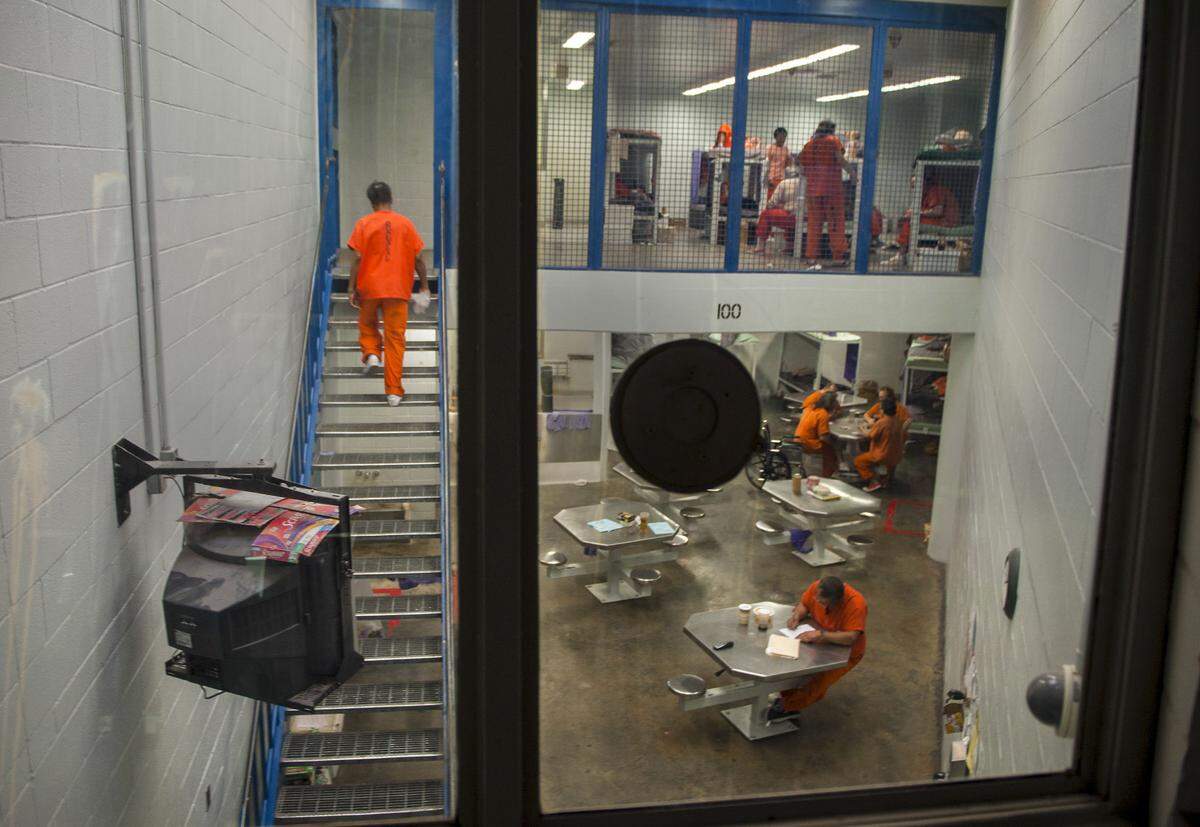
The captain instead recommended a one-step reduction in pay for 26 pay periods, and also asked that he be prohibited from working any overtime or off-duty work for 13 pay periods to ensure the pay sanction was not offset.
Another case revealed in the documents shows one deputy escape punishment for firing a 40mm anti-riot round into an inmate’s face because investigators found he was acting out of fear for a partner’s safety.
That January 2014 incident in the Main Jail began when deputies were escorting about 30 inmates to a recreational area and ended up in an argument with one who tried to punch one of the deputies, the files say. His partner, standing 8 feet away, aimed his “less lethal” riot gun at the inmate’s torso and fired, but the round hit him in the face because the inmate was thrashing about, the files say.
The files say the inmate “was eventually handcuffed, examined by medical personnel at the jail and later transported by ambulance to the hospital,” but they do not reflect what injuries he may have suffered.
The deputy was found to have “acted appropriately and within the guidelines of the Sheriff’s Departments General Order 2/01 – Use of Force policy,” the files say.
Video camera blind spots
The files also demonstrate that not all areas of the jails have video camera coverage, with internal affairs investigations finding cameras that didn’t work during an alleged excessive use of force, were covered up by inmates or “inadvertently blocked” by deputies.
Sacramento jails use an old video system and that does not include coverage of areas where inmates change clothes or receive medical screenings. At the same time, deputies in the jails are not equipped with body cameras, something Jones said he proposed to the county Board of Supervisors in 2018 but which was never funded. The result is an over-reliance on an aging system, the sheriff said.
“It’s a bit of a temperamental system, and we don’t have the money to replace it,” Jones said. “And so sometimes ... the first time we realize that a camera’s broken is when we want the video.
“We go back to look at the video, find out the camera’s been broken for God-knows-how-long, but it’s not working. ... So we want that video because you want to take appropriate action and this video is gone. ... It looks to the average person, perhaps rightfully so, that they were trying to cover something up and we’ve destroyed or otherwise lost the video. The body cams would at least theoretically obviate that because you have obviously a first-person view of what’s happening.”
Sacramento County Supervisor Phil Serna said the sheriff already has discretion of how he spends the significant funds allotted to the sheriff’s office, and could use his budget to purchase better camera equipment when he wants.
The Sacramento County Sheriff’s Office receives the largest allocation, 80 percent in the county’s annual budget, which is more than $372 million for the 2019-2020 fiscal year.
“The Sheriff is well aware of our budget process and the fact that his department’s allocation represents the largest single departmental appropriation,” Serna said. “To infer that it is somehow the fault of the board of supervisors who is delaying deployment of body cameras and functional video technology is disingenuous at best.”
Serna suggested Jones “take the more than quarter-million dollars annually that he spends on a very liberal carry-and-conceal weapons permit policy, and reprioritize those resources on improvements we all agree are necessary like body cameras and operational video equipment.”
Most complaints find no wrongdoing
Most of the complaints filed were classified as unfounded or not sustained, but even those sometimes result in the county agreeing to pay out money if officials determine it is less expensive to settle a case than fight it out in court.
Most lawsuits end with a settlement rather than a jury trial, and the amounts vary widely from $75,000 paid out to a man in 2010 who was seen on video being beaten in the jail to $650,000 paid out in June to an inmate who said he suffered an eye injury in the jail that went untreated and left him with partial loss of vision.
The Nandi Cain case, involving an alleged jaywalker who was beaten by a Sacramento police officer and ended up with a $550,000 settlement from the city and a promise of police reforms, is another that settled. In addition to his claim against the city, Cain, an African-American man whose arrest went viral when a bystander captured it on video, filed a claim seeking more than $25,000 over his treatment when he was booked into the Main Jail April 10, 2017.

Cain claimed a nurse failed to order a physical exam for him despite his complaint that he was beaten by police, and alleged the arresting SPD officer called deputies into a cell to attack him, forcibly stripped off his clothes, called him a “bitch” and said he “stank,” the file on the investigation says.
The review said deputies searched him and took his booking photos but he began to resist. The file says deputies “safely placed him on the ground,” then removed his clothes to place him in a safety suit.
“Cain was not observed to have sustained any injuries during the process, nor did he complain of any pain or discomfort to custody or medical personnel,” the review found.
Investigators found no evidence a deputy called him a bitch or said he was “crying like a bitch.”
But they determined two deputies talking to each other as he was restrained used the phrase “stank like tuna” because one of them had just eaten a packet of tuna and the other told him his breath was foul.
The deputies were exonerated by the sheriff’s review, but the county later agreed to a five-figure settlement with Cain to settle his lawsuit.
The case Merin filed against the county that resulted in the release of the internal affairs files had a similar outcome.
That case involved Mayco Rodrique, who was arrested Oct. 21, 2017, on charges of making threats, burglary and vandalism. In less two weeks, he settled his case with a no-contest plea to a misdemeanor and a 60-day sentence.
Here’s what his lawsuit says happened the afternoon he was booked into the Main Jail:
While Rodrique, now 36, was in the “pat-down” area, a deputy told him to take off his shoes and remove the laces.
“The law has changed,” said Rodrique, who had been in the jail before without having to remove his laces.
“What did you say?” a deputy asked before grabbing his head, smashing it into a wall, then twisting his right arm behind his back until it snapped.
Then, he was thrown to the ground, hogtied and carried to a solitary cell, where he was in such pain he asked repeatedly to see a nurse and was told to “shut up.”
By the time he was taken to a nurse, he was so frightened he told her “nothing” had happened to him. Days later, he was taken to a doctor who set the fractured arm in a cast and told him his recovery could take two to three years.
Sheriff Jones’ office says none of that happened, that reviews of video in the jail and interviews with deputies and Rodrique show he came into custody with his arm still recovering from an earlier break and that the only use of force was a “control hold” that was required as a result of Rodrique’s “continuous and unrelenting verbal aggressiveness and failure to comply with directives.”
Despite that, Merin filed a federal civil rights suit against the county in December 2017 that Jones says was settled last April for a payment of $97,500 from the county, which admitted no wrongdoing.
As part of the litigation, Merin received a copy of jail video showing the moment when Rodrique’s arm is broken, something he says is not unusual inside the jail.
“The reason I got into this is that I saw people were coming to my door, my office, and were saying to me, ‘Hey, I didn’t really do anything and then they broke my arm, and then they broke my leg, and then they did this or that to me,’ ” Merin said. “And I started taking the cases...
“They’re not huge cases in terms of damages, but they’re outrageous cases in the sense that constitutional rights are just being violated without regard to the consequences.”
This story was originally published December 22, 2019 at 5:10 AM.