
This group makes up 1 out of every 6 California voters. They could swing the 2020 primary
More Asian American and Pacific Islanders are voting in California – and they have the potential to influence the outcome of the state’s 2020 primary elections, data show.
AAPI voters make up roughly one out of every six voters in California. As of Feb. 10, there were 19,978,449 registered voters in California, according to the California Secretary of State, meaning around 3 million are Asian American and Pacific Islanders.
Many of those voters remain undecided, according to data and a report from Karthick Ramakrishnan and Janelle Wong of AAPI Data, an organization that publishes demographic data and policy research on Asian Americans and Pacific Islanders.
Former Vice President Joe Biden has the lead among AAPI-eligible primary voters in California. He’s followed by fellow Democrats Vermont Sen. Bernie Sanders, California Sen. Kamala Harris, Massachusetts Sen. Elizabeth Warren and Andrew Yang.
Across all Democratic or Democratic-leaning voters in California, Warren is statistically tied with Biden and Sanders, according to a poll released in early October.
A high percentage of would-be AAPI voters said they didn’t have enough information about candidates.
“They (candidates) are not seeing the bump they can get from California, and from the Asian American Pacific Islanders in California, who are one-third of the national AAPI population,” Ramakrishnan said.
AAPI Data teamed up with the Public Religion Research Institute to survey nearly 2,700 Asian American and Pacific Islanders of nine different national original groups in California from July to September.
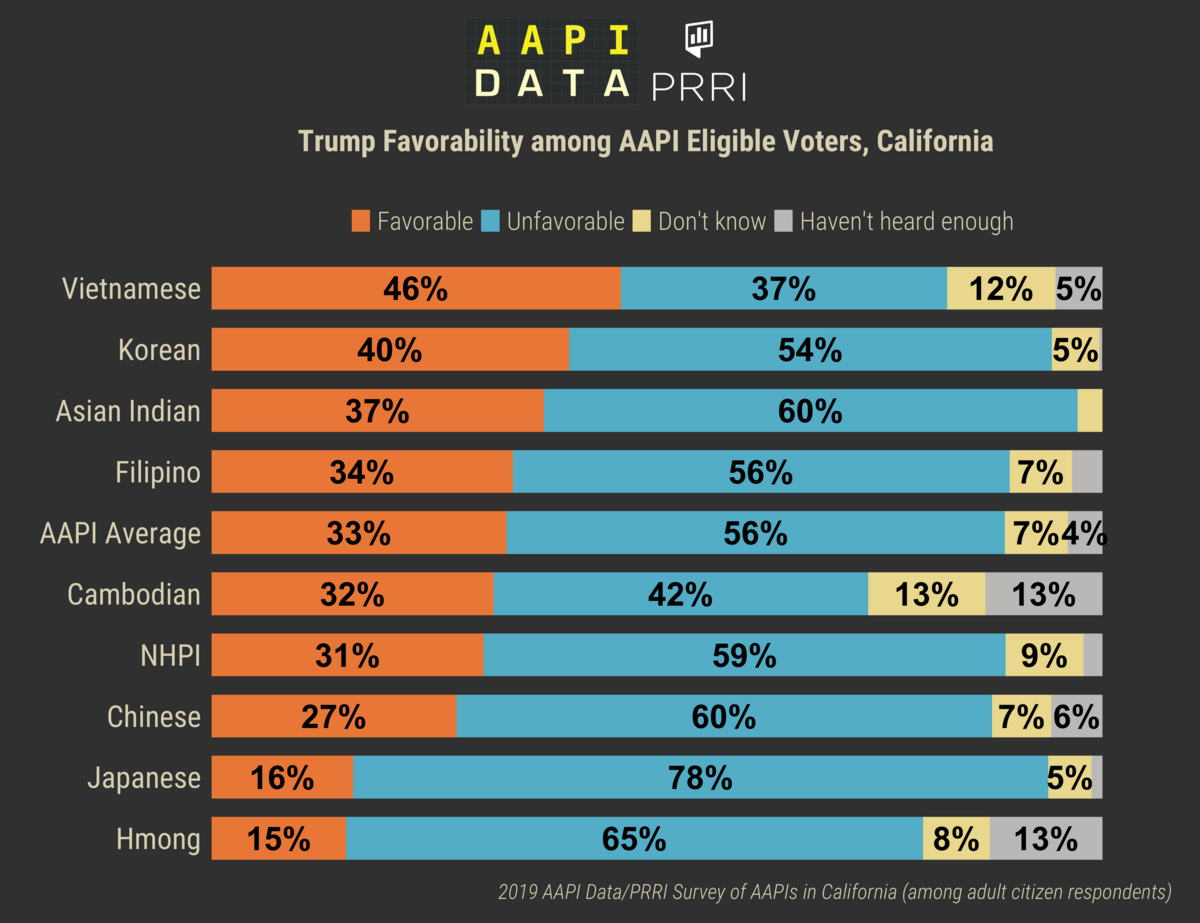
Results showed President Donald Trump held a mostly unfavorable rating among different ethnic groups among Asian American and Pacific Islander eligible voters in California. The exception was the Vietnamese community, where 46 percent favor Trump compared to a 37 percent unfavorable rating.
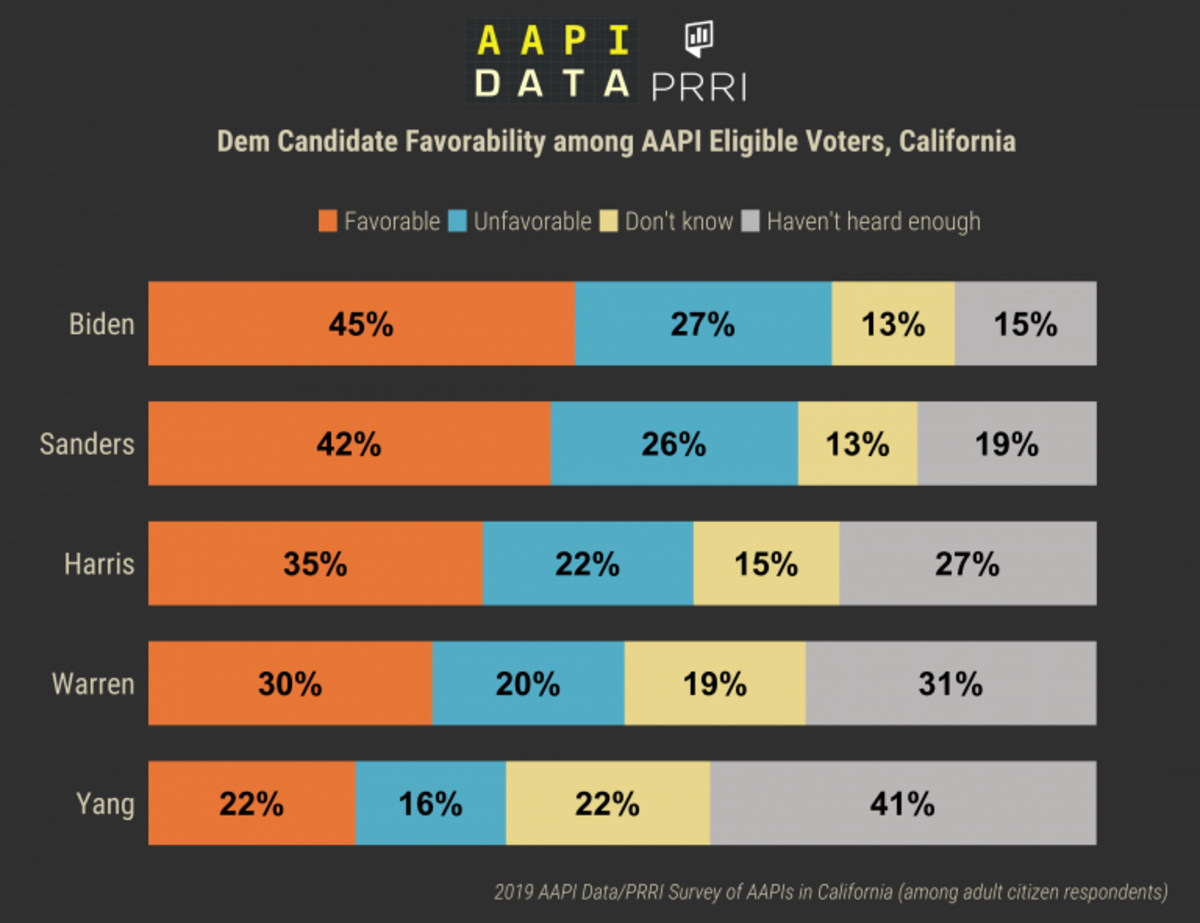
Sanders received the highest favorability rating among AAPIs born in the United States. Biden was most favored by foreign-born AAPI voters. Male voters tend to favor Biden, while prospective female voters tend to prefer Sanders.
But a high percentage of respondents said they didn’t know or “haven’t heard enough” about Democratic candidates, including Yang, a lawyer from New York, as well as Warren and Harris.
Ramakrishnan, a political science and public policy professor at UC Riverside, said AAPI voters tend to make up their minds late, so campaigns can reap significant impact by doing more outreach targeting the population.
But it is often more expensive to reach out to AAPI voters because of the cost of providing language assistance; there is also more uncertainty as to how these voters might lean politically, Ramakrishnan noted. This, coupled with a lack of awareness and relationships, could put the AAPI communities at a lower priority for politicians who instead reach out to those more likely to vote for them first.
“These communities are not well understood and therefore not many people will invest in it, creating a vicious cycle,” Ramakrishnan said.
Wong, an Asian American studies professor at the University of Maryland, said candidates tend not to think of AAPI voters first when planning how to spend limited resources, as the population is still smaller compared to other groups, despite its fast growth rate.
While the Asian American group can be intimidating because of the different languages needed for outreach, there is a consensus on some core issues in those groups, including their feelings about health care and redistribution of wealth through taxation.
Bill Wong, a political strategist specializing in campaigns and public relations, said campaigns target the Asian American Islander community substantially with advertisements and bilingual mailers in both English and their native language, but people may not be able to easily recall those efforts.
Wong noted that more than one third of AAPI voters identify as Republicans or non-partisan and therefore would not receive mail from the California Democratic Party.
“We know the country of origin of each eligible voter and whether they’ve asked for ballot information in their native language,” Wong said. “The stronger metric for us to reach out is whether you are a consistent voter or not.”
Most AAPI groups had more favorable than unfavorable views toward Democratic candidates. The report notes that Harris, who is Indian American, enjoys the highest net favorability among Asian Indians, yet Yang does not draw more favorable views from Chinese Americans.
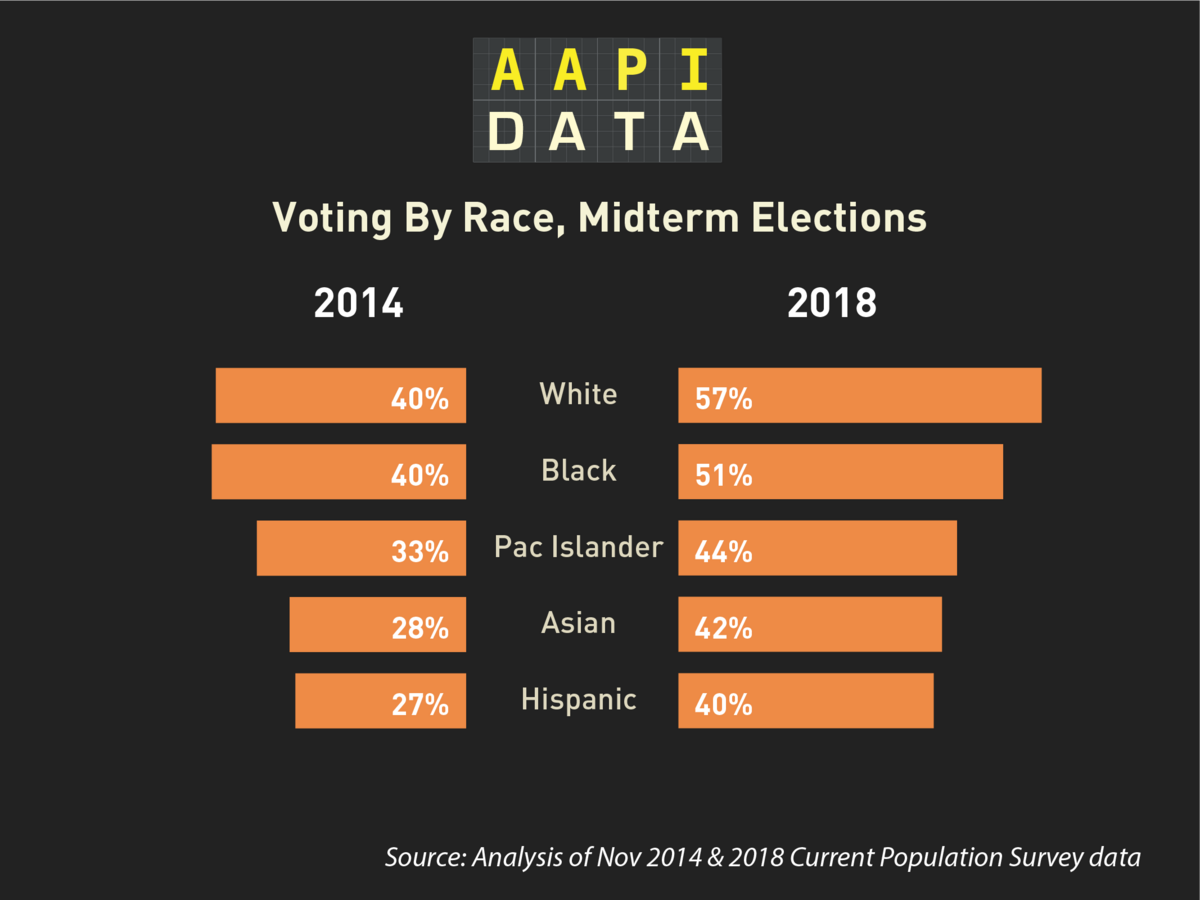
The midterm elections in 2018 also saw a sharp increase in voter engagement among Asian Americans and Pacific Islanders compared to the 2014 midterm elections, an AAPI Data report analyzing data released from the U.S. Current Population Survey shows. Voter turnout for the nation among Asian adult citizens jumped from 28 percent in 2014 to 42 percent in 2018. Similarly, turnout among Pacific Islanders rose from 33 percent to 44 percent in 2018.
A data breakdown of differences in ethnic groups shows a boost in the percentage of Indian and Filipino voters. By comparison, fewer Vietnamese American voters cast a ballot in 2018, and the group saw the lowest rate of voter turnout among other ethnic groups.
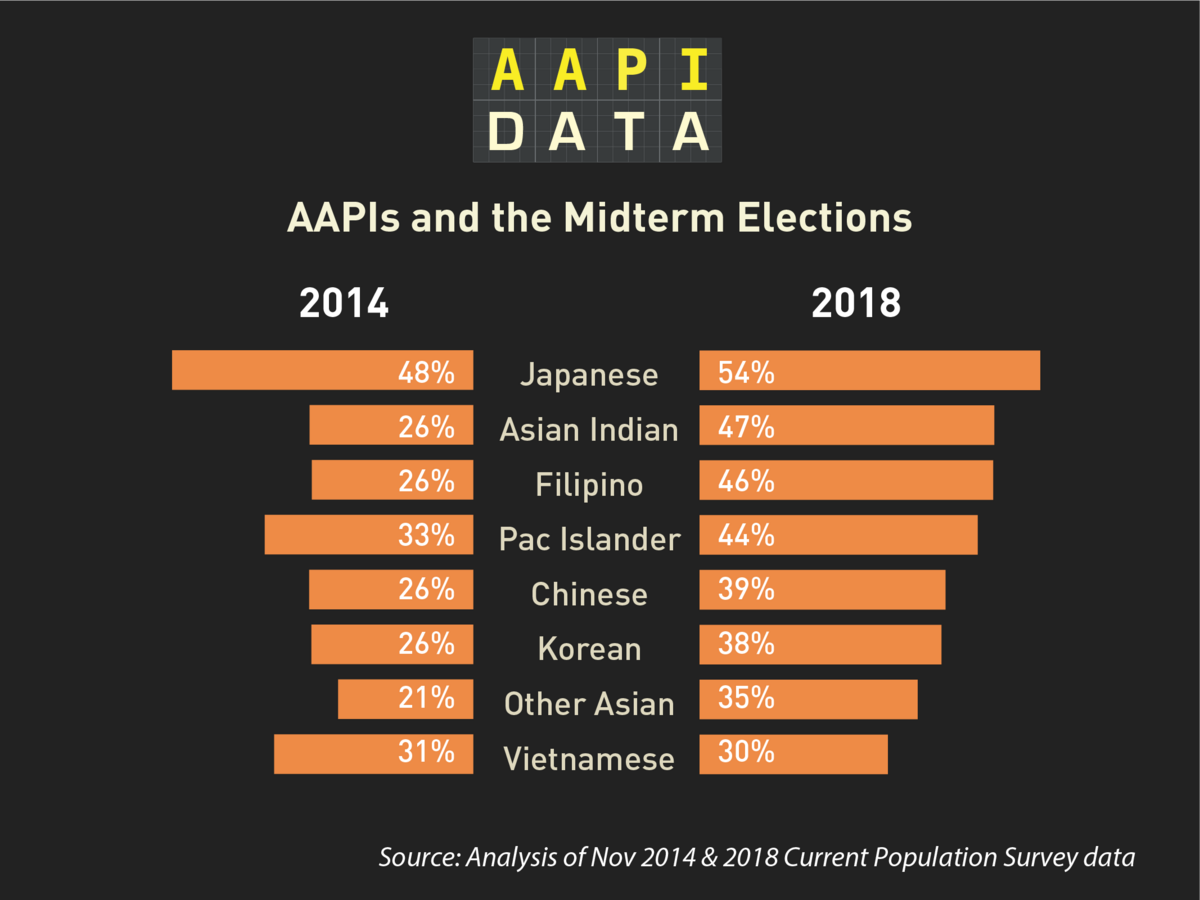
The record gains in these communities are likely to continue through 2020, according to AAPI Data.
The team aims to conduct another survey with a national scope next year with a sizeable California sample, Ramakrishnan said. The goal is to collect more data on AAPI voters’ voting preferences for the primaries and the general election.
This story was originally published October 22, 2019 at 10:38 AM.