
For the birds: Downtown Sacramento using falconry to clear the sky of pooping crows
When the sun sets on downtown Sacramento and the inky blackness of night creeps in overhead, another shadowy force fills the air – murders of jet-black crows.
At dusk, thousands of these crows take to the sky in huge flocks to find a place to roost. But with thousands of crows comes thousands of droppings raining down on the city.
“As they gather in increasing numbers, what they leave behind is sort of unsightly and quite frankly can be a mess on the sidewalks, benches, signs, you name it,” Downtown Sacramento Partnership spokeswoman Emilie Cameron said. “When you see K Street covered in the crow droppings, it’s not a pleasant experience, and then also you don’t want to have to dodge as you’re going down there.”
They tried using models of predatory birds to scare them off. They tried using special directed beams of light to irritate them. Now the downtown partnership is piloting a new program that puts falconers out on the street to deter the crows.
For the next three months, you might find Integrated Avian Solutions falconer Adam Baz patrolling with his bird on K Street between Seventh and 13th streets.
The pilot, which began Tuesday, aims to force the crows out of the high-traffic area and encourage them to roost elsewhere. Cameron went out to watch the birds in action on the inaugural night and was surprised with how effectively the well-trained hawks deterred the crows.
“He swooped in and out of the trees, the crows all realized he was there, notified each other that there was a falcon in the area and started to move on,” Cameron said. “I think it’s more well-trained than my dog.”
And well-trained he is. Baz’s 1-year-old Harris’s hawk, Jasper, patiently sat on his forearm Wednesday evening, darting his head around and occasionally rearing up to eagerly flap his tawny wings.
“The objective here is to use trained birds of prey to try to humanely manage these crows and move them more to the outskirts of the town,” Baz said. “We use the hawks very strategically to push the crows into specific areas where we believe that it’s more acceptable for them to be — so, large parks and green spaces with ample trees where they’re not pooping all over the ground or where the ground is grass instead of concrete.”
The crows in Sacramento are likely coming from the agricultural areas on the outskirts of town and spending the night in the city, Baz said.
The poop problem is so bad, Cameron said, maintenance crews can hardly keep up. There’s so much to deal with that sometimes an area that’s been power washed is covered after a few hours.
The poop isn’t just a nuisance to businesses and pedestrians, Baz said. The bacteria and fungi found in crow droppings can pose a health risk as well.
The crows aren’t invasive, Baz said, as this is their native habitation zone, but they are drawn to urban centers in order to find secure communal roosts with few natural predators nearby.
“We have some really stubborn crows,” Cameron said.
That’s where Jasper comes in.
Just his presence in the air is often enough to send smaller birds packing, Baz said, although there is a chance that crows could be killed.
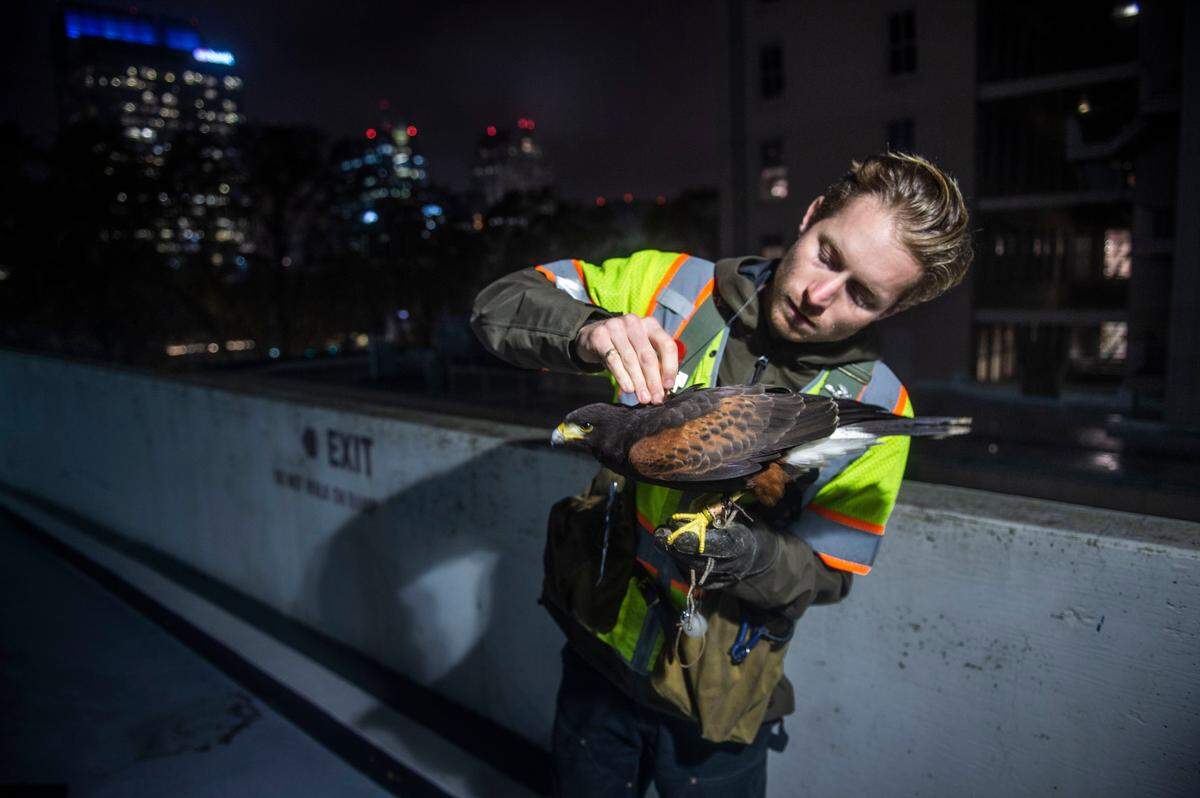
“Our primary objective is not to harm or hurt the crows at all,” Baz said. “While Jasper is certainly capable of killing crows, that’s not his primary preoccupation. He more or less follows me around in search of little tidbits of food and goes to bed happy.”
Baz, along with a couple other falconers, will wander the streets and menacingly launch their birds into flight toward groups of crows, intentionally steering the flocks in specific directions to lead them out of the area.
A similar crow management project was implemented by Integrated Avian Solutions in Portland, Oregon, which dealt with its own bird problem.
“Sacramento definitely has its fair share of crows, and not to undermine the uniqueness of the situation, but it is definitely very familiar,” Baz said. “I work with about five or six different cities throughout California, all of which have the exact same crow problem, and all of which have tried every other method under the sun, ranging from noisemakers, to owl decoys, to hiring the police department to go out and shoot them with shotguns, and none of it works — but falconry does.”
Baz said there’s no need for parents of young children or small dogs to be afraid around Jasper and the other hawks — they’re perfectly safe.
“People need not worry. They need not scoop up their small chihuahuas,” Baz said. “However, if you are a keeper of dozens of crows, you might be a little concerned.”
If there are good results after the pilot period, Cameron said, further arrangements may be considered.
This story was originally published December 5, 2019 at 4:00 AM.