
How Sacramento police left city unguarded over two chaotic nights of vandalism, mayhem
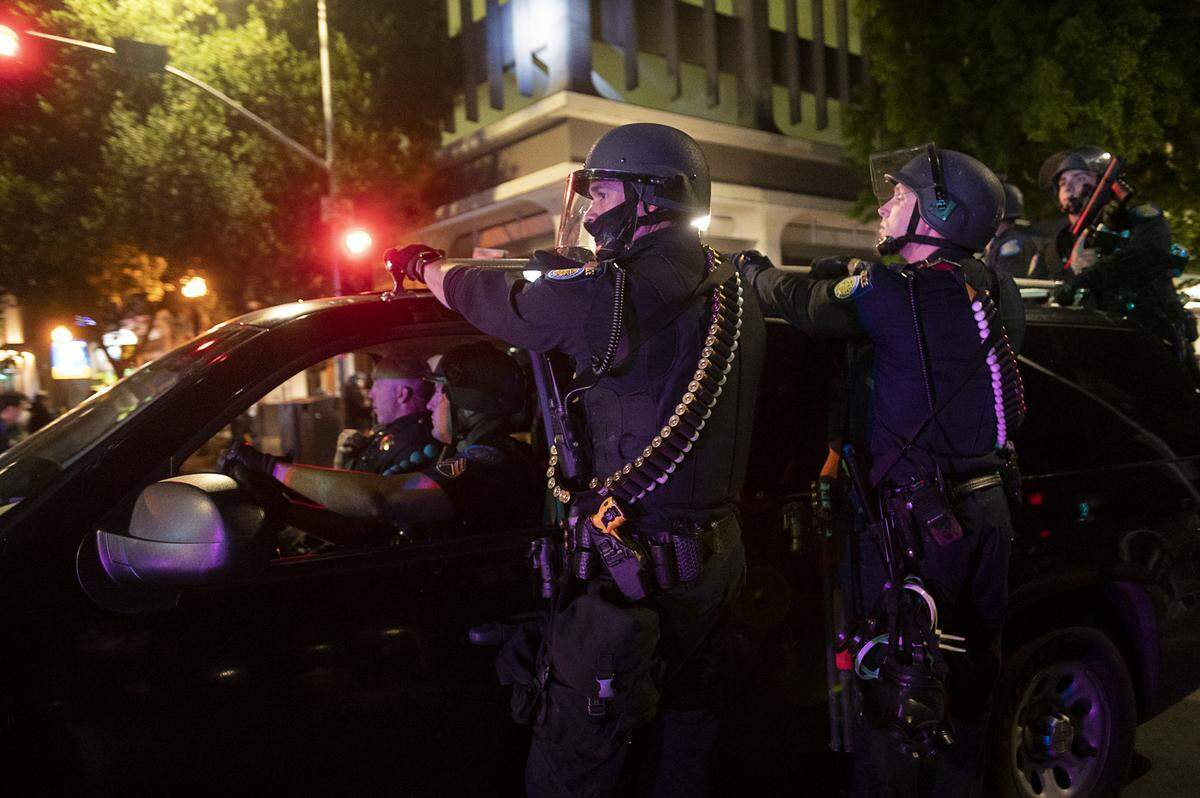
At 10:35 p.m. Sunday, around two dozen Sacramento police officers in body armor and helmets stood near 15th and J street, awaiting orders. A half-mile away, a group of protesters was dispersing after a two-hour showdown at the Capitol that included officers shooting tear gas and rubber bullets into the crowd.
For a moment, the feeling seemed to be one of ease.
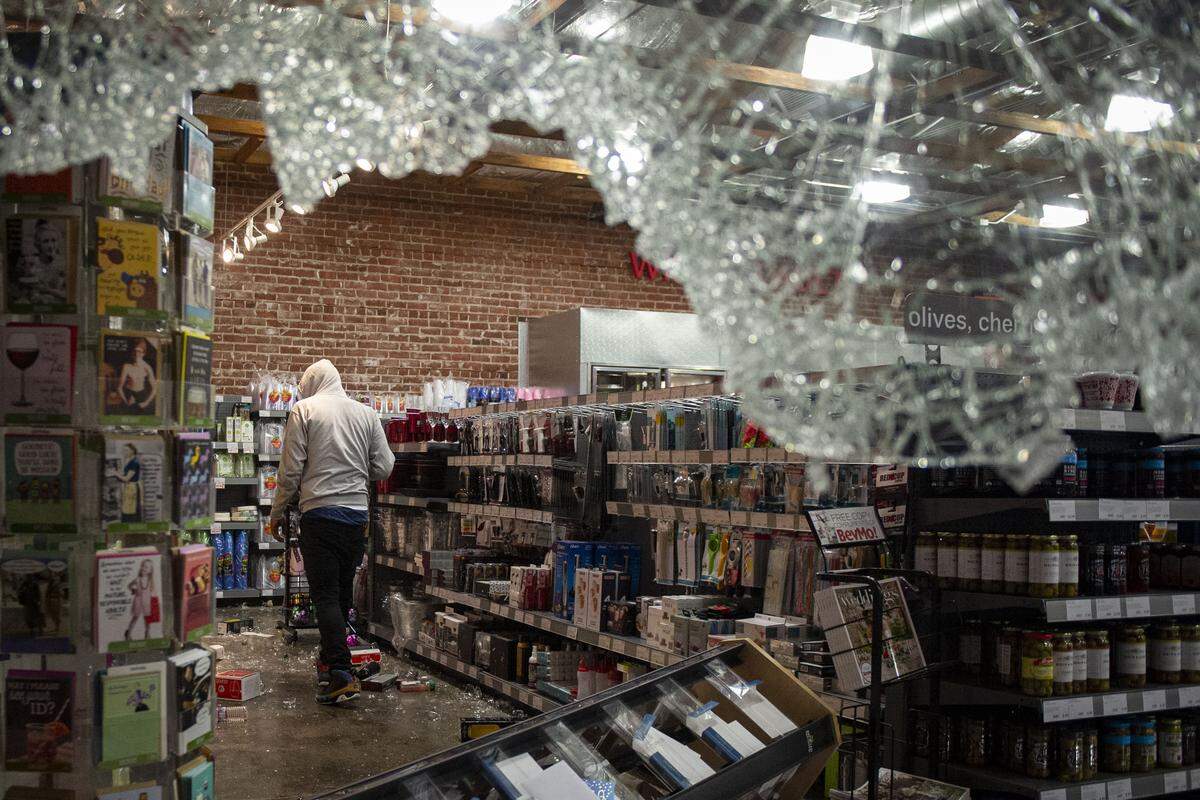
But then the officers on 15th Street departed without explanation, exposing a swath of midtown to small groups of vandals who roamed the streets, leaving a path of shattered windows, spilled booze and anxiety in their wake.
Kendrick Fields, a sous chef at Aioli restaurant at 18th and L streets, said he found himself facing off against dozens of looters Sunday night with a Louisville Slugger baseball bat after calls to 911 proved fruitless. Fields, who lives next door to the restaurant, heard the group of roughly 25 looters approaching and yelled at them from his upstairs window.
“I said, ‘Hey, you guys get away from there, they don’t deserve you guys messing with them,’ because I knew they were going to loot,” Fields said. “When I said that, about three of them said, ‘Screw you, mind your own business or we’re going to burn your house down.’ “
“And I said, ‘Really?’ And I came out here with that bat.”
Most of the looters left, but a handful remained. “And I said, ‘Bring it,’ ” Fields said, and the group relented.
He discovered later that someone had broken into the restaurant from a side entrance and made off with cash registers and alcohol.
Fields called 911 twice and tried to flag down passing officers but he was told everyone was busy with the protests. Fields said he is sympathetic to the Black Lives Matter cause and the George Floyd protests, but said he thinks the police response has been “50-50” in its effectiveness against looters.
“I know there are a lot of cops out there trying to do their jobs and do them right,” he said. “I’m not the one to judge nobody, but it seems to me that a lot of them are not doing their jobs.”
Sunday night’s scattered bedlam in midtown was altogether different from Saturday’s string of undeterred vandalism. Where Sacramento police for hours on Saturday decided not to make arrests or pursue people in hopes of avoiding a violent clash, Sunday’s show of force happened earlier in the evening — leaving people to scatter across the city for hours.
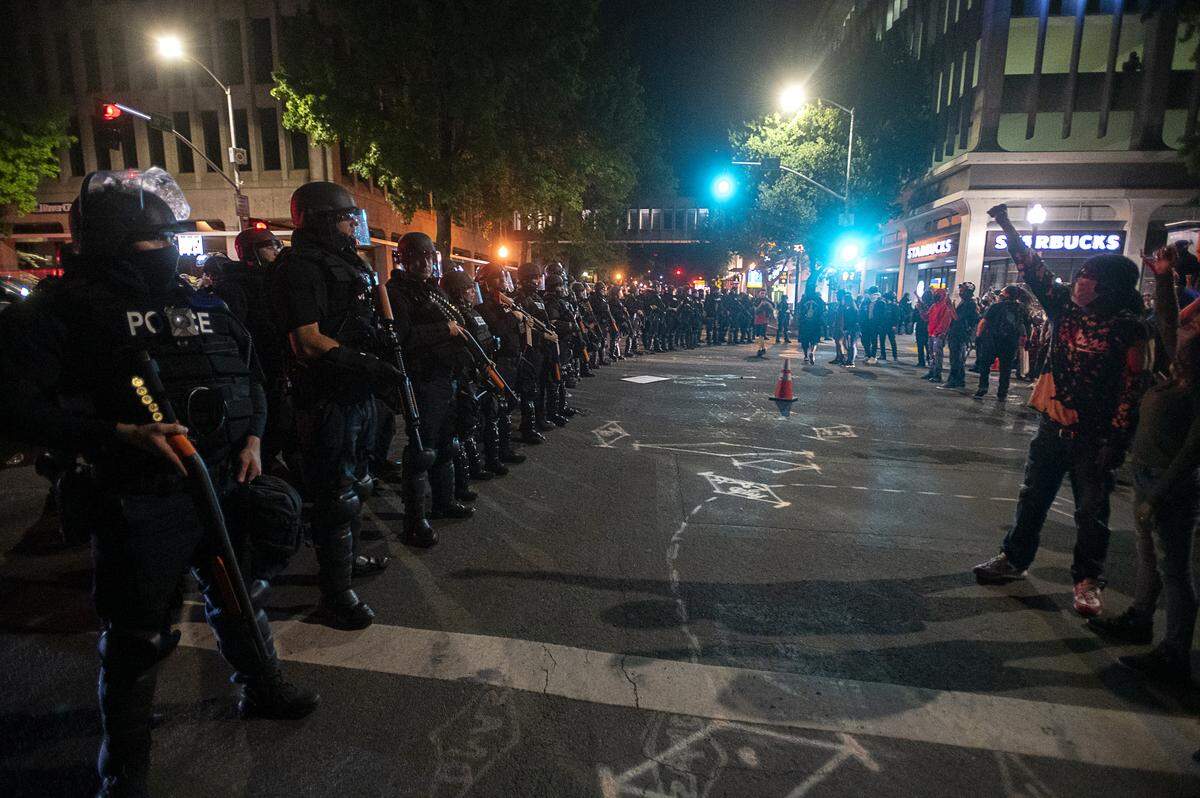
The three nights from Saturday to Monday offer a striking window into how the Sacramento Police Department is able to manage large protests and vandalism through the city. Law enforcement experts and business owners said Sunday night’s destruction showed the city was caught off-guard by a growing number of people who took advantage of the peaceful protests to sow unrest.
In moving faster downtown on Sunday, law enforcement left swaths of the city unguarded. Splintered groups of protesters and a constant stream of people arriving downtown and running toward the nearby commercial district overwhelmed police, who seemed to race from one scene to the next, like putting out spot fires as a forest burned.
At one point in the night, several officers from nearby Citrus Heights came to midtown to assist Sacramento police.
Police Chief Daniel Hahn on Monday condemned the violence used against George Floyd in Minneapolis and also called attention to the challenges his own police department has faced regarding race. Hahn praised the overwhelmingly peaceful, passionate protesters that had taken to the streets for three nights but drew a line between those groups and the people who left damage across the city.
“We saw something that I wouldn’t call a protest. I would call that intentional, organized chaos,” Hahn said in a video announcement Monday morning. “And those are people that just simply do not care about our community and do not care about our people.”
He did not address the shifting police tactics between the two nights. A spokesperson on Tuesday did not respond to questions about the change in tactics and instead pointed to Hahn’s comments from a KCRA television interview saying it was difficult and dangerous to arrest constantly moving vandals. “You have to be able to send a large contingent of officers, both as a protective detail, if you will, but also arrest teams,” Hahn said.
The goal on Saturday night, Mayor Darrell Steinberg said, was to avoid escalating an already tense situation. But when asked about preparations for Sunday night, he downplayed the need for the National Guard, vowing that police would act more quickly thanks to partnerships with neighboring departments.
“I do believe that they will intervene even faster tonight because of the mutual aid agreements that will be elevated this evening and will allow them to be able to move faster,” Steinberg said.
By Monday, the National Guard had moved into Sacramento and an unprecedented curfew was in place. Little evidence of vandalism erupted after the peaceful protests in Cesar E. Chavez Plaza.
But the lack of police response to the widespread property crimes the previous two nights left business owners frustrated their property hasn’t been guarded more aggressively. Faith leaders and protest organizers are furious that vandals and looters have hijacked an otherwise mostly peaceful weekend.
For two nights of mayhem and property destruction, including 130 businesses with smashed windows, a remarkably small number of people were charged with looting-related crimes — just 11.
McGinness: Curfew should have come earlier
Benedict Tisa, a retired FBI agent who worked in the San Francisco field office, said when looters are allowed to wander around cities unchecked, it’s a sign there are not enough officers to handle both crowd control at major protests and simultaneously patrol the streets.
“That’s the problem. There’s not enough to go around,” Tisa said. “That’s why they need the National Guard: To do property protection.”
It’s difficult to know what effect the presence of 500 National Guard troops had on a remarkably calm Monday, and how much could have been attributed to the curfew or the scores of buildings boarded up around town, as well as forceful calls for peace from community leaders.
Former Sacramento County Sheriff John McGinness said city leadership failed by not immediately ordering a curfew earlier in the weekend. That kind of move allows officers to respond to vandalism and break-ins much more quickly.
“I absolutely abhor curfews in general,” McGinness said. “But there’s a time and a place where it’s appropriate. If you had one in place, you wouldn’t be worried about having to accommodate the protesters while protecting businesses. I think that was an administrative failure.”
“They wouldn’t have been out there playing whack-a-mole,” he added.
To understand how Sunday unfolded, and what coming days might hold, it’s helpful to understand there are four different groups of people involved, said David Carter, a criminal justice professor at Michigan State University who has studied responses to protests.
First are those who believe in the issues and want change. Second are spectators who merely go to watch. Tensions rise with the third group that has a more ideological intention, like antagonizing officers on camera for hours to prompt them to use force, furthering the narrative that police use excessive force.
And fourth is what Carter called “criminal opportunists” who want to vandalize, loot and “use the demonstrations as an excuse and for ‘cover’ knowing the police will be occupied and can’t catch everyone.”
“Commercial areas with a low population where there are no demonstrators tend to be where there is little or no police coverage,” he wrote in an email, “simply because responding agencies are running out of personnel.”
The mood shifts on Sunday
Organizers of Sunday’s demonstrations were well aware they’d have to disentangle their message from the string of vandalism a day earlier. They did so by pleading with the crowd to keep the marches peaceful.
Indeed, what unfolded in Sacramento during that day was markedly different from the scenes of cop cars ablaze and police gassing crowds in other cities.
Peaceful protesters who briefly swarmed the freeway Sunday afternoon met up with another group that had marched from the Capitol’s east steps to Chavez park by about 7 p.m. The entire group at the park numbered around 800 to 1,000 people.
For a time, the activists who were leading the rallies Sunday were able to keep the crowd under control and were urging calm, saying violence was counterproductive to what the majority were there for.
After a young white man threw something at the cops at the Capitol, one of the leaders — a black woman — went over and confronted him, telling him that he was putting black lives at risk.
At Cesar Chavez Plaza until about 8 p.m. black activists gave impassioned speeches.
But as the talking dragged on, in the back of the crowd, others were getting restless. Along J Street, a man started shooting off loud, explosive fireworks, and a vehicle revved its engine and began doing burnouts.
The mood shifted immediately.
Dozens of people at the back of the rally ran that way and began cheering.
About 8:10 p.m., Grace Swint and Stevante Clark, the brother of Stephon Clark shot by Sacramento police, and other activists immediately went over, though, and urged the group to calm down.
It appeared to work. The crowd calmed.
“I’m trying to shift the narrative,” Swint, 29, of San Francisco said after, as she walked with Clark back to the rally.
But the calm only lasted a few more minutes. More fireworks went off and more burnouts commenced.
A group of a couple of hundred people splintered off and began hurriedly walking down J Street.
Seeing things get out of control, at 8:23 p.m. Sunday, other organizers, one of whom led the march from the freeway, raced over and again urged calm and solidarity, telling the crowd walking past that their safety would be at risk if they ventured away from the peaceful protest.
“We have the numbers right here,” he said. “It’s your life. You make the call, but you better know the risks. … It’s not just about you.”
“We’re trying to keep you safe,” another activist said.
Minutes later, a group of protesters on the north side of the Capitol faced off with police surrounding the building. The crowd of protesters grew by the minute, as did the number of police who converged on 10th Street.
And order unspooled as small groups began smashing business windows along J Street. Someone threw what appeared to a Molotov cocktail on one of the cross streets.
A group of young men, wearing all black, used a clapboard-style portable street barricade to smash a car’s back window. A few minutes later, one of the men in that group tried to snatch a reporter’s phone while he was shooting a live video.
In a sudden whirl of activity near 14th and I streets, a stream of cars pulled into parking spots, people jumped out, put on face coverings and ran toward the brewing mayhem.
With the darkness, a switch flipped.
And glass shattered.
‘I knew somebody who was killed by a cop’
Departments often have officers on bicycles during crowd events so they can respond more nimbly when splinter groups begin. That was the case on Sunday night, but they were largely clustered downtown near the main group of demonstrators — monitoring protests but not controlling people who are causing destruction.
Jack Reichel, who has been a familiar presence at the marches, said he and some other demonstrators interrupted two attempts to loot the Vanini clothing store downtown across from the Capitol on Sunday night near where protesters were gathered.
“Somebody threw a chair through a window and a couple of minutes later a skinny white kid came up with a hammer smashing the windows,” he said. “We confronted him and said, ‘Who are you with? Why are you doing this?’
“He said, ‘Oh I knew somebody who was killed by a cop.’ And we were saying, you are diminishing what we are doing here. I tried to confront him but he ran away and then 10 or 15 minutes later another white kid came up and started banging on the doors and I confronted him. He was pretty much saying other people are doing it so I can do it.”
Reichel said looters are not part of the protest groups, and said he has not seen them marching with the group.
“You don’t come with a hammer to protest,” he said. “Some of these people who are looting and rioting, I don’t see them over on the front lines of the marches dodging tear gas.”
Tineshia Rose, 23, of Sacramento was at 11th and L, passing by the protesters facing off with riot police as fumes from tear gas hung in the air Sunday. She said the hostility between the officers and the protesters “was not what’s needed.”
“If the cops would work with the people,” she said, “the people would work with the cops.”
At 9 p.m., they began firing tear gas toward the crowd. As reinforcements arrived, the line of officers deepened and they issued commands to disperse for nearly an hour.
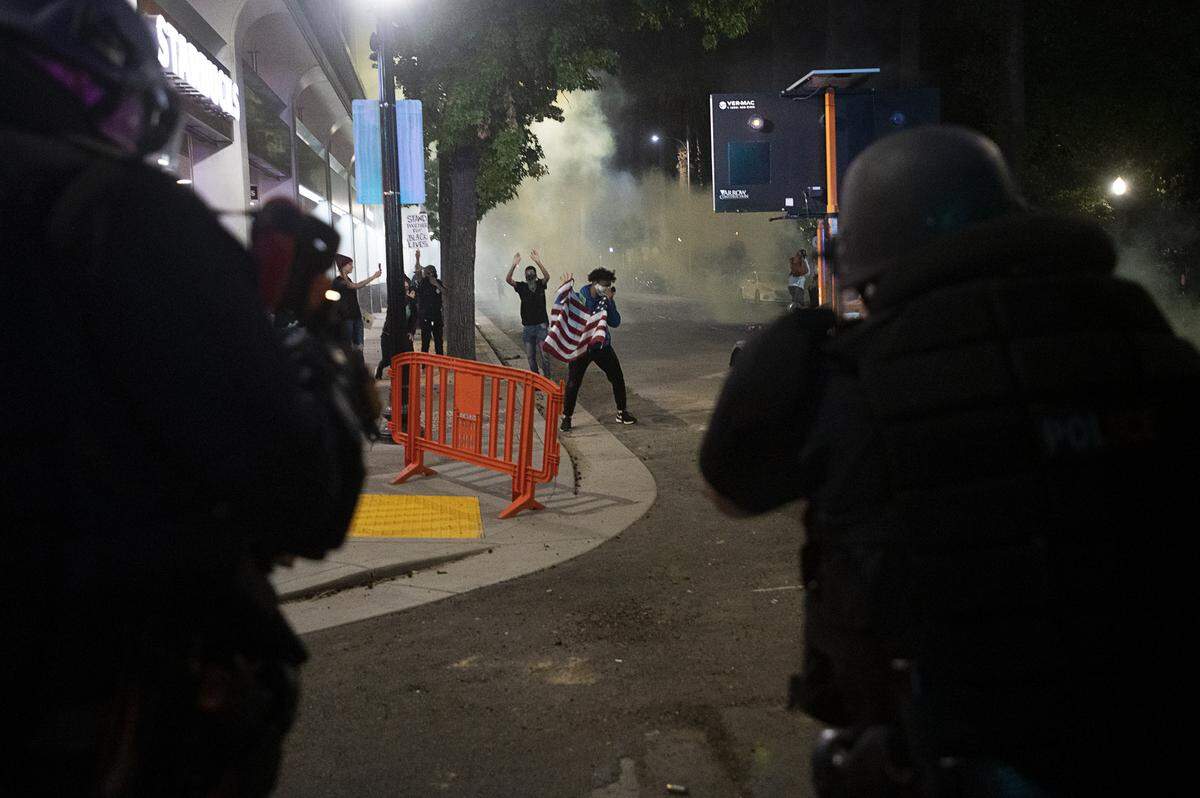
Nearby, a vehicle speeding down J Street at 9:15 p.m. nearly hit a line of officers standing in the road. People had already shattered windows at restaurants, delis, and office buildings as they headed into midtown. A man whose arm was in a sling held a gun in his other hand as he walked toward a reporter.
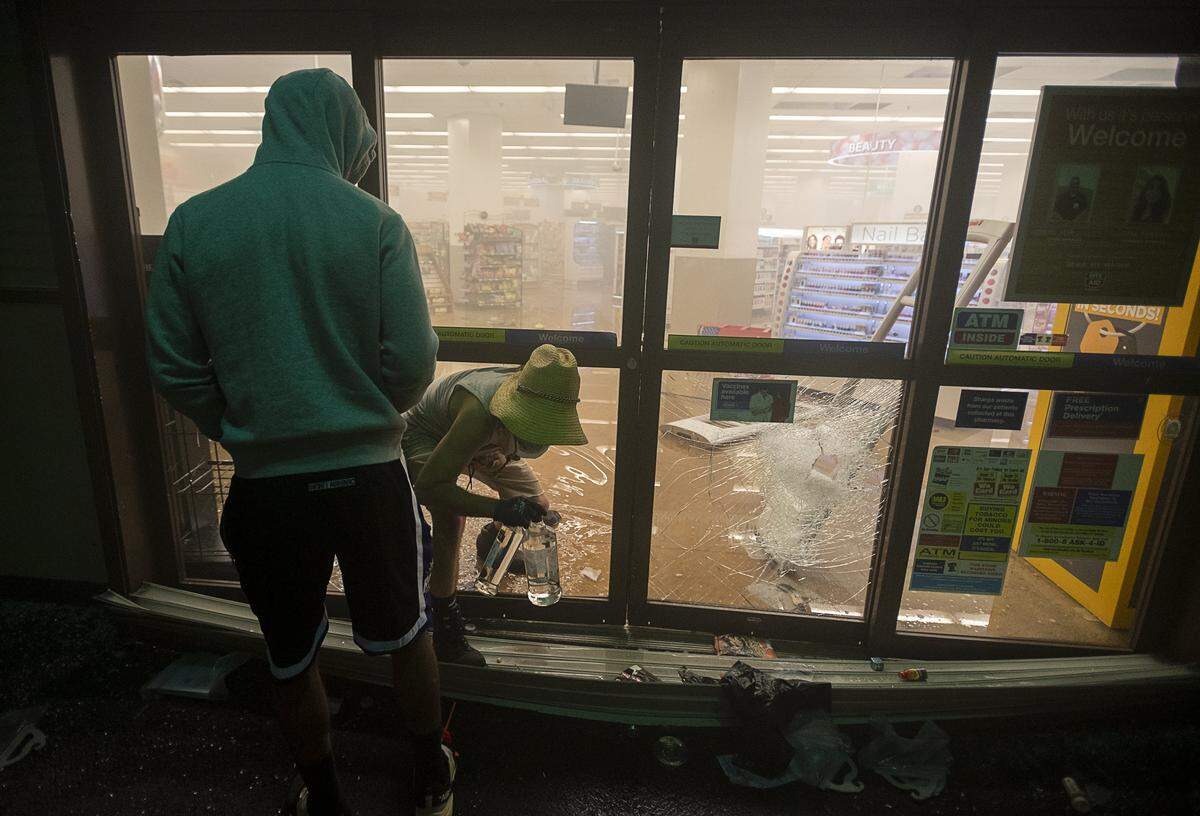
As gas lingered in the air a few blocks away, firefighters entered a smoke-filled Rite Aid that had been raided on Ninth Street. Water flowed from a 7-Eleven nearby that had been burglarized once again.
Warren Anapolsky, owner of California Loan & Jewelry at 916 J Street, said looters had tried to break into his shop on two separate nights and that he can’t understand why the police did not order a curfew Sunday and post officers throughout the area.
“They should have had police on every corner,” Anapolsky said. “They should have had more people on every intersection watching the people going by as they were going down K Street, J Street and L Street.
“If they’re on the intersections, they can see when they start to vandalize.”
Anapolsky was watching his security videos from home over the weekend as groups of looters tried to break through the steel security gate protecting his front door. The video shows them kicking at it, yanking on it and thrusting knives through it.
During the attempt Sunday night, one looter managed to wrench it upward far enough to get into the entryway and try breaking through the laminated glass window with a golf club but finally gave up.
“Last night, when I’m watching this, three times I called 911,” Anapolsky said. “They couldn’t get anybody over here.
“I watched it last night happening live on my phone. It’s like a fallacy, the whole system, they didn’t know how to set things up here. They should have had people on when people are calling for help.”
Groups splintering during protests and causing increased chaos is relatively common, said Ed Maguire, a professor at Arizona State University who has studied police responses to protests. It often happens quickly when police take enforcement action but can be more organized when groups want to “outmaneuver police.”
“These events attract very different types of people, some of whom are there expressing their First Amendment rights peacefully and lawfully, and others using these as opportunities for destruction, violence, and theft,” he wrote in an email in response to Sunday’s incident in Sacramento. “One of the great challenges for police is facilitating the rights of the former and stopping and arresting the latter.”
“And of course,” Maguire added, “where these events go badly wrong is when the police take enforcement action against an entire crowd in response to the illegal behavior of only a subset of its members.”
‘A time and a place’
At around 10 p.m. Sunday, many stretches of midtown were eerily quiet. The string of restaurants on 16th Street had not yet had floor-to-ceiling windows shattered. Kendrick Fields, the Aioli sous chef had yet to confront a band of potential vandals.
It’s clear that at around 11 p.m., something changed in midtown.
Sacramento Bee reporters watched a man lift his shirt to flash a handgun in his waistband at a man driving a van. Moments earlier, the man with the gun and a half dozen other young men had smashed the doors of the Disability Rights California office. Two men mugged a Bee photographer and stole his camera, breaking his finger. They shoved a reporter to the ground and ran away.
A woman begged the small group of Citrus Heights police officers who were guarding a ransacked BevMo to help a person who she said was getting beaten inside a nearby CVS Pharmacy. Men shouted “Run!” as officers walked toward the building. Someone was removing license plates from a vehicle parked on L Street. And about midnight, another man stood outside The Zebra Club on 19th Street, weighing where to go next.
“I want another jewelry store,” he said to the group he was with.
By midnight, a maze of police roadblocks dotted midtown, where newly shattered glass lined 16th Street. The stench of a smoldering dumpster fire hung in the air. And yet, people continued to arrive along 14th Street and head toward the destruction.
Some $10 million damage was done, with vandals damaging 130 businesses. The city announced its first-ever curfew hours later, and boarded up swaths of the city looked more like an area bracing for a hurricane by evening than a city incrementally reopening from the coronavirus-caused shutdown. The National Guard arrived mid-afternoon. And throughout the night, things stayed calm.
A large part of that was because of the actions of one man.
In 2018, Sacramento police shot Stephon Clark in his grandmother’s backyard holding nothing but a cellphone.
On Monday night, Clark’s brother, Stevante, kept 650 protesters calmer than they’ve been in days as he led them on a short march through downtown Sacramento after the city’s 8 p.m. curfew.
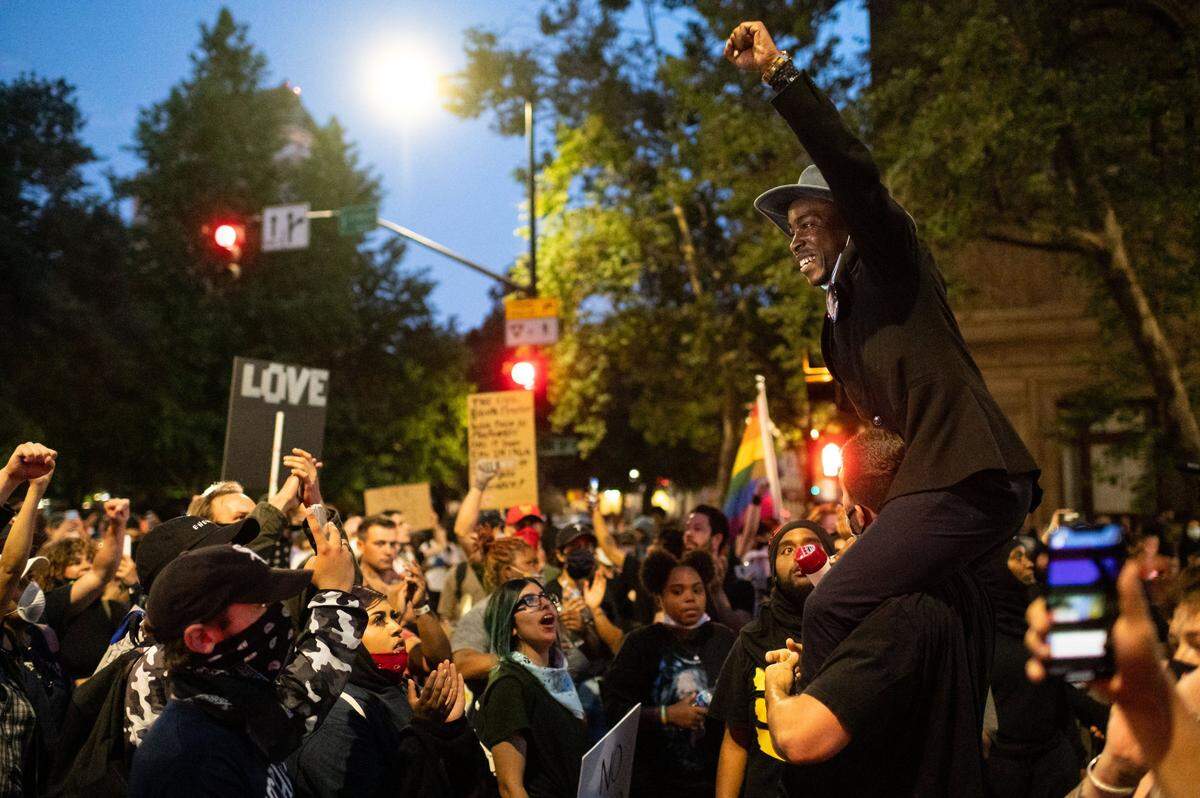
At one point, a young man climbed on the roof of a National Guard Humvee near the district attorney’s office where prosecutors declined to prosecute the cops who shot his brother. Clark told the man on the vehicle to get down. A few blocks later, arriving back at Cesar Chavez Plaza where the march began, Clark told the group to send a message to the city’s leadership that its show of force — all the cops in riot gear, the camo-clad Guardsmen carrying rifles — was unnecessary.
“I want it dark as (expletive) and them to feel like they’re ready for something and it was nothing,” he told the crowd. “I want it to be a (expletive) ghost town.”
And it largely was.
By 10:45 p.m. Monday there seemed to be more officers on the streets of downtown than pedestrians and other motorists combined. And aside from an occasional siren or arrest for someone past curfew, it was completely silent.
This story was originally published June 3, 2020 at 5:00 AM.