
Sacramento unites for Black Lives Matter as thousands take to downtown streets
A day of peace and unity in downtown Sacramento suddenly bristled with intensity Saturday after 100 protesters hopped a security fence guarding the Capitol and staged a peaceful yet emotional exchange with the commissioner of the California Highway Patrol.
Attempting to defuse a situation that was growing more delicate by the minute, CHP Commissioner Warren Stanley, who is black, emerged from the Capitol building early in the afternoon and declared over a loudspeaker that the death of George Floyd at the hands of police in Minneapolis was “totally unacceptable.” He said he was speaking on behalf of “myself and the 11,000 other employees of CHP.”
Stanley, accompanied by a handful of officers but not wearing protective riot gear, asked the demonstrators to retreat behind the fence. “You go back, we’ll go back,” he said.
A few heeded his call but most stuck around, some of them surrounding the CHP chief. Stanley chatted privately for about a half-hour with clusters of demonstrators inside the fence line about the use of tear gas and rubber bullets on protesters last weekend – a tactic, Stanley said, that was employed by Sacramento police, not his officers.
Then he headed inside the building with a small group of protesters for a private dialogue that lasted nearly an hour. The remaining protesters planted themselves on the ground, at the base of the east steps of the building, and listened to speeches as the sit-in continued even after Stanley came back outside with the protesters. Dozens of helmeted CHP officers guarded the building as the confrontation continued late into the afternoon with no obvious resolution in sight.
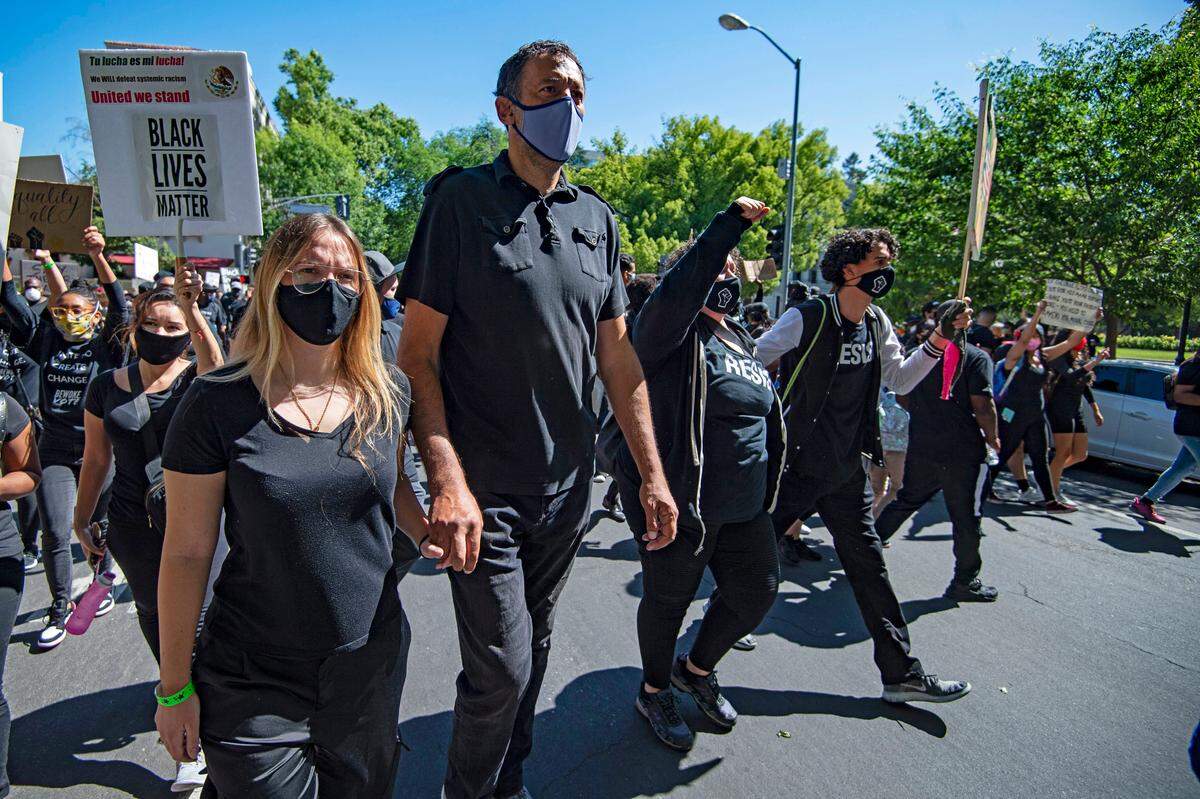
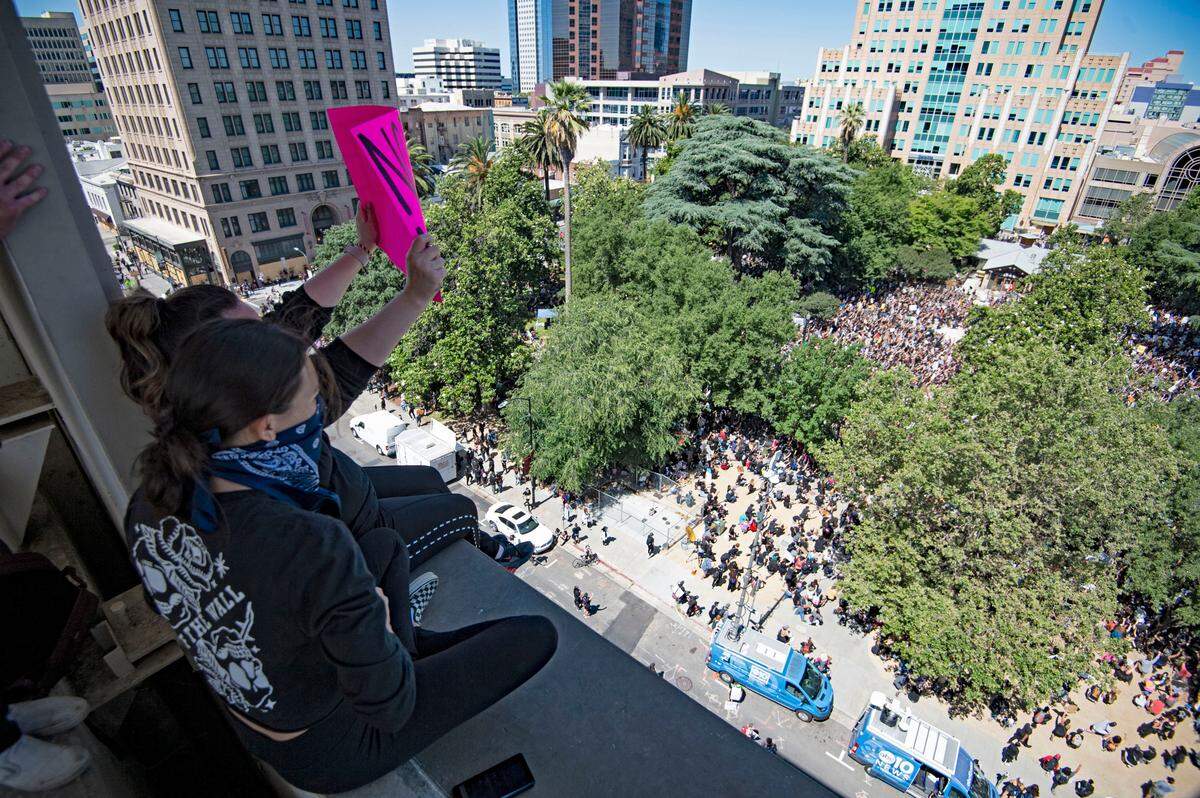
The extraordinary drama, on the ninth straight day of protests over police brutality, unfolded after thousands of demonstrators had finished marching through downtown streets in an event organized by the NAACP and other groups. The crowd strode past boarded up buildings, the result of two nights of vandalism last weekend, and wound up at Cesar E. Chavez Plaza. There they heard poetry, music and uplifting speeches from the likes of Kings chairman Vivek Ranadive, Mayor Darrell Steinberg and activists.
Steinberg, whose neighborhood was the scene of a “die-in” protest the night before that drew hundreds, drew cheers for announcing the end of the curfew and the removal of the National Guard from city streets. The mayor declared his solidarity with the Black Lives Matter movement and talked about his personal struggles to understand white privilege. The largely positive reaction from the crowd contrasted sharply with the public scolding he received when he visited the makeshift shrine set up at the plaza Wednesday.
Others exhorted the vast throng, which spilled into the streets surrounding the two-acre park, to do more than just march.
“You’ve got to go vote,” said Bobby Jackson, a former Kings player. “You have a voice .... Use that voice.”
Another ex-King, Sacramento native Matt Barnes, said the two nights of violence that struck downtown and midtown were unfortunate but served as a wake-up call.
“They hear us finally,” he said.
One issue that has simmered throughout the week also had resolution. The Sacramento Police Department announced late in the day that it was prohibiting the use of carotid control holds – or neck restraints – as a use of force for its officers. Gov. Gavin Newsom had ordered the technique ended by state training agencies.
A large march through Sacramento
The march was one of the largest Sacramento has seen in years. The crowd was so big that hundreds of people were still waiting at the starting point at Golden 1 Center when the marchers at the head of the line reached Chavez Plaza after a walk that looped around the Capitol – a trek of a little more than one mile.
While most of the protesters headed home after the official rally, about 1,000 of them assembled at the east side of the Capitol, where the CHP had erected a short security fence several days earlier. They chanted “Black Lives Matter” and invoked the name of Stephon Clark, the unarmed black man shot to death by Sacramento police two years ago.
The situation was peaceful, with only a handful of CHP officers guarding the steps without the riot gear they’ve been wearing during protests the last several days.
Then a protester hopped the fence. CHP officers advanced toward him and he retreated into the crowd. A few threw water bottles at the officers but calm was quickly restored, and the demonstrators chanted, “Peaceful protest.”
A few minutes later, however, roughly 100 protesters jumped over the fence and refused to go back. That’s when Stanley came out of the building and spoke to the crowd over a loudspeaker.
At one point the CHP commissioner traded the microphone with a demonstrator, who demanded an end to the city’s curfew. Stanley explained that the curfew – which went into effect after two nights of violence in downtown and midtown – had been declared over. The man then demanded the “release of detained civilians in Sacramento,” an apparent reference to those arrested for vandalism, curfew violations and other issues in recent days. Stanley said he had no control over their fate.
The protesters’ main grievance, though, was about Sacramento police officers’ decision to disperse a largely peaceful demonstration Sunday night with tear gas and rubber bullets.
“We didn’t use tear gas,” Stanley told them.
Sacramento police used those means to disperse a large crowd that was gathered that night at 10th and L streets, just northwest of the Capitol. The crowd left but several splinter groups went on a spree of window-smashing and theft around downtown in a repeat of the violence from the night before.
On Saturday, as Stanley tried to mollify the crowd at the Capitol, it was clear that his words weren’t going to easily defuse the situation. He said he would pray with the demonstrators but not take a knee.
One of the protesters, Chris Thomas, was unsatisfied with Stanley’s pledge to treat demonstrators fairly. “The actions have got to follow up with what he said.”
Stanley’s meeting with a small group of protesters inside the building did accomplish one goal: He appeared to convince them that it wasn’t CHP responsible for the tear gas.
“More than anything, that’s the CHP in there,” said Jamarri Lovejoy, who spoke with Stanley inside. “There’s not too much they can do. We need Sac PD. We need to get in contact with Sac PD.”
But the hundreds who refused to leave the Capitol grounds also were angry with the CHP officers, who refused their pleas to take a knee in solidarity with the Black Lives Matter movement.
“If you knew how much healing you could start if you took a (expletive) knee,” said Joshua Carter, 35, of Sacramento. ”I understand you got to work. I understand you gotta pay the bills. But one day your kids are gonna watch the tape and they’re gonna say, ‘That’s my dad, Officer Williams, and he didn’t take a (expletive) knee.’”
Other California protests
Thousands more demonstrated elsewhere across the state Saturday, including San Francisco, where at least a thousand people marched back and forth across the Golden Gate Bridge, briefly closing it to vehicles, before taking to Van Ness Boulevard. That occurred as most of the state’s 4,200 Guard troops, called up to protect cities, were being ordered to stand down.
In San Diego, more than 3,000 people marched downtown and faced off with officers guarding police headquarters, while a caravan of 300 cars moved past the state university there.
In Simi Valley, several thousand demonstrators spilled onto streets in the town where four white LAPD officers were found not guilty of beating motorist Rodney King, which helped spark the 1992 riots in Los Angeles. Protesters a few miles away took over Hollywood Boulevard chanting, “Revolution, nothing less!”
In Huntington Beach, police officers separated protesters at a beach-side rally from a few dozen counter-protesters who waved American flags and pro-Trump signs. A fight broke out, according to the Orange County Register, and one person was detained and taken into a police car.
This story was originally published June 6, 2020 at 4:53 PM.