Ban tear gas? Quickly fire violent cops? The changes Sacramento activists demand
Minneapolis is moving to disband and restructure its police department. California Gov. Gavin Newsom wants to ban police departments from using the carotid neck restraint. And Congressional Democrats have unveiled a bill to make prosecuting police easier.
Pastor Les Simmons, a longtime Black activist, believes the nationwide protests against police brutality after the killing of George Floyd offers Sacramento a fleeting and critical moment for officials to act.
“This is the moment for the biggest change within our history,” said Simmons, who’s running to represent the Meadowview and Valley Hi/North Laguna neighborhoods on the City Council. “I strongly encourage, demand, ask, plead with our Sacramento political leaders to do right by this moment. Not only for this generation but for the next generation.”
Simmons pointed to what happened after a Sacramento police officer punched 24-year-old Black man, Nandi Cain, more than a dozen times during a jaywalking stop in April 2017, drawing national attention and costing taxpayers a half-million dollars in a settlement agreement.
Two weeks ago, the city dispatched a group of officers to enforce curfew violations following a peaceful protest against police brutality, and the same officer, Anthony Figueroa, was among them.
Activists say the Sacramento Police Department’s decision to send out Figueroa illustrates the deep-rooted issues around race and implicit bias that still exist in the department.
How will this lead to changes in Sacramento?
Grassroots political activism is prompting enormous changes around the country. Much of that will be up to elected officials, from City Council members to the sheriff.
The Sacramento Bee surveyed local activists and community leaders to find out what they want to see. Here’s what they said:
Expand who can fire an officer or deputy
In 2016, two Sacramento police officers fired 18 shots at Joseph Mann and attempted to run him over with their police cruiser. The officers are no longer with the department.
But since Mann’s death, more Black men have been killed by cops in Sacramento.
Mikel McIntyre was 32 as he fled Sheriff’s deputies on Highway 50 in 2017. The following year, Stephon Clark, 22, was killed by officers in his grandparent’s Meadowview backyard. Just months later, police killed Darell Richards, 19, after he pointed a replica 9mm pellet gun at SWAT officers as he hid under a stairwell in a Curtis Park backyard.
None of the officers and deputies in those incidents lost their jobs.
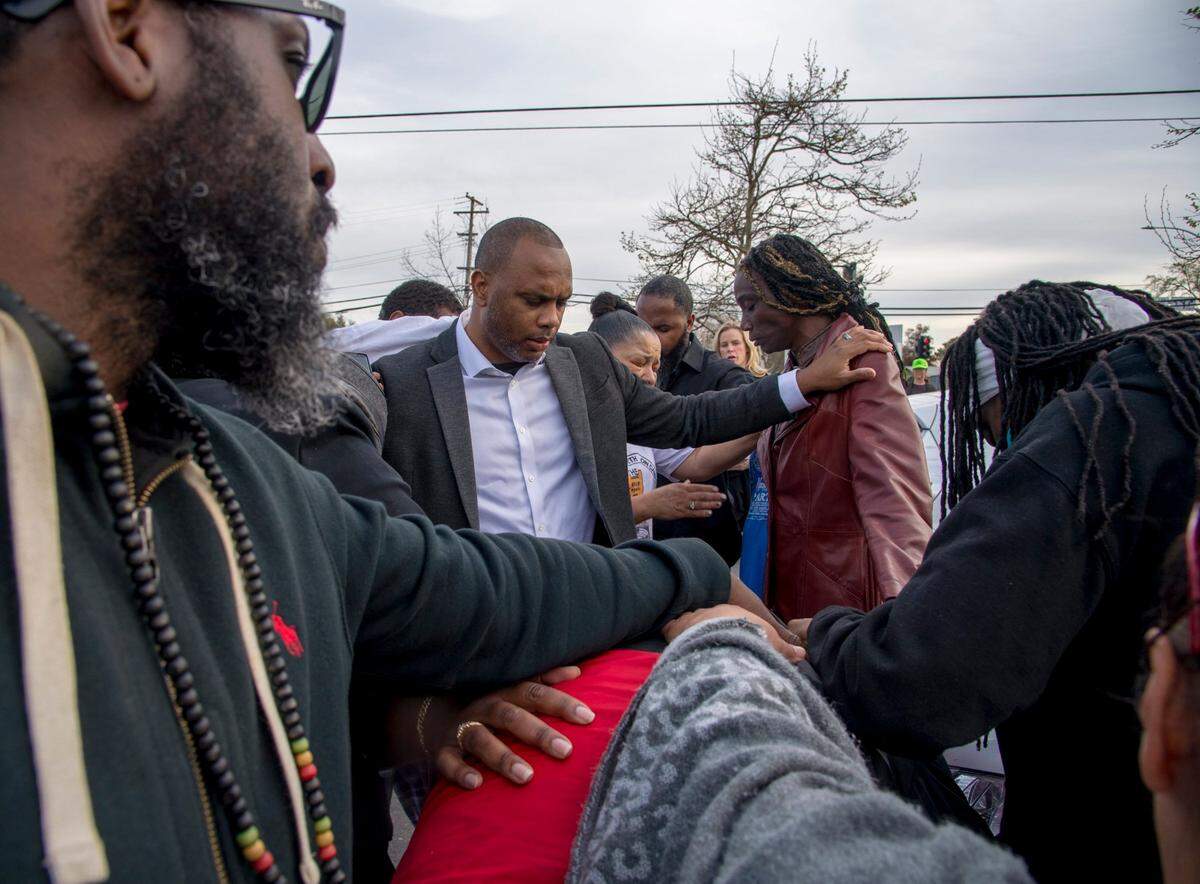
Tanya Faison, a founder of Black Lives Matter Sacramento, said the community needs to see that police officers are held accountable.
“They need to be fired, charged and we need a conviction,” Faison said. “That’s the only way the community will feel like our city and county government is safe for us. And we can’t even get to the fired part. We never get to the fired part.”
Faison said keeping those officers on the street has eroded community trust over time. Not just for the fatal shootings, she says, but for the smaller more routine harassment incidents in neighborhoods like Oak Park, Meadowview and Del Paso Heights she says suffer from “over policing.”
Currently, only Sacramento City Manager Howard Chan has the authority to hire and fire officers, according to the city charter. Changes to the city charter, such as that one, would require a voter-approved city charter amendment.
The authority the fire officers needs to lie with elected officials, Faison said.
Sonia Lewis, a founder of The Liberation Collective for Black Sacramento, said she’d like to see the City Council and review commission given power to determine whether an officer should be fired.
“They should be able to make that decision and not leave it in the hands of one person,” Lewis said
City Councilman Allen Warren represents North Sacramento, including Del Paso Heights, where Cain was beaten. He said he also would be interested in seeing this change, but the law as it stands may not allow it.
“I think we need to look at that as one of the proposed changes that we would like to make,” he said. “Now whether we can legally make them is another question. But I don’t think the state law allows the City Council to take a role in that process.”
Sacramento County Sheriff Scott Jones, an elected official, does have the authority to terminate deputies — the county’s Board of Supervisors do not. Extending authority to the board would likely require a change to the state Constitution, county spokeswoman Kim Nava said.
Ban tear gas, limit use of other less-lethal weapons
Thousands of protesters crowded Sacramento streets in protest earlier this month. Police officers and Sheriff’s deputies responded in a way they had not done in recent memory: they shot tear gas, rubber bullets and bean bags as vandals began coursing through the crowds to instigate vandalism and violence.
A teenage boy ended up with a broken jaw from a Sheriff’s deputy’s rubber bullets. A 29-year-old woman is partially blind. A legal observer was hospitalized after being hit in the face with a rubber bullet. An LGBTQ activist suffered a fractured skull and brain bleed after being hit with rubber bullets and a tear gas canister.
Similar scenarios, activists say, played out in cities across the country, prompting elected officials to consider bans on less-lethal weapons. Afterward, the city of Berkeley banned the use of tear gas, so did San Francisco. And a federal judge temporarily banned Dallas police from using less-lethal weapons and tear gas.
Sacramento City Councilwoman-elect Katie Valenzuela will represent the city’s central core and Land Park beginning in December. She said officials need to follow suit and ban Sacramento police and sheriff’s deputies from using tear gas. She also wants to see rubber bullets banned during peaceful protests.
“Just in the last two weeks we’ve seen a mom lose sight in one eye, a child have to undergo surgery, and several others severely injured by rubber bullets,” said Valenzuela. “Just because it’s less lethal than a gun doesn’t make it OK.”
Sgt. Sabrina Briggs, spokeswoman for the Sacramento Police Department, said in an email to The Bee: “Some of these less lethal options are utilized by officers on a regular basis to ensure the safest outcome possible. Taking away these options could limit the police department’s ability to safely address certain situations.”
Hire more Black officers
Seventy-four percent of Sacramento police officers are white, compared to 34 percent of the population, according to a 2018 city audit. Five percent of the sworn officers were Black, compared to 13 percent of the city population.
“Sacramento is one of the most diverse cities in the nation,” Simmons said. “The police department should reflect that diversity.”’
The department has increasingly focused on hiring diverse officer candidates, the department’s deputy chiefs have said in public meetings, including extending recruiting efforts to historically Black colleges.
Last year, one of its officers recorded a rap video targeting young people. Recorded at several iconic locations in the city, Officer Filmore Graham is pictured in his uniform and casual clothes, rapping “Be the Difference” and showing a young African American man envisioning himself as a police officer.
In February, the department also relaxed some of its requirements for recruits, including allowing visible tattoos and waiving a college education requirement for candidates with applicable military service.
Sixty-six percent of Sheriff’s Office personnel are white, according to a 2019 county report, though how many of those are uniformed is unclear. About 6 percent are Black. That’s compared to 11 percent of county residents who are Black, according to 2019 U.S. Census estimates.
Strengthen citizen oversight of police
Following Mann’s death, the city formed the Sacramento Community Police Review Commission, a group of community members appointed by the City Council, to provide oversight of department policies.
In the four years since its formation, it has helped the department revise its policies on body-worn cameras, mental health and use-of-force.
But after the Clark shooting, it still has little power to do much else. The commission exists in an advisory role, in contrast with other community boards such those in Los Angeles County and Berkeley, which have the authority to review critical incidents and even generate subpoenas.
Lewis and Simmons said Sacramento’s commission needs such power.
In March 2019, the commission recommended the council update its use-of-force policy to only allow deadly force as a last resort, modeled after San Francisco, among other recommendations. That would have gone further than the new state standard from Assembly Bill 392, which changed the statewide threshold from “reasonable” to “necessary” and was touted as the “Stephon Clark bill.”
But the council did not adopt the changes. The department’s current policy reads: “An officer shall only use the amount of force that the officer reasonably believes is necessary under the totality of the circumstances.”
“Why are these pretend entities being put in place to make it seem as though the city is progressive or wants to bring equity to these issues, but they sit on the desk of council for long periods of time?” Lewis said.
Simmons, who served as the commission’s first chair after the Mann shooting, later quit the position, he said.
“In critical moments such as the ones we had back then, the commission could not even question, couldn’t inquire and couldn’t hold accountable those responsible for these killings of unarmed black men and women,” Simmons said.
The nation’s current climate calls for overhauling the commission, Warren said.
“There needs to be accountability, transparency and ultimately there has to be consequences,” he said. “The kinds of behavior we’ve seen have not and will not change unless there are consequences for that behavior.”
“The commission needs teeth. Real teeth.”
This story was originally published June 14, 2020 at 5:00 AM.