
‘If you’re not counted, you don’t exist’: Census efforts continue in Sacramento County
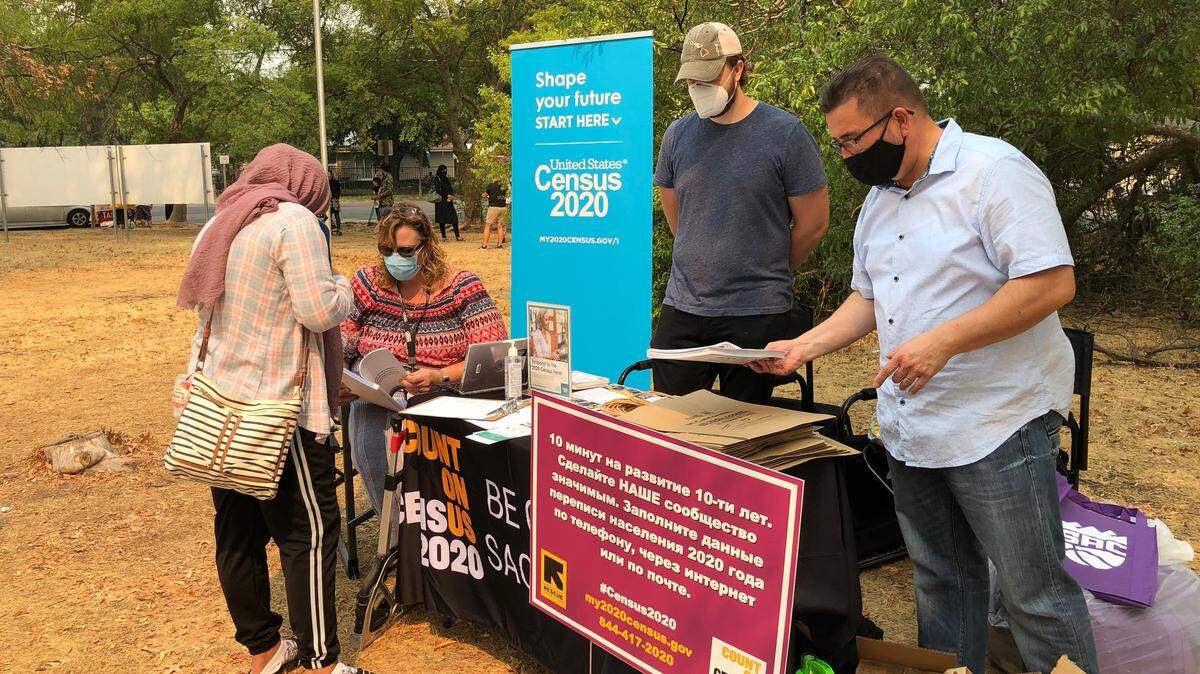
On a given Saturday, residents line up to get food assistance from River City Food Bank in Arden Arcade. Though people come for pasta, canned goods and other food, this summer many have walked away with something else: a completed census.
Abdul Basir Ahmadzai, an interpreter and case worker at the International Rescue Committee in Sacramento, has spent hours speaking in Farsi, Dari and other languages in an attempt to convince community members to fill out the census. As one of the only walk-up food banks, River City serves many who don’t own cars, including refugees, one of the hardest to reach communities in census-counting efforts.
Ahmadzai has been working with countless others in a major effort to get everyone to fill out their census, organized by Sacramento County’s Complete Count Committee. Facing a Sept. 30 deadline, the committee has been working to get as many census submissions as possible.
With a response rate of nearly 74%, Sacramento County has already surpassed the committee’s goal of 70.1%, which was the final result in the county for the 2010 census.
“We have already succeeded,” said Judy Robinson, the 2020 census manager for Sacramento County. Despite the achievement, organizers are pushing for more response, with some aiming for an incredibly ambitious 80%.
The Complete Count Committee has been meeting since fall 2018, uniting community groups across the county in an effort reach everyone. With community and government steering committees, the effort has doubled down on representing all in the county. With subcommittees focusing on ethnic and racial groups, the LGBTQIA+ community, seniors, children, different socioeconomic classes, business and industry sectors and other communities, the Complete Count Committee has gathered what they believe is a true representation of the diversity of Sacramento County.
‘So much is at stake for California’
The census, which occurs every 10 years, counts everyone living in the United States and its territories. The information gathered determines funding and congressional representation for communities across the country, making the count highly important.
Everyone in the United States is supposed to respond, with one form filled out per household. Residents can complete the census by mail, by phone or online by going to my2020census.gov.
Estimates from organizers in Sacramento County say that for each person who does not fill out the census, the county loses $1,000 in funding every year.
“Going into this process, we knew that so much is at stake for California in the 2020 census. We know that the state’s political legislation depends on an accurate count; we know that the distribution of federal dollars for critical public investments and services are all tied to an accurate count,” Niva Flor, the chief impact and strategy officer for the Sacramento Region Community Foundation said.
With some communities having up to 75% of the population labeled as “hard to count,” the committee created a massive plan with local organizations with deep roots in Sacramento County targeting various communities. Outreach events became catered to each community, pairing fun activities with census completion. While the Native American and Latinx subcommittees hosted a Kona Ice Truck and passed out free shaved ice, census takers worked with residents to complete the census.
“People are being so creative about what outreach can be,” said Gabby Trejo, executive director of Sacramento Area Congregations Together.
Other events have included caravans passing out information while playing loud music in hard to reach neighborhoods. Some organizers have put up yard signs so those walking by will take not of the census deadline. The committee paired with local food distribution sites as the demand increased with the pandemic. At River City Food Bank, nearly 20,000 residents come monthly, up 30% from normal distribution.
The Sacramento County Complete Count Committee has faced significant challenges in many areas, forcing them to be flexible with the plans they began making almost two years ago. When COVID-19 hit the community, in-person events and door-to-door outreach came to a halt and organizers had to transition to a virtual campaign.
With heat waves and long-lasting unhealthy air quality filling the region, volunteers and organizers were further set back with event cancellations.
“I am so proud of our partners and the work that they’ve done and the work that they’re continuing to do to get as many people counted as is possible. They are on a sprint through the rest of September to make that happen,” Robinson said.
Trump’s action on deadline challenged in court
With the deadline fast approaching, the fight over federal action taken by President Donald Trump earlier in the summer to move the deadline up by one month from the end of October continues to be challenged in court. The change pushed the committee to ramp up their outreach efforts while the legality of Trump’s change continues to be fought in court, with a federal judge putting a hold on Thursday to changes made to the census, awaiting a final judgment.
Ahmadzai explained that the census continues to be misunderstood in many communities, especially among refugees. While translating and advocating for the census at the River City Food Bank, Ahmadzai has heard many tell English-speaking census takers that they have already completed it, when in reality they have not and just don’t understand it.
Many have voiced concerns with sharing their information, but Ahmadzai has explained the benefits to the community that an accurate census count brings. Missy Orr, community engagement manager for the International Rescue Committee, explained the refugee community was benefiting from funding in the county to organizations and government agencies that they rely on like all other residents.
Orr said that once the language and culture barrier had been overcome and the IRC can make sure refugees fully understand the census, they are eager to complete it. The IRC has done outreach in various languages sending fliers and brochures to all families. The organization has also included census information in phone calls, classes and when assisting new families, especially due to the concern that internet and technology may not be accessible to all.
Trejo has encouraged everyone to check with family, friends, neighbors and coworkers to make sure they have filled out the census and warns people not to assume that someone has already done it. The census is the only way that funding and representation can represent populations.
“If you’re not counted, you don’t exist,” Robinson said.
This story was originally published September 21, 2020 at 5:00 AM.