Sacramento Police Chief Daniel Hahn says he’s retiring after four turbulent years
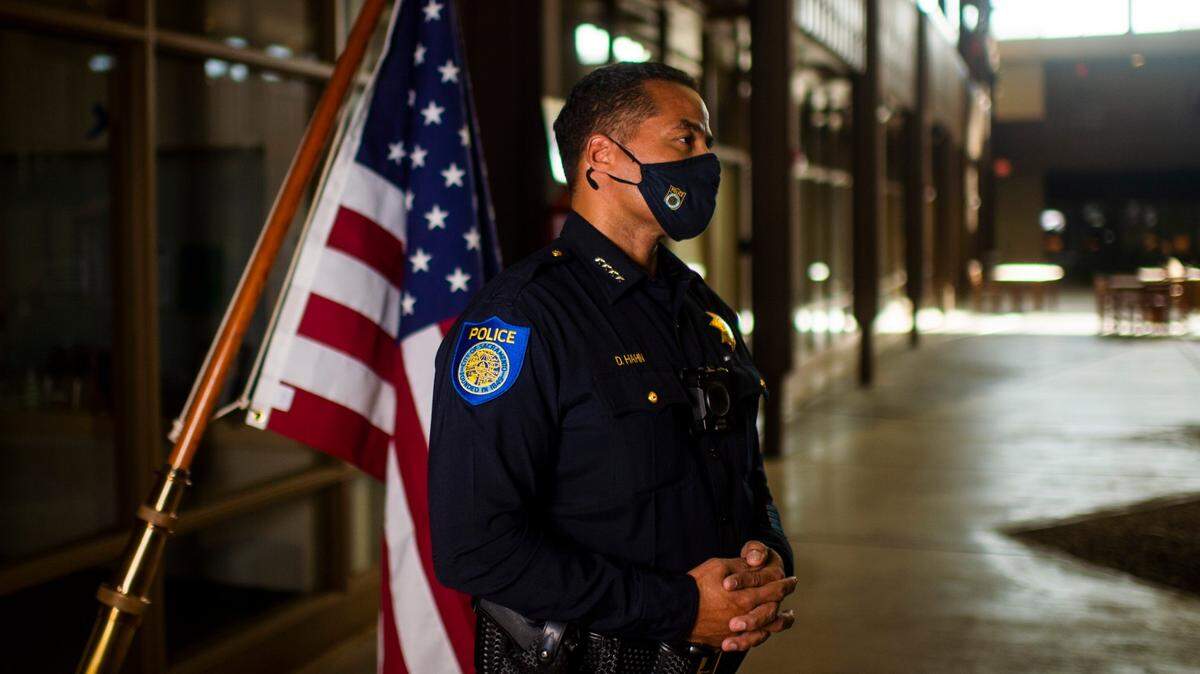
Sacramento Police Chief Daniel Hahn announced Wednesday he will retire at the end of the year after a four-year tenure.
Hahn, the first Black police chief in the city, said in a social media post he submitted his intention to retire to City Manager Howard Chan on the same day of his swearing-in ceremony in 2017.
He served as the city’s 45th in a turbulent era. In 2018, two police officers shot and killed 22-year-old Stephon Clark in the backyard of his grandparents’ home. Impassioned protests ebbed and flowed for months in Sacramento as the community reckoned with its police department.
Stevante Clark, Stephon’s brother and a community activist, said he was glad to hear Hahn was retiring.
“I love the chief but I’m glad he stepped down,” Clark said. “As a Black man, we thought he was going to represent us and our cause and our fights and it feels like as a Black man, he did not.”
Clark was extremely disappointed the city did not fire the two officers who killed his brother. The city manager ultimately decides whether to fire officers, but the police chief makes recommendations, according to the city charter.
“I believe SacPD should know the difference between a gun and cellphone and those officers not knowing the difference between a gun and cellphone should’ve been terminated,” Clark said, referring to the cellphone his brother was holding, which officers said they mistook for a gun.
No charges were filed against either officer after several investigations.
Clark also criticized Hahn for the department being noncompliant with a new state law governing use of force for nearly a year and a half, according to the ACLU.
Ultimately, the city ended up with stricter language than the state law, allowing deadly force only as a last resort, but it took too long, Clark said.
“Slow progress is no progress,” Clark said. “We expected him to act sooner.”
Hahn began his career as a community service officer for the Sacramento Police in 1987 and later rose to the rank of captain. He grew up in Oak Park, where he was raised by his adoptive mother, Mary.
“They love him in Natomas just as much as they love him in south Sacramento,” said Councilwoman Angelique Ashby in 2017. “He gets us and gets what Sacramento is about.”
Mayor Darrell Steinberg praised Hahn for taking steps to make the department more transparent and accountable, including a policy to release all body camera footage within 30 days of officer-involved shootings.
“This is a chief that comes from the community,” Steinberg said. “He understands and has the respect of the community. He understands and has the respect of the department and the rank and file and he has pushed to modernize our police department and to address some of the most difficult issues of our time.”
When he was sworn in, Hahn said a top priority of his was to connect with people in the community. After the shooting death of Clark, Hahn repeatedly met with activists and community members to hear their complaints and consider police reforms.
The Sacramento Bee previously reported that police arrived a little after 9 p.m. Sunday on March 24, 2018, responding to a 911 call of a man breaking into vehicles. Airborne Sacramento County Sheriff’s deputies in a helicopter said they saw the man use a “tool bar” to break into a window of a home, occupied by resident Bill Wong.
After they saw the man, later identified by police as Clark, break into the window, he ran south and jumped a fence into his grandparents’ yard next to Wong’s home, police said.
Officers saw Clark along the side of his grandparents’ house, and he soon fled and ran toward the back of the home, according to the department news release. Police said they then pursued Clark where he “turned and advanced towards the officers while holding an object which was extended in front of him.”
Police said officers believed the object was a gun and fired at him 20 times. Clark’s grandmother Sequita Thompson told The Bee the object was an iPhone, which police found near his body.
Berry Accius, the founder of Voice of the Youth, said in 2018 that the shooting is viewed as a defining moment to see how far the department and Hahn were willing to go in being transparent and accountable as questions were raised on what led up to Clark’s death.
Tensions were high not only from the shooting but the ensuing protests that followed. Some people were enraged by the police’s reaction to a 2019 protest march in East Sacramento where more than 80 people were arrested on a public street.
The police department made some changes in response. It revised its use-of-force policy in September 2019, adding required intervention techniques when dealing with people who appear to be mentally ill. The department also revised the policy on June 8, removing the “carotid” neck restraint as an acceptable use of force in response to the murder of George Floyd by a police officer in Minneapolis.
But members of the community in Sacramento, a city that has dealt with excessive force from police, have been frustrated with what they say has been years of City Council indecision and deferral.
The City Council adopted a new use of deadly force policy for police earlier this year. The policy replaced language regarding the use of force as a last resort. The new language reads: “A peace officer is justified in using deadly force upon another person only as a last resort when reasonable alternatives have been exhausted or are not feasible and the officer reasonably believes, based on the totality of the circumstances, that such force is necessary.”
The City Council also adopted all language verbatim from Assembly Bill 392 – the state law that strengthened the deadly force standard from “reasonable” to “necessary.” The law was passed following several deadly shootings by police, including Clark’s.
Steinberg said he hopes the next chief is supportive of additional reforms, including the city’s plan to transfer some noncriminal 911 calls away from police and redirect them to unarmed employees in the new Department of Community Response.
“I think we want to continue what Chief Hahn started,” Steinberg said. “The work is never done ... it’s a hard job.”
This story was originally published August 11, 2021 at 4:23 PM.