Davis is one of the most desirable places in the region to live. Why are so few moving there?
By Danielle McKinney and
Sara Nevis
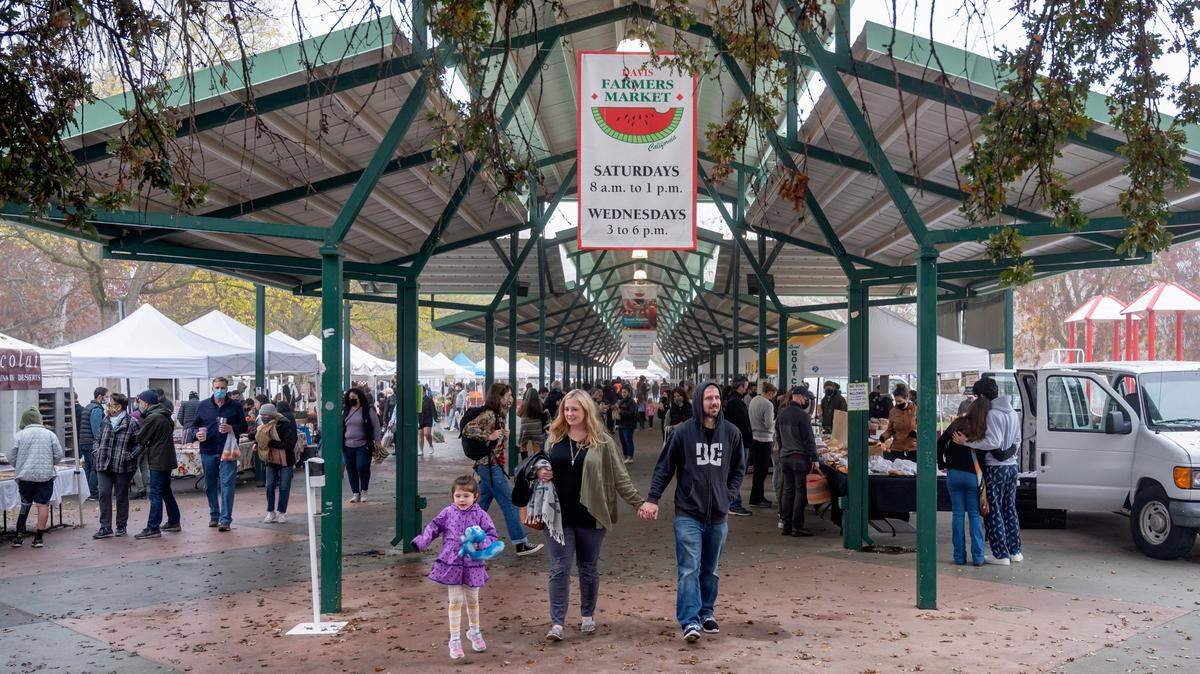
Kristen Patchett, center, of Sacramento, walks with Tim Thixton and his daughter Grace, 5, at the Davis Farmers Market at Central Park in Davis on Saturday, Dec. 4, 2021. Patchett said she used to go to UC Davis and likes to come back to her old stomping grounds.
Sara Nevis
snevis@sacbee.com
Jeff Irwin sold his home in Overland Park, Kansas, for around $250,000 and made the decision to move his family to Davis 20 years ago. He and his wife braced for the cost of housing to be nearly double what they were used to.
Irwin’s 1,600-square-foot Streng home was built in the mid-1960s and sits in the University Estates neighborhood of Davis. It has a modern flair, with four bedrooms, two bathrooms and a pool in the backyard. Irwin said over the years he has received calls from real estate agents asking if he would be willing to sell.
“Fortunately, we’ve been able to capitalize on refinancing our house as interest rates have continued to drop,” Irwin said. “Our mortgage payment is $1,800 a month, something like that, which you couldn’t rent a place in Davis like this, you can’t get an apartment sometimes for that.”
The Irwins bought their home for about $465,000 and had no clue what it would eventually be worth. Similar homes are currently valued in the $800,000 to $900,000 range, according to Zillow.
Steadily rising home prices and a lack of new housing development are two of the main reasons Davis grew by only 2% over the last decade, 2020 Census figures show. Among the area’s cities, only the tiny communities of Colfax and Isleton saw slower growth.
Davis remains one of the Sacramento region’s most desirable places to live. Its schools are excellent, regularly sending students to the best colleges in the state and nation. It is one of the most bikeable cities in the country and makes a collective effort towards sustainable living.
Due to its proximity to the University of California, Davis, it has a higher proportion of residents with bachelor’s degrees than the large majority of cities in the state.
But moving to the city is becoming increasingly difficult. The city of Davis didn’t build much new housing over the last decade. The total number of housing units in Davis increased by about 1,200, roughly 4.6%, Census data shows.
Irwin’s roots in this city run deep. He has served the community as the pastor of Davis Lutheran Church for the past 16 years. He said that he has heard story after story from members of his congregation finding ways to work in Davis yet living outside the city or of residents paying expensive rent for a small housing unit.
Irwin said that he and his wife were able to afford their home in Davis by living hand-to-mouth, saving and being a dual income household.
He said it was like “sticker shock” thinking they could even afford something at that price.
The housing landscape of Davis
When it comes to new development in Davis, residents hold a lot of the power. In 2000, residents voted to pass Measure J, the “Citizens’ Right to Vote on Future Use of Open Space and Agricultural Lands Ordinance.” The measure was put into place to protect agricultural land from urban development in and around the city.
Councilman Dan Carson said Davis has not been a “sprawling community.” He said the focus has been to protect farmland, but he recognizes there are cases where accommodations need to be made for jobs and housing and said the council is working to address those issues.
“This is actually a pro-housing Davis City Council, but we have in place, and voters just last year renewed, a local ordinance that says if you’re going to annex farmland or open space land to the city of Davis for urbanization, it can be commercial or housing that the public votes on whether to permit such an annexation,” said Carson.
The average rental cost for a 955-square-foot apartment is about $2,400 according to RentCafe.
“I have in my church some young professors I know that can’t afford to live here, so they moved to Woodland,” said Irwin. “Families can buy more house in Woodland — bigger size, less cost, so families live in Woodland more recently than live in Davis, that’s in my congregation.”
Danny Lau has been a real estate agent with Lyon Real Estate for the past six years — the last three he has served the community of Davis from his office on 2nd Street. Lau said apart from the development of The Cannery, a new complex of single-story flats and some parts of South Davis, he has not seen a huge wave of new inventory or growth in the city.
“I think there is a pride of ownership in Davis. Big corporations and large investments are kind of on the outskirts of the city,” said Lau. “People like to keep the city within the framework of its culture, within the demographic that it’s comfortable with. Davis likes to keep itself relatively like a small town with easy access to big cities.”
Lau said he has seen housing costs in Davis rise over the last few years. He said roughly 30% of his buyers are coming from the Bay Area, around 40% are still local buyers, another 20% of buyers are coming from Sacramento and surrounding areas and around 10% are coming from out of state.
“I think in the middle of the pandemic, all of a sudden the buyers’ frenzy went up even higher,” said Lau. “Interest rates were historically low, and a wave of Bay Area buyers having more remote support capability wanted to expand outside of the Bay. That further drove the real estate prices in Davis north.”
Home prices in Davis have been rising over the last decade according to Zillow. The median home price in Sept. 2010 was $494,000. As of Sept. 2021, the median home price in Davis is $832,000.
Home buying on the horizon
Lau predicts more potential buyers over the next 5 years will be millennials and the oldest of Gen Z. But a lack of new housing units and rising interest rates will cause a housing supply issue in Davis.
“I’m not an economist by any stretch of anybody’s imagination, but it doesn’t take a genius to figure out that as the feds taper out their bond purchases the affordability goes down,” Lau said. “A lot of existing homeowners refinanced during this historical low interest rate period. So that actually makes the shuffling a bit more illiquid because now instead of saying, ‘Maybe I upgrade to a new house or move to a different part of the area’ — where else are you going to find such low interest rates?”
Stephanie Maroney initially came to Davis as a graduate student and decided to stay. She has lived in Davis the last 10 years and is the owner of Handheld Sweet and Savory Pies, which she sells in downtown Davis out of a vintage 1969 Ford Vanette food truck.
She said she thinks the cost of living in Davis keeps people from being able to live there and said that her future vision for the city would be for it to become more racially, demographically and economically diverse.
“I would love for it to grow in ways that make that (vision for Davis) possible and not grow in ways that just make giant houses for people to move in and have giant yards,” said Maroney. “I don’t oppose growth, but I worry that that opportunity would make it possible for already wealthy people to have extra wealthy condos or huge houses with giant lots in yards.”
Irwin voiced some of the same future visions for the city as Maroney.
“I’d love to see more affordable housing. I’d love to see a more diverse population in Davis,” said Irwin. “I’d like to see people without the means to be able to live here – people who work here should be able to live here.”
Davis could add more people and homes soon, said Carson.
“Our voters a couple of years ago approved a very large student housing project because they recognized the need,” Carson said. “They also approved a senior complex. Neither of those have been built yet, but they’re both still in progress and going through the paperwork and hoops to actually get built.”
Makeup of Davis
With nearly 70,000 residents, Davis is a relatively small town. However, recent Census data shows the city grew by 3,171 Hispanic residents and 412 Asian residents in the last decade and lost nearly 4,500 of its white residents. Carson believes the timing of the Census and the loss of Davis residents was greatly affected by the Covid-19 pandemic.
“Our city population probably did drop by the 4,000 they (Census) recorded when in-person classes at UC Davis were shut down. Roughly half the students live in our city proper and would have been counted or not counted with the other half living on the campus itself,” said Carson. “We took a hit, but they’re back to regular operations now. If you come visit our downtown on a Friday night you will see that it’s a happening place and students are back in very large numbers.”
Carson said Davis’ diversity is in no small part due to UC Davis and its students. With the influx of students to the area Carson said in 2018 that UC Davis had to implement a growth plan in an effort to create housing on the campus itself.
UC Davis is home to over 11,000 students each year, according to UC Davis Student Housing and Dining Services. Students either live in on-campus residence halls, university operated apartments or cooperative housing units.
An agreement was reached between the city of Davis, Yolo County and UC Davis that the campus housing units be built if the university helps deal with the consequences of that growth in terms of housing and transportation, according to Carson.
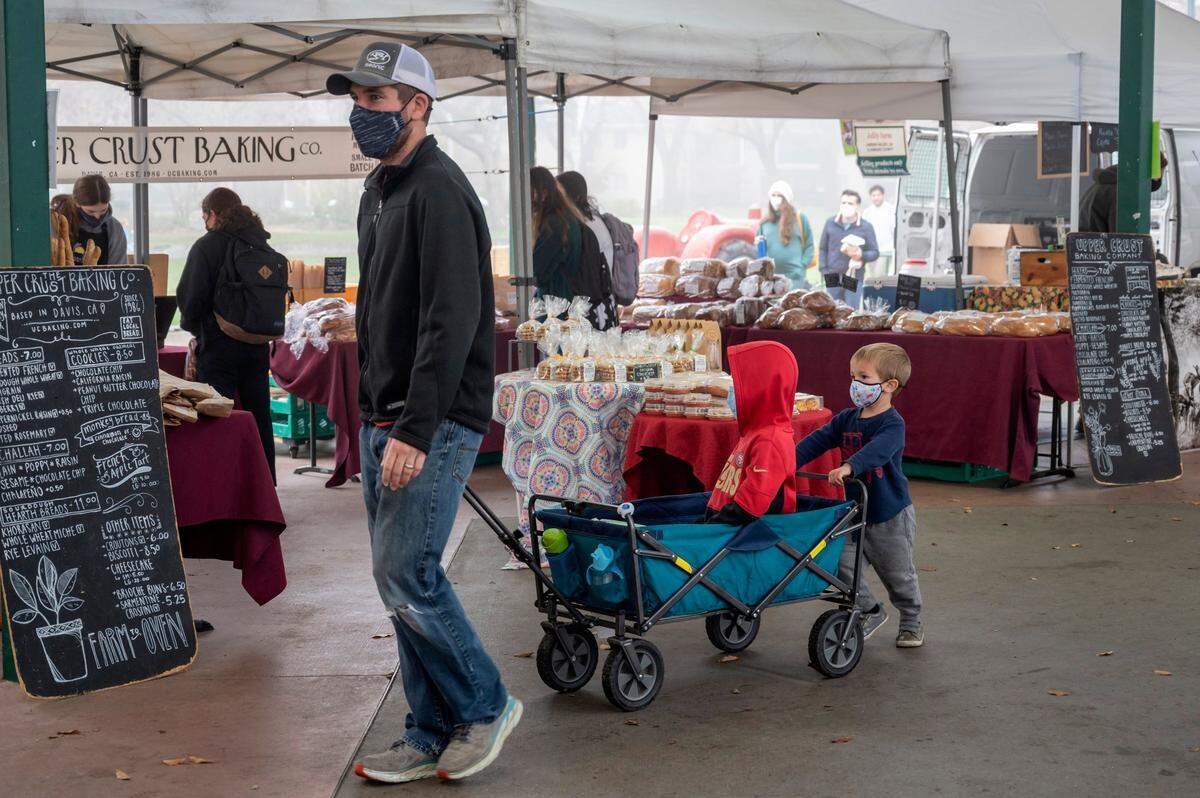
Cape Zern, of Davis with his sons Cooper, 7, and Cruz, 3, ride in a wagon at the Davis Farmers Market at Central Park in Davis on Dec. 4. Sara Nevis snevis@sacbee.com
Planning ahead
Carson said they are working on a joint planning effort called “Reimagine Russell.” Which will work to address traffic issues on Russell Boulevard, a street Carson said is the north/south dividing line between where the city of Davis ends off and the campus begins.
“Both the campus and the city are relying on that artery to move traffic around our city. Honestly, it’s the kind of planning effort that should have occurred decades ago,” said Carson. “We’d all been better off if we had, but we’re now in a new and much more collaborative mode these last few years.”
Carson said there has been reasonable concern and a lot of debate in Davis that the city has not done enough to provide the new housing that is needed. He says a concerted effort is being made by the city to address these concerns through approval of housing projects targeted to meet the needs of the student population, the senior and disabled population and family and workforce population in Davis.
“Me and my colleagues on the council have repeatedly stated and have emphasized in our new housing element that’s an area where we need to do more work,” said Carson. “There are too many people who work in the city of Davis that can’t afford to live in the city of Davis, and we know we need to do better there.”
This story is part of a collaborative project between The Sacramento Bee and seniors in the journalism program at Sacramento State. For more information about the program, or to send a message, visit facebook.com/sacstatejournalism.
This story was originally published December 29, 2021 at 5:00 AM.
Get one year of unlimited digital access for $159.99