Joan Didion, legendary New Journalism writer and Sacramento’s native author, dies at 87
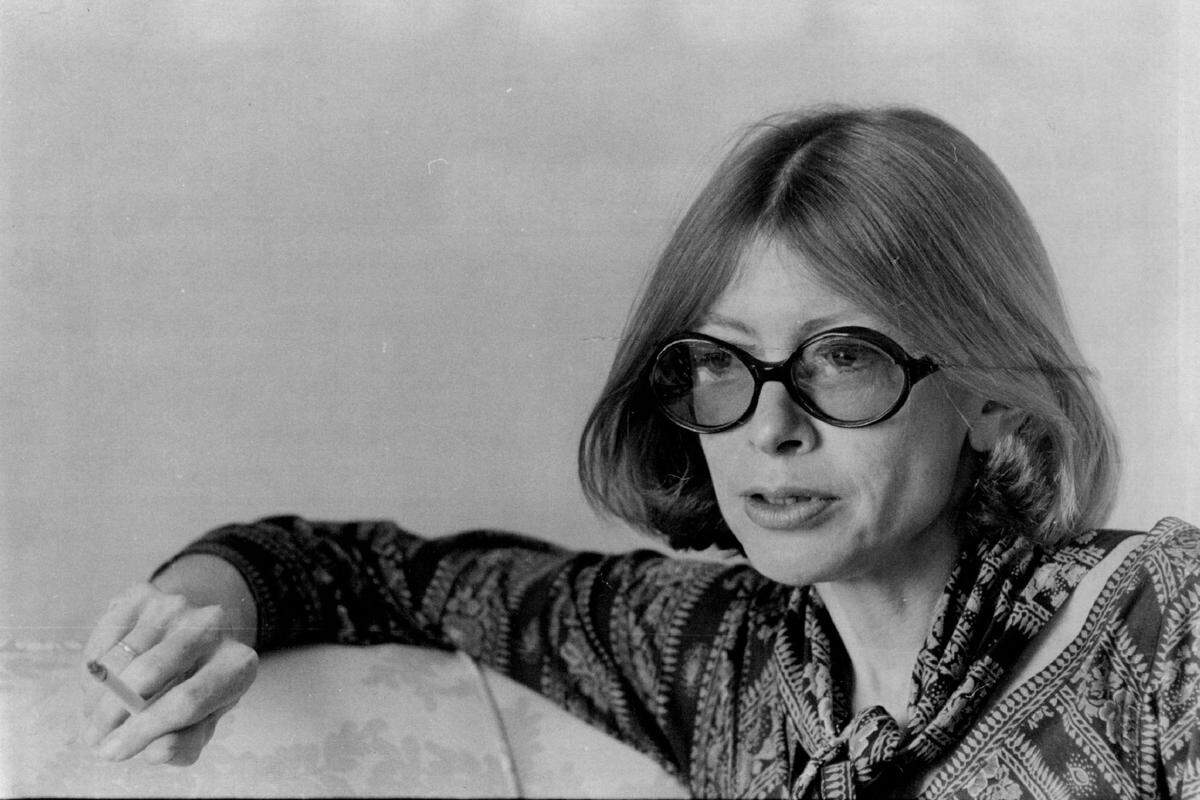
Joan Didion — the legendary writer who chronicled life, counterculture and pain in California with her deeply personal works and cutting social commentary — died Thursday morning at 87.
A fifth-generation Californian born and raised in Sacramento, Didion launched her career in New York City in the 1960s after winning an essay contest sponsored by Vogue magazine, landing the job as the contest’s prize.
A Sacramento Bee headline in 1979 deemed Didion “the unquestioned owner of California.”
“I wrote about California because I wanted to remember it,” she said in 2014, in a taped video message to accept her induction into the California Hall of Fame.
Didion died at her Manhattan home of complications from Parkinson’s Disease, publisher Alfred A. Knopf and its parent company Penguin Random House said in statements Thursday morning.
“Didion was one of the country’s most trenchant writers and astute observers,” Penguin Random House wrote. “Her best-selling works of fiction, commentary, and memoir have received numerous honors and are considered modern classics.”
Her 1968 essay collection, “Slouching Towards Bethlehem,” marked a defining work on the California counterculture movement and its center in San Francisco’s Haight-Ashbury district.
“The Year of Magical Thinking,” an autobiography of Didion’s grief following the death of husband John Gregory Dunne, whom she married in 1964, won the 2005 National Book Award for Nonfiction and was a Pulitzer Prize finalist.
Her 1979 collection “The White Album” dove into California history and politics in the late 1960s and early 1970s, a memoir whose topics ranged from drug experimentation to the Sharon Tate murders.
Didion also, in 1991, penned the first mainstream media piece suggesting the Central Park Five had been wrongfully convicted, writing on the topic in an article for the New York Review of Books. The five defendants’ rape and assault sentences were vacated more than a decade later.
Didion left Sacramento years ago, but her legacy lives on around the city, including the 2400 block of J Street in midtown. That’s where developer Julie Young replaced a former auto shop with a four-story condominium building in 2019, with ground-floor tenants Ginger Elizabeth Patisserie, Ro Sham Beaux wine bar and Babes Ice Cream & Donuts.
The building’s name? The Didion.
“Joan Didion lent credibility to the introspective intellect of Sacramento,” Young wrote in a text message. “She struck me as a possible late-bloomer, much like this town, and probably much like me. She observed hypocrisy without bias. She lifted me with magical thinking and taught us all with (her 2017 book) South and West.”
Born at Mercy General Hospital on J Street in East Sacramento, Didion moved frequently in her early childhood, the daughter of an Army Air Corps member during World War II. She returned to Sacramento in the early 1940s, graduated from McClatchy High in 1952 and got her bachelor’s degree in English at UC Berkeley in 1956.
Didion won the Vogue writing contest, the “Prix de Paris,” her senior year at Berkeley.
She went on to become an icon in the New Journalism literary movement, with Truman Capote, Hunter S. Thompson and Nora Ephron among her contemporaries.
California Gov. Gavin Newsom in a statement Thursday called Didion “peerless in her capacity to write about life, loss, love and society.”
“Her ability to put the tapestry of California and the times into words made her a treasure for her generation and generations to come.”
Didion received a National Humanities Medal in 2012, praised for devoting “her life to noticing things other people strive not to see,” and a National Medal of Arts in 2013, presented by former President Barack Obama.
Countless writers and authors mourned Didion’s loss on social media.
“Her writing about grief became its own genre,” author and TV writer Bess Kalb tweeted. “I can’t believe one person could be The Defining Voice about so much. While being so chic. All hail.”
Over a writing career that spanned more than 50 years, Didion’s work garnered more mainstream attention in the 21st century.
“The Year of Magical Thinking” was adapted into a Broadway play in 2007. A 1979 quote by Didion (“Anybody who talks about California hedonism has never spent a Christmas in Sacramento”) serves as the epigraph to the 2017 film “Lady Bird,” shot in Sacramento by another native, Greta Gerwig, who has named Didion among her influences.
And a 2017 Netflix documentary, “The Center Will Not Hold,” chronicled her life through interviews and archival footage. Didion’s nephew, Griffin Dunne, directed the film.
“We tell ourselves stories in order to live,” Didion wrote in “The White Album.”
Live she certainly did.
This story was originally published December 23, 2021 at 9:59 AM.