‘A false hope:’ These Sacramentans waited years for a voucher, now they can’t find homes
After more than a decade on the streets, Timell Brown was ecstatic to receive a highly-coveted Housing Choice voucher.
The voucher, formerly called Section 8, gives her $1,100 toward rent — enough to get a Sacramento studio apartment.
More than five months later, Brown is still sleeping in a tent.
It’s not for lack of trying. She’s applied for more than 30 apartments, forking over at least $40 in application fees each time. She has been denied every time.
“I was excited (when I got the voucher),” Brown, 34, said. “I was like, ‘Hey I got somewhere to go now. But I’m still out here.”
About 1,250 Housing Choice Voucher holders in Sacramento do not have housing, according to the Sacramento Housing and Redevelopment Agency. The number ticked up from 1,000 two years ago, despite a new state law aimed at making it easier for voucher holders to find housing.
That law, which went into effect in January 2020, prohibits California landlords from writing “no Section 8” in rental postings. The month it went into effect, 60 Sacramento postings had that phrase, The Bee reported at the time. As of this month, only two did.
But that doesn’t mean voucher holders are having an easier time finding housing.
The problem has gotten worse during the pandemic, said Kendra Lewis, executive director of the Sacramento Housing Alliance. She said her nonprofit receives multiple calls a week from voucher holders who can’t find housing.
This is new, she said. She has worked for Northern California housing nonprofits for the last 25 years.
“When somebody calls me and tells me they have a $2,500 voucher and they can’t find a place, something is wrong,” said Lewis. “That is shocking to me. I’ve just never heard of it before.”
Crowded housing market
An influx of Bay Area workers have moved to the capital city during the pandemic, seeking more affordable housing and more space to work remotely, exacerbating an already tight housing market, Lewis said. As the region emerged from the Great Recession, the typical apartment rent soared 45% over the last seven years, adjusting for inflation. The typical apartment rent in the Sacramento region is now higher than in Seattle, Washington, D.C., and New York.
To address the city’s housing shortage sufficiently, the city would need to create 16,769 new housing units for low-income residents, who earn less than $69,000 for a family of four, by 2029, according to a state-mandated report.
Landlords know they will receive monthly rent from a voucher, but they could be denying voucher holders for other reasons. Those reasons include their apprehension that low-income renters will damage the apartment, break the lease or commit crimes.
Lewis finds women of color, like Brown, are discriminated against the most, she said.
“People just have a stigma when it comes to the vouchers,” Lewis said. “They think the voucher holders are going to be a certain way so they will flat out deny them. It’s ignorant racism.”
Lewis once received a call from a disabled voucher holder who was evicted from the apartment she had lived in for 25 years, she said. Another day, she got a call from a woman whose voucher was $13 a month short to cover the monthly rent. She offered to pay the difference in cash, but the landlord denied her application anyway.
Some of the apartments for which Brown has applied would have cost significantly less in monthly rent than her $1,100 voucher.
She applied for a unit in a house just south of the Hagginwood neighborhood in North Sacramento. The rent was $995 a month — over $100 a month less than her voucher. But she still didn’t get it. She also applied for a 400-square-foot studio in south Sacramento near where she grew up. She didn’t get that one either.
A few of the property management companies have told her she was being denied for her poor credit score, which is around 460, she said. An excellent credit score is 800 and above.
Two years ago, SHRA even started offering cash incentives to landlords to accept vouchers. That program persuaded 134 new landlords to rent to tenants with vouchers, said Angela Jones, SHRA spokeswoman. But that still isn’t enough of an incentive for many. While about 12,000 families have found housing with a voucher in Sacramento, 1,200 have not.
To help remedy the issue during the coronavirus pandemic, the U.S. Department of Housing and Urban Development launched a new type of voucher called the Emergency Housing Voucher, funded by the federal American Rescue Plan Act. But Sacramentans are having a hard time finding housing with those, too, despite SHRA offering the same cash incentives to landlords.
Of the roughly 500 vouchers HUD gave SHRA, only 37 are held by people who are living in housing.
‘False hope’
The vouchers, once relatively accessible for low-income families, became very hard to get when former President George W. Bush’s administration drastically cut the program, Lewis said.
More than 54,000 people are currently on the waiting lists for various housing vouchers in Sacramento, according to SHRA. The waiting list just reopened earlier this month, so the number is now likely closer to 60,000.
Kristi Phillips, who is couch surfing with her partner and three children, has been on the waiting list for more than 12 years.
.JPG "SAC_RCB_20210528_HOMELESSFAMILY0139 (1).JPG")
The long wait only adds to the immense excitement and relief people feel when they finally get a voucher, said Crystal Sanchez, president of the Sacramento Homeless Union.
“It is like a golden ticket,” Sanchez said. “The problem is the golden ticket doesn’t have the prize at the end of the tunnel. It creates false hope because people believe once they receive a voucher, it’s the end to being homeless. But that is not the case. There are multiple barriers once you receive a voucher, including finding housing, getting through the barriers such as previous evictions, criminal records, and credit scores.
“On top of all of this, the people need to maintain communications with the entities providing the vouchers. Often times, people do not have phones or mailboxes, therefore things are not turned in on time and they lose their spot. The other thing we see is that these expire before they actually find housing.”
Voucher holders typically have 120 days to find a landlord willing to accept the voucher, Jones said. But SHRA is extending the deadline for people actively searching for housing, she said.
But Brown doesn’t know that. She is terrified of her voucher expiring. SHRA extended Brown’s voucher around Thanksgiving, but she does not know when it expires or if they will extend it again, she said. SHRA officials do not answer the phone when she calls or return her voicemails, she said.

The issue occurs not just in Sacramento, but across the country, especially in areas with “hot rental markets,” said Eduardo Cabrera, a HUD spokesman.
“It’s always heartbreaking for anyone to be enduring homelessness, but it’s especially so when it’s someone with a housing voucher,” Cabrera said in an email. “The Sacramento area is not immune to the nation’s affordable housing shortage which is driven by a combination of an insufficient housing supply, limited funding to increase it, and prohibitive local zoning regulations ... And lastly, while source-of-income discrimination is illegal in California, that does not deter ignorant or unscrupulous landlords from doing it anyway.”
President Joe Biden’s Build Back Better framework would help address the housing crisis by funding the construction or rehabilitation of more than 1 million affordable homes nationwide, said Cabrera.
“(The) framework makes the single largest and most comprehensive investment in affordable housing in U.S. history,” Cabrera said. “More homes – and more affordable housing – means lower prices and better options for working families feeling the pinch of higher housing prices.”
But the Build Back Better Act still needs approval from the U.S. Senate — a difficult hurdle. Joe Manchin III, the West Virginia Democrat and swing vote in the Senate, said earlier this month he opposed it.
She waits and worries
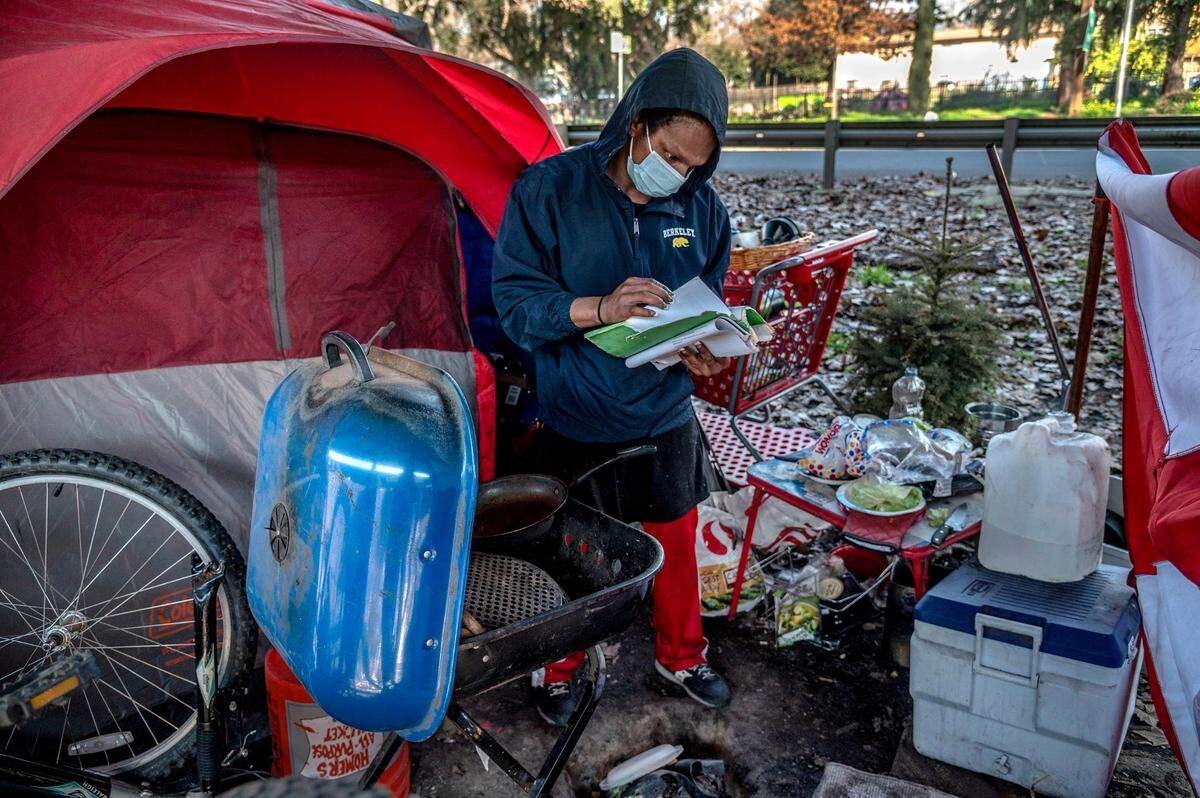
In the meantime, Brown waits. She suffers from depression, anxiety and schizophrenia. She sleeps in a gray and red tent off W Street surrounded by freeway on and off ramps.
Cars and trucks speed by, polluting the air she breathes. Outside her tent are little signs she’s attempted to make a home — a Coca Cola flag hung in an attempt at privacy, a welcome mat, a grill and a dying Christmas tree.
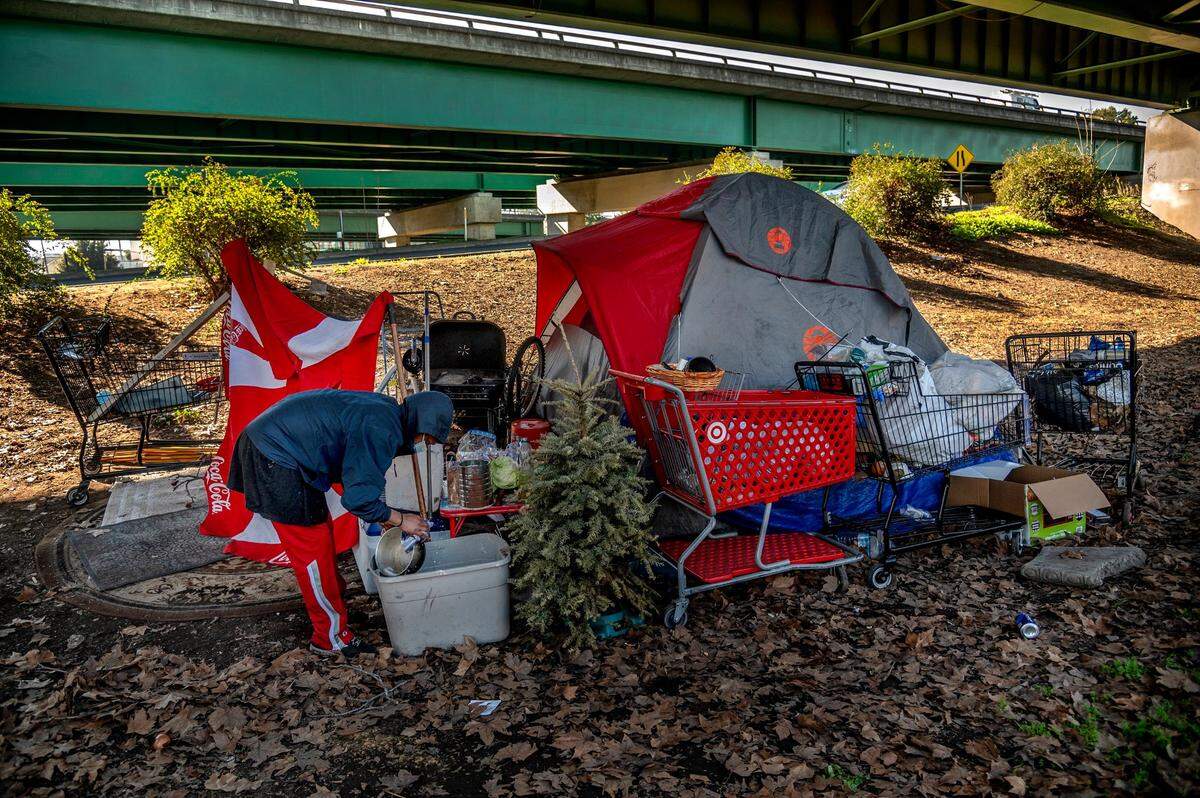
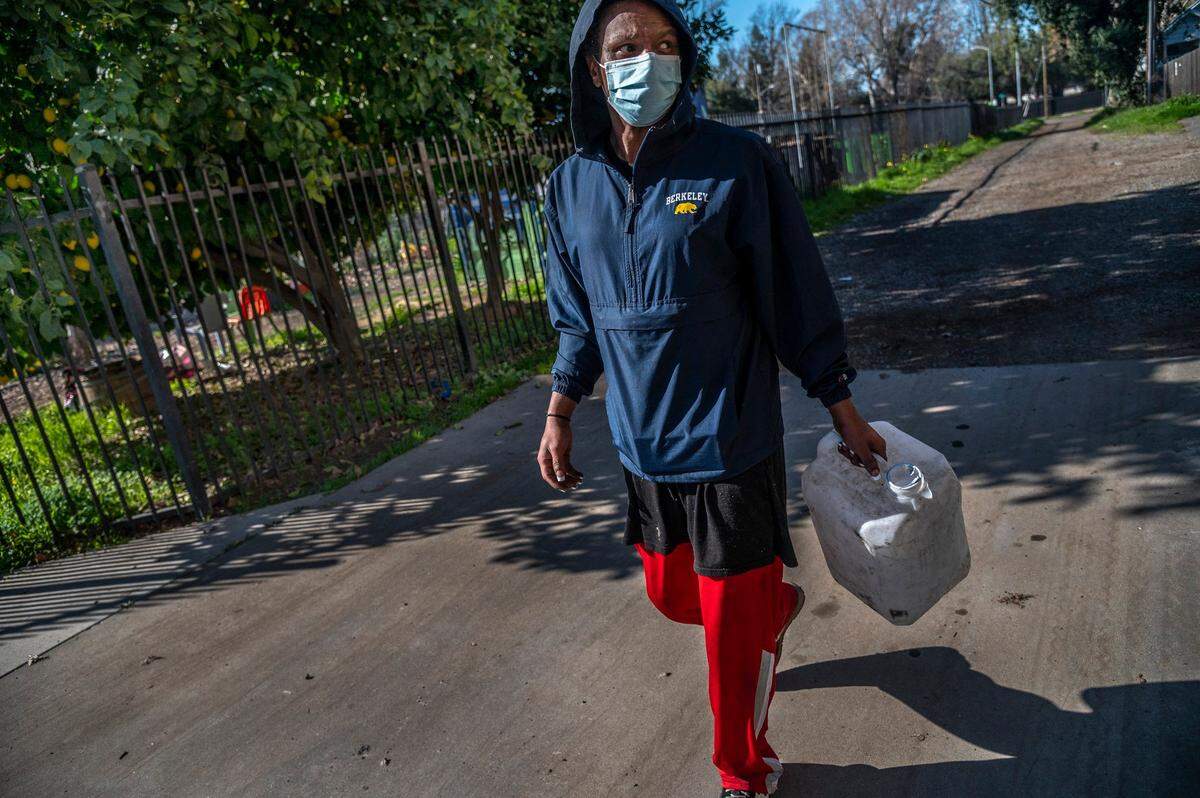
She longs deeply for housing for many reasons — she would have a place to shower, for one. She would also have place to get clean water, instead of walking around Southside Park with a water cooler jug, searching for a place to fill it. . She would have a sink to wash dishes in, instead of the gray plastic storage bin she uses. She would have a locking door for safety and wouldn’t have her belongings stolen. Earlier this month, someone stole her bicycle tire and recyclables she planned to return to get money for food.
But the biggest reason she longs for housing is to make her mom proud. Brown is a stoic, unemotional woman who doesn’t cry easily, despite her difficult situation. But the thought of losing her voucher before she can get an apartment her mom can visit brings her to tears.
“I want somewhere to call home so my mom can be proud and come visit me,” Brown said, tears forming behind her brown eyes. “She didn’t raise me to be out here like this. She was so proud when I got a voucher. She keeps saying, ‘don’t lose it, don’t lose it.’ I’m trying everything not to. But how many extensions can you get?”

This story was originally published January 30, 2022 at 5:00 AM.