
Will Fort Bragg become a choo-choo town? Skunk Train owners, city battle over expansion
Railroad or tourist train? A way to enjoy the beauty of the Pacific or potentially crass train theme park?
These questions reside at the core of a battle brewing between the owners of the historic Skunk Train and city officials in coastal Fort Bragg, and the outcome could shape the character of this Mendocino County community for years to come.
The dispute stems from the acquisition by the Skunk Train’s parent company, Mendocino Railway in November 2021, of more than 270-acres of the former Georgia-Pacific lumber mill that sits along the Pacific Ocean.
Mendocino Railway is owned by Davis-based Sierra Railroad, which runs the River Fox tourist train from West Sacramento to Woodland, and features dinner and murder mystery trios. In February, the railroad also acquired access to 30 miles of tracks in Ventura County, where it plans to start running tourist trains.
In Fort Bragg, about four hours from Sacramento, the Skunk Train operators want to use the mill land — where up to 2,000 workers once toiled — to expand its four-acre train depot downtown.
New train attractions detailed so far include train-oriented retail shops, a model train museum, a second train station near a beach area known for its small pieces of glass and rocks that wash up from the ocean and an approximate one-mile extension of its current train line.
The train line expansion would abut the Pacific Ocean and the California Coastal Trail, a particularly sore point to city officials.
Normally, development in Fort Bragg would need approval of the city. But Skunk Train officials said under federal and California state law it is a public utility, meaning any railroad-related development is not subject to governmental approval.
City officials said it’s all nonsense. The Skunk Train is not a real railroad, they said, it’s a tourist attraction.
“We’re all concerned about Fort Bragg becoming a choo-choo town,” said Fort Bragg City Councilwoman Tess Albin-Smith.
Frustrated Fort Bragg
Albin-Smith said the Skunk Train already has its downtown depot. She said the train-like theme park setting just doesn’t belong next to the Pacific Ocean in a small city with its historic buildings and small-town charm.
Making matters more contentious, the land acquired by the railroad is the same property that city officials have been trying to acquire from Georgia-Pacific for years. The two sides were never able to resolve who would pay for an environmental clean-up of the site, which contains toxic chemicals from its days as a lumber mill.
City officials envisioned much of the Georgia-Pacific land would support their “blue economy” plan, building more parkland for city residents and creating more jobs through aquaculture, the breeding, rearing and harvesting of aquatic plants and animals.
Fundraising is already under way for a $30 million marine research center and aquarium next to the Georgia-Pacific site, part of a plan to create more jobs.
“The city of Fort Bragg is angry that the railroad acquired the property,” said Mendocino Railway President Robert Pinoli. “They are fuming about it and frankly they need to get over it because the fact of the matter is they weren’t in the position to acquire it anyhow.”
City officials said they were close to negotiating a deal with Georgia-Pacific for the land and were ready to float a bond issue before the railroad swooped in.
Georgia-Pacific agreed to accept more than $1 million for the land after the railroad filed a lawsuit in Mendocino County to take the land through eminent domain. That is a process in which an entity such as a railroad can sue to legally acquire the land against the wishes of the property owner.
The dispute between the city and the railroad has turned bitter.
City officials filed a lawsuit in Mendocino County Superior Court late last year, arguing the Skunk Train doesn’t meet the definition of a public utility because it only transports tourists.
On Thursday, Judge Clayton Brennan ruled against a Mendocino’ Railway motion to throw out the lawsuit, rejecting the Skunk Train’s argument that that state courts had no jurisdiction, because the railroad is federally chartered.
Brennan said the railroad was not involved in interstate commence, calling it, “simply a luxury sightseeing excursion service.”
Mendocino Railway officials say they will appeal the judge’s ruling, which if allowed to stand, will allow the court to conduct a full hearing on the city lawsuit.
Fort Bragg Mayor Bernie Novell said Thursday’s ruling is a first step in protecting Fort Bragg’s right to ensure proper development.
“The lawsuit is about challenging their status as a railroad to make sure they follow land use policy and our health and safety codes,” said Fort Bragg Mayor Bernie Norvell. “Our goal of the lawsuit is to make sure they don’t have a choice not to follow the rules.”
Norvell said if the rules are followed he doubts city officials would give approval to a train-oriented Disneyland type complex.
Pinoli said everything will be tastefully done and the train attractions will be mixed in with parkland and plenty of open space.
Mendocino Railway officials have asked that the lawsuit be dismissed. A court decision is pending.
The mayor is 52 and runs a commercial fishing operation and a paint business. He said he has lived in Fort Bragg his whole life.
“A large part of the concern,” he said, “is that Fort Bragg could become a company town again and the railroad could do whatever it wants.”
Recent bad blood
Fort Bragg officials and the Skunk Train worked together for years until the falling out last fall. After all, the railroad brought tens of thousands of tourists yearly to Fort Bragg, who stayed at hotels and ate at restaurants.
While both parties had been competing for the Georgia-Pacific land since the early 2000s, relationships didn’t turn sour until Skunk Train officials acquired the mill site.
Norvell said train attractions, new train stations and an expanded rail line along one of the last available undeveloped stretches of the Pacific Ocean waterfront in California weren’t on the city’ radar.
Sierra Railroad CEO Mike Hart said the reality is some of the Skunk Train’s plans, such as new coastal train station, had been endorsed by the Fort Bragg City Council in 2019, though no formal vote had been taken.
He blamed Norvell, who took over the top city spot in late 2020, for inciting the situation.
“This comes down to the attitude of one person,” Hart said.
Norvell said he has nothing against the Hart, but the city, not the railroad, should be the final arbitrator of what development takes place. He has the support of the four city council members.
Historic track record
City officials are also trying to stop the Skunk Trains from rebuilding its train line.
The Skunk Train once twisted and turned on a series of switchbacks through the redwood forests of coastal Mendocino County, offering spectacular views on the 40-mile run between coastal Fort Bragg and inland Willits.
The scenery attracted tourists from around the world.
The Skunk Train, a former logging railroad, became a tourist train decades ago. Its name dates back to the 1920’s and is a reference to the pungent smell emitted from the diesel rail cars.
For decades, it brought tourists to Fort Bragg, supplementing the lumber and fishing industry. With the mill closed and a decline in fishing boats that used Fort Bragg as a base, the Skunk Train was one of the economic positives of this blue-collar community.
Then the tourist trains stopped. The California Western Railroad, which operated the Skunk Train, went bankrupt, after it lost a key lumber client, stopping trains after Labor Day 2003.
.JPG "IMG_SKUNK-2.jpg_3_1_OSLHBRCM_L693095071 (1).JPG")
By spring of the next year, the trains were rolling again. Sierra Railroad brought the train out of bankruptcy for $1.4 million.
More than nine years ago a 40-foot section of the railroad’s Tunnel 1 caved in, 3.5 miles east of the train’s starting point in Fort Bragg. The 1,112 foot tunnel was built by Chinese laborers in 1866.
The train has not run to Willits since the 2013 collapse.
Today, the Fort Bragg train stops after 3.5 miles for its return after a 15-minute stop at a forest viewing deck. The scenery by a creek and a forest is pretty but doesn’t contain the more spectacular redwood trees that were part of the longer journey.
With the stop, the entire train ride is one hour and 15 minutes compared to longer all day excursions that were available before the collapse. A longer two-hour journey is also offered from Willits.
Skunk Train officials have applied for a $21.5 million federal Department of Transportation low-interest loan to rebuild the tunnel, allowing trains to go all the way to Willits again.
City officials oppose the loan, writing to both federal and state officials to kill the low-cost financing.
Pinoli said the opposition is petty and vengeful.
Hart said he’s worried the federal loan could be rejected because of the city’s opposition.
“It certainly has raised a lot of eyebrows,” said Hart of the federal officials who will decide whether the railroad receives the loan.
Skunk Train officials have launched a petition drive, emailing past train riders on April 15 with a pre-written statement they can send electronically to federal officials, touting the train’s positive economic impact on Fort Bragg.
No mention is made of the controversy between the city and the railroad in the email.
One-fifth the size of Fort Bragg
City officials said they’re just trying to keep the Skunk Train from taking over oceanfront acreage without city oversight. It amounts to one-fifth the size of Fort Bragg.
At the Fort Bragg city council meeting on March 14, city officials also voted to send a letter to the California Coastal Commission, which must review the federal loan application for rebuilding the collapsed train tunnel.
The letter states that the repair of the tunnel “is a precursor to a larger development plan,” noting the railroad’s planned expansion on the old Georgia-Pacific site.
”The company has not yet entered into direct discussion with the City or initiated a project review process with us, so we do not have a specific project plan to evaluate,“ reads the letter by Norvell and all four of the city council members.
“However, the company’s public advertising about significantly expanded railroad operations throughout the coastal property is alarming.”
At that meeting, Hart urged the city council not to send the letter to the coastal commission.
“Your action could keep Fort Bragg isolated from the rest of the rail network,” he said.
He also called the city’s lawsuit against the railroad “ill conceived.”
Hart noted in an interview that rebuilding the collapsed tunnel would back up Mendocino Railroad’s claim that it is a public utility because it could allow the railway to carry freight again, like it sometimes did before the tunnel collapse.
“We have never heard of a city trying to have less transportation options for local businesses,” he said.
The coastal trail and rail
Even though Mendocino Railway officials haven’t revealed specific plans for the Georgia-Pacific site, the expanded rail line could be close to the coastal trail and the Pacific Ocean.
Pinoli said he envisions the expanded train line could be 100 feet from the ocean, offering scenic views of the Pacific for rail passengers and 200 feet from the coastal trail, distances that he believes are an adequate buffer.
Hart said the expanded train line by the Pacific Ocean would be a big plus for train riders.
“We want to expand the train line so all these visitors can see the beauty of the coast and be aware of the coastal trial,” he said.
Norvell said the picturesque coastal trail with its sweeping views of the Pacific Ocean is the city’s “gem” and that development close to it would be harmful.
“We are obligated to protect the coastal trail,” he said.
Pinoli said the Mendocino Railways plan is not much different than what the city wanted to do if it acquired the land. The difference is the train attractions Mendocino Railways wants to develop.
Pinoli said those non-rail parts of the plan will be submitted for full city approval but he remains firm that anything rail-related doesn’t need to pass the muster of Fort Bragg officials.
‘We have big blue out there’
Residents have also raised doubts about the railway’s plans at city council meetings, slamming the proposed development.
George Reinhart said he loved the Skunk Train at the March 14 City Council meeting, but then attacked the railway’s plans.
“We have a community that is looking at the appalling idea that this wannabe operation posing as a rail line has anything remotely close to a very good idea,” he said.
Pinoli said city officials aren’t seeing the larger picture: More jobs will be created.
“It’s one of those things where rising tides raises all vessels,” he said.
Pinoli said the rail line employs around 50 people currently, most of them full time. He has not offered an idea of how many more jobs could be created.
He said the Skunk Train attracted 91,000 visitors in 2021, up around a third from before the COVID-19 pandemic. Pinoli said the train creates a boom for the city’s economy.
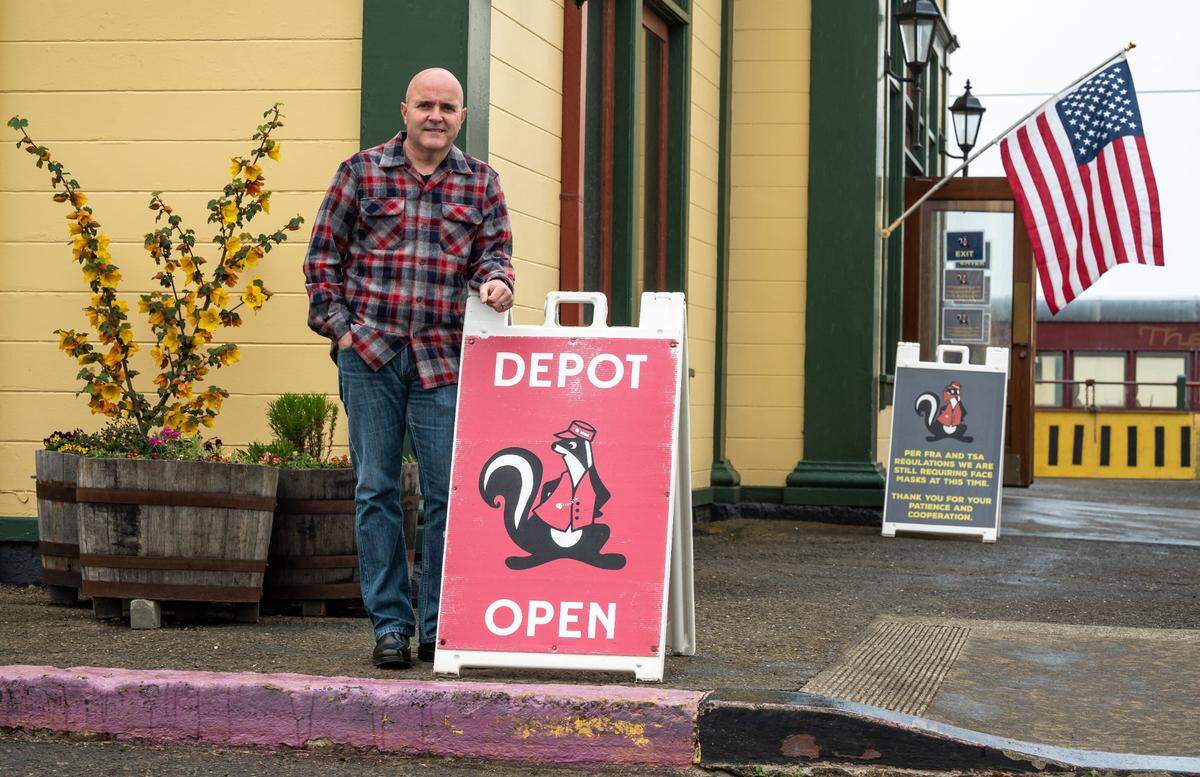
City officials aren’t convinced.
Norvell said while tourism has become Fort Bragg’s biggest industry in recent years, Fort Bragg’s coastal location has a lot to do with it.
“We have big blue out there. We have the Pacific Ocean. We have amazing weather and we have the coastal trail,“ he said. “I think there’s no doubt that people come to town for the railroad, but I highly doubt they come to town only because of the railroad.”
City and train officials seem to agree on only one point: that what development takes place will affect Fort Bragg for decades.
“This is a once-in-a-generation project, completely reimagining one of the California Coast’s most striking stretches of oceanfront land,” said a newsletter the railway distributed to residents in the fall of 2021.
Interim Fort Bragg City Manager Dave Spaur called the Georgia-Pacific site, “one of the last opportunities on the entire California Pacific Coast and we want to make sure it’s done right.”
This story was originally published April 29, 2022 at 5:00 AM.