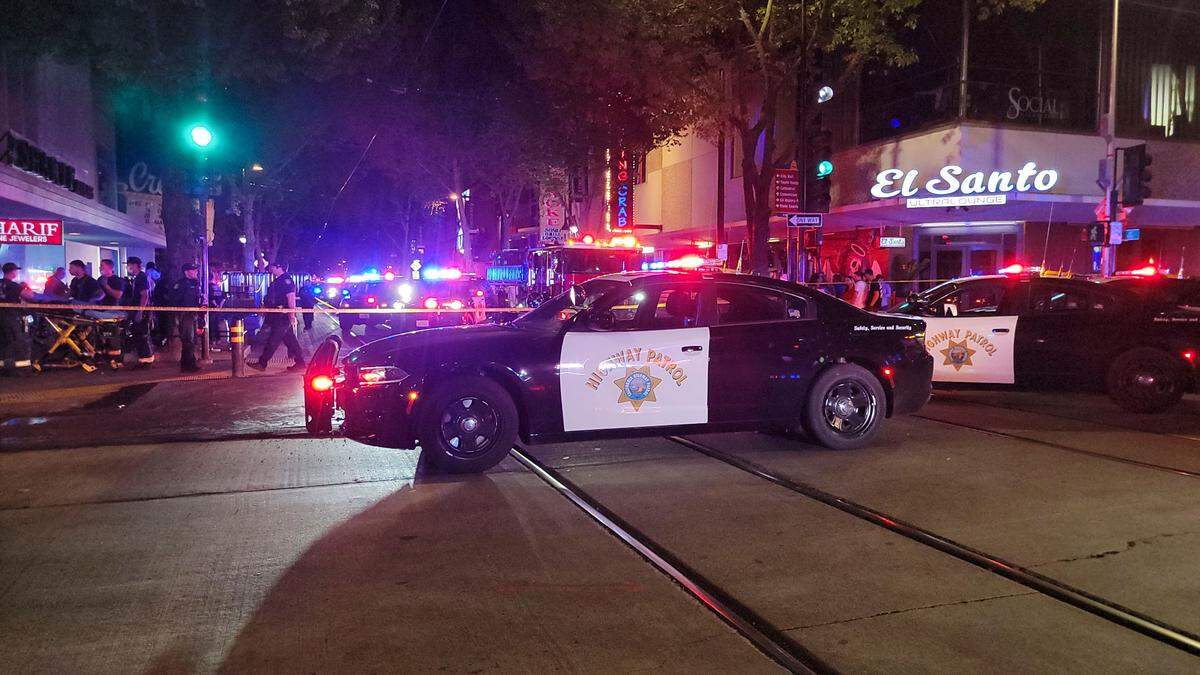
Exclusive: Sacramento mass shooting suspect had parole rejected because of violence in prison
Smiley Allen Martin, one of the five suspected gunmen in the April 3 gang shootout in downtown Sacramento that killed six and wounded 12, had his 2021 bid for release on parole rejected because he posed “an unreasonable risk of violence to the community,” according to state prisons documents on the case.
Martin’s release was rejected May 20, 2021, after Board of Parole Hearings Deputy Commissioner Timothy Kelly reported that Martin committed battery on another prisoner in February 2019 while in prison on a 10-year sentence. Kelly wrote that Martin had “engaged in criminal activity” a month after that assault and posed a “current risk of violence.”
“The inmate has demonstrated ongoing criminal and assaultive behavior that continued despite prior incarceration and rehabilitative attempts,” Kelly wrote in a four-page “nonviolent parole review decision” filed in Sacramento Superior Court late Friday. “His inability to remain free from incarceration and assaultive behavior for a significant period is highly relevant to his current risk.”
The document sheds new light on how the Board of Parole Hearings commissioner made his decision a year ago to reject Martin’s bid for release but does little to explain why Martin ultimately won his release in February 2022 after serving about five years of his 10-year sentence for domestic violence and assault likely to produce great bodily injury.
Questions remain on Martin’s credits
The California Department of Corrections and Rehabilitation has said Martin received pre-sentencing credits for 254 days he spent in jail as well as “a variety of additional post-sentencing credits” and that “he was released when he completed his term as defined by law.”
The department has refused to release information on how Martin’s credits were accumulated or at what rate. Two law enforcement sources told The Sacramento Bee that when Martin entered prison in January 2018 on the 10-year sentence his initial parole date was estimated to be September 2023.
However, emergency rules prison officials implemented last year in how credits are awarded because of COVID-19 apparently allowed Martin to accumulate enough credits to win his release in February, weeks before the April 3 shootout.
Those regulations were the subject of a public hearing hosted Thursday by the corrections department and are being targeted in a lawsuit Sacramento County District Attorney Anne Marie Schubert filed along with dozens of other DAs warning that 76,000 inmates could win release because of the rules changes.
Martin, 27, remains in a Sacramento-area hospital recovering from wounds suffered in the gunfight. He is expected to be charged with being a felon in possession of a firearm and possession of a machine gun. Court papers say Martin was armed with a fully automatic Glock 19 handgun with a 30-round high-capacity magazine and a laser sight. The documents say Martin fired 28 rounds during the gunfight.
The parole board document was filed in court Friday as part of an argument by Schubert’s office that Martin be denied bail once he is booked into jail. Judge Michael Savage signed an order Friday citing a “significant, unreasonable risk to public safety” if Martin won bail, and ordered him held until he is arraigned and a District Attorney Office’s motion against bail can be heard.
Documents: Martin committed battery in prison
Martin has a criminal history in California dating to 2013 that includes possession of a firearm in violation of probation that year and second-degree robbery in 2014.
His latest conviction stems from a 2017 incident in which he dragged his girlfriend by the hair out of a house and beat her with his fist and a belt during a May 2, 2017, argument, the parole board document says.
“The two were in a sexual relationship,” the document says. “Over a period, the inmate had coerced the victim into acts of prostitution on several occasions, with the inmate acting as her pimp, taking the money the victim was paid for the sex acts.”
He was convicted in that case Jan. 12, 2018, about two years and two months after being released from a five-year prison sentence for the prior robbery conviction.
A year after entering prison on the latest conviction, Martin was found to have a “serious rules violation,” battery on another prisoner on Feb. 3, 2019, the parole board document says.
“The inmate has been found guilty of institutional rules violation resulting in physical injury or threat of physical injury, or has one or more recent serious institutional Rules Violation Reports since his last admission to prison,” Kelly wrote in the parole board document.
The document also says “there is reliable information in the confidential section of the inmate’s central file indicating the inmate has engaged in criminal activity since his last admission to prison. A confidential memorandum, deemed reliable and dated 3/11/2019, indicates the inmate has engaged in criminal activity in this commitment.”
The decision to deny Martin’s release last May was based on four factors: the offense he was in for at the time, his past criminal record, his adjustment to the prison and comments received about his proposed release.
Martin ‘highly likely to recidivate,’ parole findings conclude
The parole board document says Martin’s work once inside the prison included one month as a dining room worker. He participated in job the month before seeking release by the parole board. He took vocational computer work for 4½ months “with satisfactory marks.” He completed a substance abuse program and a 12-hour course in victim awareness.
“It is encouraging that the inmate has participated in Vocational Computer & Related Technology for 4.5 months before an institutional transfer terminated that assignment,” the document states. “It is also encouraging that he is currently working in the dining room for the past month.”
But the parole board document also said Martin “has limited participation in available rehabilitative or self-help programming to address the circumstances that contributed to his criminal behavior, such as domestic violence, anger management, and criminal thinking, among others.”
And Kelly concluded in the document that without more programs to “address his anger and violence” Martin “is highly likely to recidivate upon his release.”
“The following circumstances of the inmate’s institutional behavior, work history and rehabilitative programming mitigate the inmate’s current risk of violence or significant criminal activity: None,” Kelly wrote.
Kelly also noted that the parole board had received a letter April 29, 2021, from Schubert’s office that warned Martin’s “criminal conduct is violent and lengthy” and he should not be released.
“Mr. Martin’s current commitment offenses involved outrageous assaultive behavior, resulting in serious injuries to his female victim,” Kelly wrote. “Mr. Martin has demonstrated ongoing criminal thinking and behavior that continued unabated despite prior incarceration and rehabilitative attempts.”
The programs Martin completed show he “appears to be on a more positive path of recent,” Kelly wrote, but “he has yet to address his entrenched issues with domestic violence, assaultive and criminal thinking and behavior.
“Therefore, at this time, Mr. Martin poses an unreasonable risk of violence to the community. The inmate is denied for release.”
Martin was out of prison nine months later.