
How income disparities in California are affecting the adoption of electric cars
The average cost of a new electric vehicle is $65,000, up nearly 10% from a year ago.
Most full-time, year-round workers in California don’t earn $65,000 in an entire year.
As California moves to quickly replace gas-powered cars with zero-emission vehicles, the biggest challenge might be the most fundamental: Most California households can’t afford most electric cars.
A Bee analysis matched zero-emission vehicle registrations from the California DMV and census data showing income by ZIP code.
The analysis found that there were about six electric vehicles per 1,000 residents at the end of 2021 in the state’s poorest ZIP codes – places where median household incomes were below $50,000.
By comparison, there were about 94 electric vehicles per 1,000 residents in the state’s wealthiest ZIP codes – places where median household incomes were above $200,000.
Put another way, electric cars were roughly 15 times as common in wealthy areas as in poor areas. And that is likely an underestimate of the disparity, since many electric cars registered in poor areas belong to businesses and government agencies, not residents.
The trend is sharpest in the Bay Area – but is also clear in the Sacramento region.
For instance, there were about 47 electric vehicles per 1,000 residents at the end of 2021 in El Dorado Hills, one of the region’s wealthiest areas. There were about four electric vehicles registered per 1,000 residents in south Sacramento’s Lemon Hill neighborhood, one of the poorest areas.
Sacramento itself lags behind most other large cities in California in electric vehicle ownership, with 15 registered electric vehicles per 1,000 residents. San Jose has the highest rate of electric vehicle ownership, with 35 vehicles per 1,000 residents. Bakersfield has the lowest, with six vehicles per 1,000 residents.
Several efforts are underway to address the problem. Gov. Gavin Newsom’s budget sets aside about $250 million to help low-income Californians buy electric vehicles – part of a $10 billion public investment in electric vehicles. The Inflation Reduction Act recently passed by the U.S. Congress would provide large tax credits to customers buying new and used electric vehicles.
And a ballot measure this November – Proposition 30 – would set aside $2.8 to $4 billion a year for electric vehicles, with much of that money going to help residents – particularly low-income residents – buy cars. The proposition relies on a 1.75% tax increase on incomes over $2 million dollars.
But it’s a steep hill to climb. Electric cars have become even more expensive as demand increases while gas prices rise.
“I have not seen one for under $15,000, $20,000,” said Cameron Caves, an Elk Grove resident who wants an electric car.
LOOKING FOR AN ELECTRIC CAR
Caves, 28, works 35 hours a week while attending Sacramento State, where he is studying film. He makes minimum wage. He’s applying for another job that will let him work “like, 20 to 25 hours more” to make ends meet. He is set to graduate in December.
Caves drives a 2006 Toyota Camry with 140,000 miles on it that he bought a couple of years ago for $3,000.
With gas prices north of $6 per gallon, Caves pines for an electric car.
“It’s better for the environment, and it’s overall much cheaper,” he said. “Even if all the electricity used to charge your car is generated through the burning of fossil fuels, it is still better for the environment because direct burning through the combustion engine is far less efficient.”
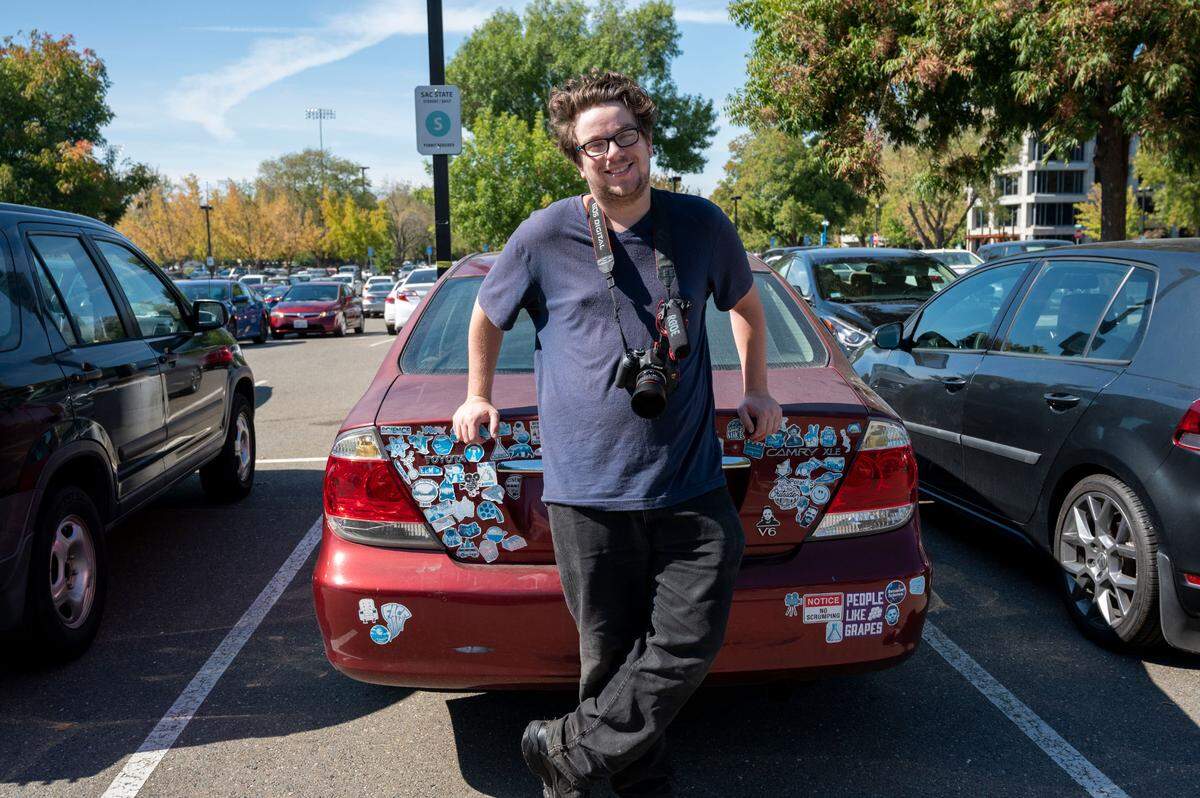
Jacob Moore is in a similar situation. He lives in Florin, a blue collar neighborhood in unincorporated Sacramento County. He rarely sees electric cars in his neighborhood.
“It would be cheaper long term, do less damage to climate change, and decrease the U.S.’s dependence on foreign oil from horrible countries,” said Moore, explaining why he would like an electric car.
Both Moore and Caves said they would be more likely to buy an electric car if government subsidies made them cheaper — or if prices came down.
But both also worry that the infrastructure in their communities and across California might not make owning an electric vehicle feasible.
Caves worries that the sort of low-range electric vehicle that is likely to come cheap won’t be able to make it to Bakersfield, where some of his family lives, without making multiple stops.
Moore is concerned that he wouldn’t be able to power his car up every night before work. “I would need solar panels on my house to charge it,” he said. “Those are way too expensive to hire to install.”
THE CURRENT LANDSCAPE
One of the biggest challenges facing would-be electric car owners without much money is the lack of a robust market for used electric cars, said Gil Tal, director of the UC Davis Plug-In Hybrid and Electric Vehicle Research Center.
“Electric cars are all new cars, and the used car market is just starting,” he said. “If you just compare where electric cars are to where new cars are, you will see that it’s almost one to one.”
Some new electric cars are designed to have an affordable Manufacturer’s Suggested Retail Price, but even those are out of reach for families earning less than $75,000 a year.
“If you look at the new Chevy Bolt, I think that the MSRP is $26,000, at the low end,” Tal said.
Demand for the no-frills versions of the Chevy Bolt and the similar Nissan Leaf is high, and dealer markups are common.
Some manufacturers have such a backlog that they “even stopped taking names to the waiting list. They said, ‘Oh, we already sold the next two years of production,’” Tal said.
Affordable electric cars are also hard to find on the used car market.
Popular used car dealer CarMax had about 30 used Teslas for sale in early October at its Sacramento, Stockton and Roseville locations. Teslas are expensive – rare in Lemon Hill but common in El Dorado Hills. Most of the Teslas were selling for between $45,000 and $70,000.
CarMax had three used Nissan Leafs for sale, ranging in price from $26,000 to $33,000, depending on mileage, features and range. CarMax had one Chevy Bolt with about 18,000 miles and selling for $30,000. Those prices are near the MSRP for a brand new Leaf or Bolt, reflecting strong demand.
“With the pandemic and the issues in the supply chain, we saw those prices jump,” said Román Partida-López, who works in the transportation equity division of The Greenlining Institute, a nonprofit. “And so now there’s even a bigger disparity in just affordability for these vehicles.”
Car manufacturers and dealers have not done a good job reaching out to low-income communities, Partida-López said, so prospective buyers may not know about opportunities to purchase an affordable electric car.
“We’re starting to see more ads out there for electric vehicles, but how many have you actually seen in Spanish or in other languages to increase awareness of these vehicles?” he asked.
Electric vehicles are most convenient for people with an outlet that can quickly charge a vehicle at home. Those outlets can be expensive to install. And many people in low-income neighborhoods rent their homes, so there is little incentive for them to upgrade.
It can be particularly tough to find charging stations outside a large, affordable apartment complex.
“We’re seeing slower deployment in multi-unit dwellings or apartments where more lower income households tend to rent,” Partida-López said. “We haven’t seen the charging infrastructure deployment that’s needed.”
WHAT’S NEXT
There are reasons for optimism, Tal and Partida-López said. A lot could change soon - in a way that could bring more electric cars to low-income areas.
As electric cars become the norm, the used car market for them should become more robust. The supply of affordable used cars could start to approach the demand, pushing prices lower.
Car manufacturers are “investing billions,” Tal said. “It just takes time.”
The state of California is also pushing hard to encourage electric car production and make electric cars more affordable.
Gov. Gavin Newsom issued a 2020 executive order requiring that by 2035 all new cars sold in the state be zero-emission vehicles. Since California is such a huge market, the order puts pressure on car manufacturers to switch to electric.
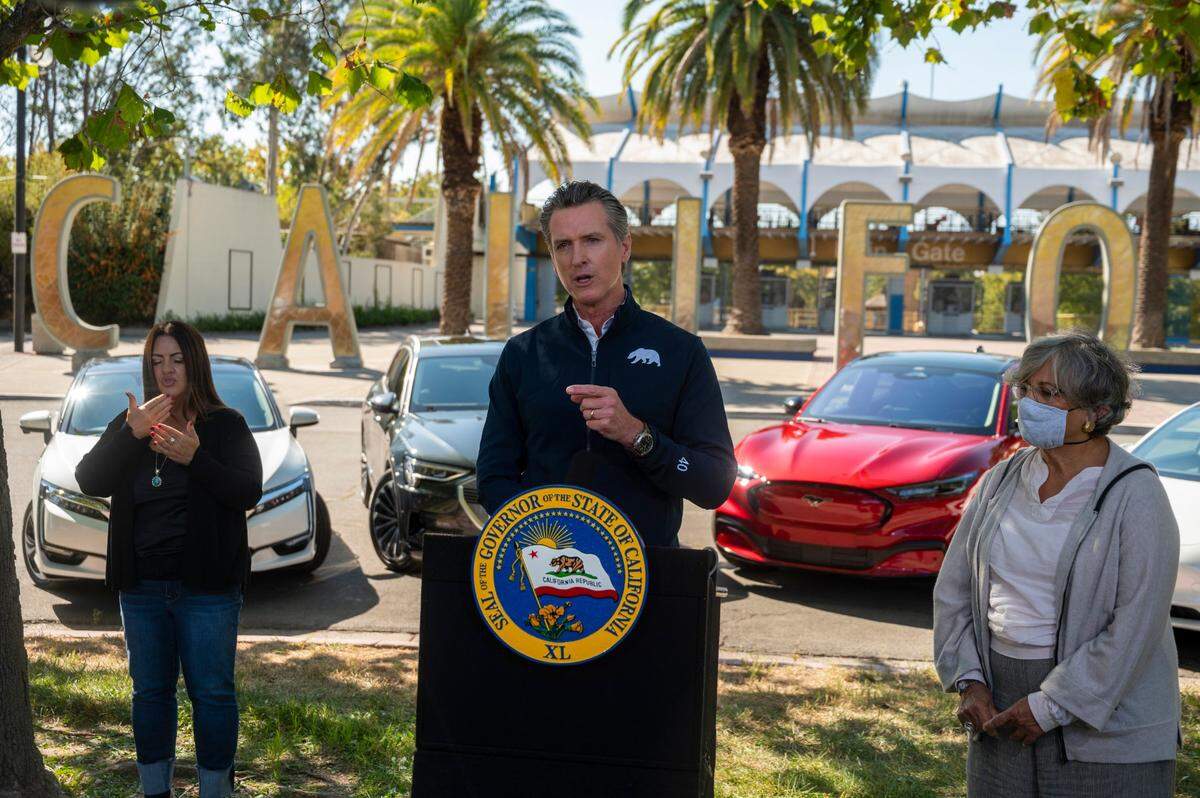
In addition, California recently adopted new regulations called “Advanced Clean Cars II” that require about one third of vehicles sold in 2026 to be zero-emission – with the bar rising each year. About 18% of new vehicles currently sold in the state are zero emission, according to the California Air Resources Board.
The state has spent billions – and is spending billions more – to improve electric car infrastructure, particularly in low-income areas. The hope is to quickly build the charging stations needed to support so many new cars.
The U.S. Congress recently passed the Inflation Reduction Act. Part of the act extends a tax credit of up to $7,500 on electric car purchases. Also, for the first time, used electric vehicles are eligible for tax credits up to $4,000, or 30% of sales price, whichever is lower.
For its part, the city of Sacramento has spent years improving electric vehicle infrastructure as part of a comprehensive strategy that also focuses on bringing electric cars to low-income communities. Local agencies like SMUD and the Sac Metro Air District also offer incentives.
California provides a number of subsidies to help people afford electric cars. The most popular is the Clean Vehicle Rebate Program, which offers up to $7,000 in rebates for a new electric vehicle. Those subsidy programs often have long waiting lists, and run out of money quickly each year.
There’s a perception that car dealers raise prices whenever there are subsidies or tax credits to help low-income buyers, taking the extra money for themselves. State programs have safeguards to keep that from happening, Partida-López said.
“Participating dealerships have to sign an agreement with the program administrator, and essentially the state, that they will not price gouge,” said Partida-López.
In November, voters will decide on Proposition 30, which would increase funding for electric vehicle subsidies.
Prop. 30 would impose an additional 1.75% tax on incomes over $2 million. Forty-five percent of the funds raised by the proposition would go toward payments to help Californians buy new vehicles, and 35% would go toward charging stations. At least half of the money for clean vehicles would go to low-income communities.
(Separately, 20% of funds raised by Prop. 30 would go toward wildfire prevention and response.)
Newsom has come out against Prop. 30, noting the state’s significant investment in electric cars. He also said the proposition could turn into a giveaway to ride-sharing companies. The proposition has received major funding from Lyft.
Others worry that Prop. 30 would drive wealthy Californians – and the companies they run – to other states, hurting the state’s tax base and costing the state jobs.
“California is bleeding high-wealth individuals out of the state,” said Jon Coupal, president of the Howard Jarvis Taxpayers Association, which often fights against tax increases. “And that’s very important because California relies on very wealthy people. Millionaires pay 40% of the state’s personal income tax revenue”
Supporters say the proposition would be one of the quickest ways to ensure electric cars are affordable to all Californians, not just the wealthiest.
“We’ve got small businesses and low-income people all over this state sticking up their hands saying, ‘I want to transition to a cleaner vehicle. I want to have less of an impact on the air pollution in my community. I want to be able to save money by having lower operation and maintenance costs for my vehicle’,” said Nick Kosefowitz, chief policy officer at SPUR, a nonprofit based in the Bay Area that focuses on urban policy. “Unfortunately we just don’t have enough money in our programs today to be able to support everybody who wants to make that transition.”
Even with increased production of electric vehicles, better infrastructure and more subsidies, the challenge is daunting.
California had about 30 million registered passenger vehicles – about three vehicles for every four people in the state. Roughly 3% of those vehicles were classified as zero emission at the end of 2021 – about three electric vehicles for every 100 people in the state.
There were fewer than one electric car per 100 residents in 525 of the state’s ZIP codes – ZIPs that are home to more than 13.3 million people. The large majority of those 525 ZIP codes had median household incomes of less than $65,000.
This story was originally published October 21, 2022 at 5:30 AM.