Eugene T. Gualco, Sacramento judge and career servant, dies at 93
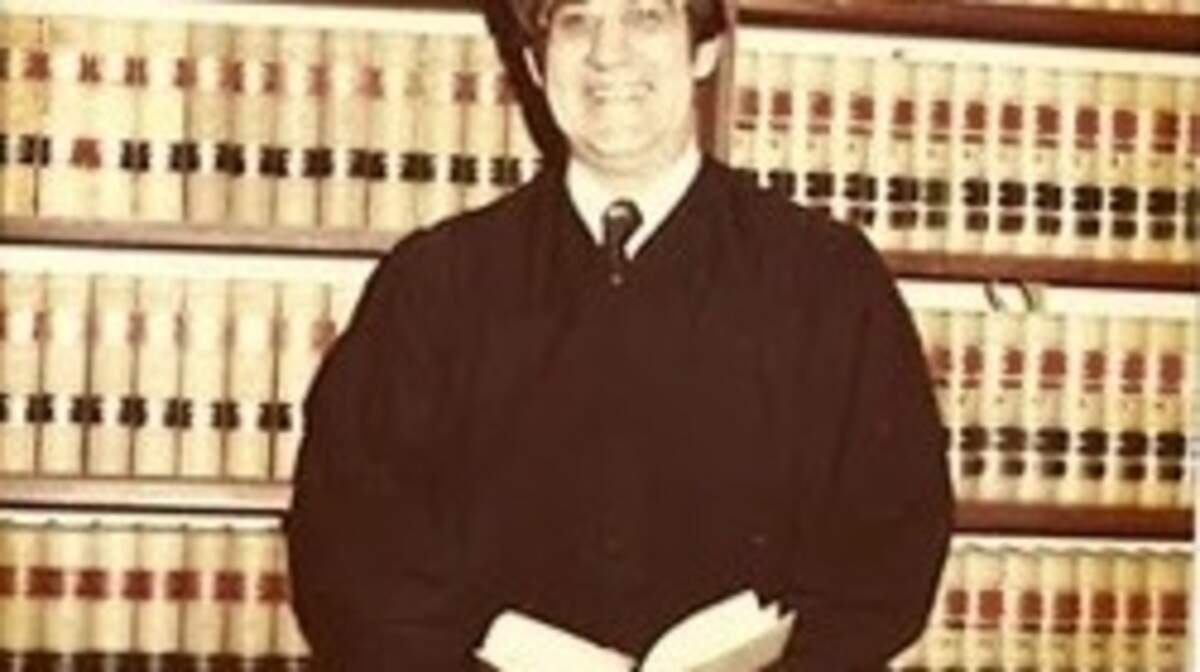
Eugene T. Gualco, a Sacramento public servant who upheld union rights as a Superior Court judge and fought for public parks in the California Assembly and on the county Board of Supervisors, died Dec. 13 at his home in Sacramento. He was 93.
“Public service was his whole life,” said Gualco’s son, Larry — who noted that his father was also a committed spectator at his two children’s piano recitals, soccer matches, baseball games and swim meets in the late ’60s and ’70s.
Gualco was born Nov. 8, 1929, the youngest child of two Italian immigrants. He grew up with a large extended family in Sacramento, who helped raise him and his four siblings. He eventually attended law school at McGeorge and UC Berkeley, passing the bar exam in 1958. That same year, he married Dorothy Blake.
The couple moved to the Sacramento area. While Dorothy became active in charitable causes in her new county, Gualco started working as a lawyer in practice with his two brothers.
A Sacramento native enters local government
When he was 34, Gualco decided to go into politics. He won his 1964 bid for a Sacramento County Board of Supervisors seat, representing District 4. He and Dorothy raised their two children, Gina and Larry, in a one-story Foothill Farms house in the district.
Gualco, a Democrat, had a record that exemplified a commitment to public space, and he attempted — sometimes fruitlessly — to increase the number of parks in unincorporated Sacramento County. In 1970, he supported Carmichael and Fair Oaks residents who wanted to turn land next to Albert Schweitzer Elementary into a park, though the majority of his board colleagues voted to give the land to a housing developer. In January of 1971, when two more liberal supervisors had joined him on the dais, the Board reversed course, approving the park that exists to this day.
He helped to establish and expand the American River Parkway during his decade on the board, and, later, from higher office.
In the winter of 1974, Gualco announced that he would run for the State Assembly seat representing the fifth district. The Bee reported at the time that he imposed a $250 cap on campaign donations. Sears, Roebuck and Co. and the California State Employees Association each attempted to donate $500, and to each donor, he returned $250.
Gualco won his race and served in the Assembly until 1978. At the end of his tenure, the Associated Press called him “the California Assembly’s strongest advocate of environmental protection in the Tahoe Basin.” Among his smaller accomplishments, he got the state of California to put up the money to build a bicycle trail from Nimbus Dam to Beals Point — which connected the American River trail all the way to Folsom Lake.
In 1978, Gualco entered the race for a congressional seat, and lost in the five-way primary. He came in second to a member of City Council, Robert Matsui, who served in Congress until his death in 2005. Before the November election, Gualco endorsed his former opponent, calling him “hard-working” and telling The Bee, “I feel confident that he will give Sacramento the same kind of conscientious service we have come to expect from our congressman.”
Back to the courts — this time as a judge
Gualco briefly returned to practice as an attorney, until Jerry Brown, then in his first stint as governor, offered him an appointment to Sacramento County’s Superior Court on Jan. 11, 1979.
Gualco spent one year in family court, which was not his favorite job (as he colorfully explained to The Bee, “It’s a meat grinder!”). He went on to adjudicate some high-profile cases in the state, including a dispute between Caltrans and unionized engineers. After Gualco sided with union workers in a 1994 ruling, Republican Gov. Pete Wilson’s office tried to discredit the judge by distributing an old newspaper profile that discussed his time as a liberal in the state Assembly and said he’d been appointed by a Democrat.
Gualco’s son, Larry, remembered his father talking about that Caltrans case. “He said, ‘I don’t make the laws. If they want to change the law, they can,’” but, in the meantime, Gualco would make sure they followed it.
In 1981, Gualco allowed a woman to sue a medical center operated by UC Davis because they didn’t give her enough information about her pregnancy. She said she would have wanted an abortion had her doctors told her that her fetus was at risk for serious disabilities and offered her the relevant prenatal test. Ultimately, the medical center settled the case.
Gualco later upheld part of a state law that banned assault weapons and required registration for people who owned an assault weapon before the 1989 ban. The state, he ruled, had the authority to require that assault weapons be registered.
A busy retirement
After the judge retired from the bench in 1994, he and Dorothy continued traveling abroad and spent more time with their large extended family in the Sacramento area. Gualco also took on more grave obligations, and became the head of a committee that investigated systemic failures at the county’s Child Protective Services in the 1990s. The committee was formed when Adrian Conway, a 3-year-old boy, was killed by his mother in 1996, just two months after the agency determined the risk in their home was “moderate.”
Gualco matter-of-factly told NPR’s All Things Considered that the public had to acknowledge that social services needed more funding to keep families together in a way that was actually safe.
People, he said, “either have to face up to the fact that it’s maybe going to (cost) them some money to properly supervise this, to get people into rehabilitation and such, or they’re going to have to accept the fact that there are going to be children killed.”
Gualco died at home in December a few weeks after a serious fall. He still lived with his wife of 64 years, Dorothy.
This story was originally published December 31, 2022 at 6:30 AM.