
Sacramento loves its trees. But will we ever recover from the damage they’ve inflicted?
Sacramento was a plain. A flat, wide open plain with dust and dirt and a lot of water but not much shade. That was before the trees.
Can you imagine? Trees now define our experience. More than food. More than water. More than anything. They keep our homes and our cars and the top of our heads cool in the summer. If not for trees, Sacramento would be an impossible place for a city (like Phoenix, just closer to the coast).
Yes, we love our trees; we get married underneath them all the time. We put their pictures on T-shirts. We name music festivals and dental offices and tattoo parlors after them. When someone tries to cut trees down — even if that someone is the government, especially if that someone is the government — we sue.
But, boy, have they turned on us.
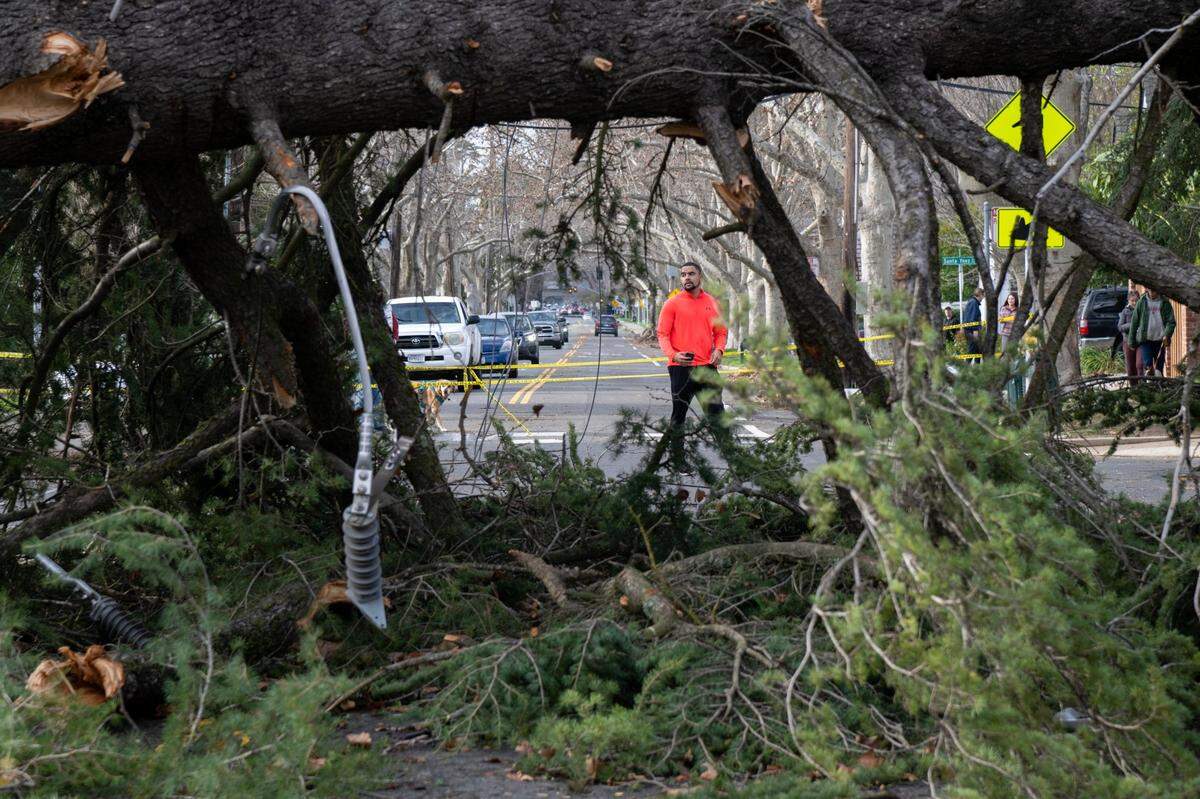
An estimated 1,000 trees have fallen in the city of Sacramento since the New Year’s Eve storm. Hundreds more toppled in the suburbs. The carnage tore holes into historic midtown homes, split cars in Orangevale and knocked out power to thousands. Two homeless people died when trees fell on their tents.
And for many, our trust in trees has been broken.
Jessica Sanders knows this. She’s the executive director of the Sacramento Tree Foundation, dedicating her professional life to protecting and celebrating Sacramento’s tree canopy. What’s happened the past two weeks, she said, “is heart-wrenching.”
“You have not only the love of trees that Sacramentans have,” she said, “but you also have to recognize the loss of power, of water, of property and of lives. You have the tree side, but you also have to acknowledge that we live in a city and we don’t just manage our trees for the trees, but for the people.”
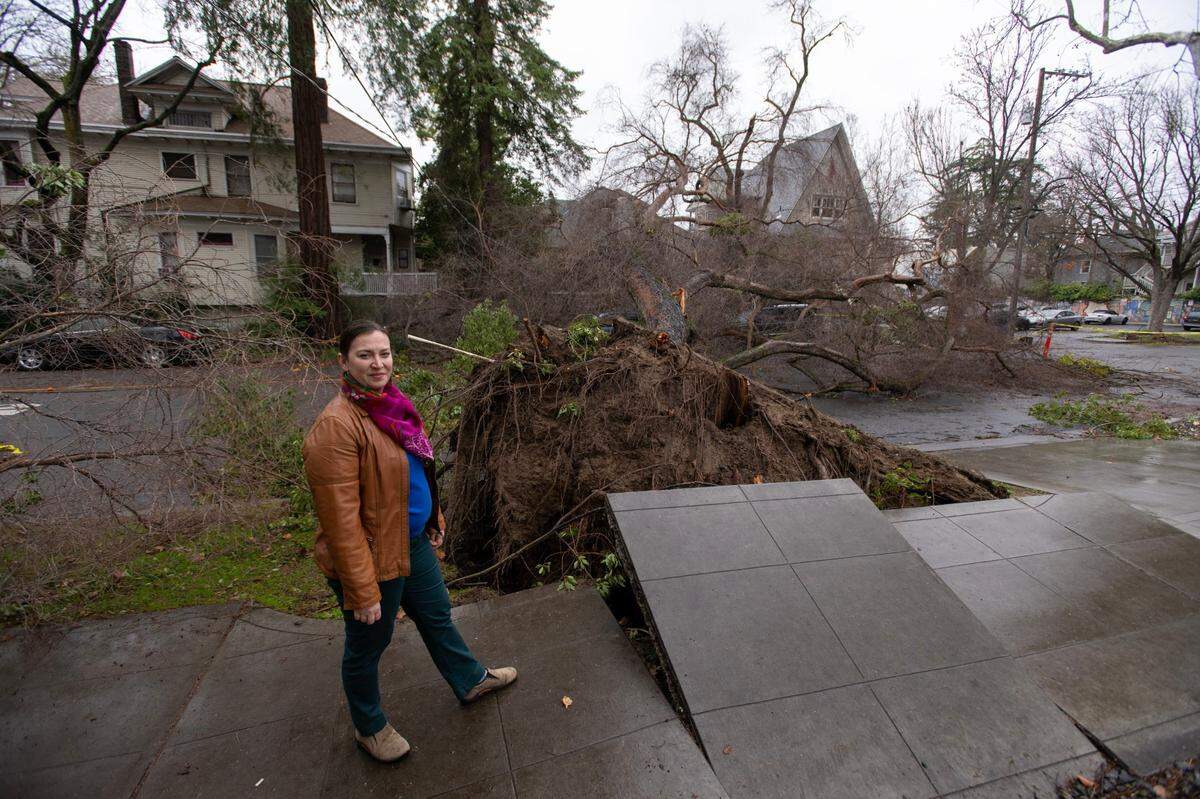
Few cities in the world can match Sacramento’s urban forest. By some estimates 1 million trees grow here. We’re on par with Vancouver, Singapore and Sydney. Paris? It doesn’t even come close, at least according to research out of MIT and the World Economic Forum, which ranked Sacramento’s tree canopy the 11th-most impressive on the planet.
Want to tear down a tree on your property? Not so fast. You’ll likely need a permit for that. Because trees aren’t just for hanging wind chimes and bird houses.
“Trees improve air quality, reduce energy consumption, help manage stormwater, reduce erosion, provide critical habitat for wildlife, and promote a connection with nature,” according to a 2018 city of Sacramento assessment. Places with more trees have lower rates of asthma and obesity.
That city assessment found 19 square miles of Sacramento were covered by the tree canopy, a remarkable figure for a metropolis of more than 525,000 residents. Even with all the strip malls, the subdivisions of new homes, the freeways — trees are a central part of our identity.
And that’s partly what has made the last couple of weeks so devastating.
Will we ever feel the same about them?
Why did so many trees fall?
The wind storms that struck Sacramento again and again changed parts of the city.
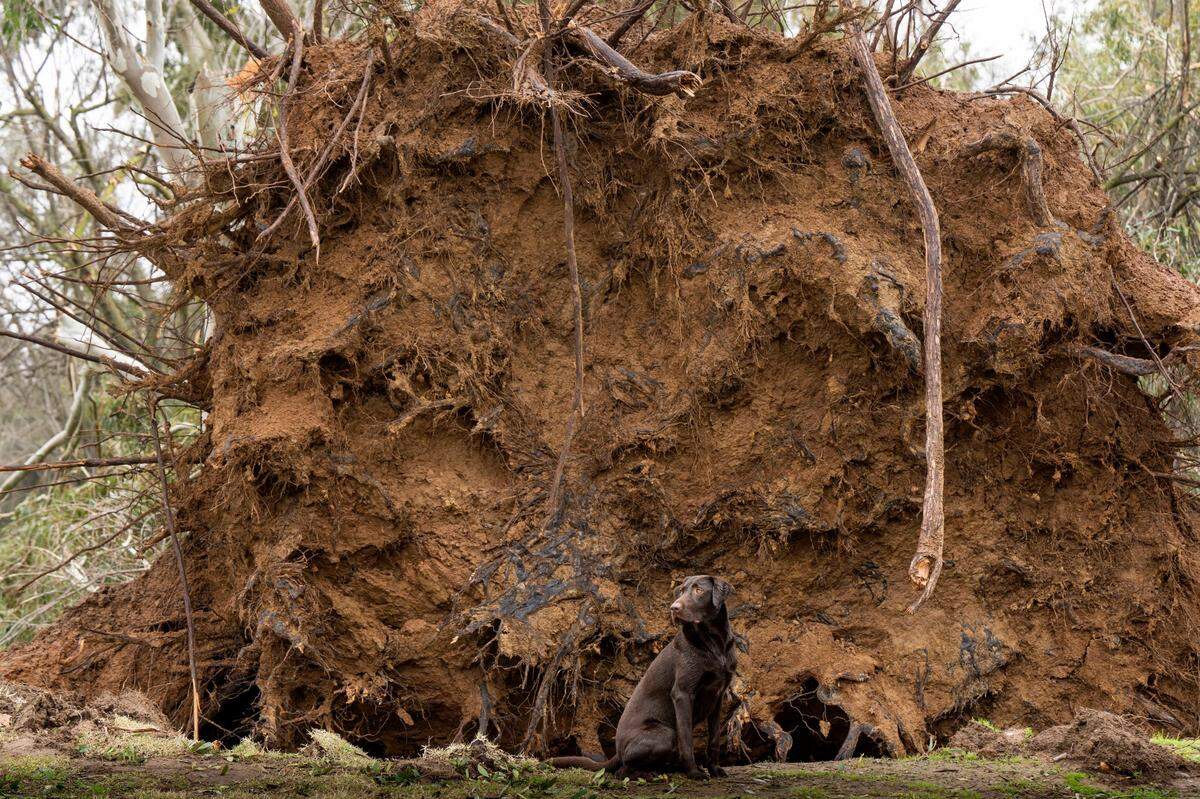
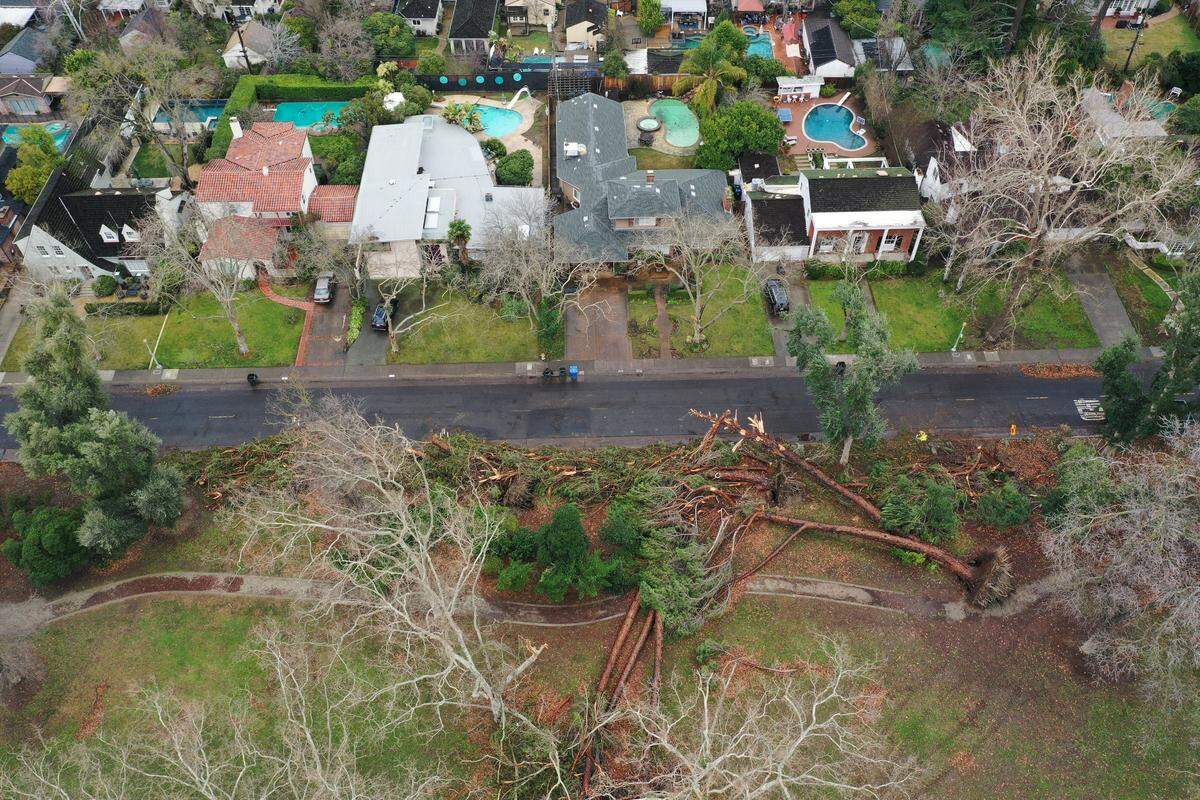
Towering eucalyptus and pine trees still lay shattered in city parks this week. Redwoods toppled in the Land Park neighborhood onto homes and across streets. Like an earthquake on a Hollywood set, sidewalks in midtown were heaved upward as roots ripped from the soil, sending enormous trees tumbling into homes that have been here for a century.
Why so many trees have fallen the past two weeks defies one simple explanation.
“There isn’t any pattern regarding specific species of trees or conditions within a certain neighborhood or particular part of the city,” said Gabby Miller, a spokesperson for the city’s Department of Public Works. “The occurrence of healthy, defect-free trees uprooting during the storm was fairly uniform throughout the city.”
“There is no species of tree that is immune from the effects of storms like this,” she added.
After days of intense rain, the soil was saturated, turning it into a soupy mess that roots were unable to grip. During the New Year’s Eve storm, wind gusts from the north reached 60 miles per hour; strong storms in this region more often are fueled by winds out of the south. So trees that had built strength against southerly winds suddenly had to contend with a changed threat, Sanders said.
In midtown, many of the trees that fell had stood between the sidewalk and streets. Years of building and development finally caught up; root balls confined in those tight spaces didn’t grow to their normal size, leaving the trees’ foundation vulnerable.
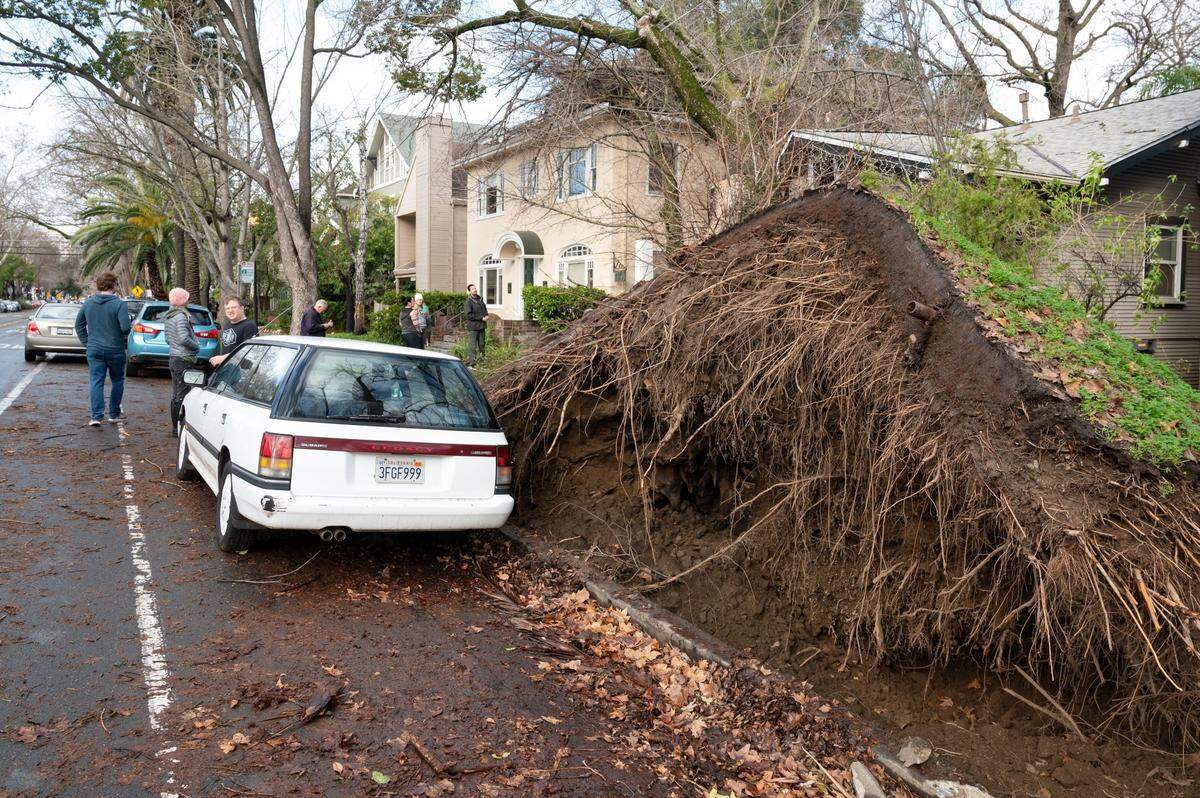
Yet the damage had an element of unsettling randomness. Many of us stood in our yards during last weekend’s vicious wind storm and thought, “Please. No. Not that one.”
“I don’t think anyone could have predicted this level of devastation,” Sanders said.
Jan Ponticelli, 64, was upstairs in her home at the corner of 36th and H streets in East Sacramento on Saturday night. She heard a crack.
As she turned her head, the conifer outside her window careened toward the roof. She dropped to the floor as the tree landed on the house, a former speakeasy purchased by her parents for $18,000 in 1963. The tree’s roots had mostly ripped out of the ground, but its top miraculously fell short of destroying the roof.
“It came crashing down, I laid on the floor and just kind of (said to myself), ‘You’re still moving,’” Ponticelli said. “And I slid down the staircase – it’s a very steep staircase – and the animals came down. I called my family, and they said, ‘Stay in the house, because it’s whipping!’”
Another tree had fallen from Ponticelli’s neighbor’s yard, breaking through an exterior wall and sprawling into the street. A nearby power line broke, leaving live wires on the ground and robbing Ponticelli of electricity for days.
The conifer remained on Ponticelli’s roof Monday afternoon. Water had begun to seep through onto her hardwood floors, and a crack was forming in the entryway despite a family member adding reinforcing beams.
Others were luckier.
Previous owners had already planted 11 redwoods in the front and side yards before Vix Aiken moved into her home at 17th Street and Eighth Avenue in Land Park about 20 years ago. A Sacramento Tree Foundation representative advised against taking them out, because they were part of the urban forest.
Colossal piles of redwood branches had been collected outside the home Monday, but Aiken wasn’t worried about any of the giants hurtling toward her property. Redwoods’ shallow but expansive root systems intertwine with those of other neighboring redwoods, collectively propping the tree canopy up. A lone redwood, as seen downed in Fairytale Town, would be more likely to fall.
“We all sort of know our trees the way we know our neighbors,” Aiken said. “When we see a tree come down, it’s really sad, especially if it’s in the park that’s dear to all of us who live here.”
Sacramento’s tree history
More than a century ago, powerful local families such as the Crockers and McClatchys advocated for trees to be planted en masse throughout the city. C.K. McClatchy, editor of The Sacramento Bee in the early 20th century, ran front-page obituaries of trees cut down in the name of development.
More than 200 species of trees were planted in Capitol Park, including Atlas cedars, Montezuma cypress and palm trees as tall as four-story buildings. A heritage oak on the grounds of the Sacramento Zoo is believed to be over 200 years old. Elmhurst’s T Street Parkway had the “hugging tree,” marked by a 50-foot-long branch that curved toward the earth like an arm stretched around a friend. The tree was taken down in 2015 after being inflicted with Dutch elm disease.
Generations of Sacramentans have nurtured and named trees. They’ve been planted by thousands. But it hasn’t always been done fairly.
Wealthier neighborhoods have the most trees. More than 40% of Land Park is shaded by a tree canopy. About one-third of East Sacramento has that benefit. Live in South Land Park or the Pocket? Chances are pretty good you’re living in the shade.
A different picture emerges in economically disadvantaged neighborhoods. Some of the sparsest tree covers are found in Meadowview, Valley Hi and Robla, according to a city analysis.
“Sacramento, as in many, many, many other American cities, has a tree equity problem,” Sanders said. “A lot of work focuses on changing that and making sure everyone has access to trees because they benefit us all.”
Many of us will undoubtedly plant trees in the months ahead, seeking to honor the legacy Sanders talks about. The tree foundation has planted more than 1.5 million trees since 1982, and now the work becomes more urgent.
Many others will look in their yards with apprehension and decide it’s time to cut down that oak tree hanging a little too close to the house or power lines. For those who take that path, Sanders said her foundation keeps a list of certified arborists who can be trusted to assess whether a tree is in poor health and in danger of falling.
For those that have fallen, and for others that will follow, Sanders’ organization has an “urban wood rescue” program that mills and dries downed trees and makes them available to be turned into planter boxes and artwork. Sanders has a coffee table from an old elm tree in Land Park.
“It’s really so important for people to celebrate our trees,” Sanders said. “Those trees that fell down, they were massive. They were beautiful. We should honor their legacy and keep that legacy in Sacramento.”
This story was originally published January 13, 2023 at 5:00 AM.