
Native Americans’ ‘living culture’ highlighted in new Sacramento History Museum exhibit
Jacky Calanchini’s daughter complains about being dragged to basket-weaving classes the same way other kids might complain about piano lessons. But just like other parents, Calanchini knows she’ll eventually be grateful for it.
“A few years ago, some of us women wanted to learn basketry in our community, but that information was so spread apart,” Calanchini said. “Now, within five or six years, our kids are using and identifying the plants and the types of baskets already.”
Calanchini is the curator of collections and a member of the Shingle Springs Band of Miwok Indians’ tribal council. She helped put together the Sacramento History Museum’s recently-opened exhibit, located in Old Sacramento, which features the Mómtim Péwinan people.
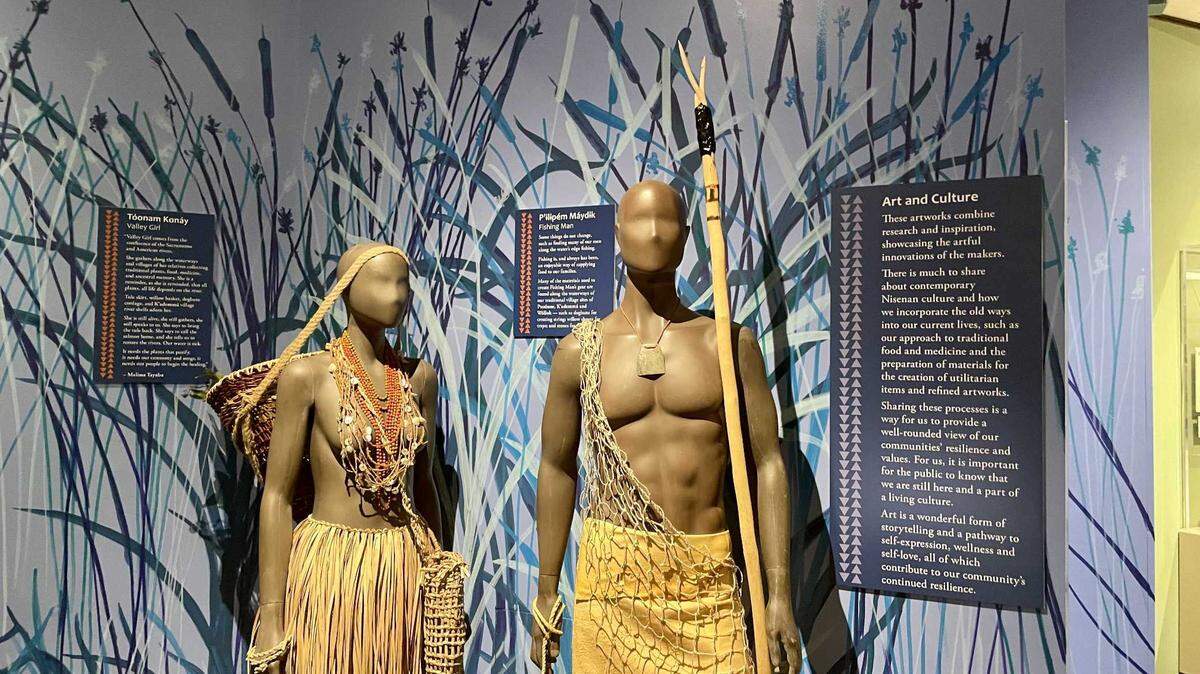
Nothing in the exhibit is a relic, Calanchini said. It’s “living culture” created in the last five years by nine tribal makers who have carried on traditional crafting techniques — including Calanchini’s daughter.
The third-floor exhibit, which opened to the public on July 23, features four full-sized mannequins dressed in traditional attire as well as toys, tools, baskets and formal regalia.
Sacramento History Museum director Delta Pick Mello worked alongside Calanchini, SSBMI exhibits and collections director Sigrid Benson and others in the tribe to bring the exhibit to life.
The museum had previously worked with the SSBMI to write a land acknowledgment statement and plan school trip educational programming, so when they decided to “refresh” a preexisting American Indian exhibit, they quickly reached out for feedback.
According to Calanchini, “these days it’s almost trending” for groups to reach out to local tribes about creating land acknowledgments, or with questions about other projects. But Calanchini said people don’t always take the tribes’ recommendations, so it was meaningful to her that the history museum let them have so much influence over how their stories were displayed.
“I knew for a fact I didn’t want it to be a historic type of exhibit,” Calanchini said. “I didn’t want black-and-white. I didn’t want sepia filters. I wanted color and vibrancy.”
Because almost every item was created new for the exhibit, the exhibit curators were able to merge two goals in how the tribe wanted their culture to be presented to the world: the desire to retain traditional crafting techniques, and the desire to save certain pieces of their culture for their own community, rather than placing them on display.
“The regalia items, which typically would not be appropriate to display in a museum setting, are treated as educational items,” Benson said. “They haven’t been danced in, they haven’t been utilized in ceremony, they were created specially for this exhibit, so that folks can see them and just start to understand what’s going on in ceremony.”
For other pieces of the exhibit, traditional materials like dogbane were exchanged for newer materials like cotton string. In addition to certain materials being in low supply or hard to access today, much of the traditional material the tribe does have access to, according to Benson, is reserved for creating ceremonial regalia for tribal members to wear.
“Substituting alternate materials doesn’t make it any less educational, doesn’t make it any less valid,” Benson said. “But those choices are to reserve for the community what is most valued. The artists who created pieces for this exhibit made very active choices about the materials they used.”
Benson also talked about embracing the living culture of the SSBMI, and growing and adapting with the materials available to them now just as their ancestors would have done as time went on.
In this way, they aren’t just historians, but contemporary artists, Benson said. Their tribe’s culture exists in the present, not only the past.
“We showcase contemporary cultural artwork of today’s community,” Benson said. “That is the way to completely bypass all of those notions of erasure. You just can’t ignore that contemporary art is made by contemporary artists.”
Coming full circle on the banks of the Sacramento
“Our connection to this land and these rivers is sacred and timeless,” said Malissa Tayaba, the vice chair of the SSBMI’s tribal council.
The Sacramento History Museum stands on traditional Nisenan land, and the SSBMI is a federally recognized tribe with a heritage linked to the Nisenan, Maidu, Miwok and Native Hawaiian peoples. They consider themselves Mómtim Péwinan, or River People.
Calanchini said that their matriarchs, or ancestral grandmothers, did their best to stay as close as possible to the land even after non-Native people moved to the area. Though the SSBMI relocated to an El Dorado County rancheria in the 2010s, where Calanchini now lives, she said she still feels a connection to Sacramento.
“I grew up in West Sacramento and used the bike trail network to get around, and I just feel so connected to the space,” Calanchini said. “It’s an honor to (have this exhibit) here.”
Tayaba said that she believes that the tribe’s grandmothers’ “love of the land” is “carried within each of (their) descendants,” and that one of the ideas they are trying to convey in the new exhibit is a deep, continuing connection to the area.
“The Mómtim Péwinan exhibit demonstrates we are still here, we still come back to the rivers to gather traditional and cultural materials,” Tayaba said in a speech unveiling the exhibit. “Some of those plants and animals are encompassed in this exhibit in various ways. Whether it is our basketry, regalia or other cultural items, we are happy to share our story and elements of who we are with all of you.”
Waking up the ‘sleeping knowledge’ of ancestors
When the women of the SSBMI decided they wanted to bring their basket-weaving traditions back to life, they relied on two surviving baskets as models. The women traveled around California to talk to elders and experts and try to regain some of the lost knowledge, according to Calanchini, and discovered just how much of it was “spread apart” or even “just wiped out.”
That’s why, explained Tayaba, they created the TEK department — it stands for Traditional Ecological Knowledge, and is referenced in much of the signage displayed at the exhibit. As Calanchini put it, they’re hoping to find the “sleeping knowledge” and “wake it up for our communities.”
The exhibit highlighted TEK by referencing the River Peoples’ connection to the salmon and water in the Sacramento River that their people relied on for generations.
“The salmon need water, just as people need water,” Tayaba said. “Part of TEK is our duty and responsibility to care for these other living beings. Water is alive to us. All of the plants, all of the animals, those are our other relatives, because our creation stories come from this land. So what happens to them is our livelihood also.”
A $100 million grant program for “Tribal Nature-Based Solutions” was announced on July 31 by the California Natural Resources Agency, and will offer funding to California’s Native American tribes to “build projects and programs to protect culturally important natural resources,” such as the Sacramento River or California forests.
CNRA is currently seeking nominations for a panel to review project proposals for the grant, and is hosting a series of three webinars on Aug. 1, 8 and 9 to provide information to interested grant applicants on the application process and timeline.
Pick Mello said that she hopes the Sacramento History Museum exhibit is “just the first step of an ongoing journey” to illuminate the native history of the area.
“We have much more work to do tomorrow and next week and many months to come and years to come,” Pick Mello said. “But for tonight, we celebrate.”
If you go
Where: Sacramento History Museum, 101 I St., Old Sacramento.
When: 10 a.m. to 5 p.m. daily. The exhibit will be in place for at least two years.
Cost: Admission is free for Sacramento History Museum members or children 5and under, $5 for kids ages 6-17, and $10 for adults. There are also reduced rates of $2 per person for up to four people with evidence of Snap EBT through the Museums For All initiative.
Information: sachistorymuseum.org/exhibits/momtim-pewinan