
Think Sacramento could use more live music? So does Mayor Darrell Steinberg. Here’s his plan
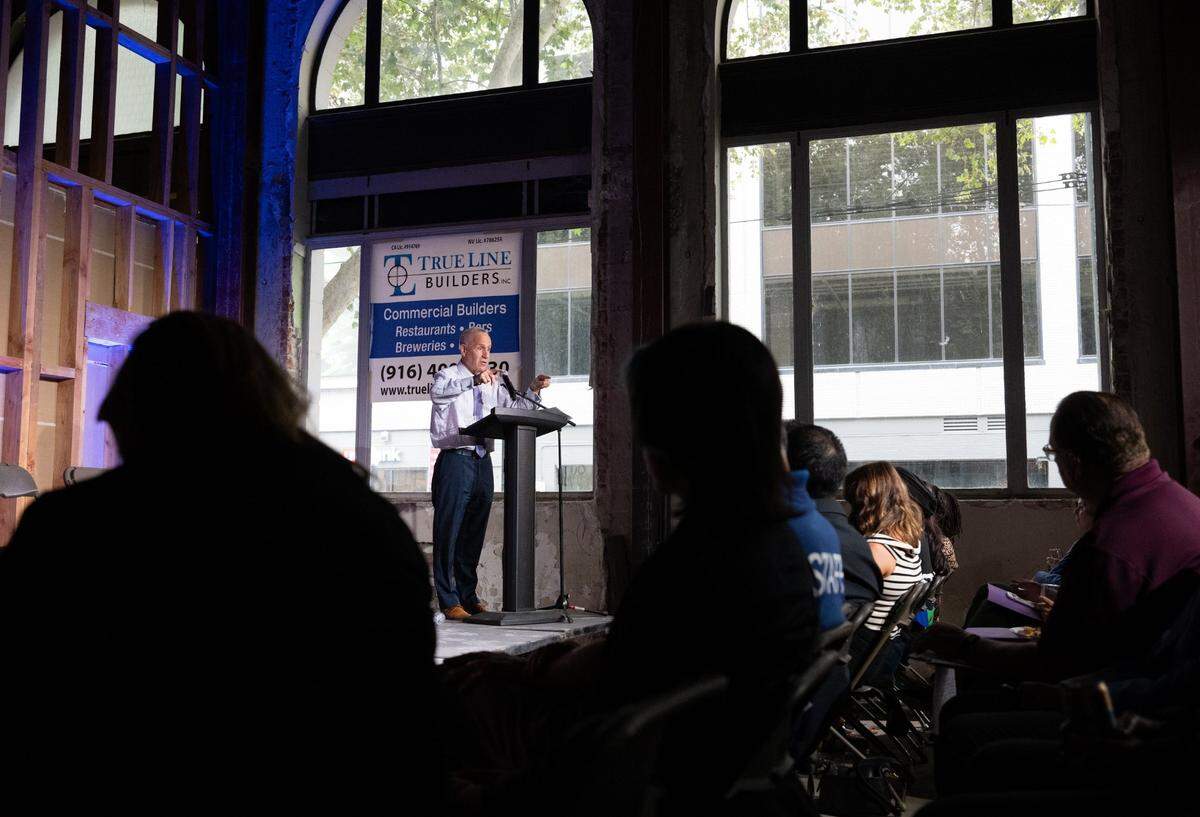
A gutted downtown Sacramento building where new owner Nick Cordano plans to open a concert hall served as a vision of and venue for the first of Mayor Darrell Steinberg’s State of the City panel discussions that focused on the future of the city’s music scene.
Hundreds of Sacramento music and entertainment industry professionals joined members of city government Monday night at 700 K St. — with its exposed electrical wiring and pipes, dusty floorboards and unpainted pillars — to envision a vibrant Sacramento scene buoyed by supportive local policy.
“I know regulatory reform is not exactly rock and roll,” Steinberg said, “but if we are going to be a city that encourages and nurtures a creative economy and insists on genuine equity, we need our regulatory environment to reflect that.”
A panel of city staff and economic development professionals weighed in at the Monday event.
Sacramento needs a “mindset shift, that doesn’t say when we gather, it’s a problem. That music isn’t a crime and that our policy reflects that” said Megan Van Voorhis, the director of convention & cultural services at the city.
What Sacramento’s Music Census found
On Monday, the city officials released the results of the Sacramento Music Census. The roughly 1,400 respondents, members of the local music scene, asked for more opportunities, bigger venues and more affordable costs to perform.
“This city makes it as hard as possible for independent music to thrive,” said one survey respondent.
Eithty-six percent of local artists play fewer than four shows per month, according to the survey. Sacramento artists rarely get by on music alone.
“Sacramento should be a place with possibilities for young people,” said Jay King, a Sacramento-raised Grammy award winning singer, songwriter, record producer and radio host.
He envisioned a future where young musicians, like himself, “can be right here in Sacramento and bring their possibility to life” and not be forced to New York City, Los Angeles or Nashville for a serious career.
King also said he is concerned about city regulations having a disparate effect on hip hop and rap artists and events. Hip hop concerts are required by the city permitting process to have more security than other genres, he said, creating prohibitive costs and logistics.
It’s not a lack of talent, local industry professionals said. It’s expensive, inefficient city regulation holding back venues and depriving artists of opportunity.
More than 30% of shows in Sacramento are hosted in someone’s home or backyard. The next most popular venue type were nonprofit spaces, and then for-profit.
“What that tells me is that there’s no incentive to open a venue,” said Julia Heath, membership director at the National Independent Venue Association, who spoke at the panel on Monday.
It presently costs $1,331 for a one-time special event permit to host a music event — no matter the size. In San Diego, it only costs $367, and in San Francisco, $510.
In addition to being costly, the permitting process is complicated and lengthy, respondents complained, requiring businesses to go through multiple city departments to get even a small event approved. This causes problems not only for interested venues, but for city staff, Steinberg said.
One of the city’s problems, said Don Pitts, founder of the company that conducted the music census, is a lack of dedicated resources. Though many city staff care about supporting the local entertainment scene, they “wear too many hats.”
In a few weeks, Pitts, who has conducted a music census for 14 other cities and previously worked in the City of Austin’s entertainment department, will release a regulatory report on the city’s music and entertainment policies.
The music census notably did not capture the entire Sacramento music scene. Though its facilitator, Sound Music Cities, said it reached out to over 50 community partners, most respondents were white, male and over 40 years old.
Don Pitts, president and founder of Sound Music Cities, said he suspects a lack of trust and the siloed and fragmented nature of the music industry could have caused the low response from the underrepresented identities.
This work, he says, is “as much about community building as anything else.”
Mayor Steinberg promises lower permit costs, easier venue booking
The music census and Monday event marked the start of a revamp of the city’s approach to music and entertainment.
Steinberg said the city would reduce permit costs, streamline and digitize permitting, establish a single point of entry through an entertainment department, expedite small and mid-size event permit approval and make it easier to obtain pop-up venues for vacant city space.
He also said the city was looking into online booking services, where interested venues — coffee shops, bars and book stores — can be connected with artists, who can shop for venues to perform at.
A particular focus was on small and mid-size venues that host 100 to 500 attendees.
“We do big things really well here,” said Scott Ford, the economic development director at the Downtown Sacramento Partnership, pointing at Golden 1 Center across the street. Now it’s time to “focus hyperlocal.”
“The creative scene and the cultural arts has always been in the underbelly of most cities,” said Tony Christ, longtime local event producer and founder of HOFisbetter entertainment company. “I think the fact that we’re having the conversation is a step in the right direction.”
This story was originally published August 21, 2023 at 10:43 PM.