How do Sacramento mayoral candidates differ on police funding and accountability?
When Sacramento police fatally shot Stephon Clark in 2018 in his grandmother’s backyard, it made national headlines. Assemblyman Kevin McCarty and Flojaune Cofer both sprung into action.
While they shared the same goal — to reduce police killings of unarmed Black men in the future — their tactics to address it were very different.
Now, as Cofer and McCarty compete to become Sacramento’s next mayor, the topic of the police budget is one of the most contentious.
Cofer rose to prominence as one of Sacramento’s loudest activists against police brutality in 2019, when then-District Attorney Anne Marie Schubert announced she would not file criminal charges against the two police officers who shot Clark. Cofer helped organize a peaceful march through the Fabulous 40s in East Sacramento, where she was jabbed with a police baton. Just after she left, police detained more than 80 people, including journalists and religious leaders.
The next day, Cofer, who is Black, joined a group of activists at a City Council meeting to express dismay at how they were treated. Steinberg put the meeting in recess after someone spoke longer than the allotted time limit.
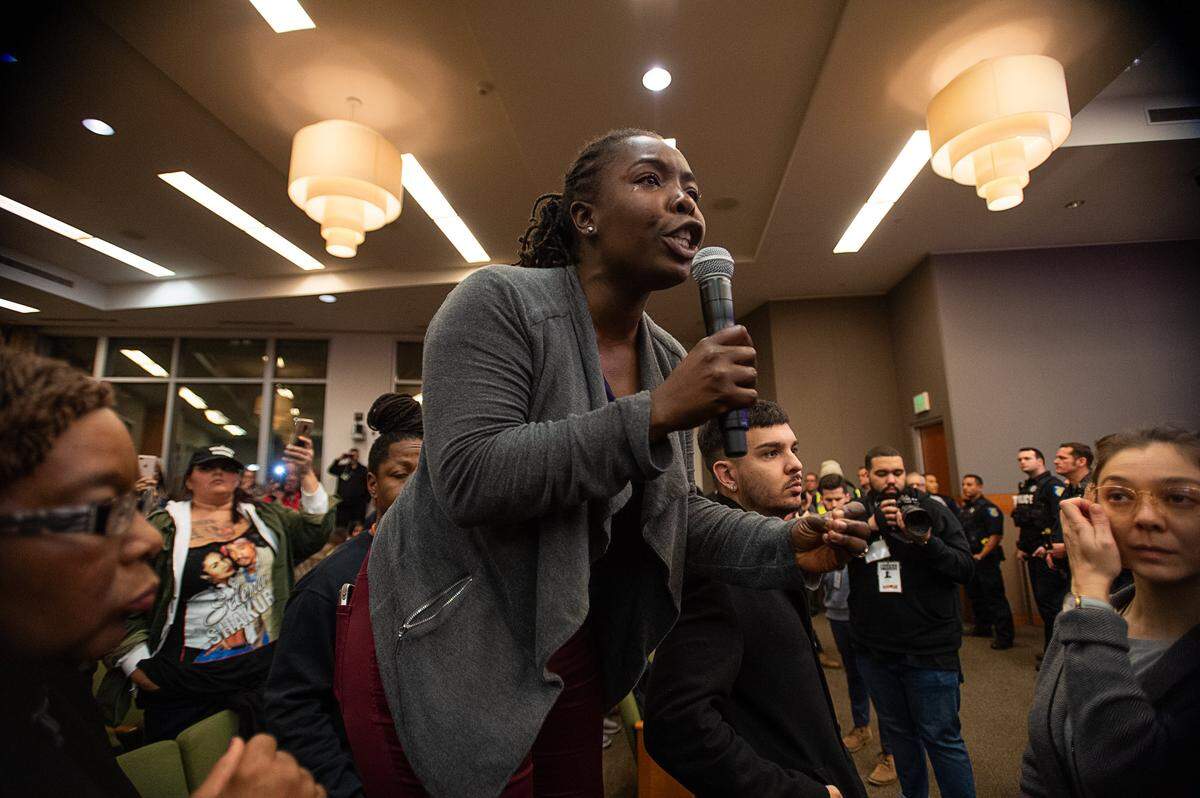
“This isn’t about law and order,” Cofer yelled while standing on a chair in council chambers, tears in her eyes, as dozens clapped below her. “This is about hearing the righteous indignation of an entire community that is bearing out the pain that we have accepted for generations.”
Several weeks later, Cofer ramped up her activism — attending an event where Schubert was speaking, holding a banner with Black Lives Matter Sacramento founder Tanya Faison that read, “DA SCHUBERT YOUR HANDS ARE BLOODY TOO.”
Shortly afterward, then-Councilman Jay Schenirer appointed Cofer to a city commission tasked with recommending the council how to spend the revenue from the Measure U sales tax increase — funds intended to uplift disadvantaged neighborhoods.
In 2020, when Minneapolis police killed George Floyd, sparking a national racial reckoning, Cofer became more well known when during a committee meeting she blasted Mayor Darrell Steinberg for using a significant amount of Measure U money on police, which the city said it needed to do after COVID tanked parking revenue.
“What you’ve given to us, it shouldn’t even be considered it is so ridiculous,” Cofer said from the dais while Steinberg was at the podium, a reversed dynamic. “We should be screaming and furious about this because this is a travesty.”
After years of trying to make change from the outside, Cofer’s appointment as committee chair gave her a more insider role. During the same time period, McCarty was on the inside in a much more high profile way, as a state assembly member.
Stephon Clark’s Law
McCarty, who is biracial, was working on police accountability legislation for years before Clark was shot. But after the shooting, it gained momentum.
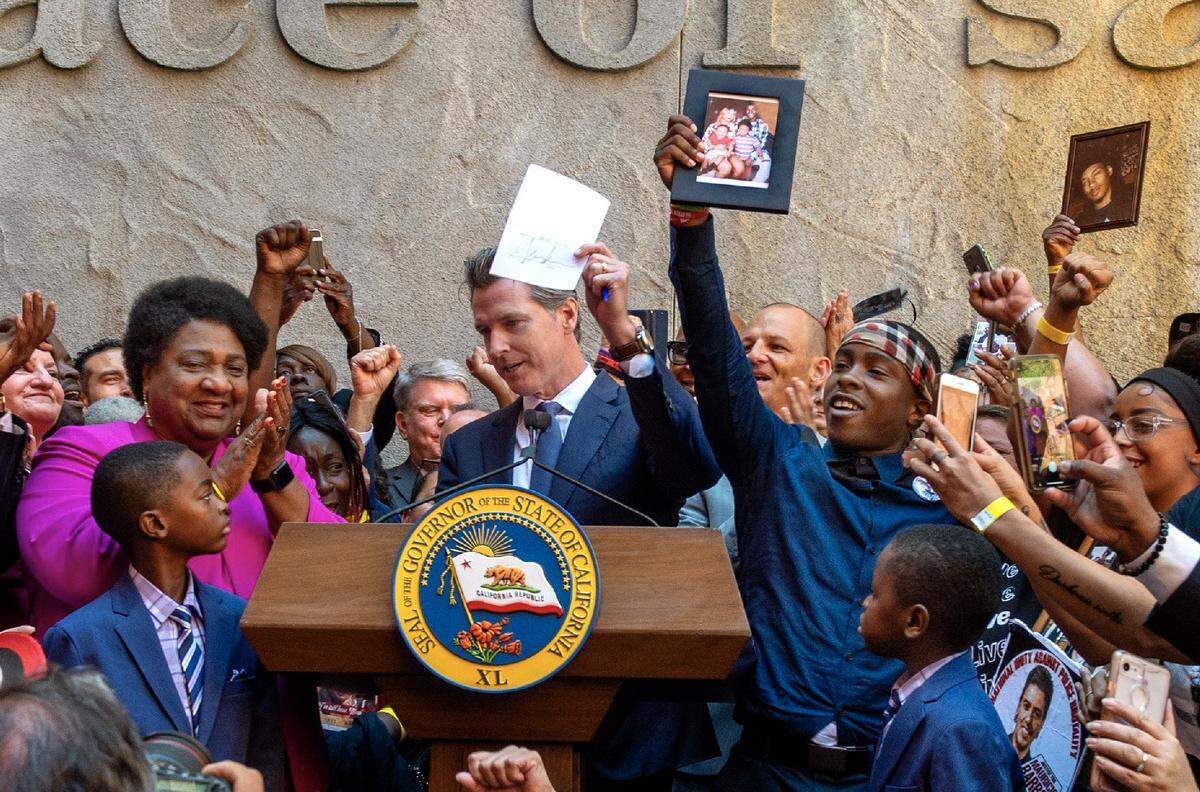
In 2019, Gov. Gavin Newsom, surrounded by Clark’s family, signed McCarty and then-Assemblywoman Shirley Weber’s high-profile bill, Assembly Bill 392. Known locally as Stephon Clark’s Law, it tightened the statewide deadly use of force standard from “reasonable” to “necessary” among other changes.
To win support from law enforcement agencies, lawmakers removed the provision that would have held officers criminally liable. Some police departments still opposed it. The American Civil Liberties Union supported it, while Black Lives Matter said it was watered down. Five years later, its effectiveness is unclear, but it was objectively one of the largest police accountability laws state lawmakers have enacted in recent years.
“My first day as an assembly member, I wrote a law that said there should be independent investigations of officer-involved shootings,” McCarty said during a recent candidate forum. “That law failed five times. It wasn’t until Stephon Clark that that bill became law.”
Fights over police budget
In the last three budget cycles, the police budget was a contentious topic among council members, with Councilwomen Katie Valenzuela, Mai Vang and Caity Maple at times voting the budget down because it wouldn’t shift more money toward a non-police alternative. Now, with the city facing a large $77 million deficit for the fiscal year that starts July 1, the police budget will likely continue to be controversial.
Both McCarty and Cofer agree to not layoff police officers.
From there the differences begin. Cofer wants to, over time, shift $70 million away from the police budget — she says that’s how much Measure U sales tax money went to the police. She wants to use that money instead to hire more non-police personnel to respond to non-violent calls.
“I’d like to see police spend 100% of their time on police tasks and would like to take some of those dollars from the 115 vacancies and move them to the Department of Community Response,” said Cofer during a recent candidate forum. “I’ve never mentioned cutting police officers, but I have mentioned moving dollars from the vacancies to make sure we can ensure health and safety.”
The council created the Department of Community Response after Floyd’s killing to shift some non-criminal 911 calls away from police. It ended up being used to respond to 311 calls about homeless camps, but not 911 calls.
The city gives money to the police department for positions that are not filled because police officials use the money instead to pay officers for mandatory overtime.
City spokespeople did not immediately provide The Sacramento Bee with the number of police vacancies in the current budget, as well as the dollar amount associated with them.
In the fiscal year that ended June 30, 2022, roughly $17 million was budgeted for police vacant positions, according to a document staff sent Valenzuela last year, obtained by The Bee.
Police Chief Kathy Lester said during a council meeting earlier this year that the number of vacancies has been consistently increasing since then, meaning the number is now higher than $17 million, Valenzuela said.
Although Cofer has previously participated in protests against police brutality in 2020, that’s not the main reason she’s proposing shifting the funds, she said. It’s mainly about using city resources more effectively.
“When someone calls 911 to says someone has fallen, there’s no weapons the firetruck comes out and then three police cars come out.” Cofer said in an interview with The Bee. “Are all those necessary to respond to a medical emergency?”
McCarty, who is endorsed by the Sacramento Police Officers Association, said he wants to grow the police budget. Although it’s at an all-time-high $250 million, the department still does not have has many officers as it had before the Great Recession, when the city population was much smaller, McCarty often points out.
McCarty wants to add officers but not until the budget grows, he said.
“This idea as far as cutting police budget, I think, would make our city less safe and have less of an opportunity to have businesses relocate in Sacramento and grow so I fully support expanding police budget as revenues grow,” McCarty said during a Sept. 16 candidate forum. “I do think we need more accountability in our laws across the state. You can support needed reforms for PD and adequately fund PD.”
McCarty currently chairs the assembly’s public safety committee, which has this session been focusing largely on retail theft.
This story was originally published October 7, 2024 at 2:00 AM.