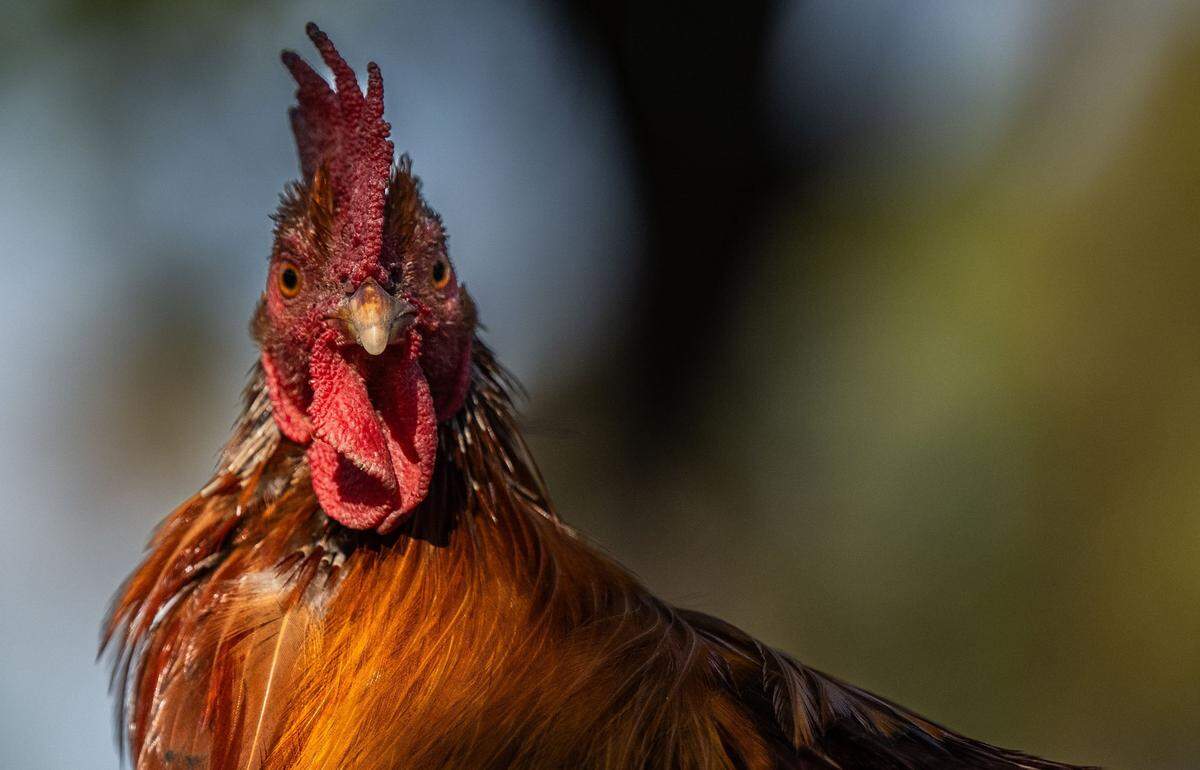
Why have feral chickens taken over the streets and yards of Yuba City? ‘Only God knows’
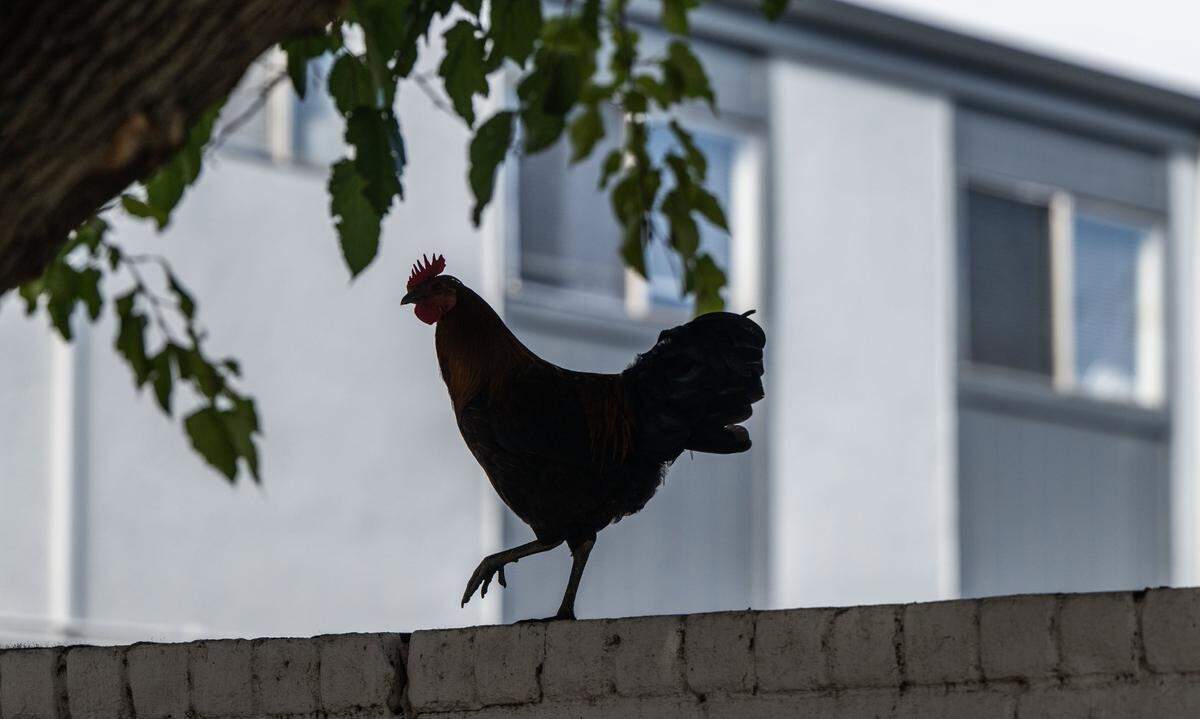
Most hear the chickens before they see them.
Their shrill crows slice through otherwise quiet mornings at unassuming business plazas and neighborhoods. The sound is unmistakable but the unaccustomed would be forgiven for thinking twice.
Nevertheless, and in so many ways, the thousand or so feral chickens of Yuba City are exactly what you think they are.
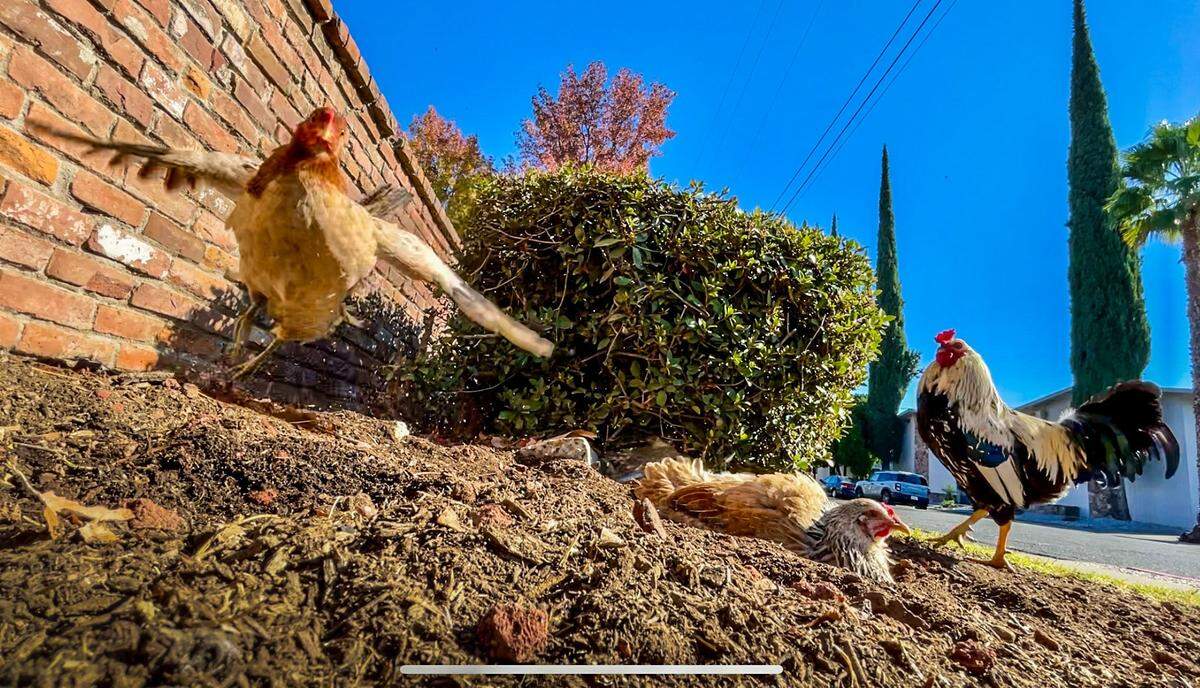
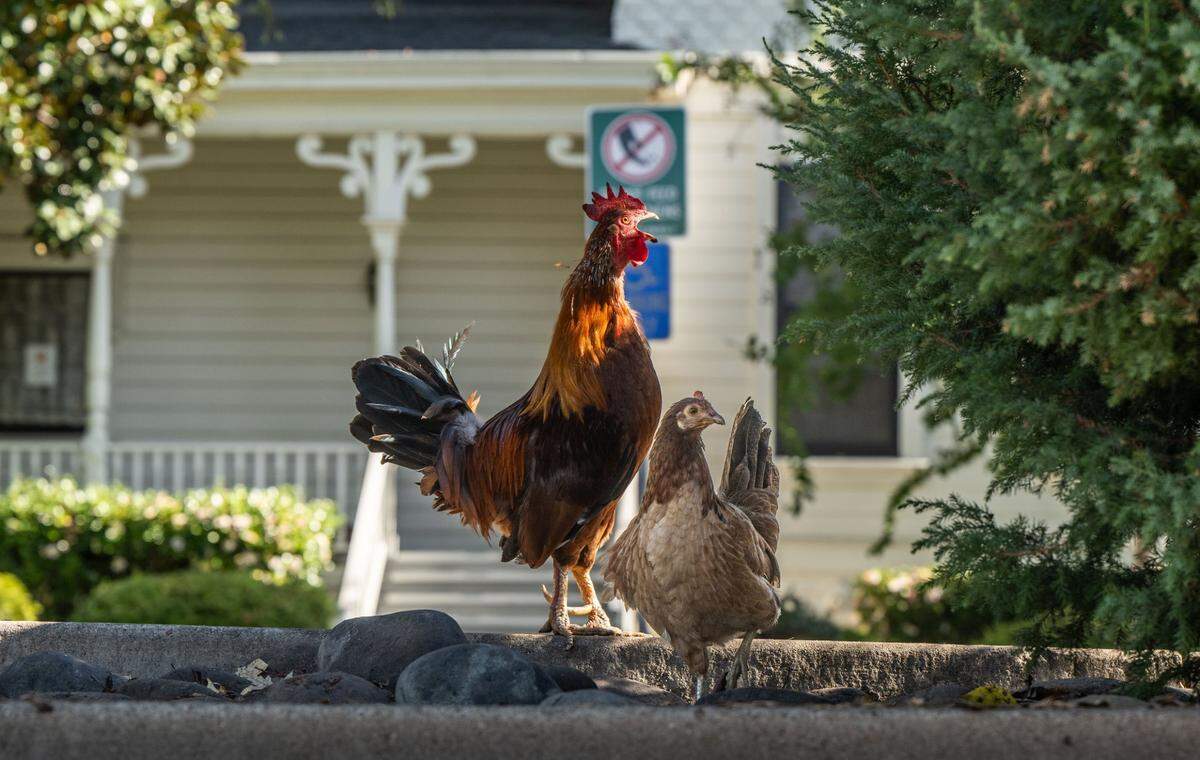
Just as they blend into their surroundings, their burnt orange, brown and red colors mixing with the early morning shadows and slightly dry flower beds, they’ve blended into the fabric of Yuba City, becoming unlikely, beloved and at times divisive symbols of the community.
The intersection of Highway 99 and Franklin Avenue, at the south entrance to town, marks the center of the community’s feral chicken population, a demographic shrouded in mystery, perplexity, love and hate.
Some admire the town fowl, observing their mannerisms and quirks, and feeding them contrary to the city’s orders. Others, primarily those who live and work among the chickens, learn to accept the frustrations of loud rooster crows, abundant amounts of what’s kindly described as “manure” and unwelcome visitors to their property.
“Mostly it’s a fun aspect and one of our quirky things we have in Yuba City,” Mayor Shon Harris said. “I’m a big fan of them. I like them, I get a kick out of the fact that they’re here.”
But, he said, they still need to be managed.
“I also acknowledge that there are some people who think that they’re nothing but a bad thing,” he added.
Unknown origin stories
Experiencing the chickens firsthand, even for residents of the city, is often a luxury, meaning it’s both optional and avoidable. However, that’s not the case for the people and businesses closest to the chickens’ homes.
Many wonder where the chickens came from, but perhaps more important, is the question of how a town came to welcome all of these feral chickens, and why those animals decided to stay.
Chad Segress, 23, and his wife Kyndra have three kids who like to chase the chickens.
A lifelong Yuba City resident, Chad grew up, and grew accustomed to, sharing space with his neighborhood birds, as many others have for decades.
“They’ve been here since before I was here,” he said. “They’re not a bad thing.”
He lives among one of many clusters of homes where the chickens frequent, near a church with a sign warning people not to feed the chickens. Like many in the community, he wonders where they all came from. But he, like many in the community, doesn’t get caught up on that question.
“The real story of how they got here, only God knows,” he said.
Several theories have been passed down for decades and combine to less than the sum of their parts, together pointing more toward unknown origins than any one root cause.
It’s imprecise to label the stories of how the chickens came to be as conspiracy theories, but they occupy a similar place in the mind, and among the city’s collective unconscious.
A definitive explanation — hard evidence of the chicken’ origins to replace all existing theories and end the debate once and for all — has not presented itself in all of these years. If anything, the absence of proof leaves more space for conjecture, more reasons to doubt the “official narrative,” which in this case, history has not firmly established.
Instead the town is left with an increasingly unsolvable mystery and more than a thousand squawking birds.
However, what people generally agree upon is that at some point, some chickens became free in the vicinity of Franklin Avenue and Highway 99 — in other words, the epicenter. How they were sprung is open to debate.
Some tell of a dramatic crash involving an overturned truck that countless chickens survived and from which they escaped into the surrounding city blocks. Others tell of a farmer who left a brood of an unknown size in the area after a fair.
Homes that are, or once were, in the area may have enabled the chicken population to grow, with some pointing to past tenants and homeowners to explain the proliferation.
The farming history of the area has led some to speculate that the chickens entered the urban environment after the city and its roads expanded through neighboring farmland. That account has similarly dramatic flare as that of the overturned truck, a tale of nature reclaiming its land and rebuking urbanization, as if out for revenge.
But most wouldn’t describe the chickens as vengeful. In fact, many subscribe to a more reasonable, but still unverified, account: the old auction yard theory.
There’s agreement that a livestock auction yard was once approximately where upward of a thousand feral chickens now inexplicably roam. When the auction yard closed, some hens and roosters were left behind and nature ran its course. In time their presence became inevitable.
But even that theory has holes.
“I don’t know of anybody who’s ever identified the location,” said Chuck Smith, local historian and editor of the Marysville Appeal-Democrat, of the old auction yard.
The chickens have been in Yuba City so long — at least into the 1980s, most agree — even longtime residents are murky on the details.
Time has a way of turning certainty to mystery. The ones with knowledge, and the memories they hold, fade away, leaving blindspots in local history filled with curiosity and uncertainty.
Unlike the mounting origin theories, the science behind the fowl’s urban lives exists on more established footing. The unknown history of all these chickens raises questions, and there are some who hold the answers.
Why chickens choose cities
Chickens are neurotic, sudden creatures. They scurry and shout in ways both understandable and unpredictable. , For example, hundreds of hens in a coop share a chaotic order to their dance. The wild chickens of Yuba City appear to organize differently than their domesticated counterparts, and almost as frantic, but the reason underlying their concern is less clear.
But that’s an outsider’s perspective. To hear it from an expert, there’s much more to it than that.
Richard Blatchford, a poultry extension specialist at UC Davis with a doctoral degree in animal behavior, studies chicken operations of all sizes, from ones like the backyard setup of his childhood to multimillion-dollar egg producers.
He’s unfamiliar with Yuba City’s chickens in particular, but he said the home they’ve carved in an urban environment, although uncommon, isn’t entirely surprising.
“Chickens feralize very easily,” Blatchford said. “They are one of the few species that can do that very easily and do that in an urban, human-dominated environment.”
Their familiarity with people gives domesticated chickens an advantage when reverted back to the wild, as that experience allows them to settle alongside people and absorb the comforts of the infrastructure of humankind, such as protection from predators and more available food sources. Even if, for a lot of chickens, that food source comes by way of garbage.
“They eat a huge wide range of food types,” Blatchford said. “They are able to get a nice balanced diet on lots of things that we may not think of as being great, but they can utilize them very easily.”
Chickens are surprisingly well-adapted to scavenging in a city. As omnivores, they can get by on everything from weeds to insects and even small mice. When it comes to pecking through trash, they adapt to that as well.
“They have taste receptors, for example, that can be specific for certain nutrients that they need,” he said. “If they find a garbage pile with leftover food items, they’re really good at picking out the bits that they need to complete their diet.”
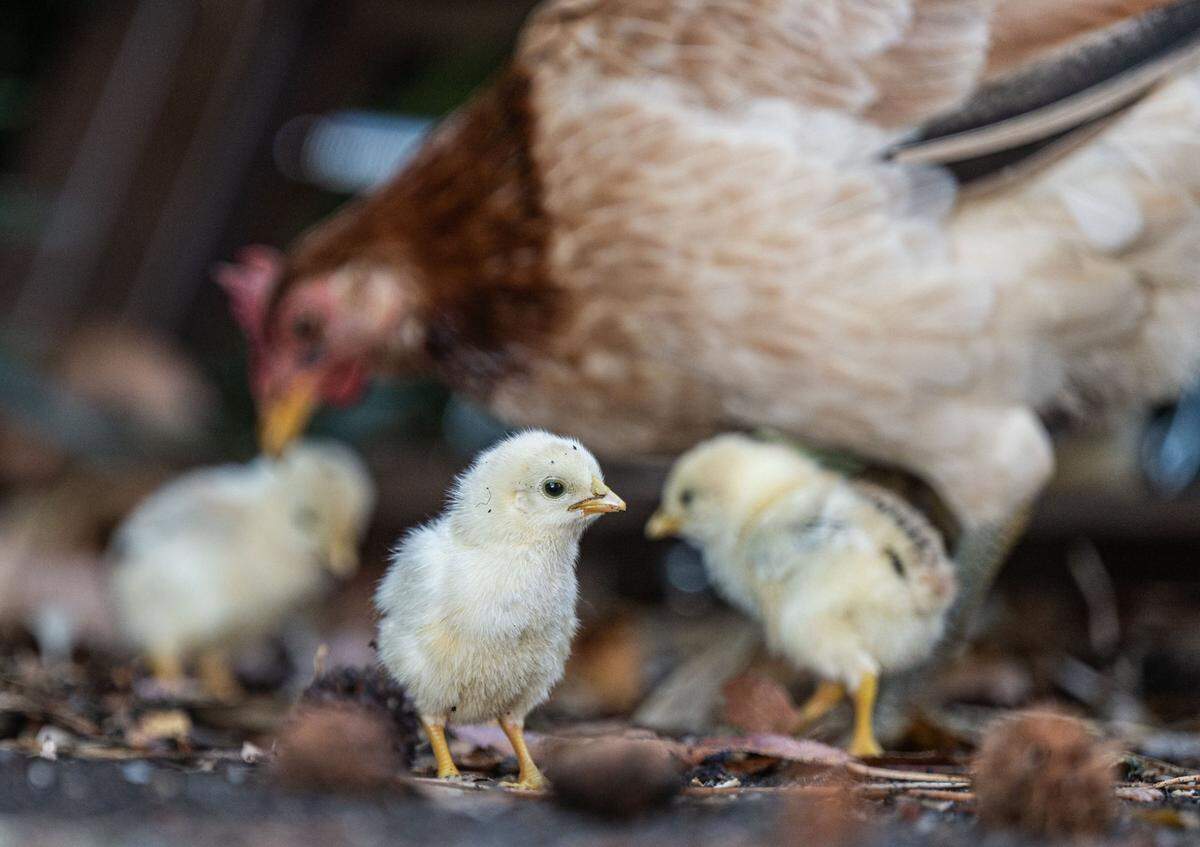
Chickens also reproduce relatively quickly. They can have at least one clutch — about six to 12 chicks — per year, but may nest more frequently in a welcoming climate such as Northern California.
“If every hen is producing that many birds, not all of them will survive. Even if 50% of those survive, that’s another generation,” Blatchford said. “You can see how it can build up pretty quickly over time.”
Then there are predators to consider. To a chicken, everything from cats and dogs to foxes and raptors is a potential threat.
“Basically everything wants to eat chickens,” Blatchford said.
But in Yuba City, particularly the urban and concrete environment its chickens have thrived, that location offers certain protections from predators, for the same reasons it’s not common to see coyotes and mountain lions roaming business plazas.
“There’s not a huge number of downsides for them,” he said.
But is the same true for the people they cohabitate with?
A problem to some
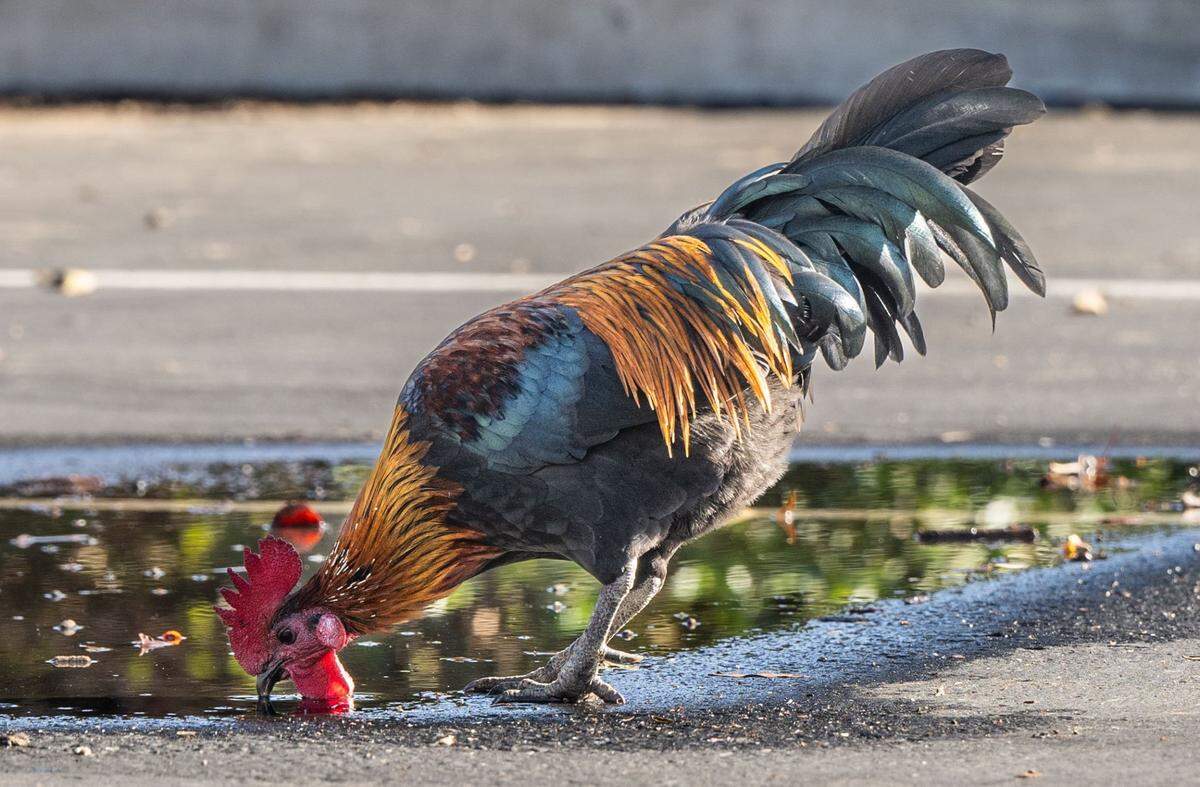
Most domestic chickens come from red junglefowl, whose ancestry traces back to southeast Asia. Red junglefowl form groups, called harems, with one rooster, several hens and the chicks they produce.
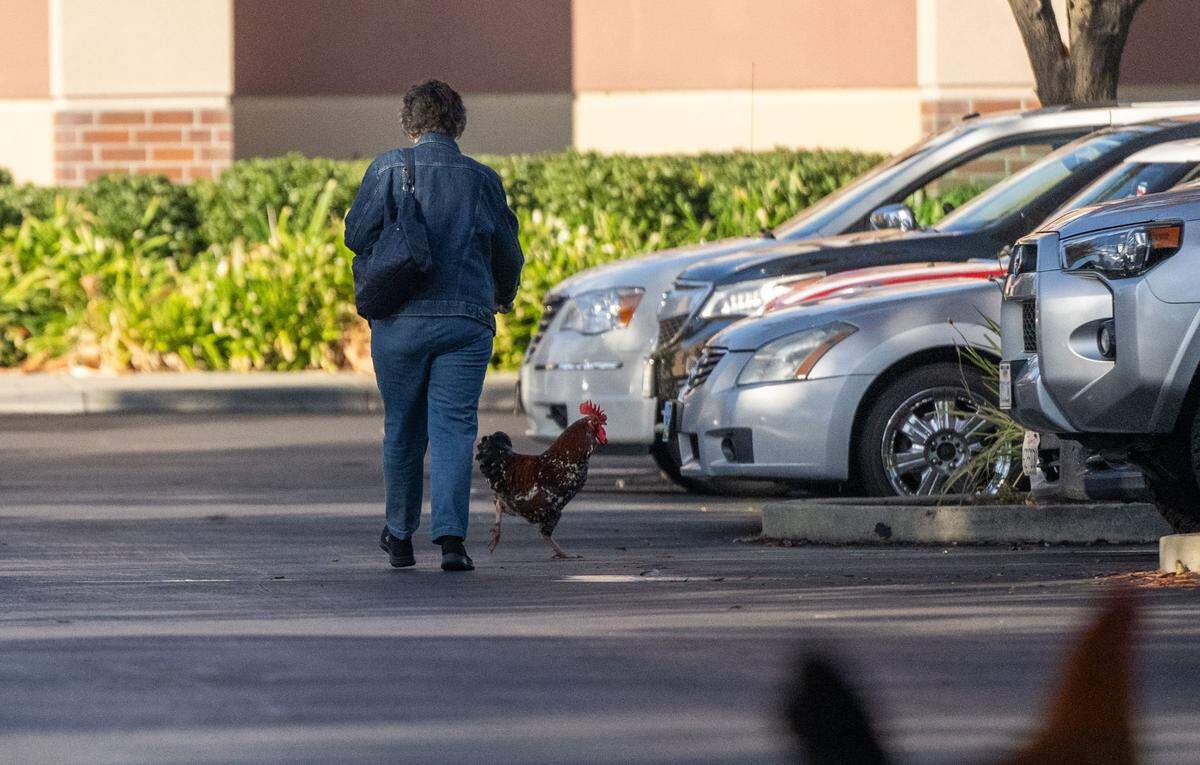
The groups, identified by some locals as gangs, are inherently territorial. People notice these different factions in some of the hotbeds, such as the WinCo Foods parking lot and outside of Cinemark.
One such gang recently started a turf battle on Navi Sekhon’s front lawn.
A half-dozen or so were loitering near a tree. Sekhon walked out her front door to take her young nephew on a walk, saw them, and reached for a large stick propped against her first floor apartment.
Immediately and stoically waving the branch in front of her while walking at a determined pace, she sent the congregation fleeing across neighboring lawns on B Street.
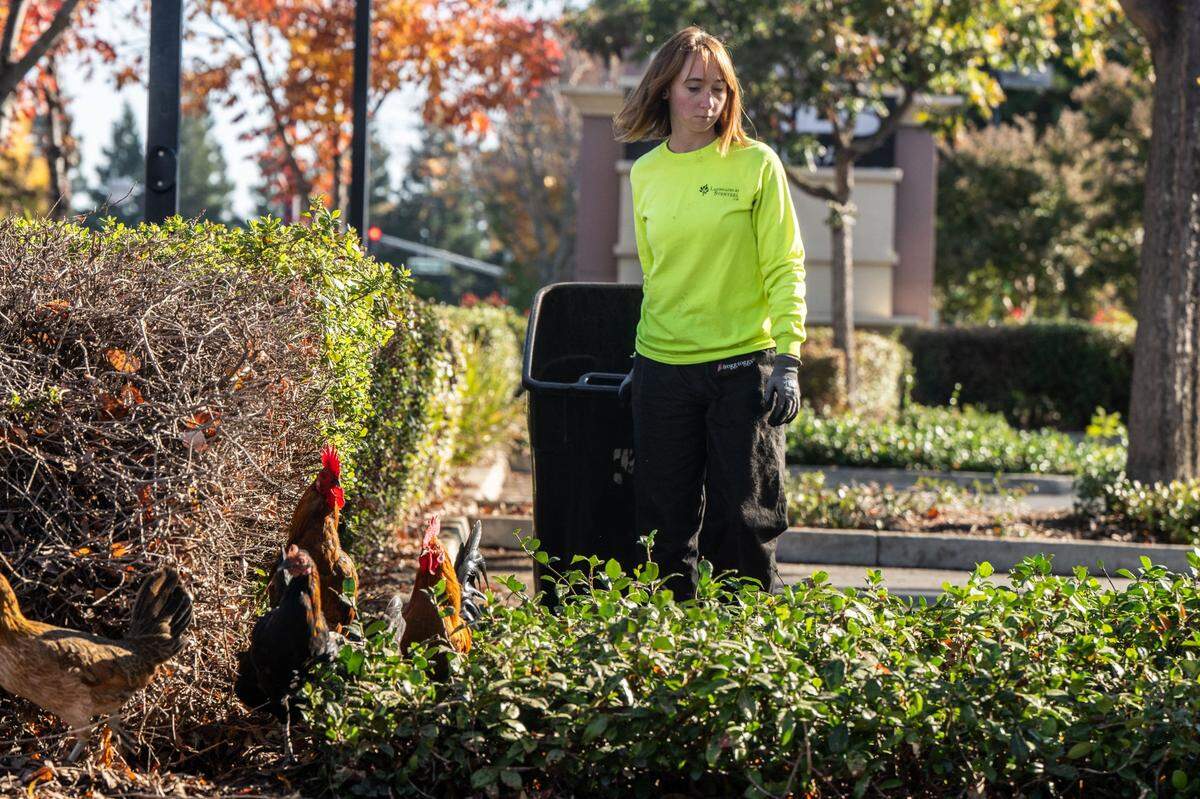
“I don’t like them. I don’t like them at all,” she said, pointing to a picked-clean stalk in a small flower pot on her front steps. “Because they eat my plants. It’s like a pain in the back.”
The chickens also leave messes on the walkway outside the homes of her and her neighbors, which they have to clean often.
Although Sekhon sent the chickens fleeing, just a few minutes later they began clumsily sneaking back toward her yard.
“See!” she said.
This is the conundrum in her neighborhood: when one neighbor shoos the birds away, they wind up at the door of another neighbor, who shoos them back. Thus, the cycle continues.
“It’s like an everyday struggle,” she said. “They’re getting out of control.”
The debate about Yuba City chickens has historically ebbed and flowed every several years. Letters to the editor of the local newspaper show the dueling perspectives of residents raising legitimate quality of life complaints and others who find joy and pride in the unofficial town mascot, which some see as “an asset.”
The community is currently in a time of peace, so far as the chickens are concerned, but it wasn’t long ago that the town’s animal services department was in a fight to relocate the birds.
Solving for chickens
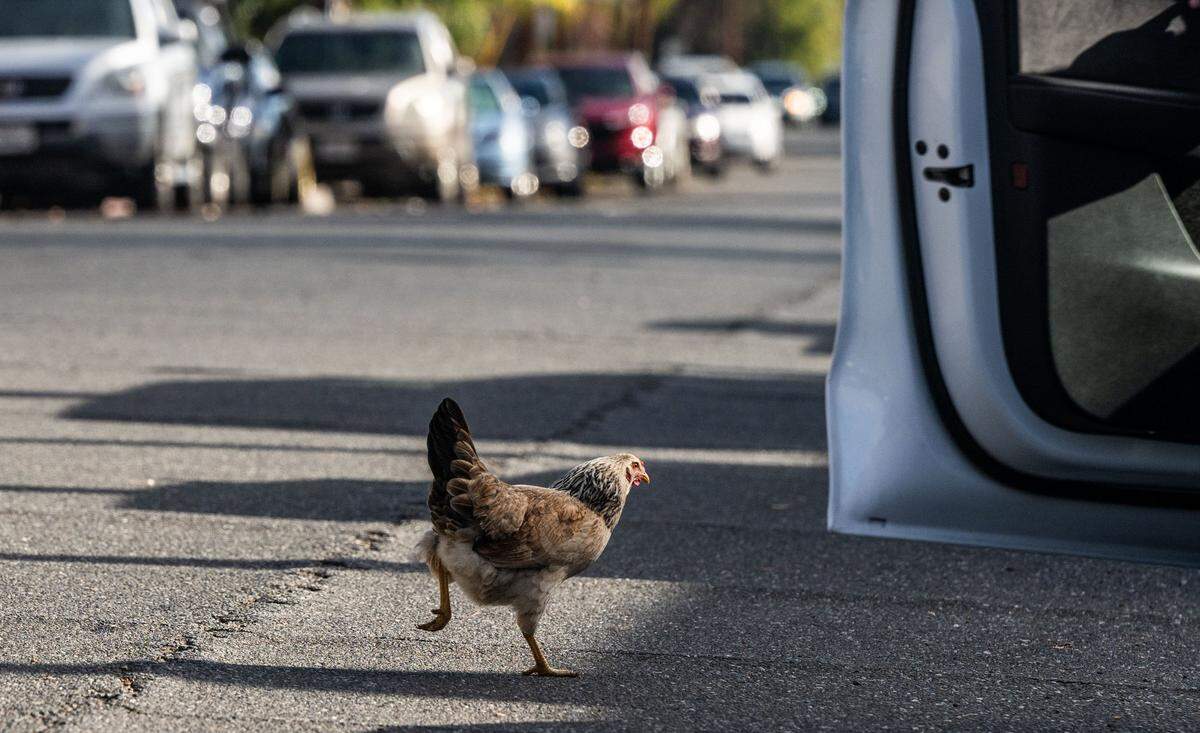
A series of complaints, many coming from local businesses, prompted the city in early 2022 to begin its Feathers to Farm program, an effort to capture and relocate a large number of the feral chickens.
Animal control officers experimented with the best methods of capturing the birds, said Megan Anderson, animal services manager, and eventually settled on an old-fashioned net. Still, the effort was labor-intensive and time consuming. Further complicating their mission, the chickens eventually learned to recognize the animal control trucks, Anderson said, and would hide when they saw officers coming.
“We were trying to make a difference in the eyes of the community that is negatively impacted by them, I guess,” she said. “For the people that love them, we were trying to allow them to roam free on someone’s farm versus in a parking lot.”
About 700 chickens were captured and relocated, Anderson said. Only a handful, for health reasons, had to be euthanized. But eventually the city ran out of willing sanctuary hosts for the displaced animals, or had people who only wanted hens, presumably for eggs and less noise.
“It worked out for a long time but at a certain point it just becomes too much for anyone,” she said. “If we’re primarily getting roosters, it’s hard to find homes for them.”
The program went on hold later that summer and hasn’t resumed.
“It felt like even after we captured as many as we did it still felt like it didn’t really make a dent,” she said.
Since then, the number of complaints to the city has subsided, said Harris.
Resilience over eradication
Sekhon, who hasn’t made a formal complaint, said the city should do more to curb disruptions and annoyances caused by the chickens, especially for those who live near them.
The chickens sprawl throughout a large chunk of the city, but most city residents live outside of that zone and only interact with them when entering into the radius of blocks that surround Highway 99 and Franklin Avenue.
“For people who are actually living — especially in this area — it’s getting out of control,” she said.
The city has historically sided with chickens while trying to answer and mitigate complaints that have arisen throughout the years. Some aggrieved residents may take issue with that approach, but as the Feathers to Farm program proved, eradicating more than a thousand chickens entrenched in the community for decades does not come easily.
“There’s not a lot you can do,” said Blatchford, the chicken specialist. “You also have to really make sure that you get everybody in the population, which can be really hard, because if you don’t, they’re just going to repopulate within another year or two and get back to the same situation.”
For the city, its chickens are not unlike wild animal populations found and maintained in other communities.
“We have chickens, other cities have deer issues — other wildlife issues — coyotes, things like that,” Harris said. “We happen to have chickens.”
But the vast majority of California and American cities don’t just happen to have chickens.
The questions of where they came from and what to do about them are met by varying perspectives, but the central questions remain: Why has the community welcomed these chickens and, more importantly, why have they stayed?
Life perpetuates
Having lived in Yuba City more than 25 years, Bijan Parhizgar didn’t realize how much he’s picked up on the local chickens.
For years he’s observed their behavior in the parking lot outside of Kohl’s, while his wife shopped inside, noticing the harems they form and the different calls they make, whether in hopes of a mate or to point out a raptor flying overhead. He’s watched them climb trees to spend the night and seen them on neighboring apartment balconies.
“It’s not something I followed seriously or as a big thing because, you know, I view them as chickens,” he said, “and they live their lives mixed with everyone else in our society.”
Out of curiosity, he once cooked and ate an egg he found, which he’s not certain was from a chicken, and does not recommend others try.
Those observations, and the egg he found, were made not too far from the epicenter. Spotting a stray chicken wandering outside of that zone is uncommon.
But Parhizgar said that recently he and his wife, as well as several Starbucks employees, began tracking the personality and behavior of a young chicken who found home outside of the coffee shop.
What’s more, that particular location is north of Highway 20, a heavily trafficked east-to-west thoroughfare where feral chickens are rarely, if ever, spotted. Nevertheless, this chicken arrived outside of the coffee shop. How it got there is as mysterious as how the rest of the chickens got to where they are. They thought it was a young hen, until it grew up and its red comb exposed it as a rooster.
Parhizgar watched as the bird learned to approach cars in the drive-thru line, picking insects and splatter from their front grills and bobbing out of the way without getting hit.
“All around the little parking lot is his territory now,” he said.
His territory, enabled and supported by the people who have taken a liking to him.
Chickens, a food animal first and foremost, have begun to transcend that designation. Similar to horses, once common work animals now often cared for by owners as much more than that, chickens have transitioned into companion animals for some.
“We don’t think of them in this way, but they’re very individual,” Blatchford said. “They all have little personality quirks. We can tell them apart.”
“I don’t know if they can identify individual people, but they can at least identify familiar versus not familiar people,” he added.
Chickens are surprisingly intelligent but obviously simple. Accordingly, it’s best to meet complicated questions about simple animals with simple answers: Just as they cross roads to get to the other side, they have stayed in Yuba City all these years because the community wants them to stay.
It’s that simple.
Some residents who live near the chickens want them gone, most residents who live elsewhere in the city prefer them to stay.
They’re the community’s chickens, and in the community’s own laissez faire way, they were given the grace to live and let live, a practice that the chickens, intentionally or not, abide by.
“Life has a way of continuing, perpetuating itself, with the chickens,” Parhizgar said.
For all these years and far from oblivion, that’s exactly what they’ve done. An unknown number of years later, the mysterious, enigmatic fixtures of the community live on, perpetually in the hearts and parking lots of Yuba City.