
Map shows deadly car crashes across Sacramento area. Do you live near these intersections?
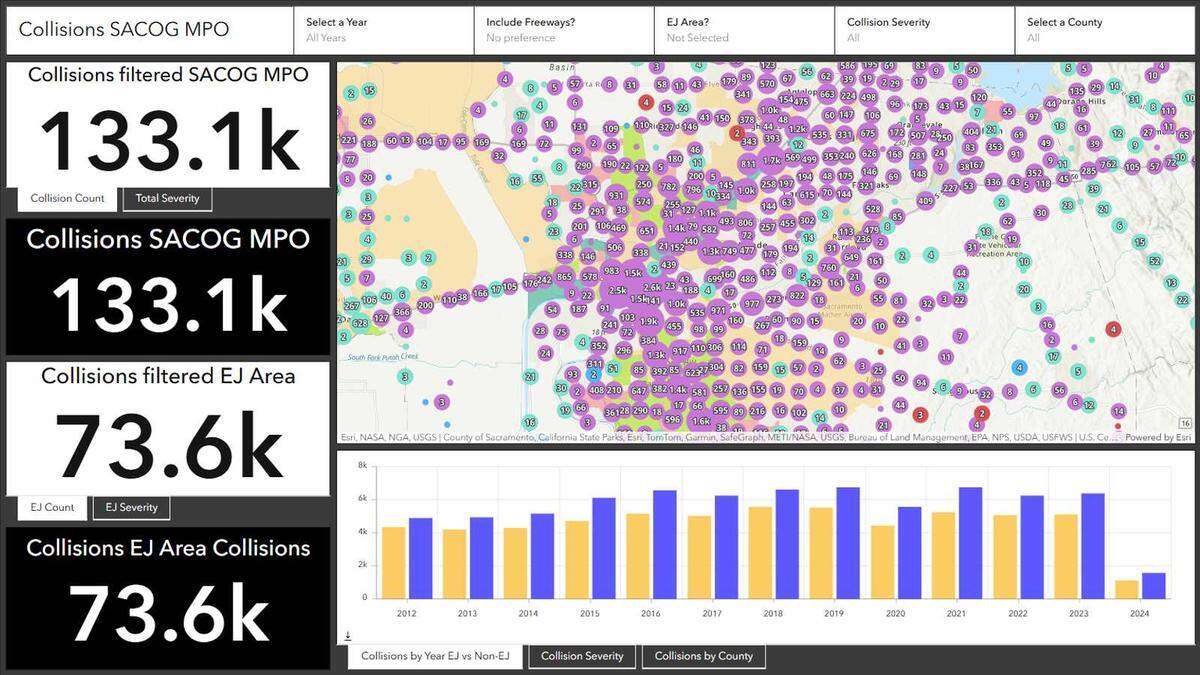
As the capital region faces an escalating crisis of dangerous roads, the Sacramento Area Council of Governments has released an interactive map that can show residents of Sacramento, El Dorado, Placer, Sutter, Yolo and Yuba counties where fatal or severe car crashes are happening in their neighborhoods.
The interactive map shows 259 fatal crashes last year in the six-county region.
On Thursday, the SACOG Board of Directors, a group of elected city and council leaders, heard in a presentation that the counties they represent have a significantly higher rate of both fatal injury crashes and severe injury crashes than the statewide rate. For every 100 million vehicle miles traveled in the six-county region, 1.8 collisions killed people. Statewide, the rate was closer to 1.4.
The region holds a similar standing nationally. Smart Growth America, a nonprofit organization focusing on development strategies, released its “Dangerous by Design” report in May showing the Sacramento-Roseville-Folsom metropolitan area was the 20th most deadly place for pedestrians in the country.
The Sacramento Bee has reported on the deaths of 19 pedestrians and cyclists on city streets this year, and the city of Sacramento may soon declare a state of emergency over pedestrian and cyclist safety.
Research and other municipalities have shown that the majority of traffic fatalities are preventable, and local leaders have taken note. At Thursday’s SACOG meeting, board member and Sacramento City Councilman Rick Jennings spoke about “creative quick-builds: solutions that can be designed with communities to make unsafe streets safe.” Earlier in the week, Jennings — who represents Land Park, the Pocket and other south Sacramento neighborhoods — said the city needed to start providing steady and ongoing funding for road safety projects.
SACOG administers regional grant programs and could play a large role in underwriting such quick-build interventions.
In Sacramento County this year, the Coroner’s Office has publicly identified more than 130 people who died in motor vehicle crashes within its jurisdiction.
Who’s most affected by deadly crashes?
The SACOG data shows that a disproportionate number of severe crashes occur in neighborhoods with high concentrations of particularly marginalized people, such as people 75 or older, low-income residents, the disabled, residents spending an outsize portion of their income on rent and people of color.
A little more than one-third of the region’s population lives in such neighborhoods, yet more than half of fatal crashes occur in them.
SACOG’s map, part of a recently released regional data dashboard that tracks economic indicators among other measures, draws on UC Berkeley’s Transportation Injury Mapping System to pinpoint where vehicle crashes occur. Users can filter crashes by year back to 2012. They can exclude freeways and look only at local roads and decide which types of injury levels to focus on — from suspected minor injuries to fatalities. The map also shows those particularly marginalized neighborhoods, referred to as “EJ communities,” short for “environmental justice.”
Pristina Zhang, project manager at Civic Thread, a local transportation advocacy organization, weighed in on pedestrian deaths and sidelines neighborhoods in May.
“The largest clusters of pedestrian injuries and fatalities occur in neighborhoods such as North Sacramento, south Sacramento, Arden Arcade and North Highlands, all (of) which are areas home to predominantly communities of color who have been historically underinvested in,” she said. “There is good work that is starting to be done, but I hope to see more attention and funding towards community-rooted strategies and design to improve our built environment and reduce unnecessary deaths of innocent people just trying to get to their next destination.”
The collisions dashboard is available at bit.ly/sacog-collisions-dashboard.
This story was originally published November 16, 2024 at 5:00 AM.