Two grandmothers died blocks apart on a dangerous Sacramento road. Will the city fix it?
Qui Chang Zhu crossed the street with her grandson, and that’s how she ended up dead.
On Jan. 31, 2018, Zhu picked up Jian Hao Kuang from Sutterville Elementary School, where his first-grade classmates called him Leo. The grandmother and the little boy left the school and headed east on Oregon Drive. They began to cross Freeport Boulevard just before 3:30 p.m.
If they had made it to the other side of Freeport, they would have walked almost 100 feet from curb to curb, traversing five lanes of traffic where drivers have a speed limit of 35 mph and some routinely travel much faster.
They never made it. A 22-year-old driver hit them with his sedan in the faintly marked crosswalk. He fled the scene, and turned himself in a few hours later.
Zhu died shortly after the crash. Although her 6-year-old grandson survived, his injuries were debilitating. According to a civil complaint filed by the family, Kuang suffered severe brain damage and will be disabled for the rest of his life. Whatever future the little boy and his parents imagined for him was gone.
An unfathomable loss.
The city paid a price too, not just in communal grief but in dollars: The family’s lawsuit would end in a $16.7 million settlement, one of the largest in the capital’s history.
Sacramento has some of the worst traffic death rates in the state, and among the hundreds of fatal collisions on city streets in the past decade, this was just one.
But the lead-up to the crash — and the decisions and delays that have followed in the seven years since — reveal the public policy failures that endanger every resident in the city.
Did the crosswalk even exist?
Zhu, who was 72, would have had to walk a quarter of a mile out of her way with the little boy to cross at a light; she opted for the more direct route. Freeport Boulevard and Oregon Drive had a painted crosswalk until just a few months before the crash when it disappeared. The family’s lawsuit says that while the city sent workers to scrape up the paint, the impression of the lines remained visible to people on foot. After Zhu’s death, those impressions were paved over.
This was part of a broader effort. From 2014 to 2018, 23 marked crosswalks scattered across Sacramento’s road network were removed.
Although council members made a “Vision Zero” pledge in 2017 to eliminate all traffic fatalities and severe injuries by 2027, the crosswalk removals continued after the pledge. A city official explained the reasoning to a Sacramento Bee reporter at the time: The Federal Highway Administration advised that on a high-volume, high-speed street like Freeport, a plain painted crosswalk was not enough. Additional safety measures — such as traffic lights or infrastructure that forced vehicles to slow down — were necessary for pedestrian crossings. And so, after a resident complained that the crosswalk on Freeport and Oregon seemed dangerous, officials decided to remove it altogether.
It has not yet been replaced.
“To send the message via crosswalk that this is a good place to cross the road is a false message,” city traffic engineer Ryan Moore said in 2018. “Our standards dictated that we remove the crosswalk or build safety enhancements.”
Moore explained seven years ago that safety enhancements weren’t an option at Freeport and Oregon, however, because the Department of Public Works did not have $500,000 in the budget to add a traffic signal.
In hindsight — accounting for the grandmother’s death, the boy’s terrible injuries and the $16.7 million settlement — that math is confounding.
But the calculation appears to be typical in Sacramento.
What can the city afford?
While the intersection has seen no material changes in the past seven years, the City Council did green-light an improvement plan for Freeport Boulevard in February 2023. Nearly two years after the council’s vote, the next phase of the project remains unfunded.
Zhu and Kuang’s family did not respond to an interview request about how the city has prioritized road safety since the crash.
But Sacramento’s budget documents tell a story of its own.
Over eight years of post-Vision Zero capital improvement programs, which lay out the funding for big projects related to city-owned property, a median of $44.4 million a year went to the Department of Transportation ($54.8 million in 2024). For the 10 plans published between 2015 and 2024, the documents show most of the funding sources remained stable during those years — except the grants that staffers cobbled together as well as the smaller influx of money after the passage of California’s Road Repair and Accountability Act of 2017, better known as SB 1 or the gas tax.
In other words, the City Council set an ambitious Vision Zero goal in 2017 to end traffic deaths in a decade, but scarcely sent more project money to the department tasked with realizing that goal.
The documents also show that the City Council was repeatedly informed about the staggering deferred maintenance backlog on roads. In 2018, they contain an estimate: The city faced a $179 million backlog. By 2024, that figure ballooned to $796 million.
Wear and tear on the roads accelerated faster because more people were in vehicles, and fewer people were traveling by bike or foot. The National Association of City Transportation Officials has reported that more people start riding bikes after cities establish safer infrastructure for cyclists; the Federal Highway Administration says more people would walk if the roads in their neighborhoods were safer for pedestrians. But Katie Valenzuela, whose term on the City Council ended this month, said that even though Sacramento could save money in the long run with investments in safer roads, the potential savings aren’t factored into budget decisions.
“No. I can answer that pretty decidedly,” she said. “We’re very shortsighted.”
At a meeting of the Law and Legislation Committee in November, housing advocate Ben Raderstorf raised another toll: the societal cost of death. In 2017, the U.S. Department of Transportation said the statistical value of a human life was $10.2 million. On average, the city saw more than 30 deaths annually for the first seven years of Vision Zero: by the 2017 measure, that was worth well over $300 million annually.
“We live in tough, austere times,” Raderstorf told the committee. “But the reality is, we are already paying for this problem.”
‘What about the rest of public safety?’
Sacramento has a notably high traffic death toll. This year, the capital region earned a shameful distinction from the development nonprofit Smart Growth America: It is the 20th-most deadly place for pedestrians in the country. Last year, data drawn from investigations by the Sacramento Police Department show the city saw eight crash deaths per 100,000 residents — 25% higher than the death rate in Los Angeles, a city with seven times the population and five times the territory.
In response to this crisis, Sacramento’s leaders aligned themselves with the Vision Zero movement on Jan. 19, 2017.
Before the City Council’s vote, Kirin Kumar, then the executive director of the transportation advocacy organization which has been renamed Civic Thread, stepped up to the mic and explained why the vote was important.
“These are preventable deaths on our streets,” he said. “These are not accidents.”
A year and a half later, on Aug. 14, 2018, the council heard about Vision Zero again — this time, when its members voted to adopt the finalized Vision Zero Action Plan. Under the leadership of Jennifer Donlon Wyant — now Sacramento’s transportation planning manager — staff had found that 79% of severe crashes happened on just 14% of the city’s streets. They called it the high-injury network, and all agreed that they could target their interventions to these roadways.
Councilmember Eric Guerra said from the dais that another motorist fatally struck another grandmother in front of her grandchild just a few months earlier while the pair walked on Lemon Hill Avenue. The crash troubled him.
“We cannot wait any more on making sure that these infrastructure projects get moving forward,” Guerra said. “It’s about commitment to funding infrastructure.”
The City Council approved the plan eagerly. Right after the unanimous vote, then-Mayor Darrell Steinberg said it was “not a report to sit on a dusty shelf, for sure.”
Those sentiments were not reflected in the next Capital Improvement Program, which shows the Department of Public Works’ annual budget decreased by $5.6 million.
As of December, with two years left to reach the 2027 goal, the city still has no established mechanism for building relatively quick safety improvements after severe crashes. Instead, Sacramento’s strategy has focused on large-scale street transformations that are mostly funded by competitive state and federal grants. The grants usually require that cities put up a “local match” to cover some of the project costs — often 12% to 40% — and the City Council allocates unreliable amounts for such matches.
Currently, city spokesperson Gabby Miller said, $10.5 million is specifically earmarked for the purpose.
The city’s emphasis on grants slows the implementation process dramatically. Grant cycles typically open once every year or two. After the application is submitted, the decision won’t be released for at least three to six months. If the department wins the grant — which is far from guaranteed — then the relevant portion of the project will likely begin six months to a year later. If the department loses the grant — which happens frequently — the process starts from the beginning. Projects are often broken up into three phases — planning, design and construction, each of which needs a separate grant.
In 2024, staff applied for a state grant to begin the next phase of fixing Freeport. Applications were due in the spring, nearly a year and a half after the original plan was approved. Although the proposal got a decent score — 92 out of 100 — it didn’t win anything and is still on hold.
At a November meeting of the Law and Legislation Committee, Councilmember Rick Jennings echoed Guerra’s sentiment from six years before: the Department of Public Works needs “a dedicated and ongoing source of funding.”
At that same committee meeting, Valenzuela noted that the police budget had risen by $100 million over the past four years.
“What about the rest of public safety?” she asked.
With a $77 million deficit looming, it’s unclear how the council will structure the next budget. Presently, the status quo continues.
A plan to fix Freeport, mired in typical delays
Freeport Boulevard would not be a particularly easy street to change.
First, it’s difficult on a bureaucratic level. Freeport is classified as a high priority, it lies on the high-injury network, and state and local data show seven fatal crashes on the road since 2017; nonetheless, it is not considered one of the “Top 5” corridors. A section of Broadway and Stockton Boulevard made that list, and an improvement project has started construction on the Broadway end of the route. With limited resources, the Department of Public Works has to prioritize, and Freeport is not quite as high on the list as other projects.
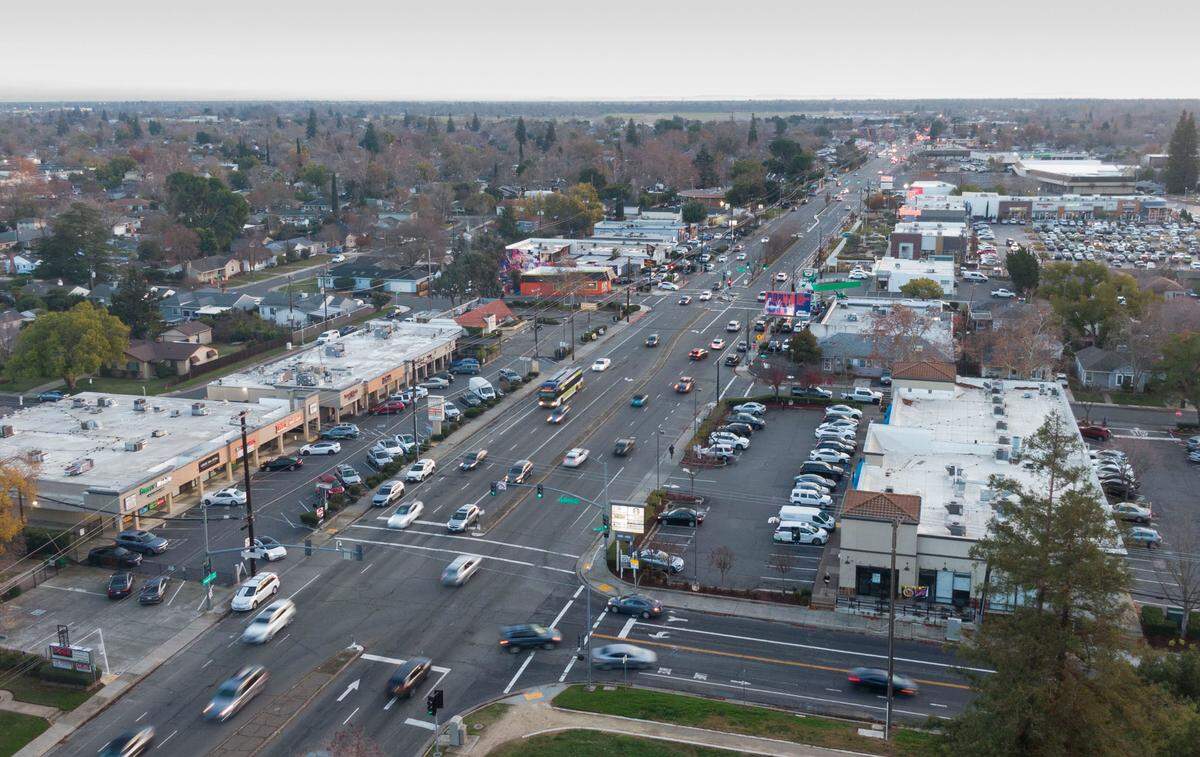
Aside from the bureaucratic issues, changing the road itself would be a large undertaking. Until 2003, the road was formally part of Highway 160. Much of Freeport has two busy lanes of traffic in each direction plus turning lanes. In the course of a day, more than 20,000 vehicles travel on it. The city described the street as “designed to freeway standards.”
Nonetheless, Sacramento has resolved to transform it. In July 2021, the Freeport Boulevard project kicked off a series of reports and community meetings. About a year and a half later, in February 2023, the City Council approved the resulting plan to try to make the street safer, which included more pedestrian infrastructure and bike lanes.
Some criticized it for not going far enough.
The critics wanted a road diet — maybe lane reductions — but the plan suggested maintaining all lanes (albeit narrowing them) and adding bike lanes mostly protected by posts. In other documents, staff have said that a crash at just 30 mph has a 40% chance of killing the person on foot, and drivers on Freeport have an even more dangerous speed limit of 35 mph for most of the project area. Despite the risk, the plan does not show an effort to significantly slow cars down.
The controversy is somewhat moot, however, since Sacramento has yet to secure funding for the design or construction, which staff estimated would run to $37 million. At a Sept. 16 news conference announcing her state of emergency proposal over pedestrian and cyclist safety, Councilmember Caity Maple said, “For the Freeport project alone, we’re looking at 10 years out before we have the funding to actually do that.” The plan itself has a less optimistic timeline, saying it would take over 13 more years to finish.
If that estimate held, the project would not be completed until at least 20 years after the crash that disabled Kuang and killed his grandmother.
Sacramento has acknowledged that it could intervene sooner: The Freeport document references potential “short-term improvements” multiple times. Thus far, however, the city has not identified any potential quick fixes while the neighborhood waits decades for change. “Based on safety data,” Miller said, “staff will analyze what improvements might be feasible to install in the near term without grant funding.”
There have been signs that leaders may shift their priorities. When Maple began to push a state of emergency declaration over cyclist and pedestrian safety in September, advocates said they were hopeful it could lead to meaningful change.
But the declaration itself doesn’t demand any funding for infrastructure. Maple said she had hoped to convince her colleagues to reallocate funds in the 2025 budget. Kiara Reed, the executive director of Civic Thread, said without money attached to the declaration, she worried it would be “just a statement that doesn’t really have any teeth.”
Maple’s staff said the state of emergency was likely to be voted on by the City Council next month.
And as onlookers wait to see whether the council will invest in road safety, the death toll has continued to rise. The Sacramento Bee has reported on the deaths of 32 people in traffic collisions on city streets just this year. Of those, 20 were pedestrians or cyclists: Mattie Nicholson, 56; Kate Johnston, 55; Jeffrey Blain, 59; Aaron Ward, 40; Sam Dent, 41; Terry Lane, 55; David Rink, 51; James Lind, 54; Tyler Vandehei, 32; Jose Valladolid Ramirez, 36; Larry Winters, 76; Sau Voong, 84; Johnnie A. Fite, 82; Robert Kohler Jr., 50; Edward Lopez, 61; Muhammad Saddique, 64; Azure Amonti Daniels, 48; Jordan Nicolas Rodriguez, 38; Nelson Lee, 64; and Lindie Jane Kraushar, 53. Two more people — Geohaira “Geo” Sosa, 32, and Kaylee Xiong, 18 — were killed this summer while riding electric scooters.
Nicholson — the first person to die this year — was a grandmother and a mother of six (four girls, two boys). Her friends called her “TT.” Nicholson’s youngest daughter, Tamar Blackman, did not agree to an interview request, but she tweeted after her mother’s death that there were “so many conversations I wish we could’ve had.”
When she was fatally struck by a hit-and-run driver, Nicholson was riding her bike on Freeport Boulevard, three blocks north of the crash that killed Zhu and maimed her grandson. According to the city’s estimate, at the time of her death, the Freeport project wouldn’t be finished for at least 14 years.
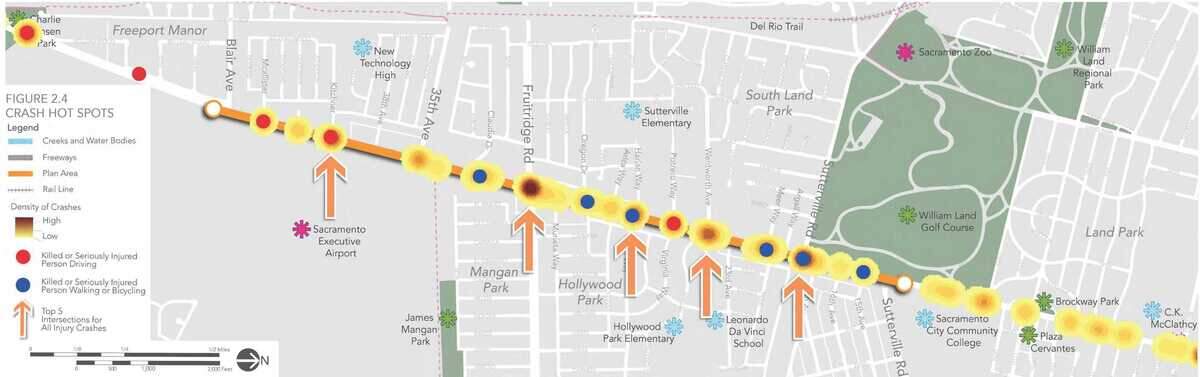
At the intersection where Kuang and Zhu were hit, the Freeport plan proposes adding a pedestrian signal and a wide median that gives some protection in the middle of the street. The median would be offset to change the angle of crossing and decrease the distance that people on foot would have to travel from curb to curb.
The city was, in part, responding to Zhu’s death, though the stakes — that the current state of the road is deadly — aren’t laid out explicitly in the Freeport plan. It gestures to the crash that killed Zhu twice. Once, Zhu is referred to as “a pedestrian fatality at Oregon Drive.” The other time is even less direct.
On page 12 of the document, a map shows crashes that killed or severely injured people on a 1.7-mile stretch of Freeport between January 2016 and December 2020. In total, there were nine. The map has no names and no stories, and all the human suffering is left to the imagination.
The grandmother and her grandson are a little blue dot.