She was hit by a truck and killed outside a Sacramento shelter. Could she have been saved?
A few weeks after the crash, Phillip Minton was waiting for his share of Wendy Connell’s ashes. He didn’t need much; just a little piece of her to put in a vial he’d wear around his neck. Their trailer still smelled like Connell, and he would breathe it in hazily.
For around five years, the couple had been living on or near Roseville Road, and they wanted nothing more than to find a real home somewhere else. About six months before she died, the pair moved into the Roseville Road Campus, a city shelter operated by First Step Communities on the edge of Del Paso Park.
It wasn’t their ideal, since it was still just a homeless shelter, and the shelter was still on that terrible street. Regardless, it felt like they might get their lives in order. A case manager was helping them, and he set up Connell, 54, with a dentist. She was headed to a dental appointment on Jan. 16, feeling hopeful. Maybe their time on the streets was coming to an end.
Instead, she took her last breath on the dangerous street they both hated.
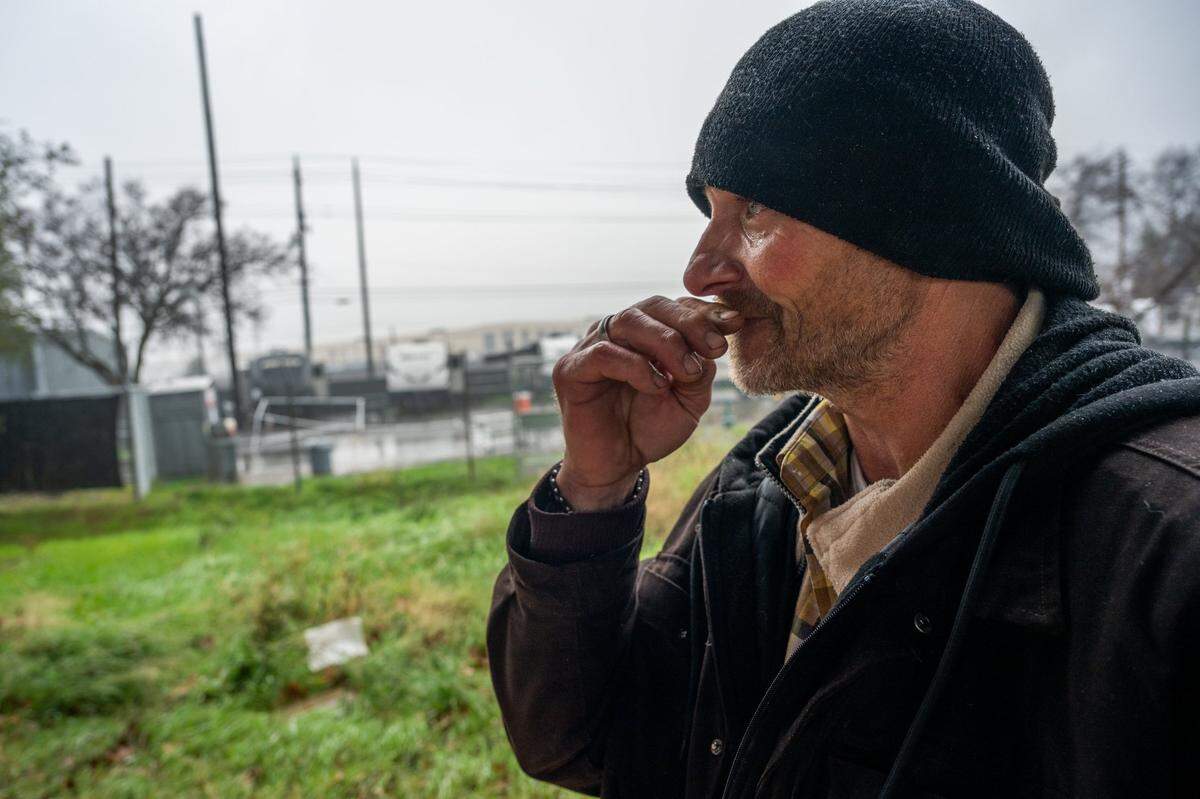
After the truck crash that killed her, Minton, 49, wanted her near his heart. He couldn’t cobble together enough money, and when a few staffers at the shelter found out, they ordered him a necklace. Minton had gotten something similar after the death of the little blond Chihuahua mix they raised together: A silver wing and a small tube of Ladybug’s remains dangle from a silver chain he never takes off. Standing at the intersection where Connell died, Minton touched the necklace gently.
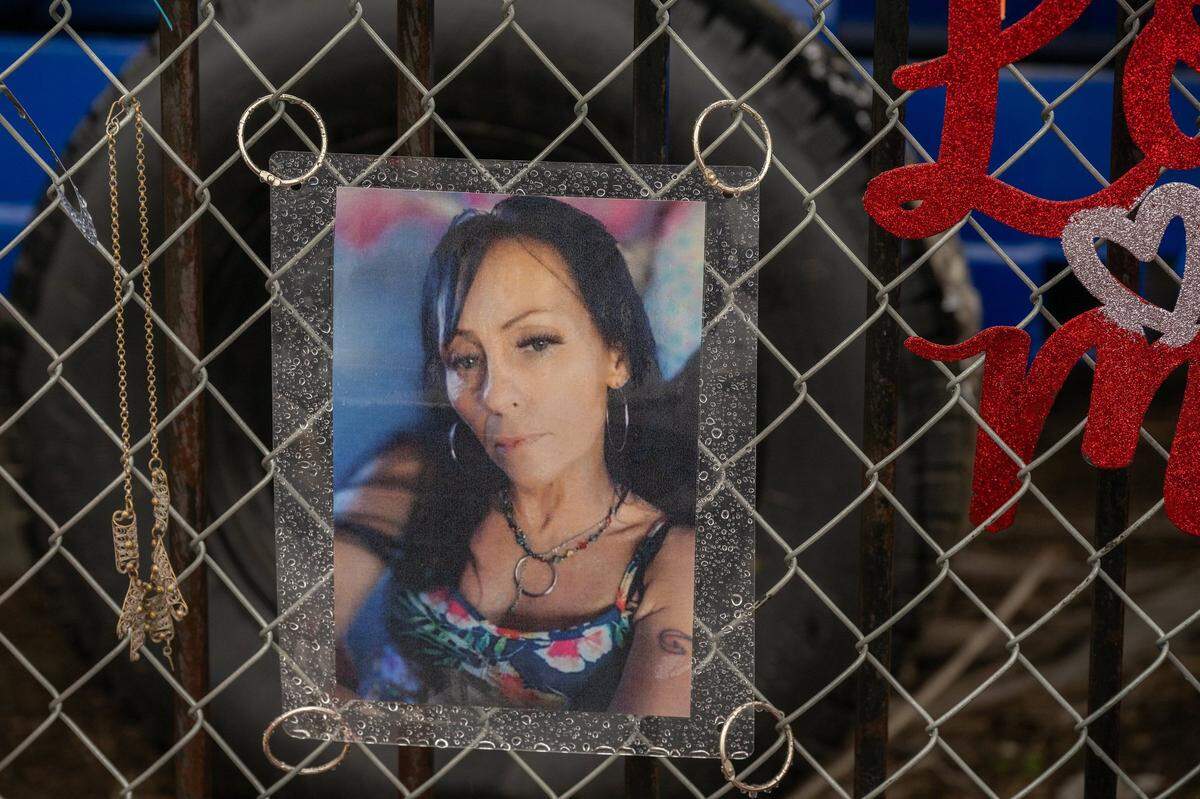

“It sucks,” he said. “Everything that I love, I gotta wear around my neck.”
As he contends with losing his love of 11 years, Minton has to deal with a haunting question.
If the North Sacramento homeless shelter had allowed its residents to exit from a back gate, would Connell still be alive?
A walk to transit that could kill you
Minton and Connell ended up at the Roseville Road Campus under duress. He said that they were living in a tent in the summer of 2024 when police officers approached. He recalled their offer: Either he could go to jail for illegal camping, or he could go to the shelter.
He and Connell decided to move to the shelter.
It had upsides, although they did miss living on their own terms. In the shelter, they both felt they were treated like children. They had a 10 p.m. curfew, and if they came back between 10 p.m. and midnight, they received a “tardy.” If they came home after midnight, they received an “absence.” They were only allowed three 27-gallon plastic containers’ worth of possessions. The trailer they lived in had no electricity and no heat.
On top of all that, unless someone picked you up in a car, it was impossible to go in or out safely.
The main entrance to the shelter is on Roseville Road, where the posted speed limit is 50 mph and vehicles routinely travel much faster. That main entrance has no adjacent sidewalk, so residents would have to walk in the dirt and, depending on how many cars were nearby, frighteningly close to traffic.

If they wanted to get from the main gate to the nearby light rail station, they could walk on a perilously narrow path wedged between a chain-link fence and a deep drainage ditch. If they had a bike, a bag or a disability that affected their movement, they were essentially forced into the road itself. For about 400 feet, Roseville Road has no shoulder on the side with the shelter — just the ditch. If they couldn’t balance on the inside footpath and they couldn’t cross two lanes of swift traffic to get to the shoulder on the other side, then nothing but a thin line of paint would separate them from cars and freight trucks moving near freeway speeds.
The shelter has a gate much closer to the light rail station that can quickly get residents off Roseville Road — still no sidewalk, but there’s a wide shoulder, and pedestrians avoid the drainage ditch and the cars and trucks moving at lethal speeds.
First Step Communities, the shelter operator, did not respond to requests for comment. Sacramento staffers wrote in a grant application that the city would “ensure residents on the campus have access to public transit.” The input of homeless people was “fundamental” to the Roseville Road Campus.
But Minton said residents complained frequently to management and staff about having to walk or bike for long distances on a perilous road, particularly to get to light rail. They repeatedly said that they wanted to enter and exit through that back gate.
Until a few weeks after Connell’s death, First Step kept it locked.
A pattern of deaths near Sacramento shelter
A month after Connell was killed at Roseville Road and Longview Drive, another person was killed in a hit-and-run south of the same intersection. Before that, UC Berkeley’s Transportation Injury Mapping System shows two fatal crashes between 2019 and 2024 at the crossroads where Connell died. Another three crashes there left people with severe injuries.
One of the dead, a 26-year-old pedestrian named Mikaela Ivie, was hit by a car and killed on Nov. 10, 2023, two months before the shelter opened.
Two more fatal crashes happened northeast of the intersection with Longview just before the city started moving people to the shelter. A two-car crash killed one person a few weeks after Ivie on Roseville and Orange Grove Drive, and, one block northeast, a third person died in a collision in December 2023.
As the shelter opened in January 2024, Sacramento publicly touted in a news release that the site was “close to a Sacramento Regional Transit light rail station.” But for the next year, residents of the shelter would often be forced to walk into 50 mph traffic to get to the station.
Then-City Manager Howard Chan, who approved the location, praised it, too. He said that the property “checked all the boxes” and was “safe.”
Julie Hall, a spokesperson for Sacramento, said this month, “Pedestrian safety is an important factor for city shelters. ... To the extent possible, the city will factor in planning for active and public transportation when siting its shelters. However, there may be limitations if a shelter is being sited at an existing city-owned property.” She also said that “every loss of life is tragic, and Phil Minton has suffered a heart-wrenching loss.”
The vast majority of traffic fatalities are preventable with changes to infrastructure. With that in mind, Sacramento’s City Council made a “Vision Zero” pledge in 2017 to eliminate all traffic deaths and severe injuries by 2027.
Connell died just outside the city limits. But the section of Roseville within Sacramento’s jurisdiction is considered part of the “high-injury network” — those city streets where the most deaths and injuries occur. The Department of Public Works has a plan to improve Roseville Road with new sidewalks and better safety infrastructure.
It’s considered a low priority.
And so Connell became a victim of two connected crises in Sacramento: dangerous roads and a grinding homelessness epidemic. She was whisked into a camp that officials said was intentionally located in an isolated corner of the city; the camp is on a street with an improvement plan that’s stalled at the Department of Public Works. Because of the shelter’s policy at the time, she couldn’t use the back gate to avoid being on Roseville Road for a long stretch as she headed to her dentist on Watt Avenue.
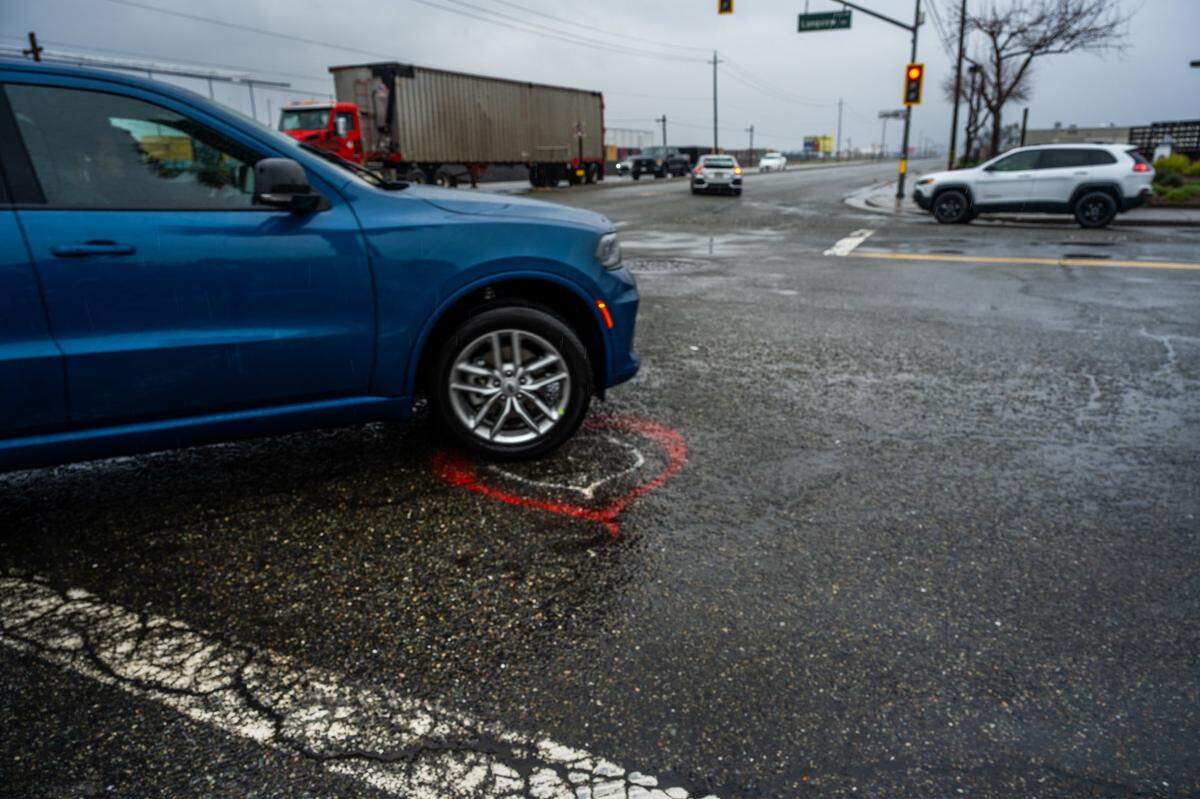
After Connell died, the California Highway Patrol suggested to local journalists that the crash was her fault. One TV station reported that the agency said she “attempted to pass the semi-truck on the right.”
But Minton insisted that the light was green — in her favor — when she entered the intersection. She would have never, he said, made a reckless decision on Roseville Road. She was always yanking people away from traffic, urging everyone around her to be more careful. She took the safest route available.
Minton said none of it was her fault. She would have preferred to take light rail, but there was no good way to get there. She wouldn’t have been on Roseville Road at all if she had a choice.
“No,” he said. “She was deathly scared of this road.”
A loving mother and grandmother
Wendy Anne Connell was born April 2, 1970, in Warrington, England, to Angelina Gallagher and Brian Connell. Gallagher was 18. “Too young,” she said, but “she was my life.”
They moved to the Los Angeles area when Connell was 3, and she grew up mostly in Glendale. When Gallagher gave birth to her son, Brian, Connell doted on her younger brother, nearly eight years her junior.
Starting from a young age, Connell had a deep affection for animals, and they seemed to feel the same way. “Animals just took to her,” said her mother. “She’s so loving and gentle.”
She could also be a fierce and stubborn protector. Once, when she was 13 or 14, her teacher instructed her to feed a live rat to the class pet, a snake. Instead, she took the rodent home and named him Smoky.
“I had a fit,” Gallagher said, “because I’d never had a rat.”
But the teenager insisted, and Smoky became a beloved member of the family. He’d snuggle up in Connell’s arms and fall asleep.
In L.A., Connell became a young mother to two sons — Jasein and Scotty Schaefer, now 36 and 33. She adored the boys, and in her early 20s, she moved with them to Northern California for a fresh start. In 1993, she was delighted when she found out she was having a baby girl. Connell named her Bobbie Jo after a dear friend who died.
The name was both a tribute to a loved one and a symbol of the deep pain Connell carried throughout her life.
When Connell and Bobbie Jo’s father split up when the little girl was 7, they went through a contentious divorce. Ultimately, Connell’s ex won the custody battle, and the young mother seldom saw her youngest child.
“I think it honestly broke her,” said her daughter, now Bobbie Jo Winegar, 31. “She was my absolute best friend.”
By the time she was 14, Bobbie Jo had more agency, and she started demanding to see her mom. She’d spend more time at Connell’s house in Ophir, just outside Auburn, and they went about repairing their relationship: sunbathing by the creek, dancing to Prince and singing “Let’s Go Crazy” at the top of their lungs, laughing and laughing and laughing.
When Bobbie Jo had her first child at 19 — Wyatt Scott — Connell was by her side, helping her raise him for the first few years of his life. When Wyatt started talking, Connell’s first grandchild called her “G.G.”
She taught Bobbie Jo everything about parenting a baby: how to change a diaper, how to feed him, how to coax him to sleep. The grandmother had seemingly endless patience with the infant. She chatted with him, and when he fussed and cried, she’d just say, “Tell me all about it!”
Although Connell had a way with the little one, Bobbie Jo said, the grandmother couldn’t abide baby music. She played him ’90s alternative rock.
True love after struggle
By the time she met Phillip Minton, Connell was in her mid-40s. She’d had a series of abusive men in her life but Minton, finally, was soft with her. Their relationship offered Connell the kind of love she had never really received from a partner.
“I honestly, personally, didn’t like Phil at first,” Bobbie Jo said, because she knew they used substances together. The sentiment didn’t last, though. “Over time, I just saw, ‘You love and adore her so much.’”
Minton and Connell became inseparable. Their connection brought a spark of joy to the most mundane days.
“We got a kick out of people-watching,” Minton said. “We could sit at Walmart for hours and just have the time of our lives.”
They moved in together, and Minton noted she was very particular about her appearance. “She loved that straightener,” he said, chuckling. He took to calling the bathroom “her office.”
They didn’t fight much, but even when they did, he was charmed by her: Anger brought out her English accent. They exchanged rings. She engraved his ring with her nickname for her tall beau: “My Beast.”

Around 2018, Minton lost his job and couldn’t find another one. Without enough money to cover the rent, they lost their housing. For a while, they bounced around from hotel to hotel. Then, the pair moved to the street.
Their bond remained strong. Minton, a handyman, rigged up batteries so that Connell could still straighten her hair every day.
For the past four or five years, they had lived on or near Roseville Road. They both despised it, but they were stuck in a vicious circle: Being homeless made everything much harder, and they could never scrape together enough money for a month of rent plus a down payment.
Bobbie Jo moved to South Carolina three years ago, and she’d begged her mother to move out there many times. She could get sober, have a new life. “I just wanted my mom,” she said.
Connell declined. She wanted to stay close to her two sons, and, Bobbie Jo said, “I’ve had conversations with her in the past where she’s not afraid to tell me, ‘I don’t want to get sober.’” After such a hard life, she said she needed drugs to numb her pain.
But in 2024, she changed her mind.
New beginnings and loss
After Connell and Minton moved to the Roseville Road Campus, their lives changed for the better in a few significant ways. They started regularly going to a clinic to treat their addictions (most recently, they had been using fentanyl). Both of them had been sober for about four months. Gallagher, who has been living in Fair Oaks and saw her daughter at least once a week, saw the change. Connell had been talking seriously about becoming a paralegal. She seemed committed.
Bobbie Jo, too, could tell it was different this time. Her mom was resolute in a way she’d never seen before. She seemed happy about her sobriety.
Minton agreed. They were motivated to find “a place that we could actually call home,” he said. “To see what life would be like together.”
Her death has made it hard for Minton to stay sober. “There’s nothing I want more,” he said, “than to leave this world.” He was trying to keep at it for Connell and their two dogs, Baby Girl and Sissy.
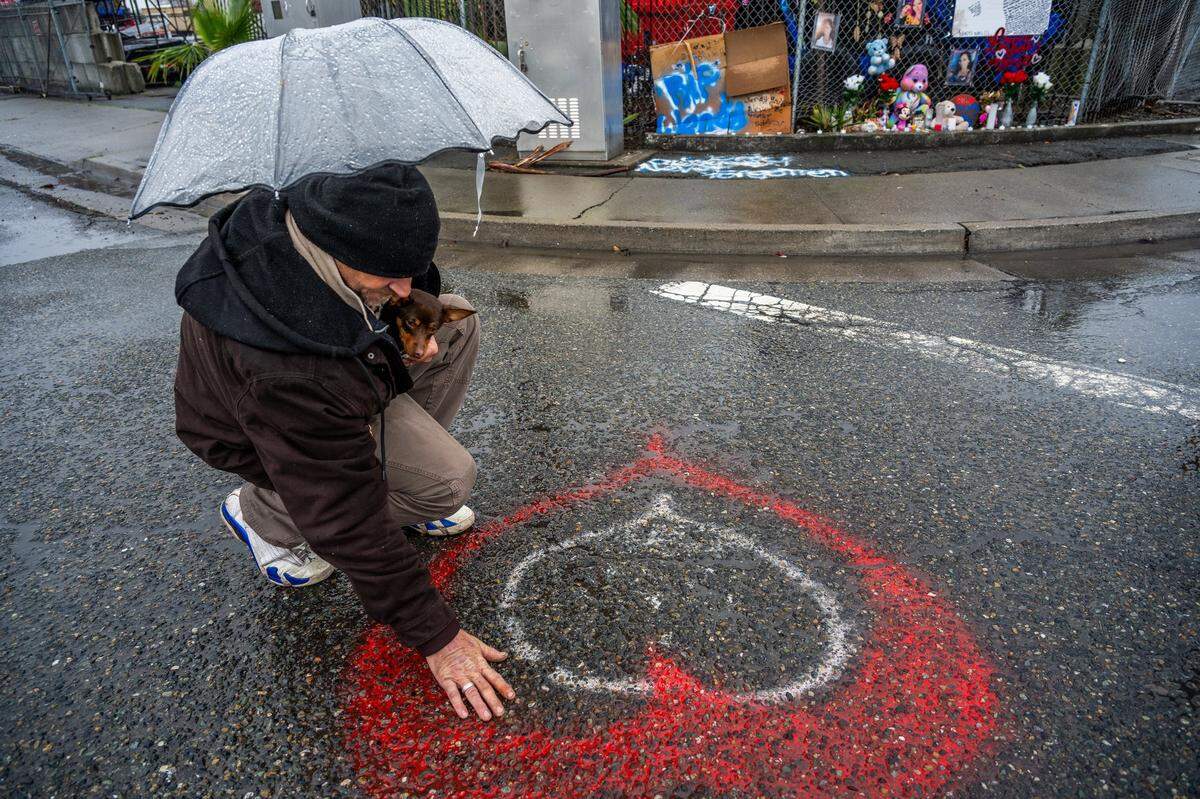
He and his niece built a memorial for her on the corner of Roseville and Longview, and he wrote Connell a long note, addressed to “my love.” While they were not yet legally married, they referred to each other as husband and wife.
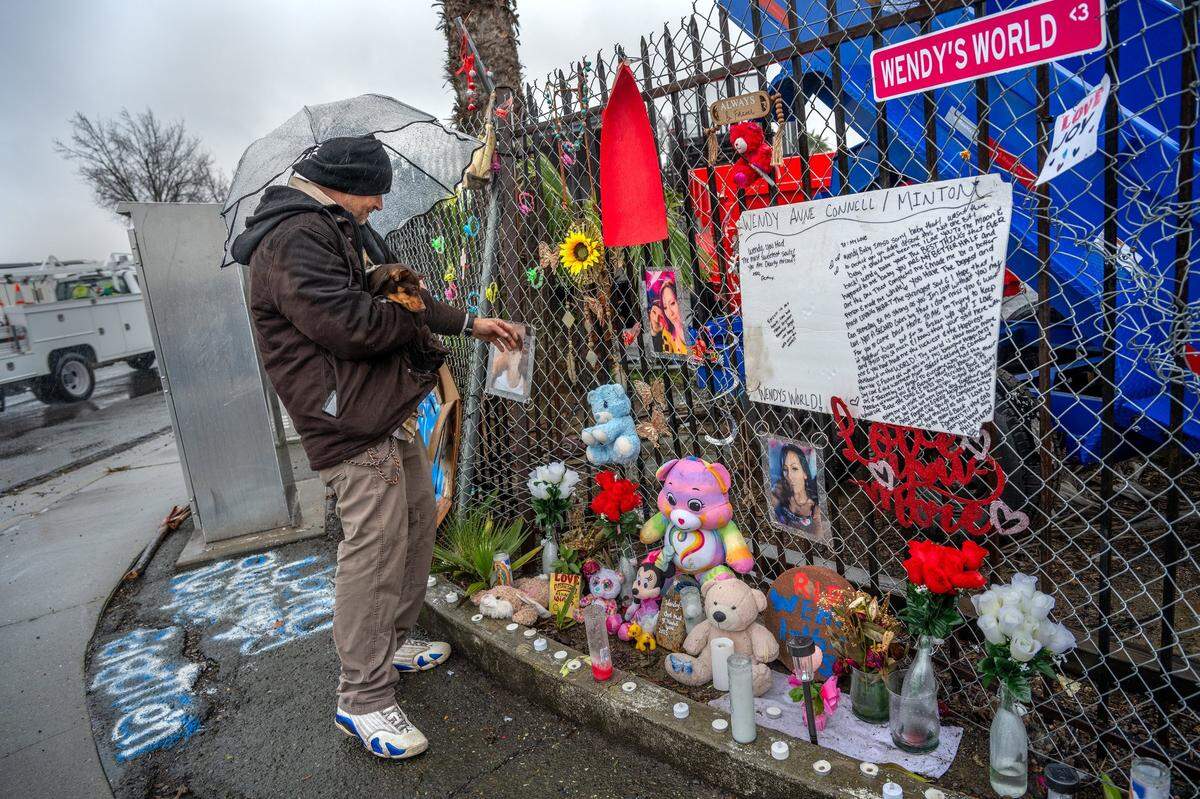
He had been headed to the dentist with her the day she died, but turned around to grab a notebook he’d forgotten in their trailer; he’d been working on a new resume. Moments later, he raced back to her and tried to perform CPR. He touched her delicate face as she was dying. “I couldn’t save her,” he said, tears in his eyes. When the cops left the scene, he mopped up her blood with his shirt; he couldn’t stand the thought of leaving part of her there in the road.
She’d led a troubled life, yes, but also one filled with so much warmth and love. And now, he said, she was gone because a Sacramento shelter policy pushed her onto an unsafe route to the dentist. After all that she had survived — violence, addiction, grief — she was killed by a dangerous road and a locked gate.
In his message to Connell at the memorial site, Minton wrote that he wished he had died instead of her. He spray-painted a heart on the road where her life ended. Every day, he walks out of the shelter and into the intersection. He bends down, kisses his hand and touches it to her heart.
This story was originally published February 17, 2025 at 5:00 AM.