Telephone customers come to Roseville hearing to save landlines. Here’s why
When the deadly Camp Fire swept through communities near his home in Lovelock in 2018, Rod Hass had only one means of communication — his old but reliable landline telephone.
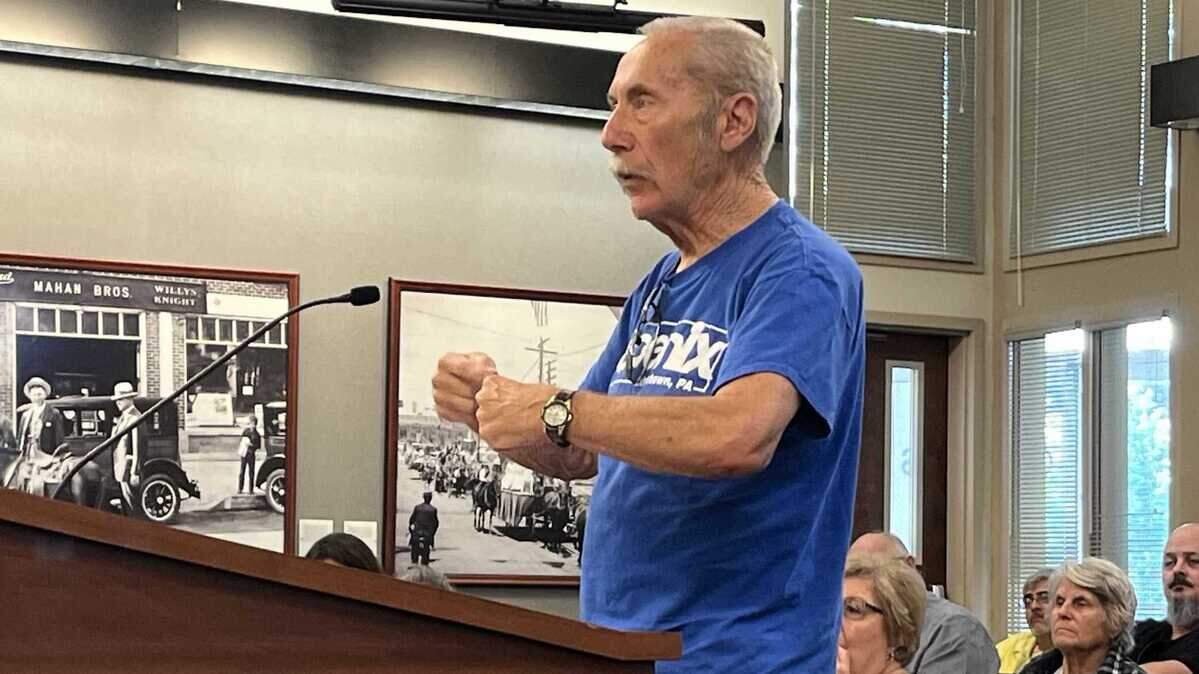
The Butte County resident was one of about 50 people who came from across the north state and beyond to a hearing room in Roseville on Wednesday, the vast majority of them making the trip to beg California communications regulators not to allow telephone companies to end landline services.
“The cell service is so bad at our house that people who are coming up on business, repair people and so on have to go to the top of the driveway because the cell service doesn’t work in the house,” Hass testified at a hearing by the California Public Utilities Commission at Roseville City Hall.
During the Camp Fire, which devastated the town of Paradise and killed 85 people, both cell and landline service went down, but the landline came back up quickly and was a lifeline, he said.
Hass’s testimony was part of a fact-finding effort by the commission as it decides whether to change or update the state’s rules requiring phone companies to provide basic service to all people living in areas that they serve. Such changes could mean that landline services, which rely on an old network of copper wires rather than cellular or internet-based connections, will eventually be phased out.
The issue came to a head last year, when AT&T, which has begun efforts to retire its copper wire landline service in some parts of the country, sought to be relieved of its obligation to be a so-called carrier of last resort in California. The company lost that battle last year, but the question prompted the California Public Utilities Commission to launch an inquiry into whether its rules for providing telephone service to underserved areas and consumers should be updated.
“There was an enormous amount of feedback from the public — all overwhelmingly opposed,” said Ernesto Falcon, who works on telephone-related issues for the Office of Public Advocate, a division of the CPUC that is meant to protect consumer interests. “So the commission is exploring what reform of the carrier of last resort (regulations) would look like.”
The commission has held a number of in-person and remote hearings on the topic, and plans to hold another in-person event in Santa Rosa on April 30. Remote hearings that can be accessed by anyone will be held next month.
Phyllis Coy and her sister drove for six hours from their home in Eureka to make their voices heard.
“There are areas in Humboldt County as well as other counties throughout California where cellphones have no reception and so are useless,” Coy said in her testimony. In rural areas, she said, you can’t even go out your front door to yell for help in an emergency, because the nearest neighbor may be a mile or more away, she said.
It is not yet clear whether the commission will ease or change rules around basic telephone service. Specific changes have not yet been proposed, and commissioners are waiting to gather public comment before developing possible new regulations later this year.
The current rules do not protect landlines as such, but they do require the main telephone service provider in an area to offer a basic service that includes reliable voice communication, access to 911 emergency calls, access to directory assistance and other services. These could be provided over a very reliable internet or cellular connection, but such connections are not available in all parts of the state.
The rules also ban a company that is currently serving as a carrier of last resort from pulling out unless there is a replacement firm willing to take on the role.
At its quarterly earnings call in January, AT&T CEO John Stankey, said the company had begun the process to be relieved of its obligations to provide service on some of its old wire networks, a transcript posted online shows.
The company is also backing a bill in the California legislature that would ease requirements on carriers of last resort. That bill, which is backed by a coalition of business, tribal and other groups including AT&T is scheduled to be heard in the Assembly Communications and Conveyance Committee on April 30. It is opposed by the organization representing California’s 58 counties, which says that the measure “threatens critical telecommunications access.”
“Removing COLR obligations — even in areas deemed ‘well served’ — could lead to significant coverage gaps, especially for residents who depend on landline phones during power outages when cellular networks may be down,” the group said in an April 10 position paper on its website.
The Office of Public Advocate also opposes simply removing the obligations of companies that are carriers of last resort without taking action to protect consumers, Falcon said. If copper wire landlines are to be phased out, they must be replaced with reliable, high quality and high speed services, he said.
His agency has recommended that before a communications company can exit its role as a carrier of last resort, it must ensure that high-speed broadband access is installed throughout its service area. Broadband can be used to provide voice calls as well as high-speed internet that many rural communities still cannot access.
At Wednesday’s hearing, a few speakers did support retiring the copper wire network and seeking newer solutions for communications networks.
Joey Tran, public policy coordinator for the Roseville Area Chamber of Commerce, said that retiring copper wire could be part of the response to what she described as an “urgent need to modernize the communications network.”
“We understand the transition away from legacy copper services can be daunting, but recognize that there are alternatives that operate like traditional landlines without copper,” she said.
Wednesday’s hearing was chaired by Administrative Law Judge Thomas J. Glegola and attended by CPUC member Darcie Houck. The commission’s staff is expected to release recommendations for new rules during the third quarter of this year.
The CPUC will hold its final hearings on the rulemaking virtually on May 5 and May 13; participants can learn more at cpuc.ca.gov/pph.