
Board approves plan to raze 600 trees on American River Parkway in Sacramento
AI-generated summary reviewed by our newsroom.
- Flood board approved plan to remove 600 trees near Watt Avenue bridge area.
- Army Corps project aims to fortify 11 miles of levees with erosion control rocks.
- Opponents criticize low flood protection gains and environmental disruption.
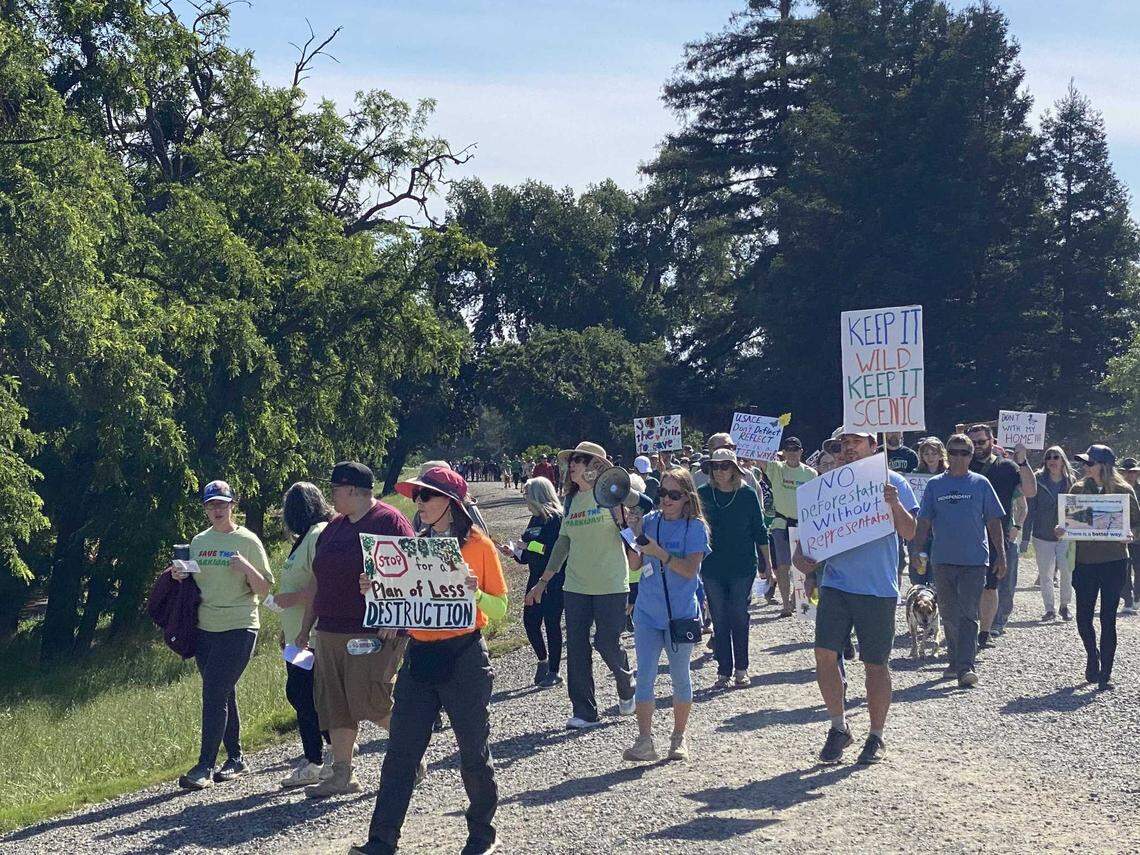
They combed through more than 8,000 pages of reports. They consulted lawyers and engineers and arborists. They organized civic actions drawing hundreds, all protesting a plan to raze about 600 trees north of the Watt Avenue bridge.
These demonstrations by environmental advocacy nonprofits attempted to persuade the Central Valley Flood Protection Board to either pause or vote against destroying trees and disrupting wildlife on the American River Parkway. The U.S. Army Corps of Engineers, which proposed the plan, said the area needs rocks to fortify banks and prevent erosion.
Board members voted Friday unanimously to approve a final Corps report, clearing the last hurdle for construction to begin.
“With a levee failure, you’ll lose” all the trees, said board member Mary Jane Griego, who tuned into the approximate seven-hour meeting over Zoom.
But groups including Save American River Trees, nonprofit Save the American River Association and residents say less destructive methods can be used to achieve similar results. The U.S. Army Corps of Engineers current plan does not sufficiently prevent damage from a 200-year flood event, they said.
“This is Sacramento’s Yosemite, our Yellowstone,” Marni Fylling-Ellison, a biologist, educator, author and illustrator said during public comment.
The Corps’ project, called the American River Levees upgrade, adds “enhanced bank protection” to 11 miles along the lower American River, Natomas Main Drainage Canal, Arcade Creek and Magpie Creek, the Corps said on its website.
“The levee system has been identified as vulnerable to erosion, seepage, and stability issues, which, if unaddressed, could compromise community safety, critical infrastructure, and key transportation routes,” the Corps said on its website.
Residents mainly had concerns with projects north of the Watt Avenue bridge. A report said the “assurance for the levees along the American River will remain around approximately 60%” in the event of a 200-year flood after the Corps finishes the project.
That’s evidence the Corps’ plan does not sufficiently safeguard levees, said Julie Gabele during public comment. In comparison, improvements for levees on the Sacramento River will raise “assurance levels” to 90%, according to the report revised in May 2016.
Supervisor Rich Desmond, who represents the area on the Board of Supervisors, acknowledged he faces a “political risk” because he supports the U.S. Army Corps of Engineers’ plan. But his obligation is to keep people safe, he said, and he spent “countless hours reviewing the project documents, reading material provided by the opponents, meeting with experts, with residents, attending public meetings and town halls.”
Desmond said the project has a minimal impact on the American River Parkway while ensuring protection. The work will avoid devastation from any severe flooding weather events, such as recently in Texas when the Guadalupe River in Kerr County flooded from heavy rainfall and killed 135 people.
“Those fears are real, and those are the fears that keep me up at night,” he said.
The public comments, turning emotional at times, lasted about four hours. Residents implored and pleaded with the board to listen to their concerns. They cited problems with the Corps’ apparent mix-up between trees’ diameter and girth and the California Environmental Quality Act, also known as CEQA.
Resident Jessica Mattsonaa said she suffered a severe brain traumatic injury in her 40s and relied on the American River Parkway to heal her depression. Though she could rarely walk, Mattsonaa still went to the cocoon of peace filled with swaying reeds and animals.
Mattsonaa, a teacher, cried as she recalled telling her students about the destruction.
“The shock and dismay on their small faces at the thought that grown ups would cut down and destroy habitats,” Mattsonaa said, “it was really emotional.”
Construction is scheduled to begin next year, and will be complete in 2027, said Tyler Stalker, the Corps’ chief of public affairs, in an email.
The construction will end in 2027, he said.
