

California county sought a mental health facility. Years later, it doesn’t exist
AI-generated summary reviewed by our newsroom.
- Yolo County delayed Crisis Now plan due to funding gaps and facility issues.
- Original proposal included crisis center, mobile team and recovery beds for care.
- Lack of local resources led families to seek care elsewhere.
Distance did not matter to Melanie Klinkamon when searching for her missing daughter.
Klinkamon’s adult child had a mental breakdown during the COVID-19 pandemic, disappearing for months and even at times leaving California. During one such episode, Klinkamon sought help for her daughter, who was eventually diagnosed with schizoaffective bipolar disorder.
When Klinkamon called law enforcement in December 2021, they were accompanied by a crisis response team. A clinician recommended Klinkamon take her daughter to a mental health facility in neighboring Sacramento County, about 15 to 20 minutes away.
After reaching the building on Stockton Boulevard, Klinkamon’s daughter jumped out of the car and disappeared. The mother canvassed streets for hours between Stockton Boulevard and Broadway, but did not find her on that day — and, for months.
Now, Klinakmon wonders if a mental health intake facility in Yolo County, a shorter distance away in her home county, could have helped her eldest child.
Since 2021, Yolo County has attempted to create a receiving center where families or law enforcement can drop off loved ones in a crisis.
But different versions of a program called Crisis Now have not materialized for about a decade as three different department heads attempted to find funding. A series of flaws in planning, a lack of funds and California’s changing mental health system creating more work for counties have now led to an uncertain future.
Tony Kildare, Yolo County’s mental health director, said “unforeseen obstacles” prevented the county from enacting its plans. The future program includes using existing crisis stabilization services in Yolo and Sacramento counties, by leveraging a partnership with cities, hospitals and others, he said.
“Yolo County is committed to fully implementing the Crisis Now model and is actively working to develop a solution that ensures continuity of services,” he said.
Yolo County has made advances to create new avenues to help those suffering from a mental health crisis, Klinkamon said, adding she’s not displeased with the county. But, establishing the program could have helped her daughter get help faster, she said.
“If Crisis Now would have been instituted prior,” Klinkamon said, “we may not even be where we are right now.”
What is Crisis Now?
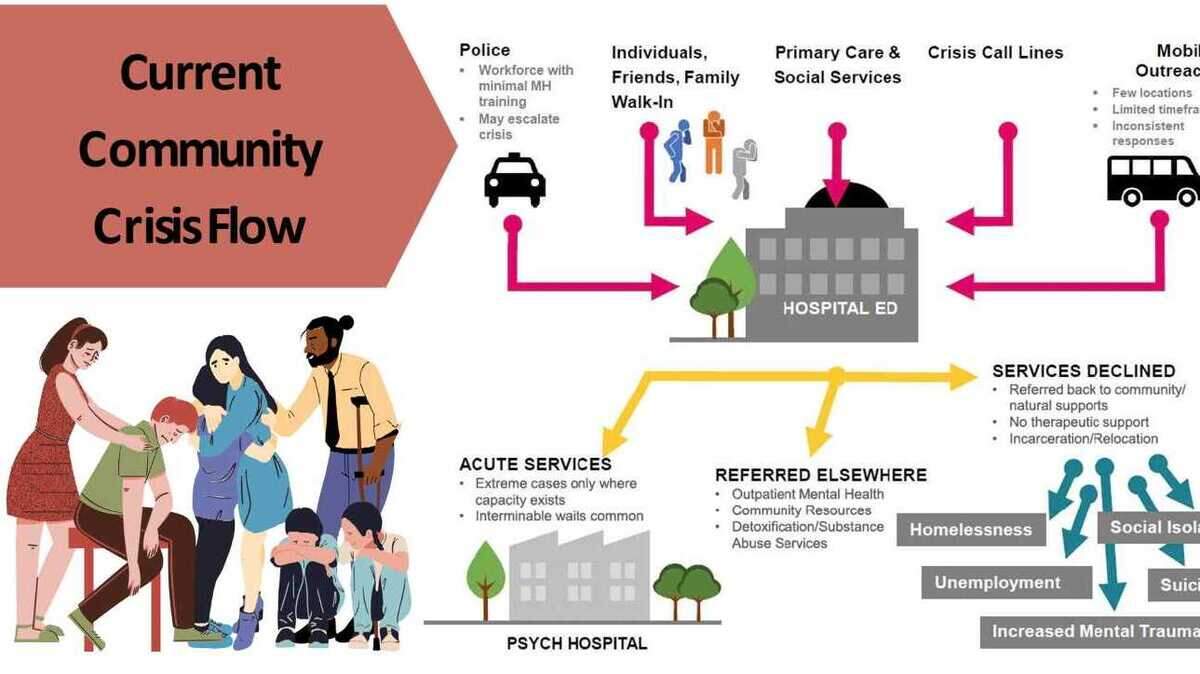
During the COVID-19 pandemic, many who struggled under the throes of anxiety and depression flooded into hospitals, overwhelming emergency departments.
In Yolo County, about 50% of people placed on a “5150 hold” — referring to an involuntary 72-hour hospitalization — were released with little or no resources, said Yolo County’s former Health and Human Services Director Karen Larsen during a 2021 Yolo County Board of Supervisors meeting.
These individuals sometimes also ended up arrested as well, she added. The result created a vicious cycle of a person swinging in and out of jail and hospitals, she said.
“We know we have an issue that we have to intervene in,” Larsen said during the meeting.
A solution to help these people included a program called Crisis Now, Larsen said.
The concept for Crisis Now stemmed from a 2016 report by the National Action for Suicide Prevention to redesign how communities respond to behavioral health emergencies, said Kristen Ellis, a senior director of consulting operations with Recovery Innovations, a global organization which offers consulting services to state and county governments.
The program hoped to reduce crises. Communities in Arizona, Alaska and other California counties adopted this model and experienced drops in emergency department visits, a decreased burden on in-patient beds and faster response times from law enforcement, she said.
“Results depend on how fully the model is implemented and how outcomes are tracked, but the data is promising,” she said.
Three components make up this initiative, estimated to cost $11.8 million in Yolo County in 2021. It includes a crisis call center, a mobile crisis team and a receiving and sobering center offering short-term or long-term beds for recovery. Larsen proposed in 2021 about 10 beds for a 24-stay and about 16 for a longer stay over days.
Yolo County, throughout the years, in some form had a crisis call line and a mobile crisis team, containing clinicians who partner with law enforcement agencies to respond to calls.
Larsen hoped to gather enough funding to create the third component which Yolo County did not have. Troubles with sustaining similar projects in the past led Larsen to promise “diversifying” Crisis Now funding streams, she said in 2021.
“A program like this can make everyone safer, including the police,” said Supervisor Gary Sandy during the 2021 meeting. “It’s high time we see something like this, and I think it would bring much, much needed change to Yolo County.”
A failed project with inadequate funds
The project had not yet come to fruition by its projected date of February 2023.
A new director of Yolo County’s Health and Human Services, Nolan Sullivan, listed out “critical flaws” in the original plan to use vacant portable buildings and parts of a juvenile detention facility to hold beds, according to his remarks at a May 2023 meeting.
To create an in-patient facility, Sullivan said start-up costs grew to about six to seven million dollars for just a three to five year pilot program. And, though the county sought to construct these facilities, no contractors could handle the cost, he said.
During the May 2023 meeting, Yolo County’s Mental Health Director Karleen Jakowski added long-term funding had not been identified in the original plan, and now focused on a “creative funding mechanism” to help insured and uninsured patients.
The number of beds also reduced to six beds from 16, Jakwoski said.
Residents still sought these services.
Christy Correa, a West Sacramento resident, said law enforcement tackled her son as he suffered a mental health crisis in 2022.
He received no psychiatric care, and was arrested, she said. If Yolo County had a place to take him, she wonders if he would have fared better.
“I did not want the cops to show up,” she said.
Yet, two years later, Kildare, Yolo County’s mental health director came back to the board in April saying there were inadequate funds to make it through a three-year pilot. He added the current plan, examining ways to work with existing providers, comes with challenges such as limited capacity and transporting patients to those facilities.
And, planning for the future of the Crisis Now program coincides with an approximate $4 million budget deficit for the Health and Human Services Department.
For Correa, she still hears stories about families who could benefit from the Crisis Now program. Those instances bring back memories of her son being tackled.
“As long as this is happening to another family,” she said. “It’s still happening to me, to my family.”