
Whale of a tale: Remembering Humphrey’s magical journey up the Delta 40 years ago
AI-generated summary reviewed by our newsroom.
- Humphrey the Whale made his way Sacramento-San Joaquin Delta where he remained for weeks
- Local citizens, scientists and military coordinated an armada to guide him out
- Humphrey's visit produced tourism, merchandise, monuments and lasting Delta lore
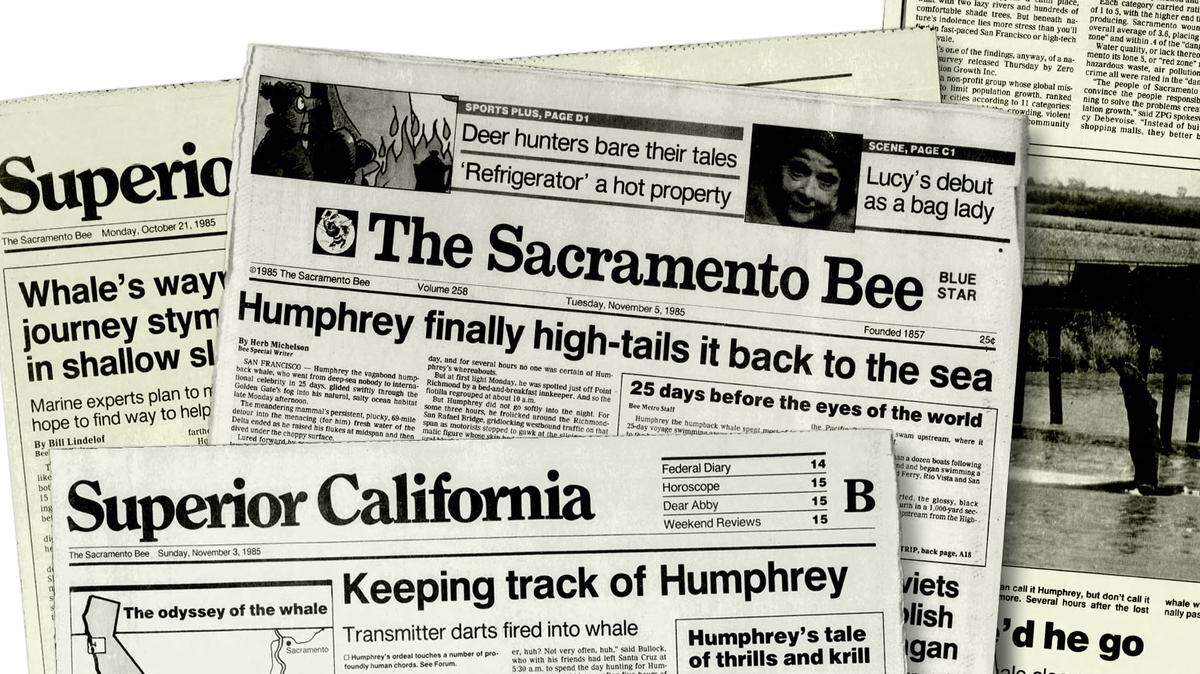
Humphrey the Whale first swam into the hearts of the world via the San Francisco Bay on Oct. 10, 1985.
On that Thursday in early fall, the 40-foot wayward adult humpback male took a wrong turn on his migration from Alaska to Mexico and was spotted near Oakland’s Outer Harbor. For the next four days, he passed through Richmond and Benicia, wandered up into the Sacramento-San Joaquin Delta and into the tiny town of Rio Vista in Solano County. By mid-October, “Wrong Way Humphrey” had painted himself into a corner in a Delta slough where he languished for another three weeks.
On Nov. 3, 1985, buoyed by efforts from scientists, local farmers and fishermen, Humphrey was led out of the Sacramento River. The following day, he was back in the Bay and passed under the Golden Gate Bridge into the Pacific Ocean, on his way home, finally.
Ask any Northern Californian about Humphrey, and they might get a twinkle in their eye. He was, in no uncertain terms, the big news story in the weeks he was caught in our waterways. His legacy was almost as grand – he inspired books and songs that solidified his status as a local folk hero.
Thousands of regular Delta citizens bore witness to the baleen giant’s freshwater detour. Here, on the 40th Anniversary of his visit to their home, some of those citizens swim through their memories of Humphrey the Whale in the Delta.
‘What is it? A whale or something?’
In October 1985, Kathy Fevereiro was living in Rio Vista and working for Augusto Insurance. During Humphrey’s visit, Fevereiro crossed the Highway 12 Rio Vista Bridge (now called the Helen Madere Memorial Rio Vista Bridge) every day with her young son to visit a family member in the hospital in Lodi. The daily trip gave her son a great story to share at school.
“One morning, it was his turn to do show and tell,” Fevereiro recalled. “And he got up there and he said, ‘Every night we get to see Humphrey. We get to see the big whale as we’re waiting on the bridge to cross it.’”
Phil Pezzaglia was just out of high school and cruising around Rio Vista in a friend’s 1973 green Chevy Camaro when they first spotted the whale in the Sacramento River behind City Hall.
“I remember us pulling in there, driving slow, looking at all the crowds of people and thinking, ‘I wonder what’s going on?’” Pezzaglia, a Delta historian whose family has lived in Rio Vista since 1871, said. “I distinctly remember saying, ‘What is it? A whale or something?’”
It sure was — something big enough to attract crowds of 10,000 a day to Rio Vista — whose population at the time was just over 3,100 — and big enough to make the national news.
“Every time you turned on the news, it was on every newscast. It was on CNN, all the newspapers, the local River News, the Herald newspaper, plus the Sacramento Bee, the San Francisco Chronicle, the Vacaville Reporter,” Pezzaglia remembered. “Everybody was covering it.”
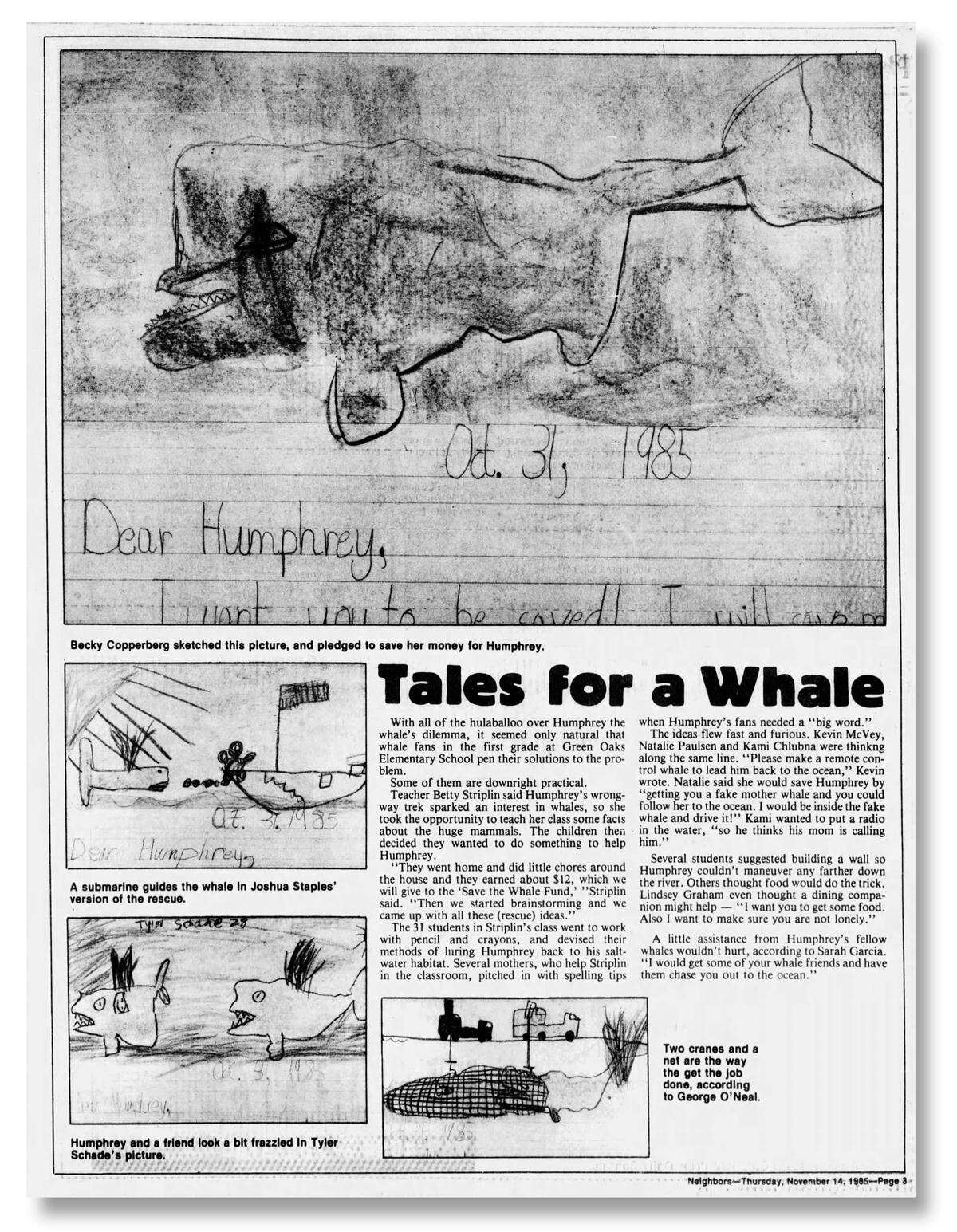
Many locals profited from the visiting celebrity. Humphrey merch popped up — hats, T-shirts, Christmas ornaments and even shot glasses went up for sale at bait shops and gas stations. And the crowds kept coming.
“Humphrey got put on everything,” Pezzaglia said. “But it was definitely something that you saw, young and old, all ages were out there waiting to see that whale.”
San Francisco photojournalist Ron Tussy, a Rio Vista native, got a gig out of the Humphrey phenomenon. Newsweek magazine sent Tussy home to Rio Vista and put him on a boat to get the story.
“They put me in contact with the University of California, Davis. Their marine biologists were called in for help,” Tussy said. “So they pulled this team in, and I got on one of their boats.”
In addition to being on the ground (or, rather, in the water), Tussy had a personal family connection to Humphrey. His father, Henry “Hank” Tussy, was the first to spot the whale while working as a bridge tender on the Rio Vista Bridge on Oct. 14, 1985.
“He immediately went, ‘Wow, that’s a humpback. Well, what the heck is it doing here?’” Ron Tussy recalled. “So he thought for a second, ‘Who do I call about this?’”
Hank Tussy knew a thing or two about reacting in an urgent situation. He was in the second wave on Omaha Beach during the Normandy Invasion on D-Day in World War II. Closer to home in Rio Vista, Hank had been an ambulance driver, volunteer fireman and EMT. His call to the Coast Guard upon sighting Humphrey resulted in a comical conversation.
“He’s telling them ‘I’m seeing through the binoculars right now, half a mile away from the bridge, a humpback whale fluking,’” Ron Tussy said. “Then he asked my father, ‘Have you been drinking?’”
For the record, Hank Tussy had not been drinking, but Humphrey’s appearance in Rio Vista packed the berg’s hotels, restaurants and bars.
Jim and Vickie Baumann, the then owners of The Point, a popular watering hole right on the Sacramento River, said Humphrey meant that they got pretty darn busy — for better or worse.
“At first, it was great, because there was a lot of interest and everything. But then the traffic was horrible,” Vickie Baumann remembered of the crowds that drove in.
The Point also went down in Humphrey the Whale history: the employees told San Francisco Chronicle writer Birney Jarvis that they came up with the name.
“Jim told him that we came up with Humphrey the Humpback Whale,” Vickie said. “So he gave us credit for naming him.”
By Oct. 25, 1985, Humphrey was stuck up in Shag Slough, the shallow backwater 33 miles from downtown Sacramento. Scientists were worried. He’d been out of the ocean for almost two weeks. He had already developed blisters from being immersed in freshwater — an environment that would harm, and eventually kill, most sea creatures.
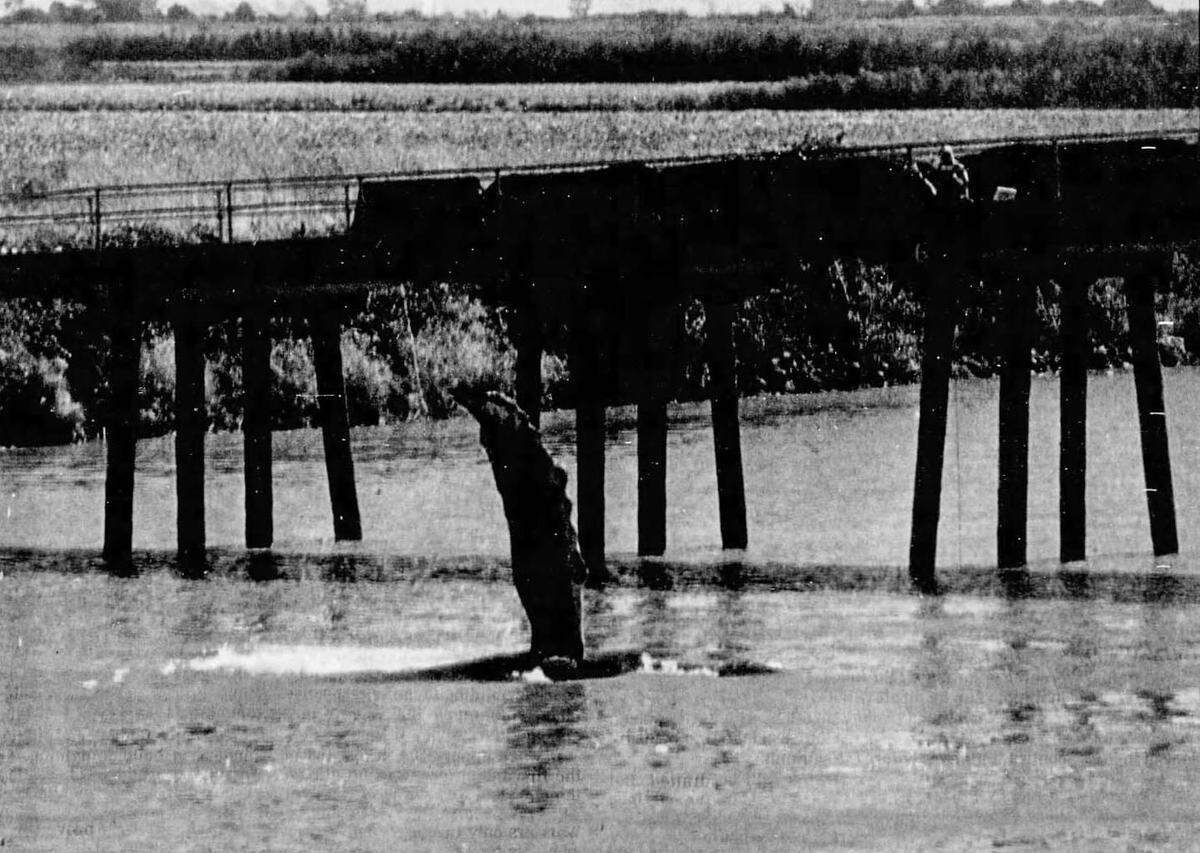
Fifth-generation Delta pear farmer Doug Hemly was in a plane looking down on the slough, flying into Rio Vista Airport from Washington, when he saw Humphrey — and the crowds — with a bird’s eye view.
“So the pilot gets on the international communications channel for Rio Vista and asks what they’re doing,” Hemly said. “And after they told him, he whips around to me with his eyes big, and he says, ‘They say there’s a whale down there!’”
As Humphrey’s situation became more desperate, saving him became a priority for John Garamendi, who was living in Walnut Grove with his family and serving as a state senator. Garamendi, a staunch advocate of preserving the Delta, recalled that the rescue evolved into a military operation, literally.
“It was basically 24/7 for a few days,” said Garamendi, who currently serves in the U.S. Congress. “We had private boat owners and yacht clubs and on and on, and the military all engaged. The Coast Guard sent its major cutters, the Navy sent in a couple of its ships.”
After a week and a half of Humphrey’s antics in Shag Slough, a Hollywood sound engineer created a tape of whale sounds — specifically of the animals feeding — that is credited with tempting the whale out of the Delta.
“This whole parade of interested people that wanted to help formed up behind the whale, as the whale moved down the river with the sound system and the recording, towards San Francisco Bay,” Garamendi recalled.
Jack Findleton, a Sacramento fishing guide originally from Long Island, led that parade, an armada of 20 private vessels and U.S. Navy gunboats that ushered Humphrey back to the Bay. In early 1986, Findelton co-authored a book about the whole adventure, “The Great Whale Rescue.” It’s one of the many enduring elements of the tall tale of Humphrey the Whale.
‘A mighty whale was he’
If you, like Humphrey, take a trip to Rio Vista, it’s easy to witness his legacy. He’s D.H. White Elementary School’s mascot, and the skatepark at Val De Flores Park is shaped like a whale.
You might even get eyes on his possible kinfolk, as Rio Vistans did in May 2007 when Delta and Dawn, a mother-and-calf humpback duo, wandered right under the Rio Vista Bridge and stayed for nine days. If you do see a whale in a river, there’s an app for that — and call the Coast Guard.
There’s probably no chance you’ll see Humphrey himself, though. Even though he returned to the Bay for another stressful visit late Oct. 1990, it’s assumed that he’s sleeping the Big Sleep up in the never-ending-plankton-buffet in the sky, trading stories with Findleton and Hank Tussy about those 26 days in the fall of 1985 when their lives, along with those of countless other citizens, merged like a delta.
Perhaps no citizen is as integral to Humphrey’s legacy as Richard Fonbuena. In Oct.,1985, Fonbuena, a then-12-year-old Rio Vista kid, entered a poetry contest with other local young folks. His poem was chosen and adorns Humphrey’s monument in Downtown Rio Vista, just feet away from the Sacramento River. It goes:
Humphrey the Humpback Whale,
a mighty whale was he
He swam into the Delta, to see what he could see
The people stood and stared, and the fish were scared
He was famous across the nation, until they ended his vacation
Fonbuena won $50 for the five-line original work, which he spent on a skateboard. He still gets texts about the poem.
“My friends will go down there and take pictures with it and send it, even to this day,” Fonbuena said.
Forty years later, Fonbuena is a sales manager for a fitness equipment company and a father of four. When he thinks back on the day the monument was unveiled, when he and Humphrey the Whale went down in Northern California history together, Fonbuena remembers being nervous. He also remembers feeling that he was a part of something big. As big as, one might say, a whale.
“I didn’t come from a family that was wealthy, so I thought it was really cool to win 50 bucks. But I remember standing there that day, and realizing how important that was and how special that was,” Fonbuena said. “That was much more important than 50 bucks.”
Freelance Writer Helen Harlan turned 6 years old on Oct. 10, 1985 — Day 1 of Humphrey the Whale’s first adventure inland. She grew up near the American River in Sacramento and is a lifelong animal lover. Watching the story of Humphrey on the news in the weeks of her sixth birthday is one of her earliest childhood memories.