
Who is Beth Bourne? Q&A with Davis activist who stripped to protest trans students
AI-generated summary reviewed by our newsroom.
- Beth Bourne’s activism involves protesting school policies on transgender rights.
- Bourne transitioned from environmental planning to leading local conservative activism.
- She seeks greater public discourse and critical questioning in debates on gender policy.
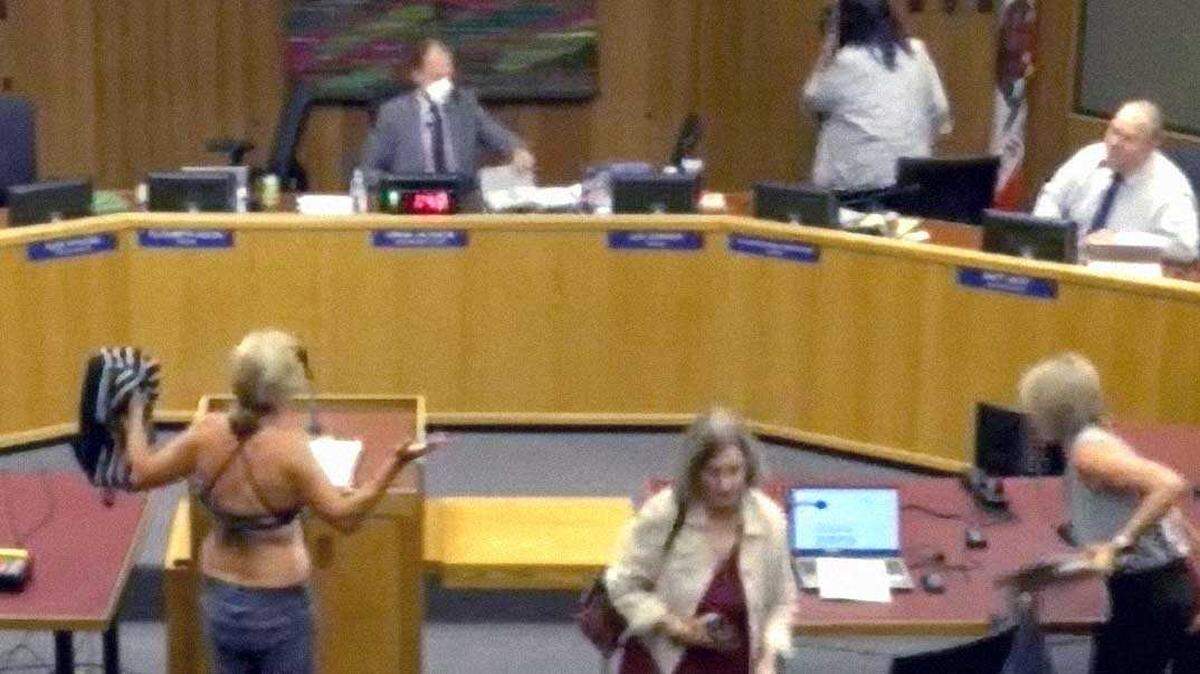
Beth Bourne’s most recent protest to land her in the news involved her stripping to her bikini during a Davis Joint Unified School District meeting to protest what she called a policy of allowing transgender students to pick a bathroom aligning with their self-identity.
The Sept. 18 school board meeting was just Bourne’s latest activism. In 2023, after Bourne hosted an event discussing trans women in sports, Davis schools received repeated bomb threats. Bourne is also the Yolo County chapter chairwoman of Moms for Liberty, a nonprofit that describes itself as advocating for parental rights.
The focus of Bourne’s activism has shifted over the years. In the early 1990s, Bourne gave up driving for seven years as an environmentalist and eventually moved to Davis with her then-husband to raise her family in a small town. She also previously worked as a planner for San Luis Obispo County, Palo Alto and for the Sacramento Area Council of Governments.
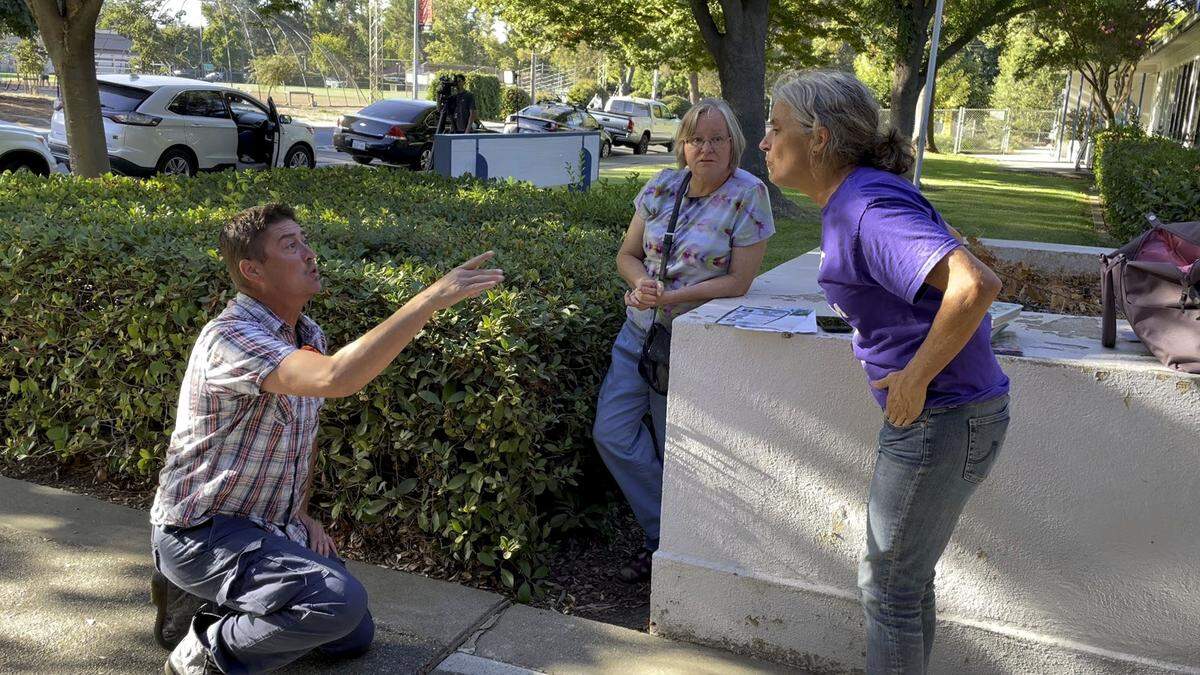
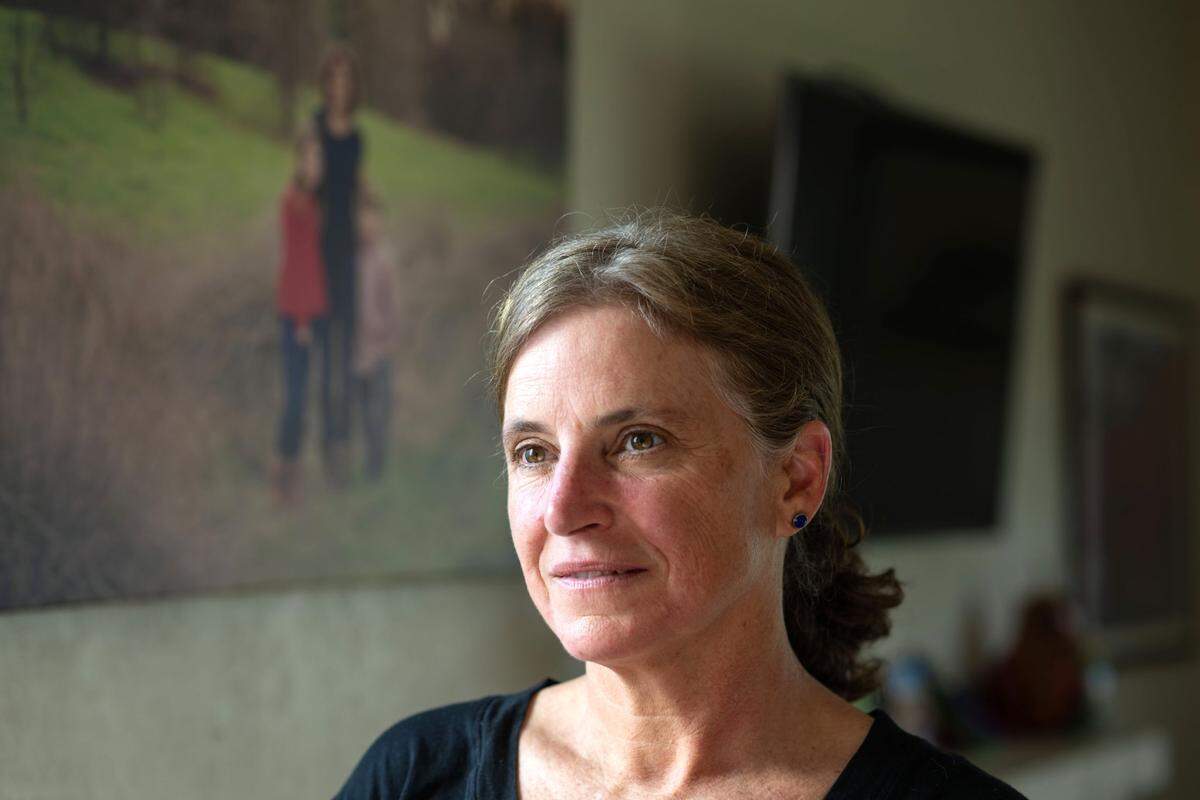
Now, Bourne, 55, regularly protests at school board meetings, coming into conflict with residents in her hometown of Davis and beyond, over policies related to transgender students. She views herself as a mother saving children from a burning home, she said.
The Sacramento Bee spoke with Bourne to learn more about who she is and how she formed her beliefs.
The following interview has been edited for clarity, length and to conform with AP style, which our news organization follows.
Q: Do you call yourself an activist?
A: In the past, I probably would have said I’m an advocate for parental rights and for helping kids understand that their body is perfect and that they need to accept this biological reality, and an advocate for girls and women in sports. But I think the term I overheard a mother call herself was an accidental activist, right? So I have definitely become somebody who is willing to be an activist and I do it in all different kinds of actions, whether it’s the state capital or school boards or sporting events or pride events.
Q: How would you identify your political leanings?
A: I don’t want to say I’m a one-issue voter, but I am right now. And so, I supported Trump and JD Vance. So, yeah, I say right now I’m voting for any Republican because they are speaking out on this issue.
Q: Could you tell me a little bit about where you grew up?
A: I was born in Maryland. My dad worked for the U.S. State Department, so I lived for three years in Bangkok, Thailand when I was really young, and then I moved to Mexico City in third grade, and lived there through middle of eighth grade. So I was in Mexico City for six years, growing up at an international school, and then I went to high school in San Diego, North County, which is more Republican.
Q: How did you get to Davis?
A: After finishing my undergrad, I worked for three years as a transportation planner in SLO County. I worked for the Council of Government, San Luis Obispo and also for Caltrans. I was a pedestrian bike coordinator for the county.
After three years, I’d met a guy who had grown up in Davis, and I thought, “This is like utopia for cyclists, right?” Everybody rides a bike. I was seeing older ladies riding their bikes. And I thought, “Wow, I want to live in a town where everybody you know is an environmentalist and rides their bikes.” And so I moved here when I was 26, and I got a job.
I only stayed at that job for a year because I wanted to go back to graduate school. I got a really good job working as a research assistant at UC Davis, and it paid for my grad school, and I worked mostly in farmland preservation for one of these professors who worked in Cooperative Extension. I was living the dream.
I ended up working for the city of Davis as an assistant planner. And I really loved that job. Then when I got married, it was to somebody who wanted to work in the Bay Area, and so we both got jobs in Palo Alto. I was a senior planner in Palo Alto for five years, and then when we had our second child, it was like, well, let’s move back to Davis. His family was from Davis. I had loved the easy life of living in Davis, and it was just much more affordable. So we sold our house in Menlo Park, moved back to Davis.
Even then, I thought, “Oh, it’s great to be in a community that’s so progressive and liberal.”
I still think that in the old Davis, people still were against GMOs in our food and questioning the vaccines for our children, maybe spacing them out. A lot of ideas I kind of agreed with. And so that’s why I’m so shocked to see how far left Davis would eventually become. If I could go back to 2003 and what it meant to be a Democrat, I would probably still be a Democrat.
Q: How can you walk up in front of strangers and ask them questions and film them?
A: I’m so passionate about it, because I so strongly know for a fact that children are being harmed by this. And so it gives me this ability or this strength to not worry that people are going to say ‘You’re acting unhinged, or you’re acting like a crazy woman, or you’re acting transphobic, or you’re hateful, or why are you? Why are you acting this way?’ Because I know that I’m not crazy, I’m not hateful, that I’m actually the one who’s trying to protect these people that are being harmed.
Q: What do you do for fun?
A: I do like to golf. So I do have people that my boyfriend and I can do fun things with. I exercise every day. I still try to swim every day, because I think that’s really important, that you take care of yourself, because what you’re doing involves a lot of people trying to hurt you and break you down. Run you out of town. Run you out of Davis. And so just trying to stay fit and healthy. Feeling strong gives you some confidence. I can run away faster when I feel like I’m going to be attacked, which happens to me.
Some of these protests, you have to have some fun with it. So when it doesn’t feel very dangerous and it’s just interesting to watch the trans activists kind of attack us, I try to think of that as fun. You know, it’s work, but it’s also you have to find humor in it.
Q: A lot of what you’re doing gets so much attention. Are you scared for your safety? Do you get death threats?
A: I’m human, so I’m always scared and very aware of my surroundings. And I’ve taken lots of precautions to stay safe in my home and to keep my son safe.
Q: What sort of precautions?
A: If you give out too much information, you’re letting them know what you’ve done. But I would say for the record that I’ve taken all the precautions possible, legally possible to keep my home safe and keep me safe. I mean, obviously things like security lights, video cameras everywhere.
Q: How do you make a living right now? (Bourne’s job at UC Davis was eliminated in June after the university announced budget cuts.)
A: I’m fortunate. I do have some assistance from my parents.
How do I get by financially? Well, it hasn’t been that long. So at this point, I am just doing what I can to keep my expenses as low as possible. I’ve put in six different job applications, and I’m still hoping that I could return to work at UC Davis.
Q: Do you have a certain religion that you ascribe to?
A: Yes, I was Catholic, and I would say that I’m still a practicing Christian. I actually don’t use religion when I speak out on (transgender issues) and I know other people do, but that’s not me.
Q: What do you hope a political or societal outcome will be from your advocacy?
A: First thing is, think critically. Don’t always trust what’s happening because it’s established medicine or you can still question things. And then the second one was, we need to have open discourse, right? We need to have spaces where people come together and they debate things. You should be able to have a discussion at your dinner group or with your book club or in your local library.
Q: What do you hope your legacy will be?
A: So I want my legacy to be somebody who wasn’t afraid, to almost lose everything to try to get my message out.
This story was originally published September 24, 2025 at 7:29 PM.