What does Sacramento’s city manager actually do? Here’s why they are important

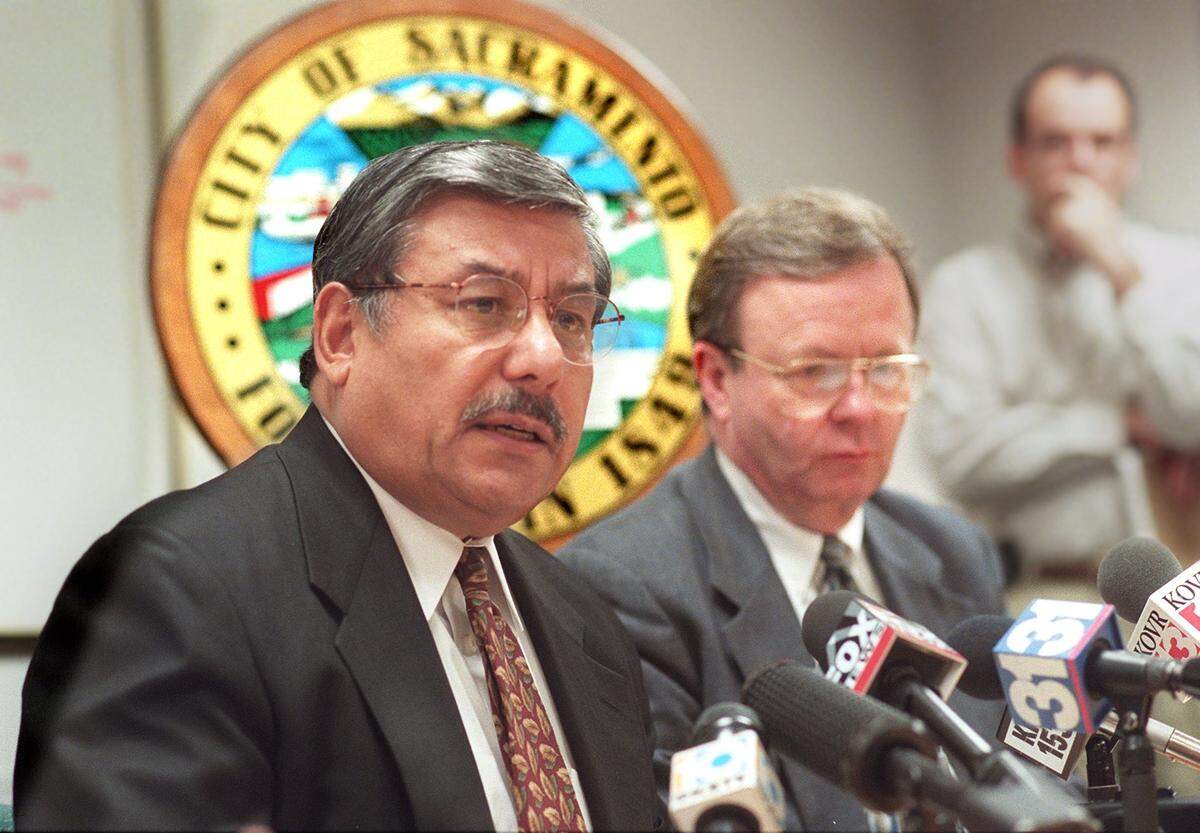
The first time Bill Edgar walked into Joe Serna Jr.’s office, the late Sacramento mayor told Edgar how things were going to work.
“I’m going to be the mayor, the leader of the people and you’re going to run the government,” Edgar recalled Serna telling him. Edgar, who is now 86, began serving as Sacramento city manager in March 1993, two months after Serna became Sacramento’s 52nd mayor.
Serna told Edgar about things like how he wanted a good administration with good results and that he didn’t want Edgar out in the community testing policy ideas. It was, Edgar said, “a good definition of the mayor and the council.”
With the announcement by city officials on Tuesday morning that Maraskeshia Smith will become Sacramento’s latest city manager in January, now is a good time to review what precisely a city manager does. It is a critically important but often overlooked role for cities, with elected mayors and council members sometimes commanding more public attention, but wielding less actual power.
“The city manager is like the city’s CEO,” said Nicolas Heidorn, a professor at University of the Pacific’s McGeorge School of Law. “They are responsible for the day to day operations of the city, and all the department heads in the city report up to the city manager. They generally can hire and fire department heads.”
Heidorn added, “So really, in a city like Sacramento, the city manager is effectively the leader of the city from a staff level.”
Seema Patel, a professor at University of California, College of the Law, San Francisco — formerly UC Hastings — also attested to the influence of city managers.
“They really act as the orchestral conductor of everything that happens in a city on the ground,” Patel said.
Sacramento hasn’t had city managers its entire existence, with the position a byproduct of the Progressive Era of reform in the early 20th century. Previously, the city used a strong mayor style of governance, where the mayor functioned like a CEO. Heidorn said that an early reform briefly created a commission-style of governance in Sacramento. The city welcomed its first city manager, Clyde Seavey, in 1921.
Some city managers have come and gone in Sacramento’s history, though others have yielded significant influence, such as Bartley Cavanaugh who held the job from 1946 to 1964 and Walt Slipe, who served from 1976 to 1993.
Gregg Lukenbill, who owned the Sacramento Kings during Slipe’s tenure, said that Slipe was city manager during “a much more convoluted environment” than Cavanaugh. Lukenbill said that Slipe helped him do what he was trying to do.
“He was a guy who really was a master of creating solutions to just about any problem and that’s why the city kind of blossomed under his tenure as a city manager,” Lukenbill said.
With city managers able to wield sizable power, even amidst complex bureaucratic dynamics, this power has sometimes been tested in Sacramento. While Heidorn said that the vast majority of California cities now have city manager forms of governance, five of the 10 largest cities in the state — Los Angeles, San Diego, Oakland, San Francisco and Fresno — are strong mayor cities.
Two recent Sacramento mayors, Kevin Johnson and Darrell Steinberg, have also attempted strong mayor initiatives with voters that failed. Heidorn suspected this will be a perennial issue for Sacramento voters.
“I’d be surprised if it doesn’t come back up again in the next, say, 10 or 20 years,” Heidorn said.
This story was originally published September 30, 2025 at 3:10 PM.