Sacramento County says fully funded CalFresh benefits appear for some SNAP recipients
AI-generated summary reviewed by our newsroom.
- Sacramento County says partial CalFresh benefits will begin next week.
- USDA released about $3 billion of $4.65 billion contingency funds, causing cuts.
- Many households face halved CalFresh benefits; some eligible families may get $0.
Sacramento County’s brief restoration of full CalFresh benefits was thrown into uncertainty Friday after the U.S. Supreme Court temporarily blocked a lower court order that had required the federal government to fund the food assistance program in full.
The high court’s emergency intervention came hours after county and state officials said CalFresh recipients had begun seeing full November payments, following a U.S. District Court ruling that had ordered the Department of Agriculture to distribute 100% of the Supplemental Nutrition Assistance Program, or SNAP, benefits.
The Supreme Court order, issued by Justice Ketanji Brown Jackson, paused the lower court’s directive until at least 48 hours after a federal appeals court rules on the matter. The emergency stay allows the Trump administration to proceed with partial payments for now, even though full benefits had already reached some Californians. The administration had argued it lacked authority to draw beyond a limited contingency fund during the ongoing government shutdown, which reached its 39th day on Saturday.
The court action caps a week of legal and political back-and-forth over food aid for more than 40 million Americans, including 5.5 million in California.
Earlier Friday, Sacramento County officials confirmed that some CalFresh recipients had already begun receiving their full November benefits. They urged residents to continue checking their balances throughout the day, cautioning that timing and amounts could vary as federal and state agencies continued to coordinate.
“We are already seeing fully funded November benefits for some recipients,” Sacramento County officials said in a statement. “We do not know how long it will take for all recipients to receive their benefits — please encourage all account holders to check their balance throughout the day.”
Officials added that households with regular disbursement dates between the 8th and 10th of the month may not see any disruption, though further guidance was still pending from the state.
The local update followed a Thursday evening court order requiring full funding, and a sharply worded statement from Gov. Gavin Newsom, who called the Trump administration’s actions a “sick political game.”
The reversal comes just a day after U.S. District Judge Mary McElroy in Rhode Island ruled that the Trump administration’s SNAP funding plan was unlawful and ordered immediate restoration of full benefits. That evening, Newsom announced that federal officials were ordered to issue 100% of November funding, calling the delay “unlawful.”
“California will continue fighting to ensure that our families can access the food they need and deserve,” Newsom said. “The court rightly shut down the Trump administration’s attempt to use the well-being of American citizens as pawns in their sick political game.”
More than one in seven California residents relies on CalFresh to meet basic nutrition needs. The program is administered by the counties and funded jointly by state and federal agencies.
Analysts at the Center on Budget and Policy Priorities say the USDA released only about $3 billion of the $4.65 billion available in contingency funds, resulting in deeper cuts than necessary in CalFresh benefits.
“Providing partial benefits will be unprecedented and presents operational challenges for states,” the nonpartisan think tank’s researchers wrote. “Due to the administration’s decision not to provide full benefits, it will likely take states longer to get assistance to the families who need it to afford adequate food.”
How CalFresh cuts will play out for families
Under federal rules, SNAP benefits are calculated by subtracting 30% of a household’s net income from the maximum benefit for that household size. This month, however, the USDA is slashing the maximum benefit roughly in half, so households with even modest incomes will see much steeper reductions that those with none.
For a single mother with two children, the math tells the story. With no income, her family would typically receive $785 a month. Under the new plan, that drops to $392, a 50% cut.
But if she were to earn $900 a month at work, her usual benefit of $515 would fall to just $122 because USDA is halving the maximum benefit of $785 first and then applying the income reduction.
In the example, if she were to earn $1,500 a month, her typical $335 benefit vanishes entirely — $0 this month — because the income deduction exceeds the reduced maximum. The nonpartisan center’s researchers estimate that as many as one in nine SNAP recipients will wind up in this situation.
At a Thursday media briefing hosted by the news outlet SciLine, researchers from several universities described SNAP as one of the nation’s most effective anti-hunger programs, not only reducing food insecurity but also boosting local economies.
“SNAP recipients are between 20 to 30% less likely to be food-insecure than eligible non-participants,” said Craig Gundersen, who holds the Snee Family Endowed Chair for economics at Baylor University. ”This is an astounding success story.”
The program’s effects ripple through grocery aisles and beyond, said Lindsey Haynes-Maslow, a health policy researcher at the University of North Carolina at Chapel Hill. Children in food-insecure households, she said, are more likely to miss school, perform worse academically and earn less as adults.
“SNAP helps lift people out of poverty,” said Haynes-Maslow. “For every dollar invested in SNAP, $1.50 goes back to the local economy, so we’re funding grocery stores, farmers markets, convenience stores.”
If you need food right now
Here’s where Sacramento-area residents can go to find a food distribution site near them:
Sacramento County: sacramentofoodbank.org
El Dorado, Nevada and Placer counties: feedingthefoothills.org
Yolo County: yolofoodbank.org
Yuba, Sutter counties: www.feedingys.org
Check your account at getcalfresh.org to see if information is needed to keep your account up-to-date. You can also go there to apply for CalFresh.
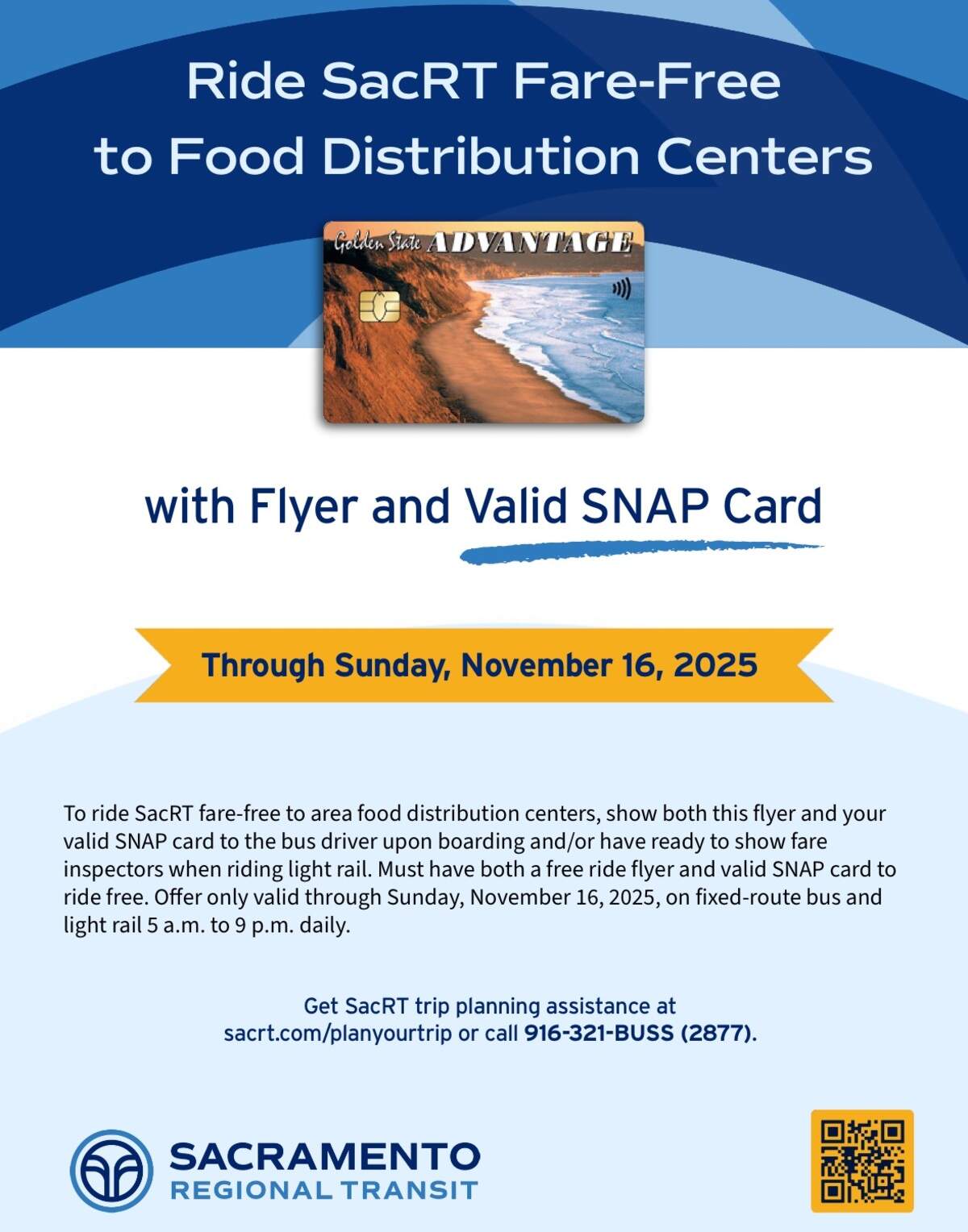
Need a lift to a food bank? Now through Nov. 16, CalFresh enrollees can present their benefit cards and the free ride flyer on Sacramento Regional Transit to ride free to Sacramento distribution centers, according to Rose Arteaga, a social services practitioner with RT. The offer is valid on fixed-route bus and light rail transit from 5 a.m. until 9 p.m. daily.
This story was originally published November 7, 2025 at 9:14 AM.