Northern lights stun California. Here’s when we could spot ‘unreal sight’ again
Stargazers across California recently caught glimpses of the northern lights — and the colorful natural phenomenon could be visible again soon.
The aurora borealis might be visible from states across the West on Wednesday, Nov. 12, and Thursday, Nov. 13, according to the National Oceanic and Atmospheric Administration’s Space Weather Prediction Center.
The center issued a series of geomagnetic storm watches in response to coronal mass ejections “that have erupted from the sun over the past several days,” it said Tuesday, Nov. 11.
Eruptions “of solar material and magnetic fields” can set off geomagnetic storms when they arrive earthside, the center said, noting that the storm level on Wednesday could be “severe.”
What are the northern lights?
“Auroras are colorful, dynamic and often visually delicate displays of an intricate dance of particles and magnetism between the Sun and Earth called space weather,” NASA said on its website.
They’re caused by “electrons colliding with the upper reaches of Earth’s atmosphere,” according to the National Oceanic and Atmospheric Association.
“Our sun is constantly spewing out high-energy particles out into space,” Kyle Watters, a physics and astronomy lecturer at Sacramento State, previously told The Sacramento Bee. “Those particles honestly would be fairly hazardous to us as human beings, but luckily for us, Earth has a magnetic field.”
This field traps those charged particles, he said, and funnels them either towards the North or South Pole.
The result is a “really pretty light show,” Watters said.
Typically, aurora borealis forms about 50 to 300 miles above the Earth’s surface, NOAA said on its website.
What color is an aurora?
According to NASA, auroras get their radiant colors from “atoms and molecules being energized by colliding with energetic particles in the upper atmosphere.”
The northern lights can appear in a variety of colors, NASA said, ranging from “eerie green” and blue to purple, pink, red or even white.
“The color of an aurora depends on the type of gas that is hit and where that gas is located in the atmosphere,” the space agency said.
Where was aurora borealis spotted in California?
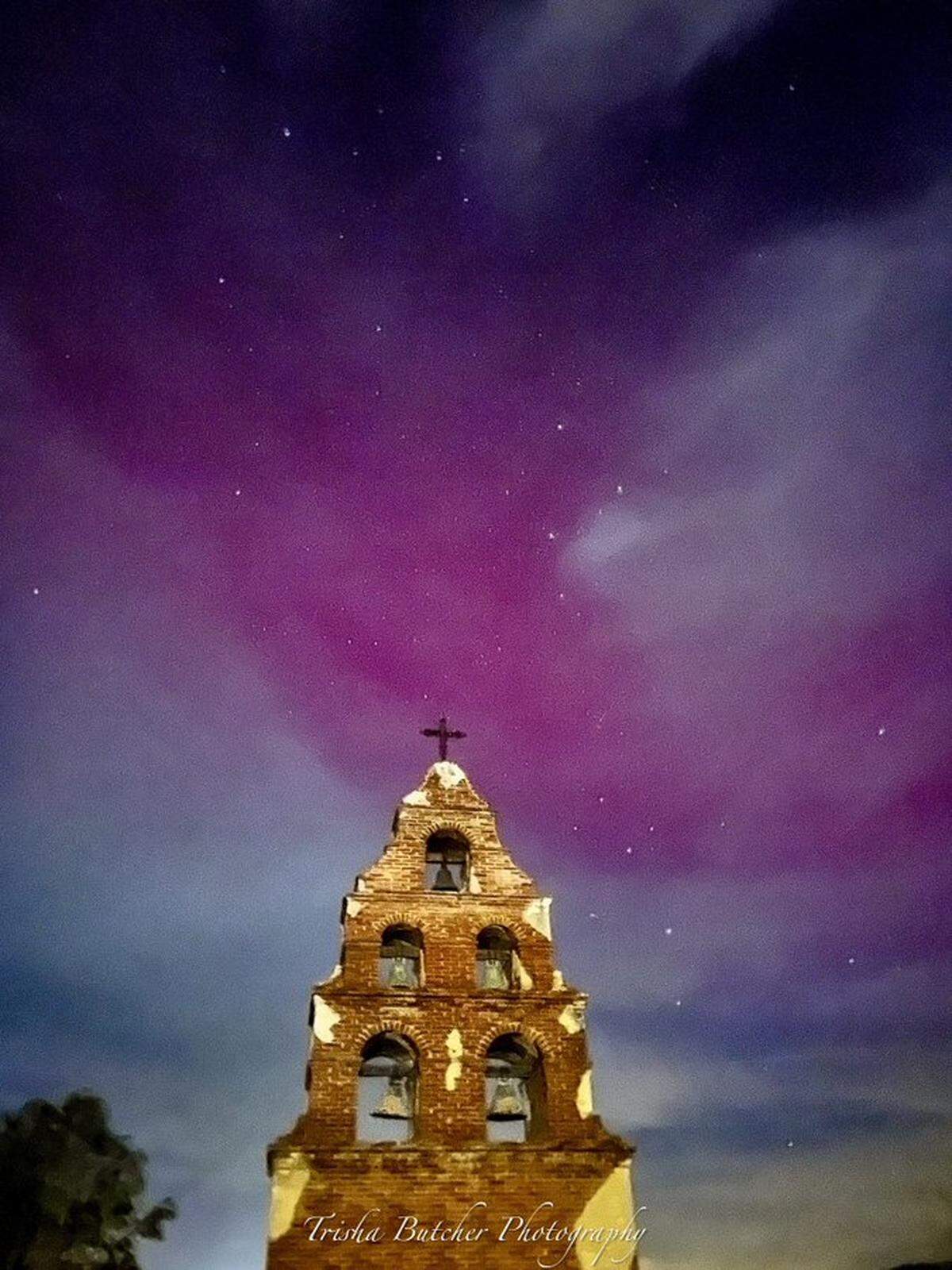
Residents across California reported seeing the northern lights on Tuesday night, with rare sightings as far south as Los Angeles and San Diego County.
On X, posters shared stunning pictures of the aurora borealis in the sky above the Bay Area, San Jose and Sequoia and Kings Canyon national parks in the Central Valley, with one poster calling it an “unreal sight.”
“Okay the northern lights above California are insane rn,” X user Breanne Thomas wrote in a Tuesday post, sharing a photo of pink and purple lights dancing off a plane wing. “It’s hard to capture through the window but wow.”
“This is a once in a lifetime event,” X user Wayne Lambert wrote in a Tuesday X post, sharing photos of the aurora borealis in the sky over Desert Center in Riverside County.
In the Sacramento area, Reddit users reported seeing the aurora from Carmichael and East Sacramento.
Not everyone was able to spot the northern lights without using a camera.
In a Tuesday post, X user Brick_Suit wrote that the aurora was “very faint to the naked eye but (the) phone picks it up easily.”
The northern lights also made appearances in the Golden State in March 2023 and May 2024.
X user Frank Meyers said the recent display looked “much more intense than May of last year, clearly visible to the unaided eye at its peak!”
In a Tuesday post, he called the aurora “just incredible, one of the most incredible things I’ve ever seen!”
Will aurora borealis be visible in California?
NOAA’s Space Weather Prediction Center has an aurora dashboard predicting the visibility of northern lights across the United States.
According to the forecast, northern states bordering Canada — including Idaho, Montana, North Dakota and Washington state — have the best chances of catching a glimpse of the northern lights.
However, it could be possible to glimpse the aurora from farther away.
“The aurora does not need to be directly overhead but can be observed from as much as 1000 km (about 627 miles) away when the aurora is bright and if conditions are right,” the center said.
.jpg "AuroraBorealis_KateyHamill_0G2A0001-2_(copy_1).jpg")
What’s the best way to watch northern lights?
According to NOAA, follow these tips to increase your odds of seeing the northern lights:
- Go to a place where you have a view to the north
- Wait until it’s dark outside
- Go to a place with as little light pollution as possible
- The most active auroras occur between 10 p.m. and 2 a.m.
How to take pictures of the northern lights
According to social media users, it may be difficult to spot the northern lights without using a camera.
In a Tuesday post, X user Brick_Suit wrote that the aurora was “very faint to the naked eye but (the) phone picks it up easily.”
Hello Aurora, a mobile app for aurora borealis enthusiasts, shared a comprehensive guide to taking pictures of the northern lights with your smartphone.
Here are a few tips:
- Use a tripod to keep your phone steady
- Enable night mode if your phone has it
- Switch to manual or pro mode for more control
- Turn off your flash
- Use a time or a remote shutter to prevent movement
This story was originally published November 12, 2025 at 10:57 AM.