Meet one of Sacramento’s leaf season Claw operators: ‘Every pile is different’
In a newspaper clipping more than 50 years old, a photo shows two little girls in Ceres raking a huge pile of mulberry leaves. One of them smiled. The other girl, however, was 7 years old but all business: her back straight, knees slightly bent, with a serious expression under a bowl cut.
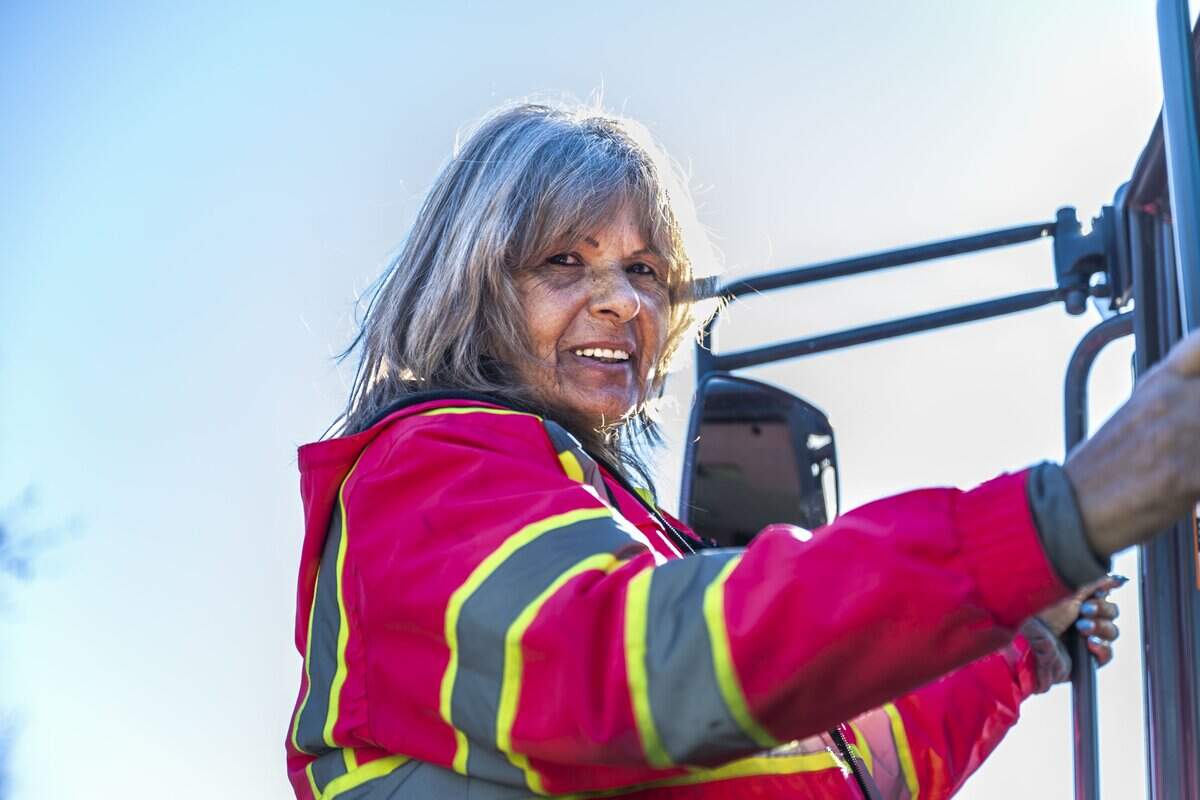
At 61, she’s now a Claw operator for the city of Sacramento who couldn’t be more tickled by the way her life has circled back to big piles of leaves.
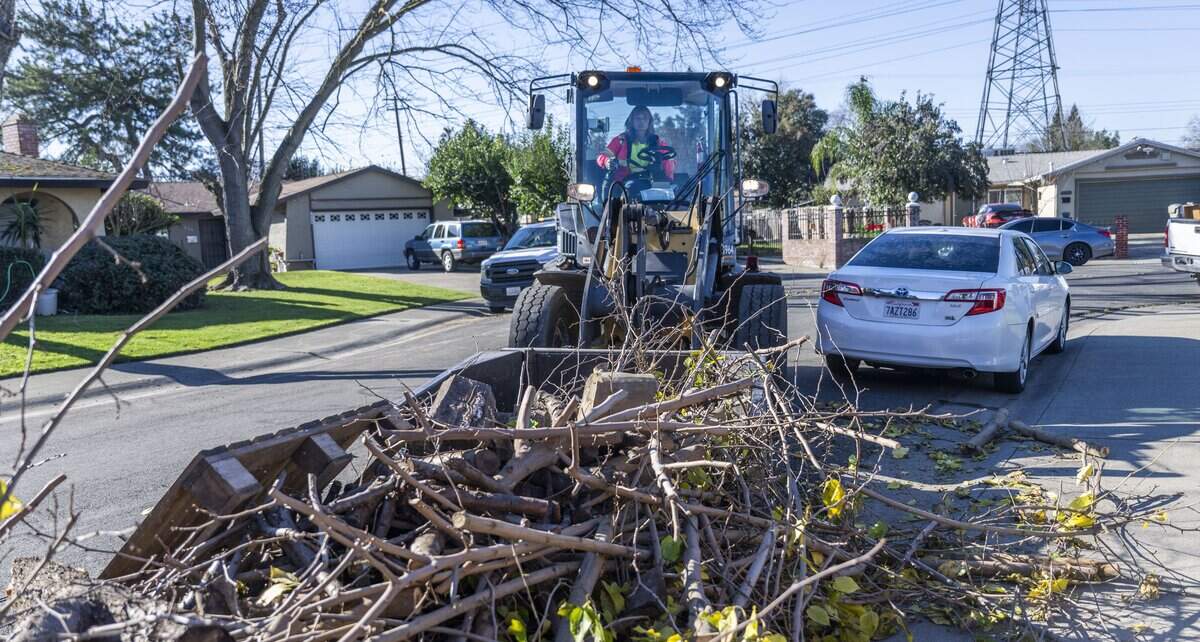
Marie Raymond said that operating this specialized piece of equipment presents an interesting challenge. She grinned: “Every pile is different.”
For most of the year, Raymond works with a crew on bulky item pickups, clearing mattresses, cabinets and other large refuse from the streets. But from November through January, she’s on the leaf beat.
Leaf season is a relentless sprint to prevent floods, falls and frustration. Left in the street, leaves can back up storm drains; they can present a slip hazard, particularly to pedestrians, cyclists and motorcyclists; and they block bike lanes and parking spots. So for three months, Raymond and a small group of city workers repeatedly save the City of Trees from a descent into chaos.
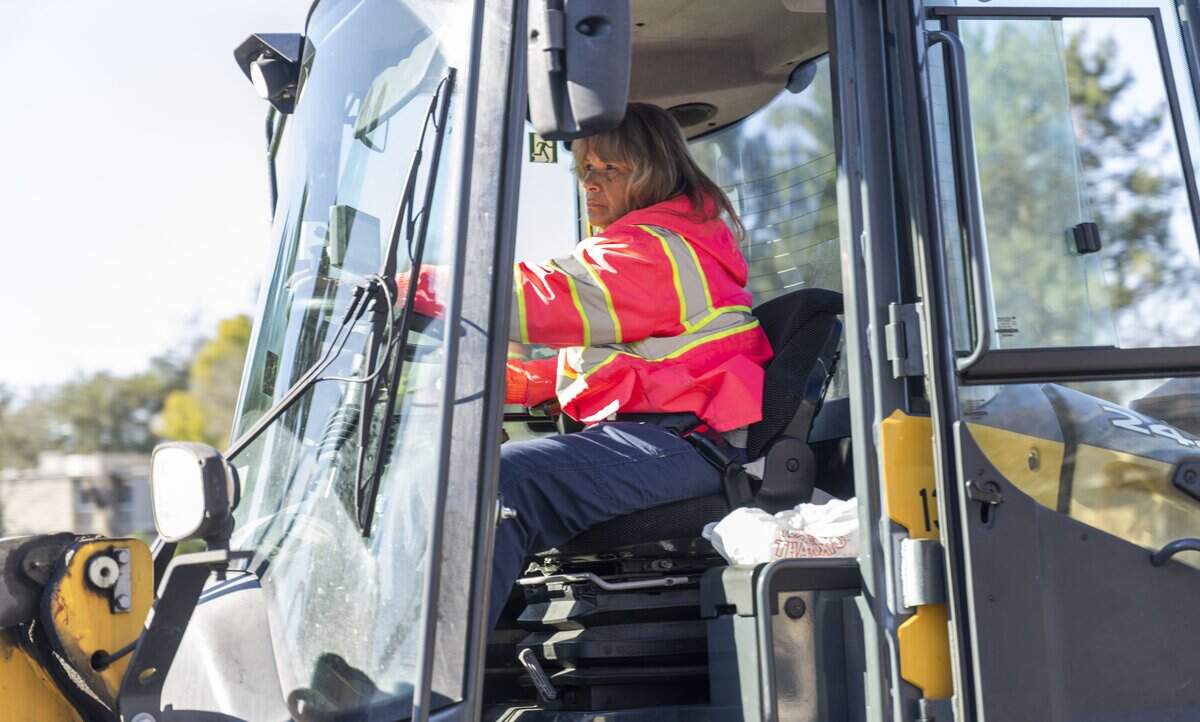
Standing by her rig in South Natomas with her powder blue nails just-so, she said, “It’s nice to be able to see your work when you’re done”: The job provides immediate satisfaction, hundreds of times a day. Plus, she personally hates clutter. In her personal life, “I love throwing things away.”
The job is mentally and physically demanding, with grueling hours and limited opportunities to use a bathroom. The workers often communicate with hand signals because metal is screeching against asphalt and engines are roaring all day. Last winter, Claw teams cleared about 20 million pounds of leaves and plant debris.
“I just want to put a shoutout to all my coworkers,” Raymond said. “I see what they do every day. I’m there with them. … They’re noticed and appreciated.”
It’s difficult, and illegal dumping cleanups can sometimes involve revolting scenarios (yes, she has had an undetected bucket of poop explode in her pincers — “You smell that in the Claw all day”). It can be gross, although she said leaf season is usually fine.
“It’s not for everyone,” she said. “It’s not easy; it’s hard. You have to love it. It has to be something you want to do.”
How do Claw teams work?
Raymond and her partner are one of a handful of teams scouring Sacramento waste piles. The total number of workers varies: Currently, the city has nine two-person crews, seven of which are on tree detritus duty. The year-round employees are buttressed by additional leaf-seasonal workers to stave off disaster. Outside of leaf season, all Claw teams focus on bulky item pickups or illegal dumping.
On a sunny January morning, Raymond held up a binder with an inch-thick stack of neighborhood maps: her routes. They spend two weeks north of the American River, two weeks south. She and her partner have to drive down every single street on the route, even if they don’t see any leaves: Their movements are automatically logged. Raymond tracks it all, too, marking her paper maps.
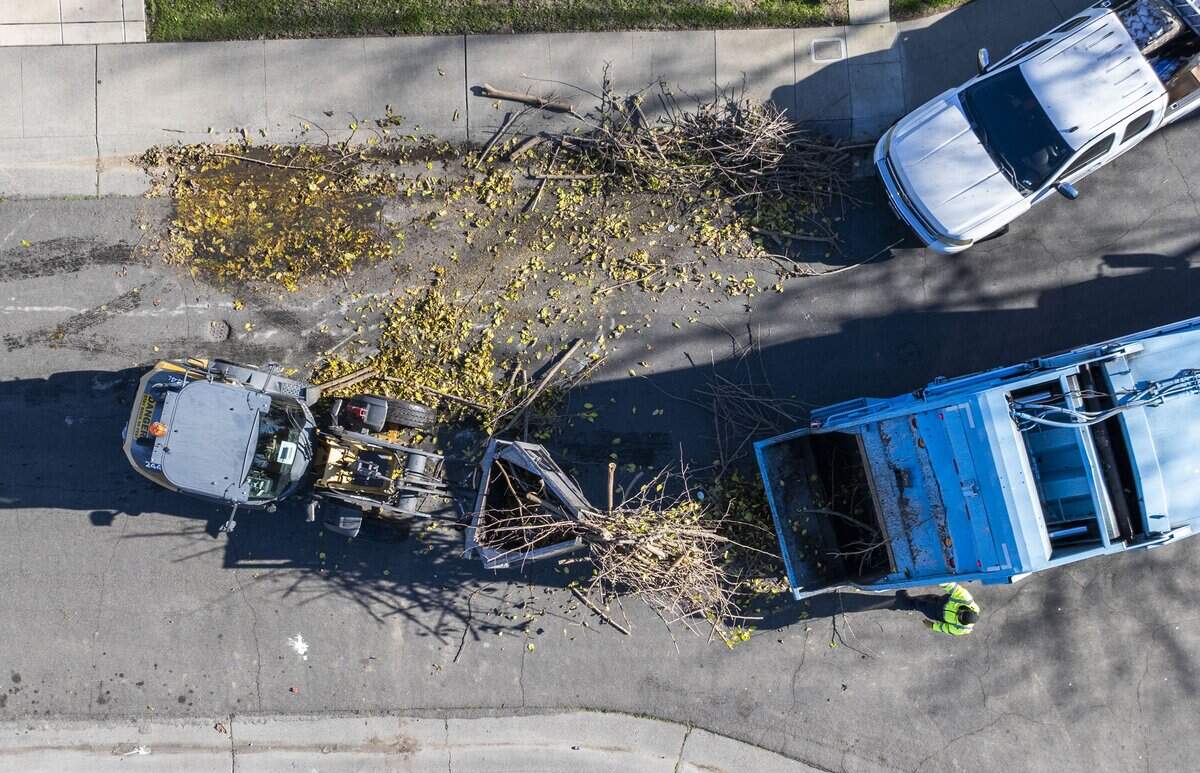
In each crew, one person drives the rear-loading truck, and the other drives the Claw. The truck driver hops out with a big broom at each stop, sweeping up debris that the Claw can’t easily grasp and making sure everything gets into the back of the truck. When the truck gets full, the driver has to go to the dump to empty out the contents, and the Claw operator often consolidates small piles on the route into one big pile — “stacking” — so they can work more quickly when the truck returns. (Raymond doesn’t stack at the end of the day, though: “If it’s later in the day, and I stack a big pile in front of somebody’s house, and we don’t pick it up, they call, they’re mad, ‘Why is this stuff in front of my house?’”)
Usually, Raymond works a normal 8-hour shift Monday through Friday starting at 6 a.m., but during leaf season, she and many of her coworkers can work 12-hour shifts — sometimes on weekends — because of all the mountains of leaves.
Raymond said she and her partner usually switch off between operating the Claw and operating the truck each day.
First, Raymond says, the Claw is more fun to maneuver. They switch off so that it’s “fair,” she said, because “we both like to drive the tractor.”
Second, the Claw is hard to endure for days on end. The vehicle was designed for use on dirt, and even though the Recycling and Solid Waste Division of the Department of Public Works buys the thickest tires conceivable, every bump seems to wallop the driver right in the bones. Even a manhole cover sends a tremor up through the vehicle; cracks that wouldn’t even register in a sedan can send your sunglasses flying off your head in the Claw. Don’t even ask Raymond about speed bumps.
“The ride is so rough,” she said. “It’s like a pit bull’s got you by the hips, shaking you all day.”
Large machinery was her dream
Raymond’s dreams as a kid defied gender norms: She loved trucks. She remembers being “small — I mean really small, before I could see over the windowsill,” but looking up at the trucks. Whenever a driver saw her hand signals on the highway and obliged with a blast of the horn, she beamed.
“I always looked up at them,” she said, “and knew I wanted to drive that truck.”
Her dad bought her Honda CB125S — a motorcycle — when she was a 13-year-old Modesto tomboy. She learned the importance of a leaf-free street not long after, when she rode onto a slick of wet leaves and toppled over on the bike (she was fine).
But driving didn’t seem like a viable career path at first. Because of that, in her twenties, she started a class to learn how to be an office assistant. She despised it. “I got about 37 words a minute on a typewriter,” she said. Around 28, she enrolled in trucking school and never looked back.
She’s driven all kinds of big vehicles. She hauled cauliflower to dairies in the Central Valley; she hauled hot asphalt; she was a bus driver in Roseville. In Roseville, she spotted an ad for waste management services and got into the world of garbage. About 12 years ago, she transferred to the city of Sacramento.
She enjoys manual vehicles that require her full attention: “I like this better than automated. Because automated is just repetition, repetition, repetition, and this is challenging. There’s a lot to it. You’re moving your head every three seconds to make sure cars aren’t getting behind you. You’re navigating between the cars. Sometimes (the leaves are) next to the ditch, so it’s maneuvering to make sure they don’t fall into the ditch.”
The critical work she and her colleagues do is essential to a functioning city. Essential services can be a kick.
“It’s just a thrill to me,” she said. “If you love it, and it’s something that excites you, something you want to do, it’s like a big Tonka toy.”
What can residents do to help leaf, trash collectors?
Raymond had a few tips for residents who want to help her and her colleagues pick up waste more safely and efficiently.
For bulky items that include glass — such as a mirror, a glass-top table or a window — she said it’s safer when residents cover the glass with cardboard and use duct tape to securely pack it in. That way, the glass won’t be as easy to shatter while she and other city workers move it. If the glass does break, the shards will be more contained in the cardboard.
For leaf piles especially, she said, please keep the piles out of the gutter and away from any ditches. Although she is dextrous at maneuvering the Claw, it can’t really tilt into street gutters. When the worker on the ground has to sweep them up manually, that wastes time and effort. “If it falls into the ditch,” she says, “then my ground-man has to go pull it out by hand.”
And not long after she spent about 10 minutes wrestling a giant heap of large, unwieldy branches into the back of an organic waste truck, she texted one more suggestion: “These tree branches need to be cut down to three feet,” she wrote. A branch that’s 3 feet is easier to work with and allows her to do her job more efficiently.
To help drivers out on a human level, she said, businesses could be more flexible about their bathroom policies. The city has a dearth of public restrooms, which affects these public servants, too. “If people would realize that we’re out here working, and we need a place to go to the bathroom, it would be nice,” she said.
To all non-waste-related drivers, she said, “Have patience. Don’t get behind the tractor when we’re working. Just give us a moment.”
Raymond and her coworkers are critical to a functioning Sacramento. But she doesn’t really dwell on that. When she finished talking about her job, she hopped back into the Claw and trundled down the street, deftly picking up another big pile of leaves.