
Court ruling lets 20,000 immigrant truck drivers keep California CDLs — for now
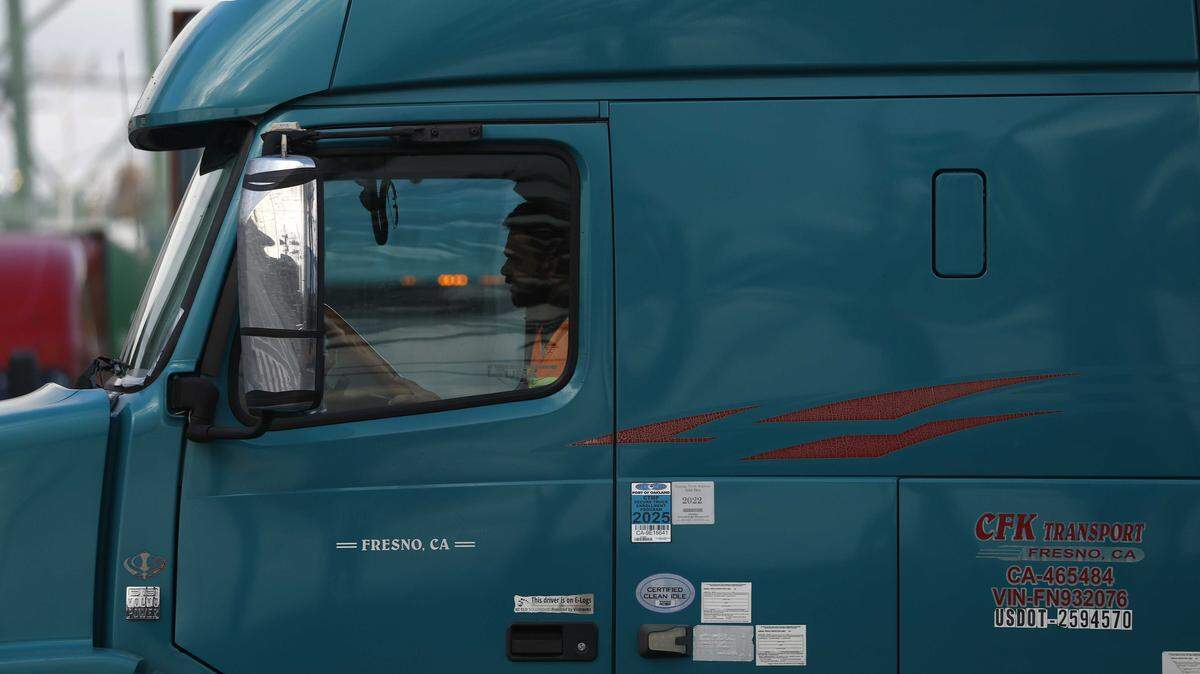
More than 20,000 immigrant truck drivers in California could keep their commercial driver’s licenses, at least temporarily, after a tentative ruling last week in Alameda Superior Court.
The ruling Wednesday challenged efforts by both the Trump administration and California officials to revoke the licenses issued to non-domiciled drivers, many of whom are asylum seekers or immigrants with temporary legal status.
The case stemmed from a lawsuit filed in December 2025 by the Sikh Coalition, the Asian Law Caucus and the Jakara Movement. The groups argued that the Department of Motor Vehicles failed to follow state law when it moved to cancel the licenses.
“At the start of the hearing, the judge essentially told us what she was going to rule, in the petitioner’s favor, finding that the DMV did violate its duties under state law,” Munmeeth Kaur said, legal director for the Sikh Coalition and a primary representative attorney.
Kaur said the judge directed both sides to meet and develop a process allowing affected drivers to reapply for their licenses under California law while addressing federal concerns. A written order from Judge Karin Schwartz was expected this week.
“For example, if drivers have cancellations, they need to be able to immediately reapply for a new license. So, in that case, they’re saying there is a state law that the state needs to follow,” said Katherine Zhao, a senior staff attorney at the Asian Law Caucus.
Federal pressure mounted
The dispute began in June when U.S. Transportation Secretary Sean Duffy announced a nationwide audit of how states issue commercial driver’s licenses to immigrant drivers. Federal officials said the review was intended to determine whether unqualified individuals had received licenses and posed safety risks.
The controversy escalated after two fatal crashes involving Sikh immigrant drivers.
In August, a California-based driver, Harjinder Singh, made a wrong U-turn on a Florida highway, killing three people. Two months later, in October, 21-year-old Jashanpreet Singh crashed into stopped vehicles in Ontario, near Los Angeles, fatally injuring three people. A driving-under-the-influence charge filed in that case was later dropped.
The crashes triggered public and political backlash against immigrant truck drivers, particularly within California’s Sikh community, which numbers nearly 250,000 — the largest Sikh population in the nation, with many living in the Central Valley.
By September, the U.S. Department of Transportation reported that 17,000 non-domiciled commercial licenses in California had been improperly issued, alleging they extended beyond drivers’ work authorization dates. The disputed total later rose to 20,000.
“This is a direct threat to the safety of every family on the road, and I won’t stand for it,” Duffy said at the time.
Under federal pressure, California began notifying drivers that their licenses would be canceled. Sikh drivers were disproportionately affected, according to community leaders.
When the state later granted a 60-day extension, pushing the cancellation deadline to March 6, Duffy announced Jan. 7 that the Federal Motor Carrier Safety Administration would withhold $160 million in federal funding from California for failing to revoke 17,000 licenses.
“It’s a reckoning day for Gavin Newsom and California,” Duffy said. “Our demands were simple: follow the rules, revoke the unlawfully-issued licenses to dangerous foreign drivers, and fix the system so this never happens again.”
California has since filed its own lawsuit against the U.S. Department of Transportation, challenging both the funding freeze and federal threats to block the state from issuing trucking licenses
State warns of consequences
Attorneys for the state argued that complying with the court’s tentative ruling could expose California to federal retaliation.
Forcing the DMV to keep the licenses intact “will risk the ultimate harm that California is trying to avoid,” said Barbara Horne-Petersdorf, an attorney with the state Department of Justice. “DMV is not insulated from any retaliatory action.”
The Department of Motor Vehicles declined to comment, citing active litigation.
The cancellations rattled California’s trucking industry, where Sikh drivers make up an estimated 35% of the workforce, according to an industry group. The impact has been especially sharp in Central Valley cities including Yuba City, Sacramento, Stockton, Fresno and Bakersfield.
Raman Singh Dhillon, chief executive officer of the North American Punjabi Trucking Association, said drivers were left in uncertainty for months.
“California should give drivers clarity on what they are doing to make this better for them, or on exactly what will happen to them,” Dhillon said.
He criticized the state’s response to the crisis.
“California did not react to anything in the last four or five months,” Dhillon said. “They did not say anything, do anything or come up with anything.”
Dhillon warned that removing thousands of drivers would strain supply chains. California moves roughly 40% of U.S. freight and produces more than 375 varieties of fruits and vegetables shipped across North America and overseas.
“It’s still going to take months to see what exactly the loss is going to be, but I know there is definitely going to be a driver shortage, and we are already experiencing it,” he said.
For non-domiciled owner-operators, the impact has been personal.
“They have been facing a significant loss because they can’t drive their trucks,” Dhillon said.
Referring to non-domiciled owner-operator truck drivers who lost their licenses or were notified they could soon lose them, Dhillon said many are facing significant financial hardship. These independent contractors purchased trucks, homes and cars and still must cover mortgages, rent, insurance and loan payments, even though they cannot legally drive.
“How will they bear their expenses?” he asked.
Zhao said many drivers feared losing their jobs.
“This decision does mean a lot to them, because by next Friday, they will lose their licenses,” Zhao said. “They’re telling me they’re talking with their employers. They’re kind of trying to figure out if they have a job coming next week.”
‘The entire system got shaken up’
Harsimran Singh, who has operated a Stockton-based trucking firm for 15 years, said he began losing thousands of dollars each month after non-domiciled drivers at his company lost their licenses in October 2025, leaving 35 trucks idle.
“We support any decision in favor of qualified drivers,” he said of the tentative ruling.
Singh described the crackdown as politically driven and destabilizing for an industry already under strain.
“The entire system got shaken up in October 2025,” he said. “The companies remained clueless then about the next move, and the drivers also got afraid about their fates.”
He estimated it could take at least a year for his business to stabilize. He called for stricter oversight, including six-month training programs and English-language instruction for immigrant drivers seeking commercial licenses.
“Everyone feels elated when they get justice,” he said.
Beyond the financial impact, the controversy has heightened fear within the Sikh and immigrant trucking community.
Drivers have reported hostile rhetoric online and, in some cases, tense interactions on the road. Some stopped hauling routes to Southern states such as Oklahoma, Texas and Minnesota, fearing increased scrutiny from immigration authorities.
Dhillon, a U.S. citizen, said he also received threats.
“I even got targeted,” he said. “I received emails from people threatening me and calling me names.”
Dhillon said that drivers are afraid to work and feel they are being targeted by the public and, in some cases, by law enforcement.
“The public should not generalize about immigrant and brown drivers,” he said. “If somebody’s color is brown, it doesn’t mean they’re the culprits. Every community has a few bad people. That doesn’t mean the whole community should be targeted.”
This story was originally published March 2, 2026 at 12:25 PM.