How a new Sacramento program change left homeless families with kids sleeping outside
A recent change to the city of Sacramento’s motel shelter program — a longstanding lifeline for hundreds of homeless mothers — is leaving families kicked back out on to the streets without notice, or even knowing why.
The changes, which went into effect Monday and designed to save the city $3.2 million, include:
- Motel staff will now make some decisions about which families get a room, and which families get evicted.
- Motel staff also have the unilateral ability to place families on a “do not rent” list, barring them from staying there. They are not required to share the list with the city or the nonprofit the city pays to run the program.
- The motels, fully paid for by the city since 2020, now require some of the families to pay for a portion of their rooms. Families who can’t pay may be evicted immediately.
- Families won’t be able to stay in the motels past six months, even if they still don’t have housing to move into.
The changes have so far caused at least six Sacramento families with autistic children, who had lived in the motels between five and 24 months, suddenly left without a room last week. Motel staff told four of the families they were on a “do not rent list” but did not give specifics on why.
All six families were still living in the motels last Sunday, the day before the city changed its program. Whatever the violations were that caused the “do not rent” list, they had never prompted eviction notices, leaving them blindsided when the program changed.
The city has an appeal process that participants can use to overturn rule violations that lead to evictions, but none of the six families were given the option to submit an appeal last week, they said.
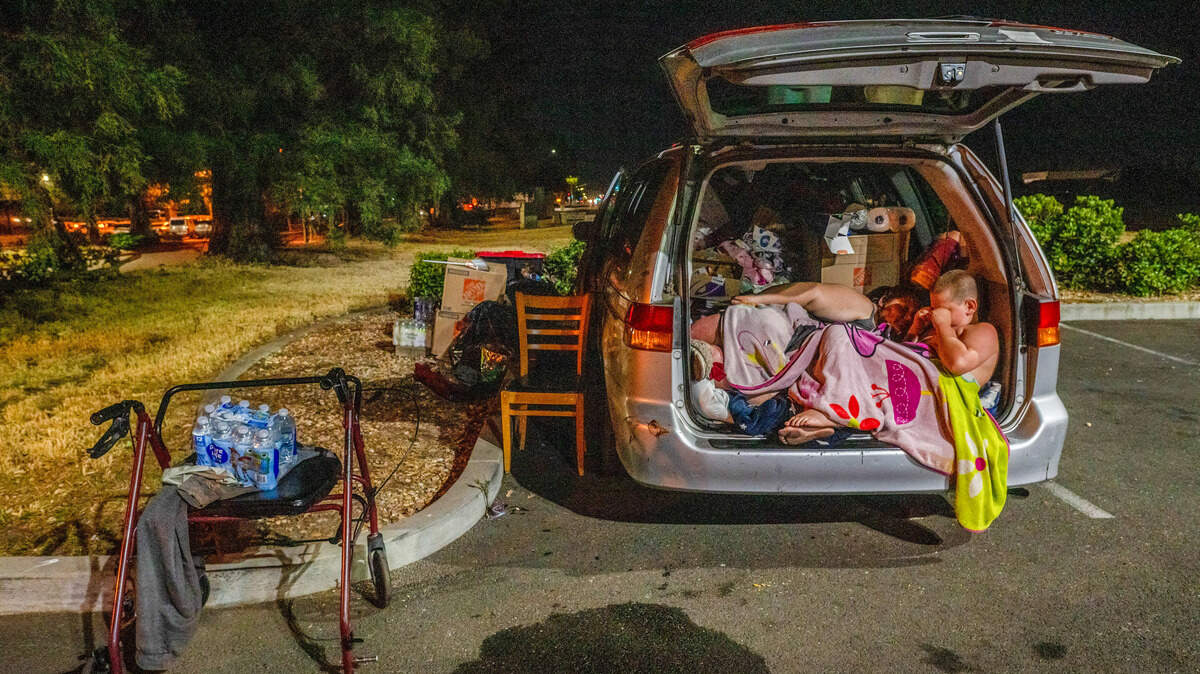
Two of the families slept in their vehicles for a week.

No notice, no appeals
The previous version of the program, which ended Monday, had rules that stated certain violations would cause an immediate eviction; others would result in a 30-day notice to vacate the room, or a warning, according to a June 2025 city audit of the program.
The new participant code of conduct makes no reference to a 30-day notice period, or warnings. Instead, they say guests can be “asked to leave the premises and may not be issued another voucher” if they cause damage to the room or motel grounds or if they have an ongoing conflict with another guest.
Julie Hall, a city spokesperson, said Friday that despite that, a notice period is still in effect for families who face eviction for certain rule violations, though that period is less than 30 days. She did not say how much notice families would be given before being evicted.
The city started the program in December 2020 to get families off the streets, especially those who had been evicted amid the Covid-19 pandemic. It’s remained the main way the city shelters families, but the new version gives a lot of power over how they are treated up to motel staff, instead of trained case workers.

The audit last year found the previous version of the program already had rules that many guests found too stringent. It warned that studies have shown that when shelter rules are too strict, many people leave or are kicked out before they find permanent housing.
According to Hall, the city made the changes to the program in part to free up case workers’ time to help the guests find housing, hopefully leading to guests moving into housing sooner, without getting stuck in the motel shelters for over a year.
“The city shifted to a voucher-based program in part to allow case managers to focus more intensively on helping people transition into improved housing circumstances instead of having to manage rules on behalf of the motel owners,” Hall said. “As a private business, motels have the option to accept a voucher or not. Like other voucher programs, there is no mandate that all vouchers must be accepted. Motels manage their own DNR (do not rent) lists; they are not required to share this information with the City or with Step Up (On Second).”
The City Council in May approved new contracts with Santa Monica-based Step Up on Second to run the program, despite the audit’s concerns about how Step Up was running certain aspects of the program, as well as multiple motel companies. The staff reports for those votes did not note a changed process for evictions or the shift of certain responsibilities from Step Up to motel staff.
Council member Lisa Kaplan during the May 26 meeting asked what impact the change would have on the participants. City manager Maraskeshia Smith said she would get back to her with a memo to answer that in the near future.
Kaplan still has not received that answer, she said Friday.
“I did not get a memo detailing exactly how it changed and why so many families ended up back in the streets,” Kaplan said.
The item, which was on the consent calendar, had no further discussion and passed unanimously, with Mayor Kevin McCarty absent.
‘We didn’t get that info’
Amy Heckart, 46, found out she was on the “do not rent” list only after she and her two children, ages 10 and 11, moved their belongings out of the Northgate Boulevard Motel 6 they’d been living in for about two years, she said. They thought they were just moving to a new Motel 6, on College Town Drive.
Because Heckart’s minivan doesn’t run, Step Up arranged to drive the family to new motel on May 28. They packed up and were ready to move. But she got a text from her Step Up case worker that morning saying the ride was canceled. Staff at the College Town motel then told Heckart they didn’t have a room for the family after all. They then tried to get back into their current room, where they’d lived for two years.

Motel staff locked them out.
“We were notified that you will be DNR (do not rent) from Northgate,” a text message to Heckart from a Step Up case worker read. “Please call 211 for other shelter options and 311 for access to (Outreach and Engagement Center shelter) options. You can also call the other motel and see if they will accept you.”
Hackart responded: “Did they say why they DNR listed me?”
The case manager replied, “We didn’t get that info.”
Hackart called the other three motels that participate in the program, some of which are owned by the same company. Each told her she could not stay there. She and her two children slept that night, and for the next week, in their inoperable Honda Odyssey minivan.
Antonita Brown sleeps in her Chevy Cruze with her partner and two children, ages 6 and 13, next to Heckart. She also doesn’t know why her family is on the “do not rent” list. Motel staff told her it was “damages” to the room but didn’t say what the damages were. She suspects it could be from the time they asked staff to tighten up the screws on the bed frame.
“They never said until I moved out of my room that I’m on the ‘do not rent’ list,” Brown, 33, said. “When the city of Sacramento came down (and hosted meetings), they said that everybody is guaranteed a room, at least for the first 21 days.”
Because they don’t know how they landed on the “do not rent” list, they’re not sure if they can ever get back into the motel shelter program — the city’s only non-congregate shelter option, and the go-to for homeless families.

Heckart can’t think of anything that would have put her on the “do not rent” list. She said one time her autistic 10-year-old son ran down the hall unaccompanied, leading to a 30-day eviction notice, she said. But then staff reviewed the surveillance video showing her running quickly after her son, so they canceled the notice, she said.
On another occasion, motel staff gave Heckart a warning notice for her son breaking a sprinkler while playing in the grass, she said.
“You can’t be a part of this program and not get violations,” Heckart said. “They have so many foolish things.”
Why are the families on the ‘do not rent’ list?
In addition to Heckart and Brown, two other mothers were told they were on the “do not rent” list and not told why. Patricia Miller, whose kids are 4 months and 4 years old, and Marcella Parks, whose kids are 7, 9 and 15, are both still staying in their Arden Acres motel. Unlike Heckart and Brown, they were able to get back into their previous rooms after learning their new motel had no rooms for them. How long they’ll be able to stay there is unclear. They were supposed to leave June 1.
None of the entities involved with the motel program provided reasons to The Sacramento Bee for why the four families were on the “do not rent” list, or how they can get off it.
Sierra Fitzpatrick of Step up on Second, the nonprofit the city contracts with to run the motels, referred The Bee to the city and the motel. Hall referred The Bee to the motel. A staffer at the front desk of the motel said he did not know the answers and did not know who would.
Families on the “do not rent” list for the motels can still get into other city shelters, but all of those are congregate, Hall said.

On Wednesday night, Heckart dozed off intermittently in a folding chair outside her minivan while her children slept inside it.
“My legs are all swollen, we are all tired,” Heckart said. “I’m disabled from three spine surgeries. It’s becoming a real stressful process. We keep asking why. We were in the program, we were supposed to still be in it.”
Next to Heckart, the Brown family all slept in their sedan, which does not have air conditioning.
“It’s unbearable,” Brown said. “This is my first time living in a car. It’s hot, our AC doesn’t work, and our car is overheating.”
In addition to Brown and her children, her partner Isaac Wright also sleeps in the car with them, trying to get as much rest as he can before he has to get up to go to work at 4 a.m.

City staff have offered to take both families to a congregate shelter on Auburn Boulevard, about seven miles away, she said. Brown declined because her daughter would no longer be able to walk to school. Heckart declined because her son is autistic and gets overstimulated in congregate shelters.
In the meantime, the families were preparing to spend another night in their vehicles Friday.
“We’re trying to just figure out how we’re going to make it through the next day,” Brown said. “The city did not understand the calamity the move they made was going to cause. This is not OK.”