Afghan community members, local leaders hold listening session. ‘A very good step’
Mustafa Babak, an immigrant from Afghanistan, said that immigrants in the United States are incorrectly viewed solely as takers.
Babak said that negative stereotype has only become more prominent for Afghan immigrants, in particular, since the fall of Kabul and Taliban takeover of Afghanistan in 2021, which sparked mass migration to the U.S.
So, to a room of roughly 40 Afghan community members, elected officials and nonprofit leaders Saturday in Sacramento, Babak explained why he felt that perception is wrong.
“It’s not that,” Babak, executive director of the Afghan American Foundation, said in an interview. “Yeah, they are takers for the first six months, year, but then after that, they don’t want to be receiving. They actually want to belong … and that’s exactly what Afghans are doing in Sacramento.”
Since 2021 especially, Sacramento has become a hub for Afghan immigrants. Babak estimated that as many as 40,000 to 50,000 Afghan individuals live in Sacramento County, which he said was among the largest groups in any part of the U.S. Official census data show closer to 20,000 Afghans in Sacramento County, though Babak said that number is likely underrepresented for various reasons.
Local elected officials hear Afghan voices
To help change negative perceptions of Afghan immigrants and help the community receive support and resources, Babak and other community leaders said it is important to engage with local leaders.
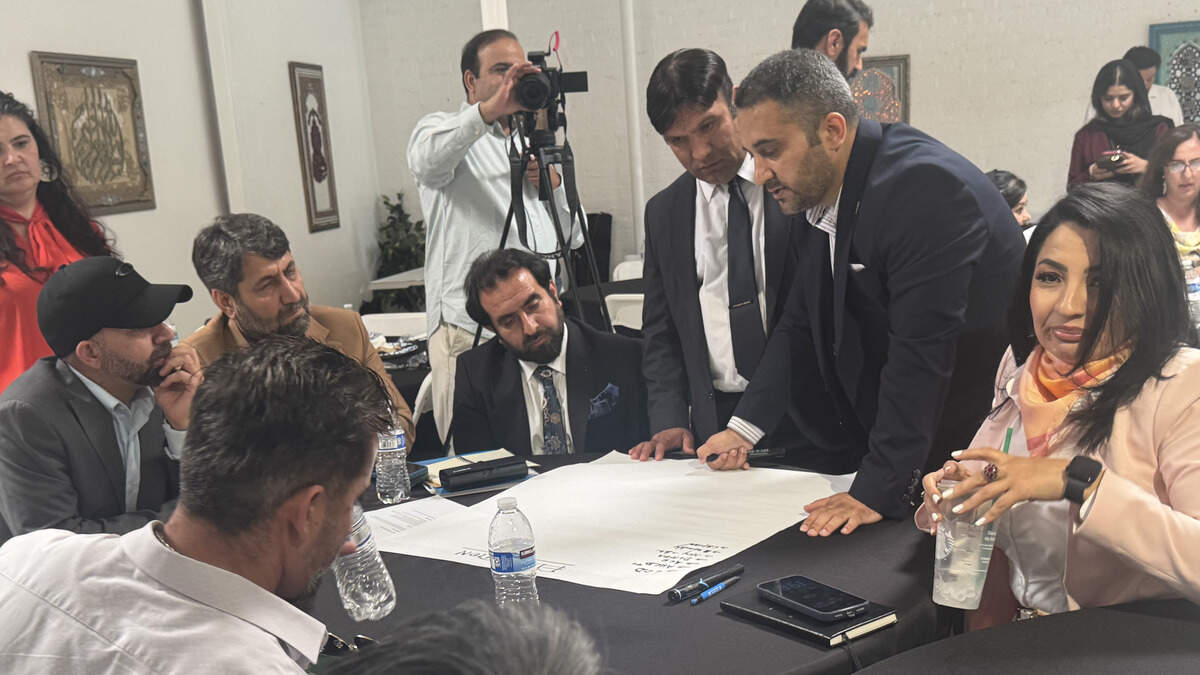
Because of the high concentration of Afghan individuals in Sacramento, Babak and other leaders partnered with the California Commission on Asian and Pacific Islander American Affairs to host what they called an Afghan listening session Saturday afternoon in Old North Sacramento.
The listening session involved the attendees splitting into groups to discuss problems facing the Afghan community in the U.S. as well as potential solutions, followed by a report back to the whole group. The event also featured Afghan food, a tour of local Afghan businesses and speeches from community leaders and elected officials.
“This is what makes Sacramento special. We have people who come here from all over the world. They create a stronger, more diverse community. We share the culture, the heritage, the food, all of those things,” said Councilmember Roger Dickinson, whose district encompass much of north Sacramento. “Meetings like this are a great opportunity for people to articulate what it is that they face as needs and challenges, so that those of us who have the opportunity to work on those issues can meaningfully address them.”
Assemblymember Maggy Krell, a Democrat whose district includes a majority of Sacramento, was also in attendance and took part in the listening session. The group tackled four topics: education, immigration status, economic development and health, with Krell taking part in the education conversation.
“I’m just really appreciative for getting a chance to be in community with them today,” Krell said. “This community is incredibly resilient. They’ve done so much for Sacramento, just deeply engaged in the community.”
A first of its kind event
A representative from Rep. Doris Matsui’s office was also in attendance, encouraging members of the Afghan community to reach out to make their voices heard. The representative earned applause from those in attendance after one attendee praised Matsui’s outspoken support of the Afghan community, especially after federal immigration agents reportedly detained multiple Afghans living in the Sacramento area late last year.
“They have singled out entire communities with rhetoric that is reckless, dangerous and blatantly racist,” Matsui told reporters last December.
The California AAPI commission’s executive director, Khydeeja Alam, who helped put the event together alongside Babak, was also among those in attendance. Alam said organizing the event, which she said marked the first time the commission had specifically met with the Afghan community, was especially important because many don’t recognize that Afghans are a part of the AAPI community — and that many Afghans don’t realize that they can access AAPI resources.
To express her point, she described a conversation with a senior official soon after she began her current role:
“He asked me, ‘Afghanistan, is that part of the Asian community?’” Alam said. “ ... and he’s like, ‘On the census, Afghans are asked to mark white, not Afghan.’ So, even in the census … Our identities don’t exist.”
What were the takeaways?
Each of the four groups gave roughly five-minute reports from their 25-minute discussions, offering ideas for how to face the challenges Afghan Americans are currently dealing with.
Much of the discussion tied back to the importance of giving Afghan immigrants the opportunity to become functioning members of their communities by getting jobs, creating businesses, becoming educated, learning English and understanding the country’s culture.
Multiple attendees called education the most important issue facing Afghan Americans, saying that if there are increased resources devoted to acclimating young Afghans to the country and setting them up for successful careers, they not only will be able to provide for themselves better, but also contribute to their communities more.
“Every child that walks through the door of a classroom that is Afghan is a gift,” said Diann Kitamura, a state AAPI affairs commissioner. “The mindset of our educators must change.”
Babak called the listening session “extremely productive,” noting that the elected officials, nonprofit organizers and other leaders were taking notes on the issues discussed.
“There’s no way we can solve problems in a two-hour listening session, but I think this is a very good step,” Babak said. “The important thing is that many of the nonprofits were here, and the representatives and the officials. I think their job now is to say ‘Okay, let’s follow up.’ We talked about these issues, so what’s next? I think that will be where the real work starts.”